
When donors ask what safeguards pastoral support ministries use for counseling, they are not asking for bureaucratic reassurance. They are asking whether a ministry can carry sacred, volatile material—confession, trauma, suicidal ideation, marital crisis—with the fear of the Lord, appropriate competence, and accountability. In pastoral care, the counseled person is often spiritually vulnerable and socially dependent on the church, which raises the stakes beyond ordinary customer protection.
Scripture treats shepherding as a trust with real consequences. Ezekiel condemns leaders who “strengthened not the weak” and “bound up not that which was broken” (Ezek. 34:4). James warns that teachers will be judged with greater strictness (Jas. 3:1). Those texts do not function as a substitute for clinical standards, but they do establish a theological premise: counseling ministries must be structured so that power is restrained, truth is honored, and harm is actively prevented.
Safeguards begin with role clarity and ethical scope
Clear definitions of what the ministry does and does not do
Many failures in pastoral counseling begin with category confusion. Pastoral counsel is not the same thing as licensed psychotherapy, and crisis pastoral care is not the same thing as emergency mental health treatment. A prudent pastoral support ministry defines its scope in writing: what kinds of issues it will address, how sessions are framed (spiritual direction, pastoral counseling, coaching, or referral-based care), and which presenting problems trigger immediate escalation.
Donors should expect to see an explicit boundary line between pastoral counsel and clinical treatment, especially for diagnoses that require specialized care (for example, psychosis, eating disorders, complex PTSD, or severe substance use). The point is not to abdicate ministry; it is to practice wise stewardship of competence. The ministries that merit confidence tend to name the limits of their role without embarrassment.
Written ethics and safeguards against spiritual manipulation
Pastoral support ministries carry spiritual authority even when they are not a local church. That authority can be misused through coercive counsel, premature certainty, or counsel that binds consciences where Scripture has left room for wisdom. Strong ministries use written ethical standards that address spiritual abuse directly: no threats, no leveraging spiritual fear, no counsel that isolates someone from family or medical care, and no “secret-keeping” that overrides lawful reporting obligations.
This is where donors can ask an unusually clarifying question: does the ministry have a process for receiving and investigating complaints about counselor conduct? A hotline number is not enough. Safeguards require documented intake, impartial review, and consequences when a counselor violates policy.

Confidentiality must be real, but it cannot be absolute
Informed consent and plain-language confidentiality limits
Confidentiality is often treated as either a sacred absolute or an administrative formality. Mature pastoral support ministries treat it as a covenant with defined limits. Counselees should receive a plain-language informed consent document explaining how information is stored, who can access it, and when disclosure is required or permitted.
For donors, the most important safeguard is clarity about exceptions: imminent risk of harm to self or others, abuse of a child or vulnerable adult, and court orders. A ministry that implies “everything is confidential no matter what” is not protecting counselees; it is setting them up for betrayal when reality forces disclosure.
Mandatory reporting and abuse response protocols
Most U.S. states require certain professionals to report suspected child abuse, but requirements vary by role and jurisdiction, and clergy-penitent privilege is treated differently across states. Ministries that serve across state lines need explicit legal review and training so that counselors do not improvise under pressure. A credible ministry documents its reporting pathway: who is contacted first, how a report is filed, and how the counselee is supported through the process.
Donors should also look for safeguards that keep the ministry from becoming the “alternative system” for handling abuse allegations. A pastoral support ministry should never function as a substitute for lawful reporting or for a church’s responsibility to cooperate with authorities.
Clinical and pastoral competence requires training and supervision
Screening, credentialing, and ongoing formation
Not every counseling ministry must be staffed exclusively by licensed clinicians, but every counseling ministry must be staffed by appropriately trained people for what it claims to do. Screening should include background checks, reference checks, theological alignment, and an evaluation of suitability for emotionally intense work. Where ministries do employ licensed counselors, donors can reasonably ask whether licenses are verified and whether continuing education is required.
We also recommend looking for training in trauma-informed care. Trauma is common in crisis care contexts, and untrained helpers can inadvertently intensify symptoms through spiritualized pressure, simplistic forgiveness demands, or premature confrontation. Trauma-informed training is not a secular replacement for biblical counsel; it is a discipline of attention to how suffering is carried in the body and in memory, so that ministry can be gentler and more truthful.
Supervision that prevents isolation and drift
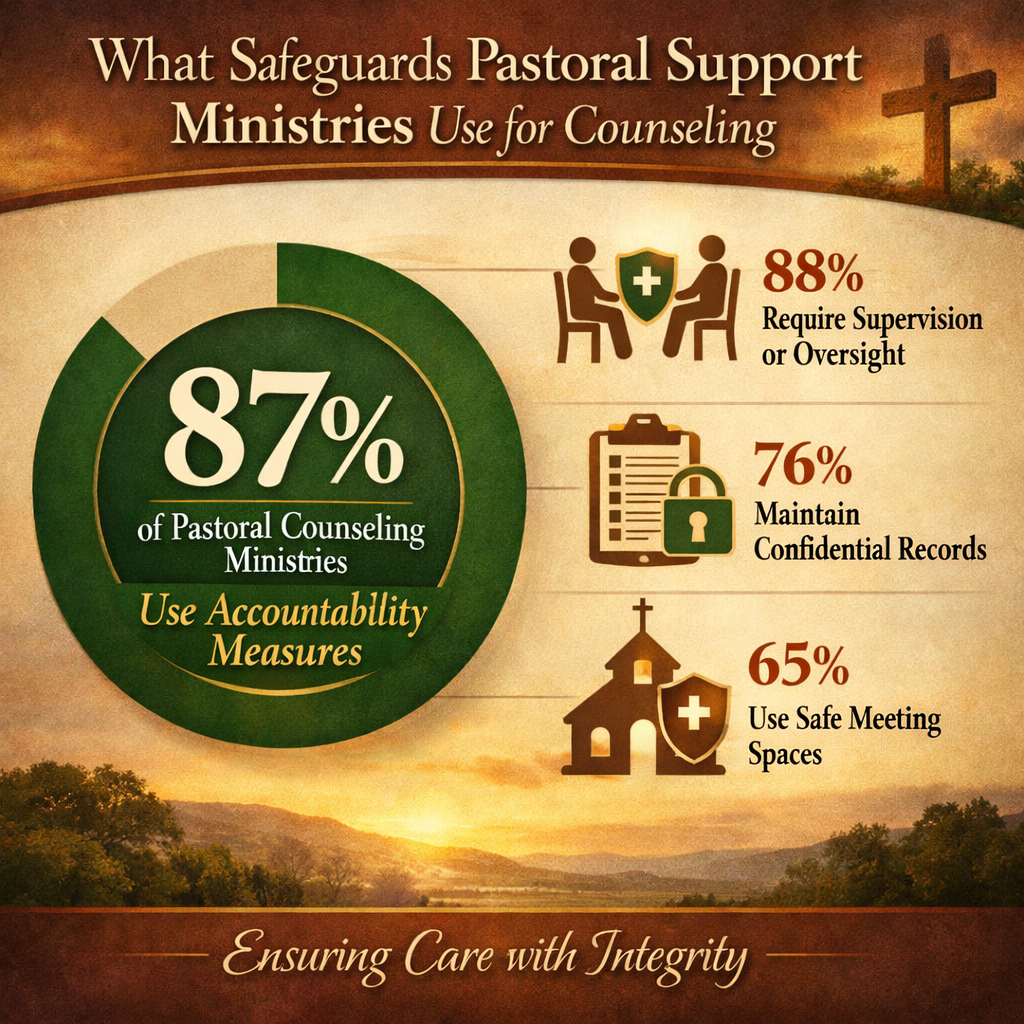
Counselors who operate alone are more likely to drift—ethically, theologically, and clinically. Supervision is one of the most practical safeguards a pastoral support ministry can provide. This can take several forms: clinical supervision by a licensed professional, pastoral supervision by seasoned ministry leaders, peer case consultation, and periodic audits of documentation and boundary practices.
When ministries offer counseling to pastors themselves, supervision matters even more. Pastors can be reluctant to disclose suicidal ideation, addiction, or domestic violence in the home if they suspect the counselor will respond as a colleague protecting reputation. The ministry’s safeguard is a structurally independent supervision and escalation process, so that “care for the shepherd” does not become “cover for the shepherd.”
Crisis care safeguards must address risk, not just comfort
Suicide risk protocols and emergency referral pathways
Pastoral support ministries often serve people who are not merely discouraged but at imminent risk. A ministry’s compassion is tested by whether it has a structured way to assess risk and act decisively. Donors should look for written suicide risk procedures: screening questions, documentation expectations, supervisor escalation, and clear handoffs to emergency services when needed. The goal is not to turn pastoral counselors into emergency clinicians; the goal is to prevent paralysis when seconds matter.
In the United States, the 988 Suicide & Crisis Lifeline has become a central access point for immediate crisis support. Its adoption is widespread since the 2022 launch of 988 as a national number SAMHSA 988. Ministries that serve in crisis contexts should know how and when to involve 988, local mobile crisis teams, and emergency departments, and they should communicate those options clearly to counselees.
Boundaries that protect both counselee and counselor
Some donors assume that “24/7 access” is synonymous with love. It can also be synonymous with dependency, burnout, and blurred roles. Healthy ministries set boundaries around availability and after-hours contact, while ensuring urgent escalation routes exist. They also maintain policies that reduce dual relationships and private, unaccountable contact—especially in digital counseling contexts where texting can quietly become the primary channel.
Across our verification work at Most Trusted, the organizations that meet The Most Trusted Standard tend to treat boundaries as an expression of fidelity. They honor the dignity of the person being counseled by refusing dynamics that quietly transfer spiritual power to the counselor.
Governance and transparency are donor-facing safeguards
Independent oversight and conflict-of-interest discipline
Even well-designed counseling policies fail when no one is accountable to enforce them. Strong pastoral support ministries have boards that are not simply insiders or friends, and they maintain conflict-of-interest policies that are actually followed. Independence is not a secular obsession; it is a practical way of obeying the biblical insistence that leaders be above reproach.
For donors looking at ministries in Pastoral Support Ministries for Counseling and Crisis Care, governance questions are not secondary. A counseling ministry can be doctrinally orthodox and emotionally warm while still being structurally unsafe. Oversight is where good intentions either become durable practices or dissolve under pressure.
Documentation, data stewardship, and honest reporting
Counseling ministries handle sensitive data. Donors should expect privacy policies, secure storage practices, limited access controls, and clear retention schedules. Ministries that provide telehealth-style services should also be candid about the platform used and the steps taken to reduce unauthorized access.
Transparency also includes honest program claims. Counseling outcomes are complex; simplistic testimonies can obscure relapses, ongoing disability, or the slow work of healing. Mature ministries resist the temptation to market certainty. They report what they can support, and they avoid implying that a donor gift guarantees a particular emotional or marital outcome.
- Written scope of care with defined referral thresholds and crisis exclusions
- Informed consent that states confidentiality limits in plain language
- Mandatory reporting protocol and documented abuse response pathway
- Screening and training appropriate to the services offered, including trauma awareness
- Supervision and case consultation to prevent isolation and boundary drift
- Independent governance with conflict-of-interest discipline and complaint handling
FAQs for What safeguards pastoral support ministries use for counseling
Should pastoral support ministries use licensed counselors only?
Not necessarily. The more complex the presenting issues, the more a ministry should rely on licensed clinical expertise, but a blanket rule can create its own problems by excluding seasoned pastoral counselors who operate responsibly within a defined scope. The safeguard donors should prioritize is fit-for-purpose competence: verified credentials where required, appropriate training for the ministry’s stated services, and supervision that keeps counselors accountable.
How can donors assess counseling safeguards without reading private case files?
Donors can assess published policies and verifiable practices: informed consent language, confidentiality limits, mandated reporting procedures, counselor screening and supervision standards, governance independence, and the existence of a complaint process. Most Trusted’s verification work is designed to help donors evaluate these kinds of structures against The Most Trusted Standard without requiring access to private counselee information. Donors exploring Pastoral Support Ministries can reasonably ask ministries to describe these safeguards in writing.
What donor confidence should rest on
Pastoral counseling ministries exist because Christ’s people are called to bear one another’s burdens, and because suffering is not an abstraction in the church. The question is whether that burden-bearing is arranged so that the vulnerable are protected, counselors are accountable, and crisis care is competent enough to do no further harm. The strongest safeguards are not slogans. They are written commitments, trained and supervised people, and governance structures willing to confront failure when it appears.



