
What share of donations funds direct orphan care is a fair question, and it is not a question Scripture permits us to treat as impolite. Christian donors are not purchasing a feeling of compassion; we are practicing stewardship before God, and that stewardship includes asking how money translates into protection, stability, and long-term flourishing for vulnerable children.
But the question also requires care. “Direct orphan care” can mean daily residential care, family preservation that prevents separation, foster and kinship support, adoption services, trauma-informed counseling, and reintegration work. A ministry can report a high percentage to “program” and still do harm if its model incentivizes institutionalization. Another can report a lower percentage to “direct care” because it invests in trained social workers, monitoring, and safeguards that keep children safe and reunite families. Mature discernment asks for both financial clarity and model clarity.
Direct orphan care is not a single line item
Why definitions matter for Christian stewardship
Many donors grew up with a simple mental picture: an orphanage bed, a meal, a school uniform. In practice, the healthiest orphan care work often looks like fewer beds and more families. Across the global field, research and practice have increasingly emphasized that children generally do best in family-based care, not large institutions, especially for children under three. The Lancet’s review of institutional care documented consistent developmental risks associated with institutionalization compared to family settings, particularly for young children (The Lancet).
That reality complicates the financial question. If a ministry’s “direct care” is defined narrowly as dollars spent inside a residential facility, then donors can accidentally reward the very model many child-protection experts now caution against. Christians genuinely disagree about the best pace and pathway for reform in different countries, but few credible actors deny the need for family-based alternatives when they are possible and safe.
Reasonable categories that donors can verify
When we assess orphan care ministries, we look for a clear, consistent way of describing how funds move from donor to child. A responsible ministry can usually distinguish between:
- Direct child and family services (food, shelter, school fees, medical care, counseling, case management)
- Child protection and safeguarding (background checks, reporting pathways, training, audits)
- Capacity building (training foster families, strengthening local partners, social work development)
- Administration (finance, HR, compliance, IT)
- Fundraising and communications (donor engagement, appeals, reporting)
Those labels are not moral verdicts. They are clarity tools. A ministry that cannot describe its categories without vagueness will struggle to demonstrate integrity when questions become difficult.

What donors usually mean by share and what ministries can actually report
The program ratio is a starting point, not a finish line
When donors ask what share funds direct orphan care, they often mean, “What percentage goes to programs rather than overhead?” That instinct is understandable, but the sector has had to reckon with the fact that an obsession with low overhead can produce underinvestment in systems that prevent abuse, strengthen local governance, and measure outcomes. Charity Navigator, GuideStar (now Candid), and the BBB Wise Giving Alliance publicly cautioned against using overhead ratios as the primary marker of nonprofit performance (Candid).
For orphan care, this caution is not theoretical. Safeguarding policies, trained supervision, secure record systems, and independent audits cost money. They can sit in “administration” while functioning as a frontline defense for children.
Why two ministries with the same percentage can differ morally
Two organizations can both report “85% to programs,” yet one may operate a harmful institutional model while the other funds vetted kinship placements, family strengthening, and professional case management. The number does not tell you whether children have consistent caregivers, whether birth families are assessed and supported, whether local authorities are involved, or whether the ministry’s incentives reward family reunification or bed-filling.
What this means in practice is that donors should treat the percentage as one datapoint inside a fuller set of questions about the ministry’s theory of care and its controls.
What a healthy share often looks like in credible orphan care work
Ranges exist, but integrity has recognizable signals
We avoid publishing universal “good” percentages for direct orphan care because contexts vary: emergency relief after a crisis differs from long-term foster care development; a U.S.-based adoption services organization differs from a community-based reintegration program overseas. Even so, credible ministries tend to show several common patterns: a majority of expenses are tied to program work, fundraising is present but not dominant, and administrative spending is sufficient to support professional financial controls and child safeguarding.
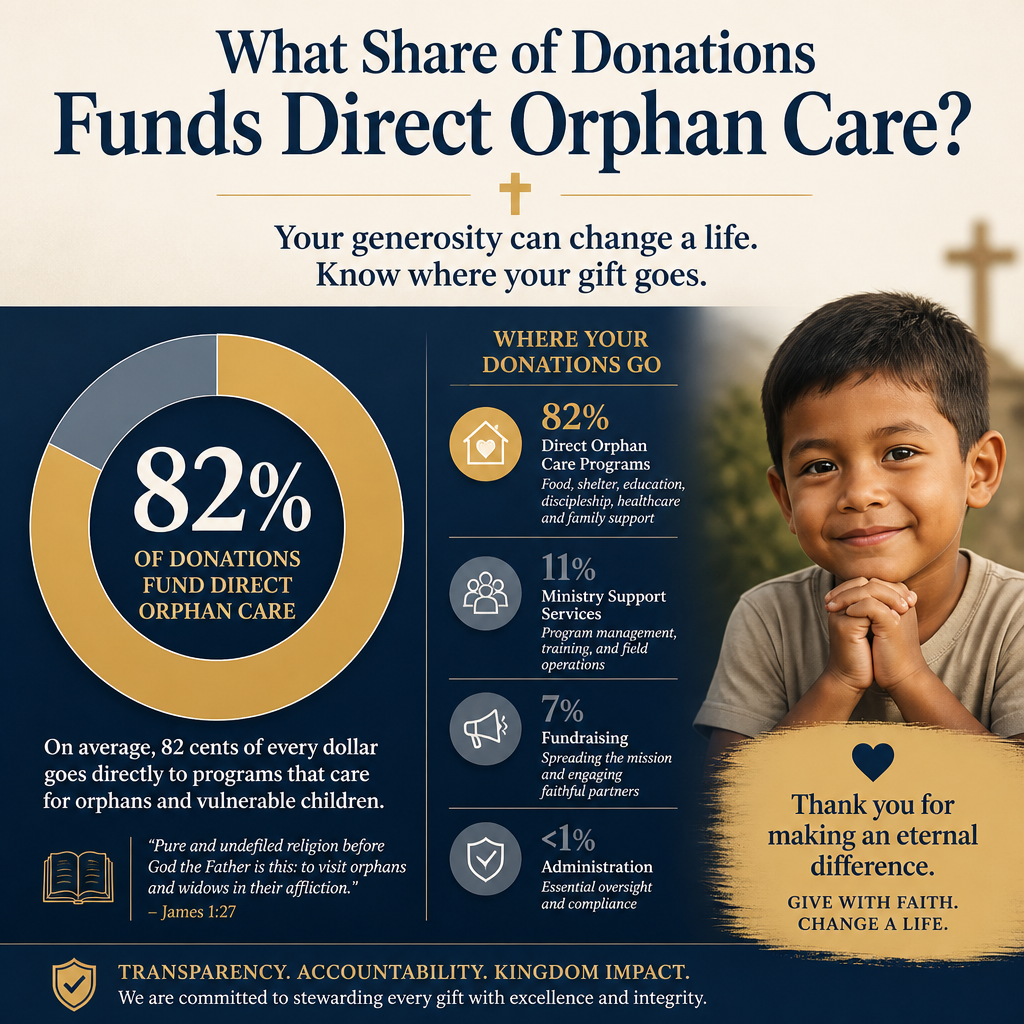
The harder question is not whether a ministry’s program percentage is high, but whether its program spending is directed toward a model that protects children and strengthens families. If “direct care” spending is primarily facility maintenance and staffing for long-term residential care, donors should press for evidence that the ministry is minimizing institutionalization, pursuing reunification where appropriate, and working toward family-based alternatives.
Direct care that is genuinely direct
In the strongest ministries we evaluate at Most Trusted, “direct” typically includes casework, family support, and sustained follow-up, not only goods and services delivered. That approach aligns with an older Christian conviction: mercy is not only immediate relief but also wise love that seeks durable restoration. James’s insistence on care for orphans and widows is not merely a command to feel compassion, but to act in ways that withstand scrutiny (James 1:27).
For donors who want to situate this question within the broader landscape of vetted ministry models and risks, we maintain editorial coverage of Orphan Care Ministries that reflects both theological conviction and evidence-based concern for children’s long-term well-being.
How to evaluate a ministry beyond the percentage
Ask for evidence that the ministry is not incentivizing separation
Orphan care has had to confront a sobering reality: many children in institutional care are not double orphans, and poverty can be mistaken for abandonment when donor-funded beds are available. Estimates on the exact proportions vary by country and definition, and we encourage donors to be cautious with sweeping claims. What is not contested is that institutional placement can be driven by economic vulnerability as much as by the absence of living parents, which makes prevention and family strengthening central to ethical practice.
Donors can ask ministries to document how children enter care, what legal and social assessments are required, and what steps are taken to identify and support extended family. The presence of written policies is not enough; donors should look for training, reporting pathways, and third-party oversight.
Use governance, transparency, and safeguarding as moral measures
Across our verification work, we see that ministries that meet The Most Trusted Standard tend to treat governance and transparency as child-protection issues, not merely administrative chores. They publish timely financial statements, explain allocation methods plainly, disclose related-party transactions, and provide clear safeguarding documentation appropriate to the populations they serve.
We also recommend applying a question shaped by the When Helping Hurts framework articulated by Steve Corbett and Brian Fikkert: does the ministry’s approach reinforce local agency and family strength, or does it concentrate power and resources in ways that can distort incentives (When Helping Hurts)? Orphan care is especially vulnerable to distorted incentives because children are uniquely compelling to donors and uniquely unable to advocate for themselves.
For donors comparing ministries within this theme, our reporting on How Orphan Care Ministries Use Donations addresses common allocation models, what credible reporting looks like, and the warning signs that merit further questions.
How Most Trusted approaches the question under The Most Trusted Standard
What we verify and what we will not reduce to a slogan
Most Trusted exists because Christian donors deserve more than marketing language and more than a single ratio. Under The Most Trusted Standard, we examine financial integrity, governance and leadership, transparency and effectiveness, and the ministry’s faith foundation as a lived reality, not a brand. For orphan care work, we pay particular attention to safeguarding, partner accountability, and whether the ministry can demonstrate that its model serves the child’s best interest rather than the organization’s growth.
We do not treat “overhead” as inherently suspect. We do treat opacity as suspect. A ministry that cannot explain how it allocates shared costs, cannot provide consistent audited financials when appropriate, or cannot describe how it protects children from exploitation is not ready for donor trust at scale.
What donors can reasonably expect to see
A ministry worthy of Christian confidence will usually provide:
- Clear definitions of “program,” “administration,” and “fundraising,” with consistent year-to-year reporting
- Evidence of safeguarding implementation, not merely a policy document
- A coherent model of care that prioritizes family-based solutions when feasible and safe
- Transparency about how partners are vetted and monitored
- Outcome-oriented reporting appropriate to the work, without manipulative storytelling
These expectations are not bureaucratic hurdles. They are ways of honoring the image of God in children by refusing to treat their lives as fundraising assets.
FAQs for What share of donations funds direct orphan care
Is a higher program percentage always better for orphan care?
No. A higher program percentage can coexist with a harmful model of care, including long-term institutionalization that weakens family reunification incentives. Donors should treat the program ratio as a starting point and then examine the ministry’s safeguarding, admissions pathways, reintegration practices, and accountability structures.
What should count as direct orphan care when a ministry focuses on family preservation?
Family preservation often is direct orphan care in the most ethically important sense because it prevents unnecessary separation. Case management, emergency family assistance tied to a reunification plan, counseling, and support for kinship caregivers can be direct services even if they do not look like residential care. Donors should ask for clear definitions and for evidence that services are tied to child-protection assessments rather than indefinite dependency.
A percentage can be clear and still be incomplete
Christian donors are right to ask what share of donations funds direct orphan care, but we should refuse the false comfort of a single number. The faithful question is whether a ministry’s spending, model, and safeguards together serve the child’s best interest and strengthen the families and communities God has placed around them. When a ministry can show that alignment with clarity and humility, donors can give not only generously, but confidently.



