
When Christian medical ministries send tax statements, they are doing more than closing the books on a calendar year. They are shaping donor confidence at the point where stewardship becomes documentation, and where good intentions meet IRS rules, membership models, and the ministry’s own claims about accountability.
For many Christian donors, the question is not merely, “Did they email me a PDF?” The harder question is whether the document actually corresponds to what was given, whether it is accurate under the ministry’s legal structure, and whether the ministry communicates clearly about what is and is not tax-deductible. Those are compliance questions, but they are also moral ones. “Moreover, it is required of stewards that they be found faithful” (1 Corinthians 4:2).
Why tax statements matter in Christian medical ministry giving
Receipts are part of truthful witness
Christian medical ministries often sit at an intersection of compassion and complexity: memberships, shares, designated gifts, benevolence funds, and occasionally separate charitable arms. Donors may assume every payment is a “donation,” but not every payment is a charitable contribution under federal tax law. A year-end statement that blurs those lines can inadvertently invite donors into inaccurate filing, and it can erode trust when donors discover the discrepancy later.
Scripture’s repeated insistence on honest weights and measures (Proverbs 11:1) has direct relevance here. A tax statement is a modern “measure.” Precision is not bureaucratic fussiness; it is neighbor-love expressed through administrative integrity.
The IRS is explicit about substantiation
From a donor’s perspective, the most basic requirement is straightforward: if a contribution is deductible, it must be substantiated properly. The IRS explains what counts as proof of a charitable contribution, including bank records and written communications from the charity, and it specifies when additional acknowledgments are required for certain gifts IRS.
What this means in practice is that the quality of a ministry’s year-end statement is not a “nice to have.” It is part of whether the ministry is acting competently toward the people funding its work.

What a credible year-end statement should and should not do
It should identify the legal recipient and the nature of the gift
Christian medical ministries vary in structure. Some are churches or church-integrated entities; some are 501(c)(3) charities; some include more than one entity under a shared brand. A reliable statement clarifies which entity received the funds, the entity’s tax status, and whether the donor received goods or services in return. When donors see brand names without legal names, confusion follows, especially for those who give through donor-advised funds or family foundations with stricter documentation standards.
For donors who are sorting a year of giving across multiple ministries, clarity about entity and purpose also reduces the temptation to treat every payment as tax-deductible by default. That temptation is understandable; it is also avoidable when a ministry communicates with care.
It should not overpromise deductibility
We recommend donors treat any ministry’s language about deductibility as informative rather than determinative. The IRS expects donors to apply the rules to their own circumstances, and ministries should avoid implying that “everything you paid us is deductible” unless the ministry’s structure truly supports that claim. Even for standard 501(c)(3) gifts, quid pro quo rules apply when donors receive something of value in exchange.
The IRS describes disclosure expectations for quid pro quo contributions and clarifies that only the amount exceeding the value of goods or services received is deductible IRS. A ministry’s statement does not need to be legal advice. It does need to be accurate about the category of transaction.
Common donor pain points when Christian medical ministries send tax statements
Membership payments, shares, and the category problem
Many Christian medical ministries emphasize mutual aid, shared burdens, and care for the sick. Those are biblical themes. They do not automatically map onto “charitable contribution” categories. A donor may make monthly payments that feel like giving, but function more like participation in a cost-sharing program. When the year-end statement labels those payments as “donations” without qualification, donors can be left uncertain about what the statement actually means.
This is where donors often experience a quiet crisis of confidence. It is not cynicism; it is stewardship. If a ministry’s financial language is consistently imprecise, donors have reason to ask whether other parts of the ministry’s reporting are equally imprecise.
Designations and restricted giving
Another friction point is designated giving: “Give to the benevolence fund,” “Help with special needs,” “Support administrative costs,” or “Sponsor a family.” Restrictions can be appropriate, but they increase the ministry’s responsibility to track funds accurately and report them transparently. Donors do not need granular internal ledgers, but they do need confidence that designations are honored and that statements reflect reality.
Across our verification work at Most Trusted, we observe that ministries with strong internal controls tend to communicate restrictions and designations with unusual restraint. They avoid sentimental claims that outpace accounting reality. They also keep their year-end statements consistent with their audited financials and public reporting, which is a meaningful marker of credibility.
- Unclear separation between membership payments and charitable gifts
- Brand-name receipts without legal entity names
- Statements that omit whether goods or services were provided
- Designation language that is not matched by transparent reporting
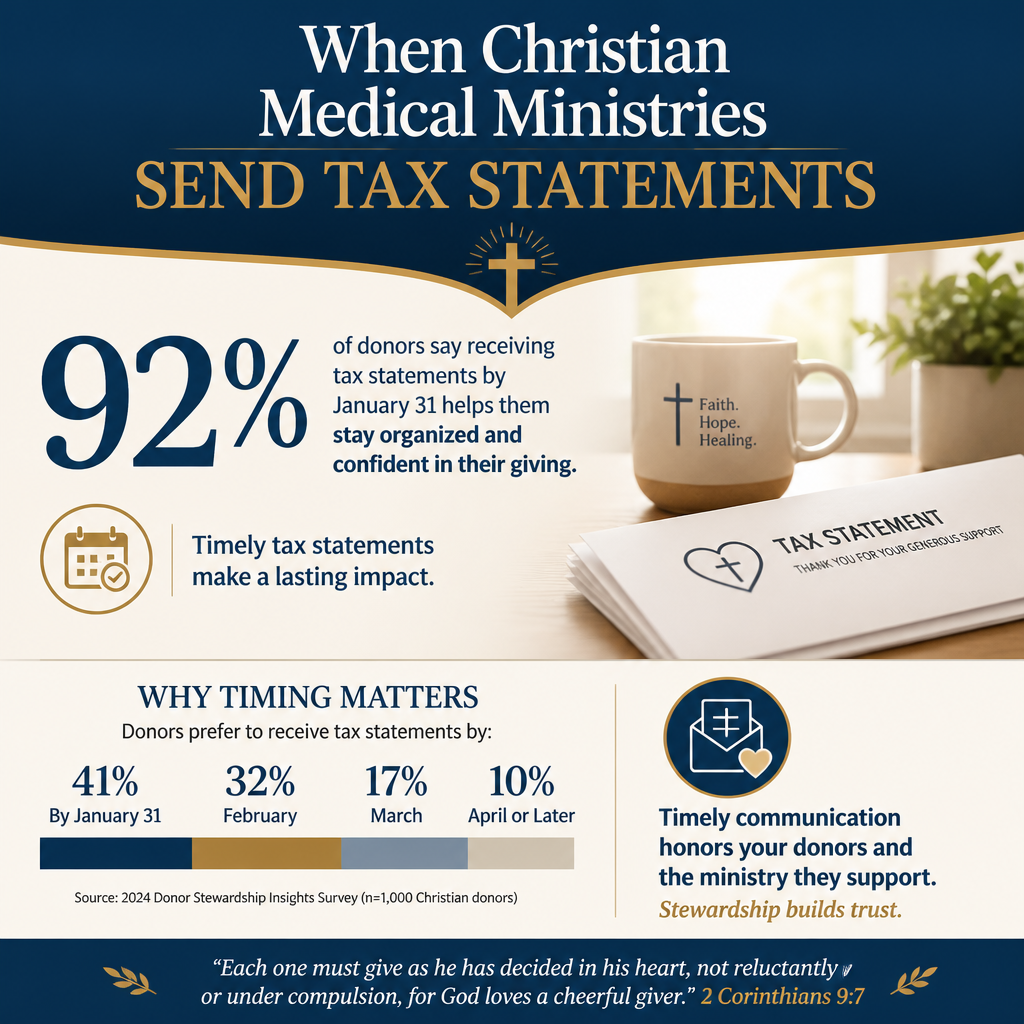
- Late statements that complicate donor filing and foundation workflows
How donors can evaluate a ministry response with The Most Trusted Standard in mind
Transparency is observable, not asserted
When a donor asks for clarification about a tax statement, the ministry’s response is itself evidence. Clear, prompt, documented responses are consistent with mature governance. Defensive, evasive, or inconsistent answers are not proof of wrongdoing, but they are signals that warrant caution.
The Most Trusted Standard focuses on verifiable indicators across faith commitments, financial integrity, governance, and transparency. We do not treat “we are a Christian ministry” as a substitute for documentation. In the New Testament, integrity is not presumed; it is proven over time. Paul’s collection for the Jerusalem church is instructive precisely because he arranged visible accountability: “We want to avoid any criticism of the way we administer this liberal gift” (2 Corinthians 8:20).
Financial integrity includes competent donor documentation
In practical terms, a donor can treat a tax statement as a window into a ministry’s operational maturity. The statement should reconcile with the donor’s own records. It should be dated. It should provide a contact channel that is staffed and able to answer specific questions. And it should not shift the burden of clarity onto the donor through vague disclaimers.
For donors who want to understand the broader landscape of giving to health-related ministries, we maintain ongoing analysis within Christian Medical Ministries, including questions of governance, financial reporting, and donor communications that often surface at year-end.
Practical next steps when your statement is unclear or missing
Ask targeted questions and request written clarification
When a statement creates uncertainty, the fastest path forward is usually a short, written inquiry. We recommend keeping questions narrow and factual. If a donor is filing with an accountant, a written reply from the ministry can reduce confusion and protect both donor and ministry from avoidable misstatements.
Questions that tend to produce clarity include:
- Which legal entity received my funds, and what is its tax status?
- Does this statement include only charitable gifts, or also membership payments or program fees?
- Did I receive any goods or services in exchange for the amounts listed?
- Are any amounts on this statement not intended to be treated as tax-deductible contributions?
Know what documentation you can rely on
Donors sometimes assume the year-end statement is the only acceptable proof. The IRS describes multiple forms of substantiation, including bank records, and it is clear that documentation matters at the time of filing, not simply at the time of giving IRS. A missing statement does not automatically mean a gift is not deductible, but it does mean the donor should be careful and orderly.
For donors who give across multiple ministries and want to strengthen their own practices, we address common documentation questions in Tax Receipts and Compliance for Christian Medical Ministry Giving, including what to save, how to interpret common receipt language, and when to seek professional advice.
FAQs for When Christian medical ministries send tax statements
Is a year-end statement the same as an IRS-compliant charitable receipt?
Not always. Some year-end statements function as summaries and may not include all language needed for specific gifts, especially when goods or services were provided or when the transaction is not a charitable contribution. Donors should compare the statement to their own records and, when necessary, request a written acknowledgment that meets IRS substantiation expectations IRS.
If my payments were for a medical cost-sharing membership, are they tax-deductible?
Deductibility depends on the nature of the payment and the receiving entity. Some payments may be fees for participation rather than charitable contributions, even if the program is Christian and oriented toward compassion. Because structures vary, donors should request clarity from the ministry about what the statement includes and consult a qualified tax professional for their particular situation.
A faithful year-end statement is a form of pastoral care
When Christian medical ministries send tax statements that are timely, accurate, and candid about what the document does and does not claim, they are serving donors well. They are also protecting the ministry’s witness by refusing the quiet dishonesty of ambiguity. Donors should not be forced to choose between generosity and clarity; mature Christian stewardship requires both, and trustworthy ministries will honor that standard in their documentation as surely as in their public messaging.



