
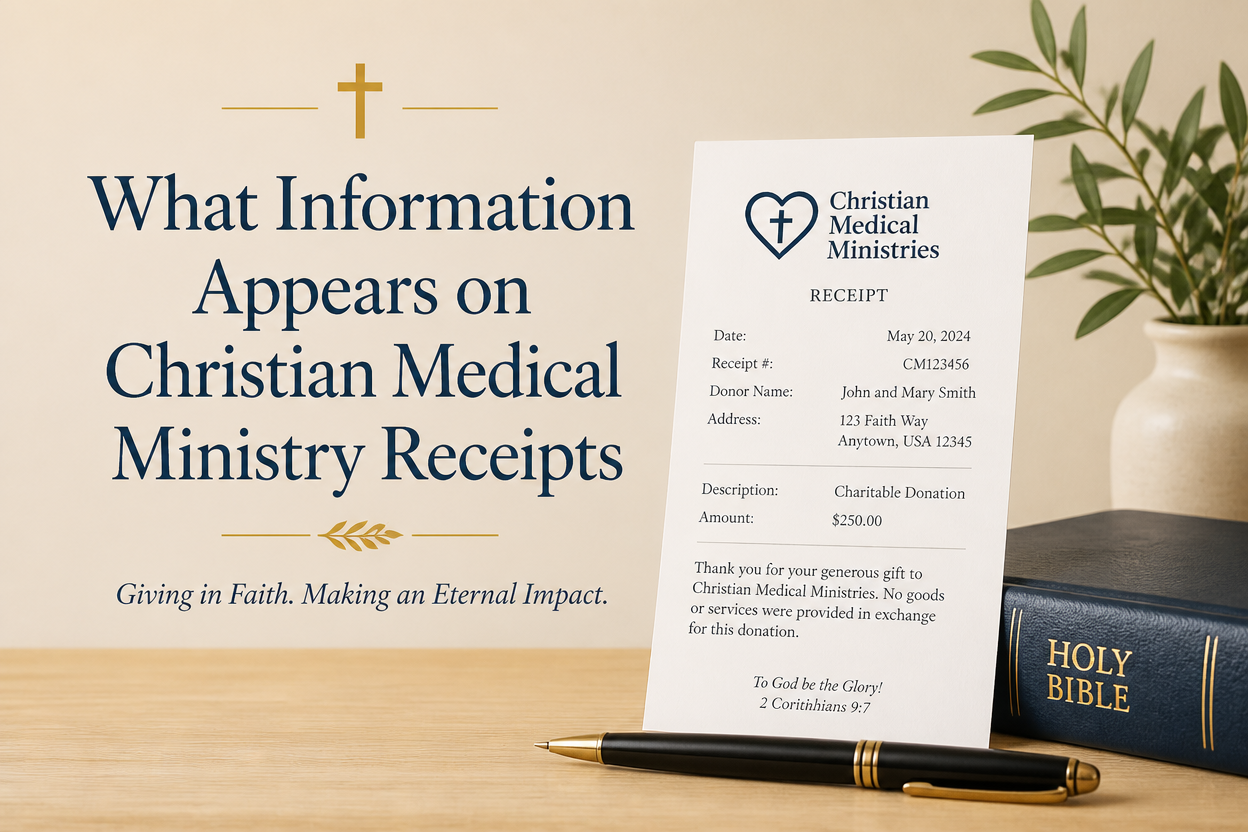
When donors ask what information appears on Christian medical ministry receipts, they are rarely asking a purely administrative question. They are trying to steward faithfully: to give in a way that is both spiritually grounded and defensible under tax law, and to avoid the quiet unease that comes when documentation feels improvised.
Receipts are not a substitute for trust, but they are an early indicator of whether a ministry treats accountability as part of discipleship rather than as a compliance burden. Across our verification work at Most Trusted, we find that ministries that take documentation seriously tend to be more consistent in the deeper disciplines that The Most Trusted Standard evaluates: financial integrity, governance, and transparency.
What a receipt is meant to prove and what it cannot
Receipts serve the donor and the public interest
A charitable receipt exists to document a gift: who gave, what was given, when it was given, and whether the donor received a benefit in return. In the United States, the practical reason is straightforward. If a donor wants to claim a charitable deduction, the IRS expects contemporaneous written acknowledgment for contributions of $250 or more and specific rules for noncash gifts and quid pro quo situations. These requirements are rooted in statute and IRS guidance, and ministries that invite tax-deductible giving are obligated to operate within them. See the IRS’s summary of substantiation rules at IRS.gov.
Just as importantly, a receipt is a ministry’s public statement that it understands its fiduciary responsibilities. Christians may disagree about the best way to fund healthcare-related ministry, but there is far less disagreement about the moral duty to “provide things honest in the sight of all men” (Romans 12:17, KJV). Honesty here is not only personal sincerity; it is legible, verifiable practice.
Receipts do not establish that a ministry is trustworthy
A clean receipt does not prove a ministry is well governed, financially stable, or faithful to its mission. A receipt can be produced by a poorly led organization as easily as by a well led one. This is why wise donors treat receipts as necessary documentation, not as an endorsement.
What this means in practice is that donors should hold two questions together. First: does the receipt meet the legal substantiation requirements for the type of gift made? Second: does the ministry demonstrate the broader patterns of integrity that justify confidence over time? Our evaluation work at Most Trusted focuses on the second question, without pretending the first is unimportant.

The core information donors should expect on a Christian medical ministry receipt
The standard elements for cash and recurring gifts
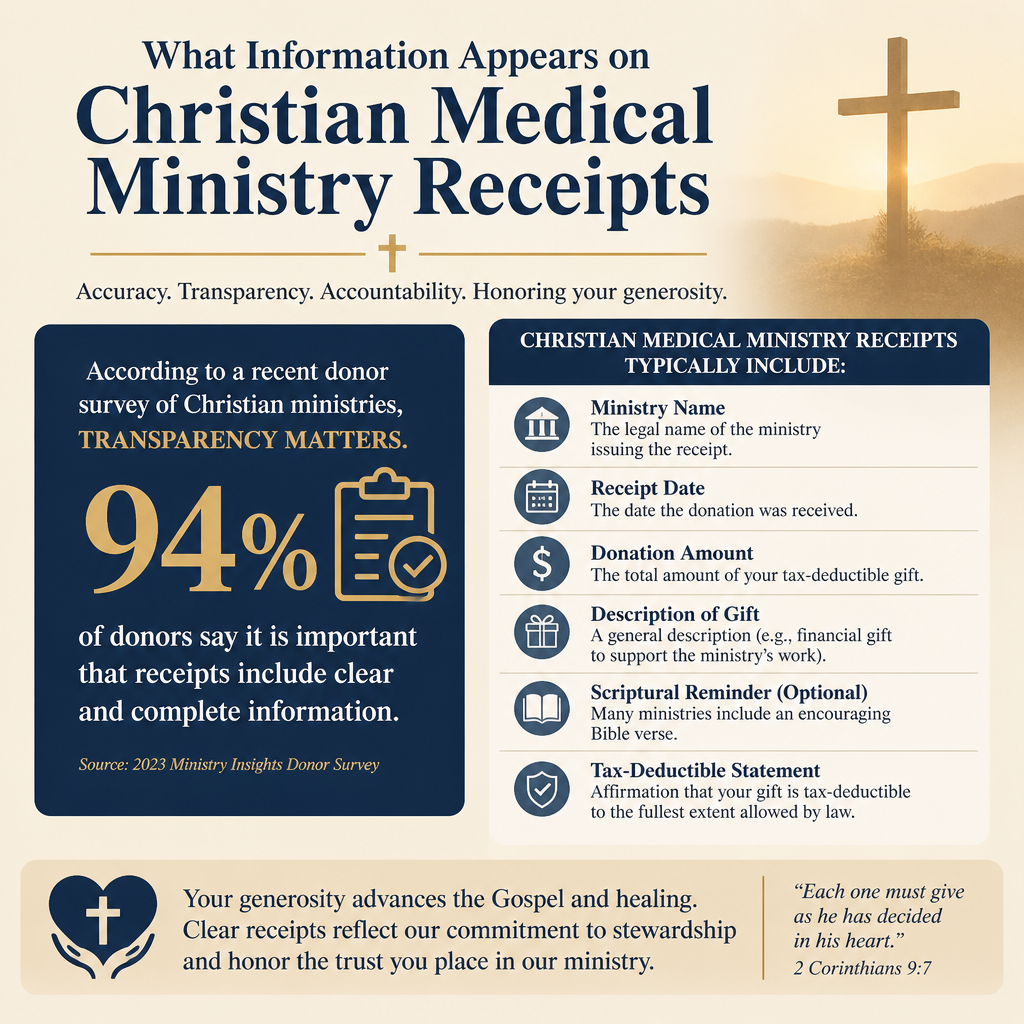
For most donors, the receipt question arises from ordinary giving: a one-time donation, a monthly recurring gift, or year-end giving. In those cases, donors should expect these basics to appear clearly:
- Ministry legal name (and often the DBA name) as recognized for tax purposes
- Ministry address or other identifying contact information
- Donor name (as recorded by the ministry) and sometimes a donor ID
- Date the contribution was received
- Amount contributed (or a year-end summary of amounts and dates)
- A statement about goods or services provided in exchange, if applicable
The “goods or services” line is not filler. For a gift of $250 or more, IRS rules require the acknowledgment to state whether the organization provided any goods or services in consideration for the contribution, and if so, to provide a good-faith estimate of their value. The IRS explanation is plain at IRS.gov.
Year-end statements and why timing matters
Many ministries send a consolidated year-end statement rather than individual receipts for every gift. This can be efficient for donors and ministries, but donors should confirm that the statement is “contemporaneous” under IRS standards, meaning it is received by the earlier of the date the donor files the return or the due date of the return. If a ministry issues statements late, donors can be placed in an avoidable documentation problem.
From a stewardship perspective, timely year-end statements also communicate a ministry’s operational maturity. The administrative work of giving receipts is not glamorous, but it is a form of neighbor-love for donors who must keep orderly records.

Christian medical ministries have unique receipt questions
Designated giving and restricted funds
Christian medical ministries often invite donors to give toward particular needs: a patient assistance fund, a medical clinic, disaster medical response, maternal health initiatives, or missionary healthcare. The moment a gift is designated, two parallel responsibilities become relevant. Donors want assurance that the ministry will honor the designation, and the ministry must avoid language that promises more control than the donor legally has.
Receipts sometimes include language such as “Your gift is designated for X; if needs change, the ministry retains discretion to apply funds where most needed.” Some donors read this as a lack of commitment. In reality, it can be a responsible attempt to align donor intent with legal and operational realities, especially when a specific need is fully met or cannot be executed as envisioned. Mature ministries will explain their designation policy clearly beyond the receipt, including how restricted funds are tracked and reported.
For donors evaluating ministries within Christian Medical Ministries, the practical question is whether the ministry’s policies are both transparent and consistent: the same rules apply whether the designation is small or large, and the ministry can show how it documents and honors restrictions.
Payments that look like dues, fees, or member benefits
Some Christian healthcare-related organizations operate in models that can feel unlike traditional charity: memberships, participant contributions, or cost-sharing arrangements. Donors should be careful with assumptions. Not every payment to a religiously oriented healthcare program is a charitable contribution. In some structures, payments are more akin to program fees, and deductibility may be limited or not available.
Receipts should not imply deductibility if the payment is not a charitable gift. Responsible ministries clarify what portion, if any, is tax-deductible and why. Donors should also remember that a receipt is not tax advice; it is documentation of what the organization claims about the transaction. When the arrangement is complex, donors should consult a qualified tax professional.
Quid pro quo, noncash gifts, and other situations that change what should appear
When the donor receives something in return
Receipts must treat benefits with candor. If a donor receives goods or services in exchange for a contribution, the acknowledgment should disclose that and provide a good-faith estimate of value. This is commonly called quid pro quo. The IRS outlines the principle and the related disclosure expectations at IRS.gov.
In Christian medical ministry contexts, benefits can surface in subtle ways: event tickets for a fundraising dinner, a banquet meal, a resource package, or a conference registration. Donors are often willing to cover costs as part of generosity, but they should not be asked to treat a purchase as a gift. Ministries should avoid marketing language that blurs the line.
Noncash gifts and why receipts become more precise
When donors give noncash items, the receipt rules change. A ministry generally acknowledges what was received and when, but it should not assign value to most noncash donations; valuation is typically the donor’s responsibility. This can matter for donated medical supplies, equipment, vehicles used in medical transport, or gifts-in-kind to a clinic.
Because noncash giving can create higher compliance risk for donors, strong ministries give clear, accurate acknowledgments and point donors toward appropriate IRS guidance. Donors can start with the IRS’s overview of charitable contribution substantiation at IRS.gov.
What strong receipts signal about ministry accountability
Receipts as part of a wider transparency posture
A well-prepared receipt tends to sit inside a wider posture of accountability: consistent bookkeeping, reconciled gift records, board oversight, and clear separation of donor-restricted funds from general operations. Receipts alone do not prove these practices, but sloppy receipts often correlate with deeper recordkeeping weaknesses.
Donors sometimes treat administrative precision as a distraction from mission. Scripture does not permit that separation. The New Testament’s concern for faithful administration is evident when the early church organizes distributions to widows to prevent neglect and complaint (Acts 6:1–6). Competent process served mercy, not the other way around.
How Most Trusted encourages donors to evaluate beyond the receipt
Most Trusted exists because donors need more than paperwork to give with confidence. The Most Trusted Standard evaluates ministries across faith commitments, financial integrity, governance, and transparency and effectiveness, precisely because donor trust should rest on verifiable patterns rather than on compelling stories alone.
For donors who are trying to align their giving with careful compliance, Tax Receipts and Compliance for Christian Medical Ministry Giving is often the right place to broaden the question beyond what appears on a receipt to what a ministry’s systems reveal over time.
FAQs for What information appears on Christian medical ministry receipts
Should a Christian medical ministry receipt include an EIN?
An EIN is not strictly required on every acknowledgment under IRS substantiation rules, but many ministries include it because it reduces ambiguity for donors and tax preparers. If an EIN is absent, donors can often locate it on the ministry’s Form 990 or other public filings when applicable, or by requesting it directly. Clarity is a mark of administrative respect for donors.
If a receipt says no goods or services were provided, is my gift automatically deductible?
No. That statement is one necessary element for deductibility in many cases, but deductibility also depends on the nature of the payment and the organization’s tax status, and on whether the donor received a benefit through another channel. Complex arrangements common in healthcare-adjacent ministries may not fit the simplest charitable-gift model. Donors should keep the receipt, review the ministry’s disclosures, and consult a qualified tax professional when the transaction is not a straightforward donation.
Giving with both generosity and clarity
Christian medical ministry receipts should be plain, accurate, and complete: the ministry’s identity, the donor’s gift, the date received, and a truthful disclosure about benefits received. When receipts are treated as serious documentation rather than an afterthought, they serve donors well and reinforce public trust in Christian witness.
The deeper question is not whether a ministry can produce a receipt, but whether the ministry’s practices make that receipt credible. Mature donors give generously, and they also ask for verifiable clarity, because stewardship is an act of love toward God and neighbor alike.



