

How Bible study ministries thank and retain donors is ultimately a question of discipleship: whether the ministry treats giving as a transactional revenue stream or as a shared participation in the Word of God bearing fruit in real people. Christian donors do not merely fund content; they fund formation, translation, teaching, training, and the slow work of endurance that Scripture commends. Gratitude and retention practices reveal what a ministry believes about stewardship, truthfulness, and the dignity of the giver.
The strongest donor relationships in Bible study and engagement ministries are built on two commitments held together: pastoral care for supporters and verifiable accountability for outcomes and conduct. Many ministries can produce moving stories, but mature donors increasingly ask for governance clarity, financial integrity, and evidence that the ministry’s methods match its theology. Across our verification work at Most Trusted, we observe that durable donor retention tends to follow when gratitude is concrete, reporting is candid, and the ministry resists the temptation to treat donors as a segmented list rather than as fellow members of the body.
Thanking is theological before it is tactical
Gratitude reflects a doctrine of partnership
Paul’s letters model a form of donor care that is neither flattering nor distant. He thanks God for the Philippians’ “partnership in the gospel” and speaks of their gifts as a “fragrant offering” (Philippians 1:5; 4:18). That is not marketing language. It is an account of shared mission under God’s providence. Bible study ministries do well when they echo this posture: the giver is not a customer to be managed, but a co-laborer to be honored with truth.
What this means in practice is that the best thank-you practices are rooted in spiritual realism. Some donors are newly generous and need encouragement. Others are long-tenured and need substantive reporting, not sentimental repetition. Still others are grieving, aging, or carrying heavy family responsibilities; they need communications that respect their attention and do not assume unlimited emotional bandwidth. Gratitude becomes trustworthy when it is restrained, specific, and oriented toward God’s work rather than the ministry’s brand.
Language choices reveal whether a ministry is safe
Christian donors are often willing to give sacrificially, but they are increasingly wary of spiritual manipulation. The boundary between exhortation and pressure is not always clear in fundraising, and Christians genuinely disagree about how direct an appeal should be. Yet Scripture warns against peddling God’s word for profit and commends integrity that “renounces disgraceful, underhanded ways” (2 Corinthians 2:17; 4:2). Donor gratitude that relies on guilt, exaggerated urgency, or implied spiritual merit tends to produce short-term revenue and long-term distrust.
Ministries that retain donors for years tend to thank in ways that are verifiable: a gift was received, it was applied as promised, and it contributed to a defined ministry activity. They avoid unverifiable claims about what a donor “made possible” when the ministry cannot reasonably trace the contribution to the stated outcome. This is a high bar, but it is consistent with Christian truth-telling.

Retention grows where reporting is honest and outcomes are intelligible
Donors stay when they can see what they are strengthening
Bible study and engagement ministries are sometimes tempted to report only stories and impressions because spiritual formation is difficult to quantify. That tension is real. Not everything that matters can be captured in a metric, and an overreliance on numbers can distort ministry priorities. At the same time, donors rightly ask for intelligible evidence that the ministry’s work is reaching people and being conducted with integrity.
Reasonable reporting often includes a blend: distribution or participation counts, training activity, translation progress, curriculum adoption, and qualitative accounts that are specific enough to be credible. When a ministry does use numbers, definitions matter. Counting “engagement,” for example, can mean anything from a click to sustained participation. Donors are not served when ministries use ambiguous terms that inflate impact.
Transparency aligns with broader nonprofit accountability norms
In nonprofit practice, the sector has pushed back against simplistic overhead fixation. The “Overhead Myth” letter, signed by GuideStar, Charity Navigator, and the BBB Wise Giving Alliance, warned that judging nonprofits mainly by administrative and fundraising ratios can punish necessary investments in systems and people that protect effectiveness and integrity (GuideStar). Bible study ministries that retain discerning donors typically explain their cost structure with calm clarity: why certain staffing, security, translation, or evaluation costs exist; what controls are in place; and what trade-offs the ministry is making.
This is also where independent verification becomes more than a seal; it becomes a discipline. Most Trusted evaluates ministries against The Most Trusted Standard, a 15-criteria framework spanning faith foundation, financial integrity, governance and leadership, and transparency and effectiveness. Ministries that welcome scrutiny tend to produce donor communications that are less performative and more reliable, because their internal records can bear the weight of their public claims.
Thank-you systems should protect dignity and resist manipulation
Promptness matters, but substance matters more
Many ministries assume retention is primarily a cadence problem: send a receipt immediately, then schedule touches across the year. Cadence is necessary, but it does not compensate for thin content or vague claims. The donor’s deeper question is moral and spiritual: “Is this ministry telling the truth, honoring Scripture, and stewarding resources faithfully?” Thanking becomes formative when it answers that question steadily over time.
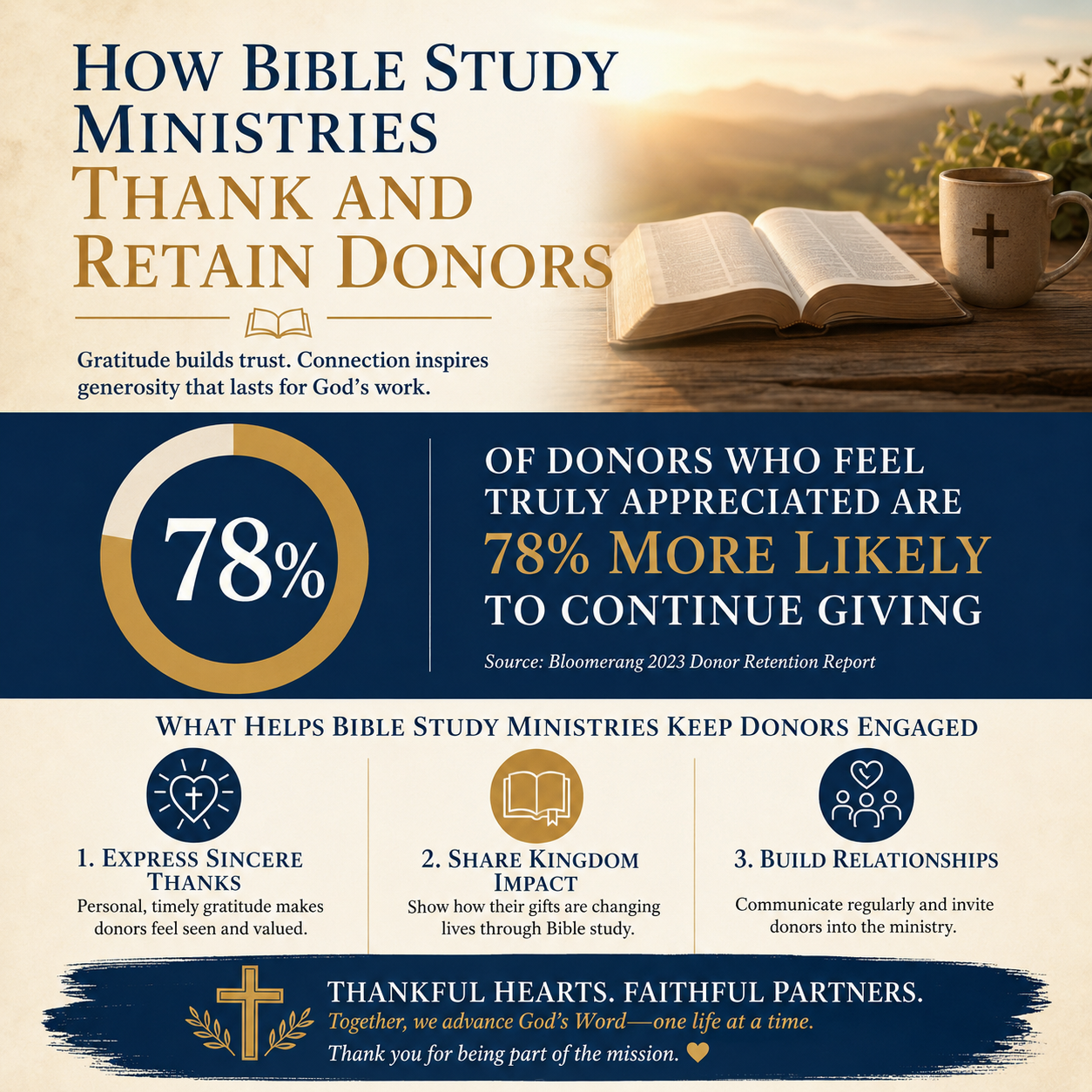
Practically, donors notice three things quickly: whether the ministry acknowledged the gift without confusion, whether communications respect privacy and preferences, and whether the ministry appears to know what it is doing. A chaotic acknowledgment process can be a warning sign of deeper operational weakness. A ministry does not need expensive software to be orderly, but it does need clear ownership, reconciliation practices, and a consistent standard for data handling.
One-size-fits-all gratitude fails mature supporters
Bible study donors are not a monolith. Some are motivated by local church formation, others by global translation, others by prison discipleship, campus outreach, or children’s Scripture engagement. Retention improves when the ministry communicates to donors in a way that corresponds to the work they care about without reducing them to a profile. The goal is not persuasion by customization; it is pastoral clarity about what the ministry does and how the donor’s partnership relates to it.
A restrained approach to segmentation is also ethically safer. Over-personalization can feel intrusive, and aggressive behavioral targeting can resemble the attention economy practices many Christian donors are trying to resist. Trust is strengthened when donors can opt into deeper communications and opt out without penalty.
What faithful donor care looks like in practice
Practices that tend to retain donors without eroding trust
Across donor engagement in Bible study and engagement ministries, we see several practices that consistently strengthen retention when they are executed with integrity. They are not novel, but they are demanding because they require internal discipline.
- Specific acknowledgments that name the program area supported, describe the intended use, and avoid unverifiable “you changed everything” language.
- Regular, candid reporting that includes both progress and constraints, especially when timelines shift or access changes in sensitive contexts.
- Clear governance signals, such as accessible leadership information, conflict-of-interest policies, and independent financial oversight.
- Respect for donor intent, with procedures for restricted gifts and plain explanations when the ministry cannot accept a restriction.
- Thoughtful pastoral content that serves the donor’s spiritual life rather than existing only to prompt the next gift.
These practices also have limits. Some donors will still lapse because of economic pressure, family needs, or changing priorities. Others may disagree with a ministry’s theological distinctives or strategic direction. Retention is not a moral absolute; it is a sign that trust is being maintained. In that sense, a ministry’s willingness to lose a donor rather than exaggerate claims can be a mark of health.
Donor care and accountability should reinforce each other
Gratitude that is detached from accountability can become sentimental. Accountability that is detached from gratitude can become clinical. Mature donor retention requires both. Donors are more likely to remain when they sense that a ministry can answer hard questions without offense: how leaders are selected and evaluated, how related-party transactions are handled, how the ministry safeguards vulnerable populations, and what happens when something goes wrong.
For donors who want to take that question seriously across the field, our coverage of Bible Study and Engagement Ministries names common risks and healthy signals, with attention to the realities of translation work, digital discipleship, and local church partnership.
Verification strengthens retention by clarifying what deserves confidence
Trustworthy ministries welcome defined standards
Bible study ministries often trade in intangible goods: understanding, conviction, perseverance, love for Christ, and obedience to Scripture. Because these outcomes are not easily audited, ministries sometimes assume external evaluation is inappropriate. Yet Scripture repeatedly calls for accountable leadership, financial integrity, and public reputations that withstand scrutiny (1 Timothy 3; Titus 1). Verification does not replace spiritual discernment, but it can guard donors from avoidable harm.
Most Trusted exists to serve donors who want to give with confidence. The Most Trusted Standard does not ask ministries to reduce discipleship to metrics, but it does ask for evidence that governance is real, finances are responsibly managed, and communications are truthful. When a ministry meets defined criteria, donor care becomes easier because it rests on stable ground. When a ministry cannot meet basic accountability expectations, no amount of gratitude messaging can ultimately sustain trust.
Where donor retention efforts can go wrong
The harder question is what ministries should not do. Some retention tactics work financially while weakening spiritual credibility: manufacturing urgency, blurring the line between testimony and guarantee, or using “exclusive” insider access as a status reward for larger gifts. Others compromise privacy, especially when ministries share sensitive field stories or identifiable details about new believers, prisoners, or minors. Retention achieved through these means is costly. It damages the ministry’s witness and, in some cases, places people at risk.
Donors increasingly recognize these dynamics. Trust is shaped as much by what a ministry refuses to do as by what it does. Strong ministries show donors their boundaries: what they will not claim, what they will not share, and what they will not promise.
For donors focusing specifically on relationship practices, our analysis of Donor Engagement in Bible Study and Engagement Ministries addresses common patterns, including where enthusiasm can outpace accountability and how ministries can communicate progress without exaggeration.
FAQs for How Bible study ministries thank and retain donors
What should a donor expect after giving to a Bible study ministry?
A donor should expect a prompt acknowledgment and receipt, a clear statement of how the gift will be used, and periodic reporting that is specific enough to be credible. Mature ministries also make it easy to update preferences, reduce mail volume, or opt out without being penalized. When communications consistently rely on vague impact claims or escalating urgency, donors are right to ask harder questions.
How can donors evaluate whether a ministry’s gratitude and reporting are trustworthy?
Trustworthy donor communication aligns with verifiable realities: accessible leadership and governance information, transparent financial reporting, and consistent explanations of strategy and results. Donors can also look for restraint in storytelling, respect for privacy, and the absence of spiritual pressure tactics. Independent verification against a defined framework, such as The Most Trusted Standard, can help donors distinguish between compelling narratives and accountable operations.
A mature ministry thanks donors by telling the truth
Bible study ministries retain donors over time when gratitude is more than politeness and reporting is more than promotion. The donor’s trust is strengthened by sober truth-telling: what was done, what it cost, what was learned, and what remains unfinished. In an age when many institutions ask for loyalty without accountability, ministries that honor the giver through clarity and integrity give donors a credible reason to continue participating in the work of Scripture shaping lives.



