

Training is the quiet determinant of whether military outreach ministries serve service members and spouses with dignity—or with avoidable harm. When donors ask what training military outreach ministries require for volunteers, the question is not procedural; it is moral, pastoral, and operational at once, because the military community routinely carries burdens that require discernment rather than enthusiasm.
Christians do not enter this work as neutral actors. We come with convictions about courage, sacrifice, vocation, and neighbor-love. Yet good intentions can collide with the realities of chain of command, operational security, trauma exposure, and pluralistic environments. The ministries that sustain faithful presence over time treat volunteer formation as a core ministry activity, not a compliance hurdle.
Training begins with theological clarity and pastoral posture
Military-connected communities often include strong public narratives about honor and resilience alongside private realities of moral injury, grief, and fractured family life. A volunteer may encounter both in a single conversation. Training that is merely motivational will not hold up under that weight; it must form a posture that is both courageous and restrained.
Why theological framing is not optional
Scripture does not romanticize suffering, and neither should Christian service. Jesus’ call to visit those in prison and care for the afflicted places ministry in hard places at the center of discipleship, but it also assumes humility and truth-telling. Volunteers need formation that distinguishes Christian presence from problem-solving, and witness from coercion. That posture protects both the service member and the ministry’s integrity.
In practice, credible ministries train volunteers to avoid using spiritual language as a shortcut around grief, shame, or anger. They teach volunteers to listen without trying to “fix,” to pray only with explicit consent, and to understand that military culture often prizes composure even when the inner life is unraveling.
Pastoral boundaries for non-pastors
Most volunteers are not clinicians or ordained clergy. Training should say that plainly and operationalize it. Volunteers need clear guidance on when to refer to chaplains, licensed counselors, or emergency services; how to respond to suicidal ideation; and how to document or escalate concerns within the ministry’s safeguarding policies. The goal is not to turn volunteers into professionals, but to keep them from improvising in moments where improvisation can injure.
Military culture competence is a form of respect
Some donors assume that loving the military means celebrating it; others assume it means criticizing it. Mature ministry resists both simplifications. Volunteers must understand enough about military life to avoid naïveté, but not so much that they confuse familiarity with authority.
What volunteers should understand before they arrive
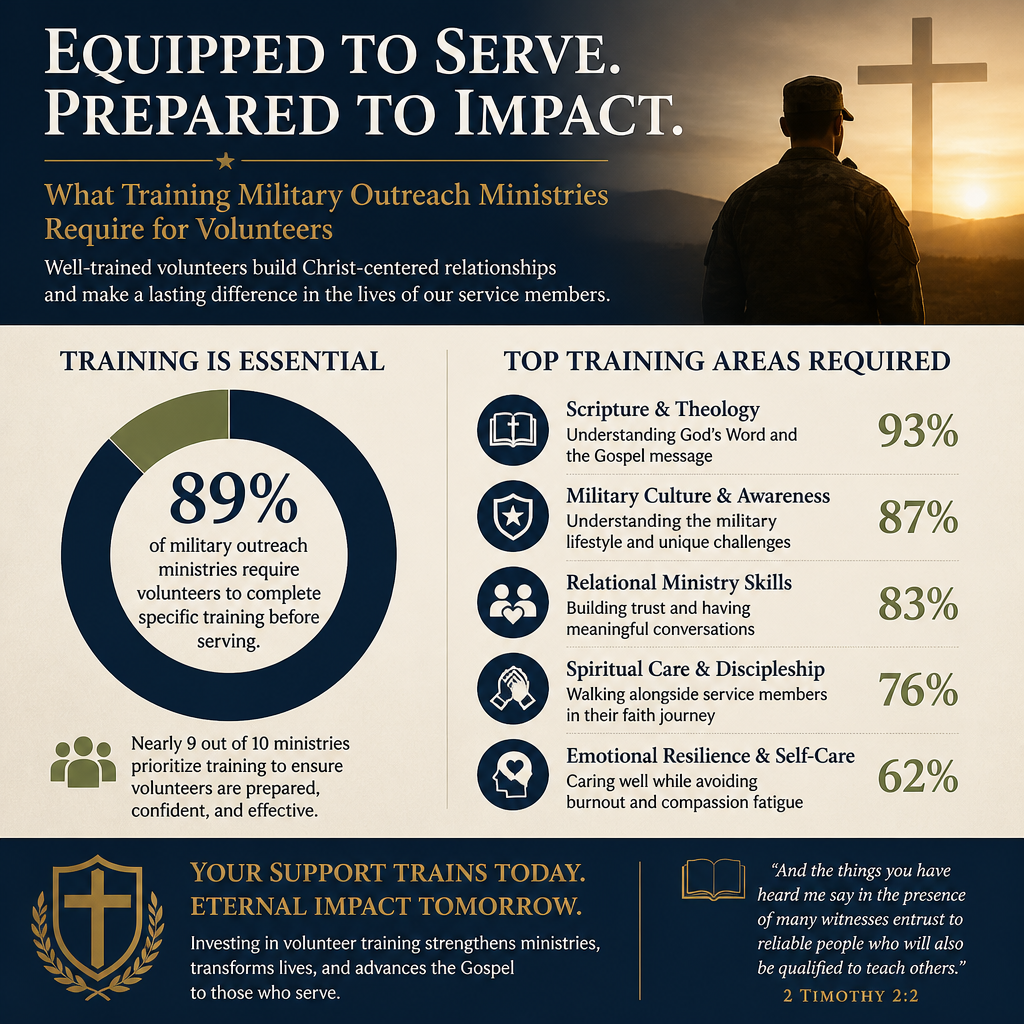
High-quality training introduces rank structure, basic jargon, deployment cycles, common family stressors, and the role of the chaplain corps. Volunteers should be coached on appropriate questions, appropriate curiosity, and the reasons many service members distrust civilians who appear to be collecting stories.
Training should also address operational security and personal security. Volunteers do not need classified knowledge; they need disciplined restraint. The same care applies to social media. A volunteer’s public post can unintentionally expose a family’s location or a unit’s patterns.
Pluralism and the chaplaincy context
Many ministry settings on or near installations exist within a pluralistic framework where access is conditioned on respect for diverse beliefs. Volunteers should be trained to share faith honestly without disparaging others, and to avoid presenting themselves as official military representatives. The military chaplaincy’s own institutional commitments—facilitating the free exercise of religion and caring for all—create a context in which Christian ministries must model both conviction and restraint.

For donors evaluating ministries in this space, it is useful to distinguish between programs that depend on privileged access and programs that are prepared to serve consistently even when access changes. That question belongs in any serious review of Military Outreach Ministries.
Trauma awareness and safeguarding protect the people the ministry claims to serve
Military service can expose people to combat trauma, training accidents, sexual assault, intimate partner violence, and the cumulative stress of repeated separations. Volunteers do not need a diagnostic toolkit, but they do need trauma awareness: an understanding of triggers, dissociation, and the ways trauma shapes trust and memory.
Trauma awareness without amateur therapy
Effective training teaches volunteers to recognize signs of distress, maintain calm presence, and avoid forcing disclosure. It also teaches what not to do: pressing for details, offering simplistic spiritual explanations, or making promises the ministry cannot keep.
Because military families include children, safeguarding must be explicit. The U.S. Department of Defense reports that in 2023 there were more than 29,000 reports of child abuse and neglect involving military-affiliated children, underscoring the stakes for any ministry serving military households (U.S. Department of Defense Office of Inspector General).
Mandatory reporting and confidentiality training
Volunteers require clear instruction on confidentiality boundaries and mandated reporting requirements, which can vary by state and setting. Ministries should train volunteers on what information can be kept private, what must be reported, and to whom. A written policy is not enough; volunteers need scenario-based practice: “If a spouse discloses domestic violence,” “If a teen reports abuse,” “If a service member expresses intent to self-harm.”
Donors should not be embarrassed to ask whether a ministry conducts background checks, trains volunteers annually, and has documented incident response procedures. Safeguarding is not a distraction from mission. It is part of loving our neighbor without sentimentalism.
Competence in relationships includes spouses, children, and the long middle of ordinary life
Many military outreach efforts focus on service members in uniform, but the long-term spiritual and emotional pressures often accumulate in the home. Training should prepare volunteers to serve the whole family system, including spouses who bear extended responsibility during deployments and children whose stability depends on routines that can change overnight.
Family systems training for ministry settings
Strong programs teach volunteers how deployment cycles affect marriage communication, parenting stress, and church attendance patterns. They also train volunteers to avoid triangulation—becoming the confidant against the spouse, the unit, or the church leadership. The volunteer’s role is to strengthen healthy connections, not to become a substitute authority figure.
Research consistently shows that military families face distinctive stressors tied to service demands. For instance, the RAND Corporation’s work on military family readiness has documented how deployment and reintegration can strain mental health and family functioning (RAND Corporation).
Practical hospitality is a ministry skill
Some of the most faithful military outreach occurs through ordinary consistency: rides to appointments, meals during reintegration, childcare during counseling, help navigating local schools, or simply showing up when a family’s support network is thin. Training should dignify these forms of service and teach volunteers to offer help in ways that preserve agency and avoid paternalism.
One simple marker of readiness is whether a ministry can articulate what its volunteers will do in the first 30 days and what they will not do, especially in families with complex needs. That kind of clarity tends to correlate with ministries that operate with sober self-knowledge.
For donors, training quality is also a governance and accountability question
Donors often evaluate ministries by outcomes and stories. Military outreach adds another layer: access, credibility, and safety depend on disciplined operations. Training is where these realities become measurable.
What training reveals about leadership
Across our verification work at Most Trusted, we observe that ministries that meet The Most Trusted Standard typically treat training as part of their accountability architecture. They document curricula, require refreshers, track attendance, and assign qualified oversight. They also define volunteer roles narrowly enough that supervision is realistic, not aspirational.
Where training is weak, other weaknesses often appear: informal governance, undocumented counseling practices, blurred financial controls around benevolence, and an overreliance on a charismatic leader’s judgment. A ministry can be sincere and still be unsafe.
Donor due diligence questions that are fair to ask
- Is volunteer training required before any direct contact with service members or families?
- Does the ministry have written safeguarding, confidentiality, and incident response policies?
- Are background checks conducted for roles involving minors or vulnerable adults?
- Are volunteers trained to refer to chaplains, clinicians, or emergency services rather than improvised counseling?
- Is training renewed annually, and is attendance documented?
These questions align naturally with how donors should think about governance, financial integrity, and transparency. They also support the ministry’s longevity. An outreach effort that loses credibility with commanders, chaplains, or local churches because of one preventable incident can set back years of patient work.
Donors who want to understand the volunteer side of this work in more detail will often find it helpful to review the norms and expectations common in Volunteering with Military Outreach Ministries, where training and supervision are central to faithful service.
FAQs for What training military outreach ministries require for volunteers
Should volunteers in military outreach ministries receive training even if they have served in the military?
Yes. Prior service can be an asset, but it does not replace training in safeguarding, confidentiality, referral pathways, and the ministry’s specific policies. A former service member may also carry unresolved wounds; training helps the ministry discern readiness and establish support and supervision that protect both the volunteer and those served.
What is a reasonable minimum training commitment for a volunteer role?
The appropriate minimum depends on the role’s risk. For low-contact roles such as logistical support, a concise orientation and safeguarding overview may be sufficient. For direct pastoral care, mentoring, or family-facing roles, donors should expect more substantial preparation: written policies, scenario-based practice, clear escalation procedures, and periodic refreshers. The more vulnerable the population and the more intimate the setting, the more rigorous training should be.
Training is an expression of love ordered by wisdom
Christian donors rightly want military outreach ministries to be bold in witness and generous in care. The ministries most worthy of confidence are not those that promise frictionless impact, but those that prepare volunteers to serve under real constraints: military culture, trauma exposure, family complexity, and the moral weight of trust. Training is where love becomes disciplined, and where a ministry demonstrates that it intends to serve the military community not only earnestly, but safely and well.



