
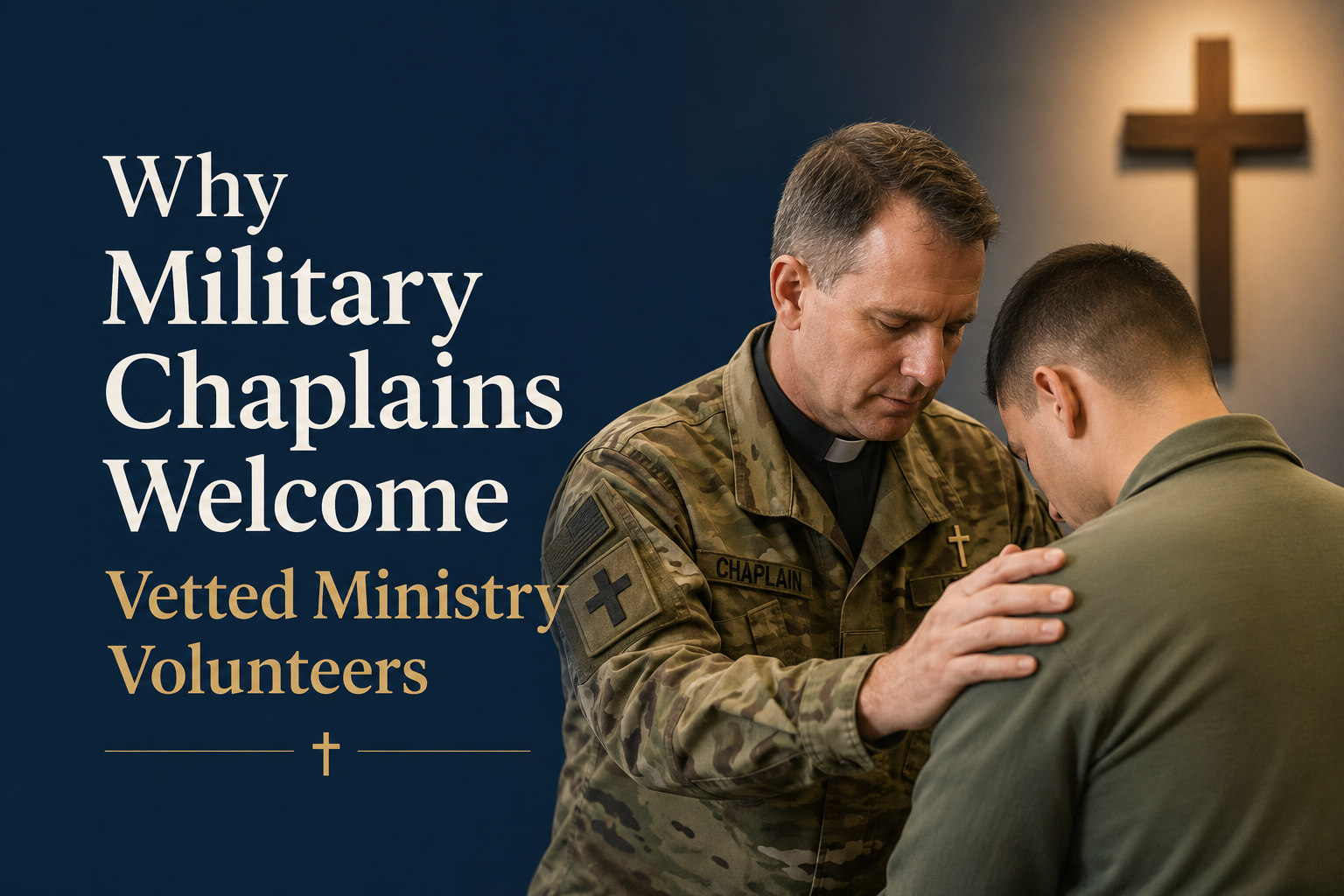
Why military chaplains welcome vetted ministry volunteers is not a sentimental question about “extra hands.” It is a matter of mission alignment, force protection, and moral care in a setting where trust is earned slowly and lost quickly.
For Christian donors, the stakes are doubled. We are not only asking whether a program is effective, but whether it is faithful, prudent, and accountable when it steps into the lives of service members and families under real strain. A chaplain’s openness to outside volunteers is often a signal that a ministry understands the difference between access and entitlement, and between zeal and wisdom.
Chaplains carry spiritual responsibility inside a tightly governed institution
Religious liberty on the installation is protected and bounded
Military chaplains serve at the intersection of constitutional limits, command authority, and pastoral care. They facilitate the free exercise of religion for service members while operating within policies designed to preserve good order and discipline. That environment is one reason chaplains can be cautious about outside groups: a well-intentioned volunteer who does not understand boundaries can create avoidable conflict, confusion, or perceived coercion.
What this means in practice is that chaplains often prefer partners who have already demonstrated institutional maturity—ministries that understand permissions, privacy, and the difference between evangelistic initiative and pastoral presence. The military is not a church campus where any volunteer with goodwill can improvise. It is a mission-critical workplace with unique constraints.
They are stewards of trust with service members and commanders
Chaplains function as trusted advisors to commanders and confidential counselors to troops. When a chaplain brings volunteers onto an installation or into a military community, the chaplain is effectively vouching that the ministry will not exploit access, mishandle sensitive situations, or create reputational risk for the unit.
That is why “vetted” is not merely administrative. It is a moral category. Scripture places real weight on the character of those who lead and serve. Paul’s pastoral qualifications emphasize reputation, self-control, and integrity in public life (1 Timothy 3). In a military setting, those qualifications translate into practices that can withstand scrutiny.
Vetting protects service members from spiritual and practical harm
Not every ministry presence is equally safe or helpful
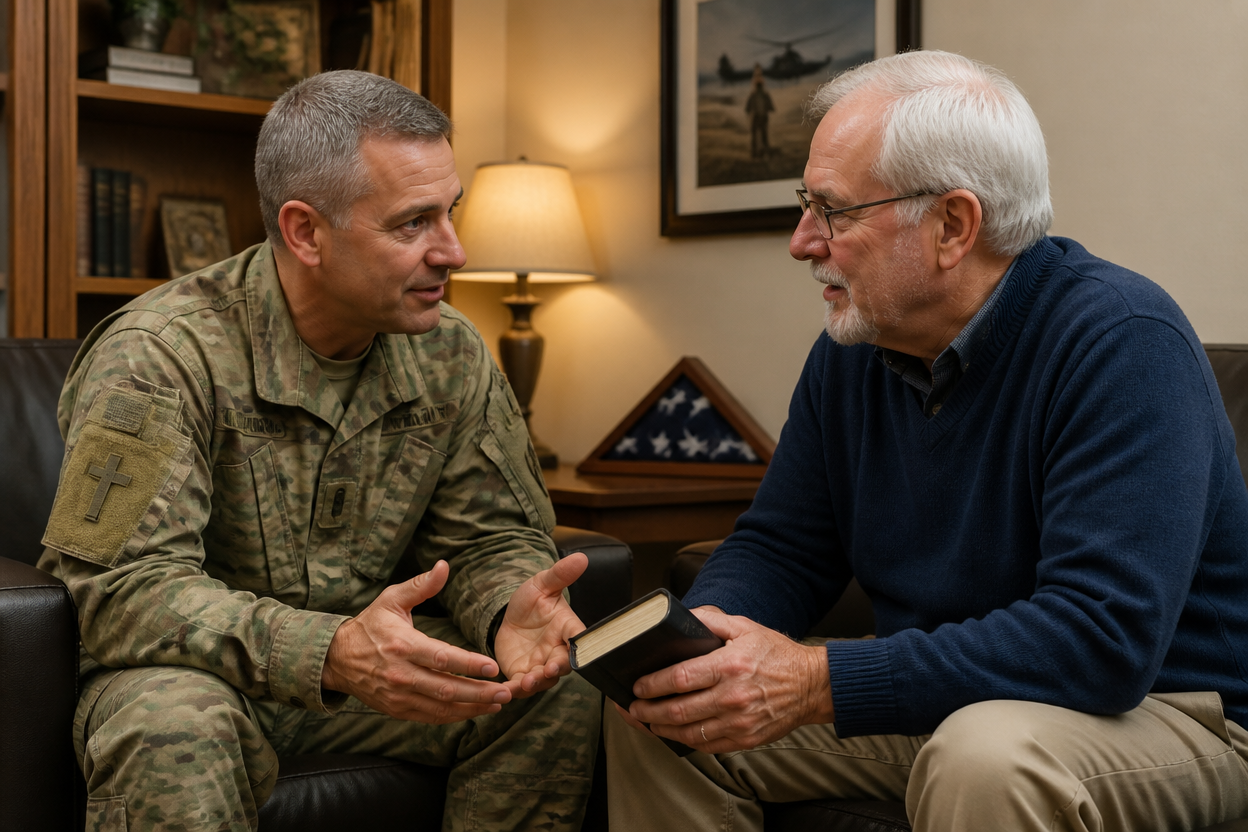
Christians genuinely disagree about how best to serve in military contexts, particularly around evangelism, counseling boundaries, and partnerships with government institutions. Yet the field has had to reckon with a basic reality: vulnerable people attract both sincere helpers and unhealthy actors. Service members dealing with grief, moral injury, family stress, or isolation are not an audience for experimentation.
Vetted volunteers reduce the likelihood of common failures: overpromising help, offering amateur counseling outside competence, mishandling mandated reporting concerns, or treating personal stories as inspirational content. Many of these errors are not born of malice; they are born of formation gaps. Vetting is one way chaplains try to close those gaps before harm occurs.
Privacy and confidentiality are not optional courtesies
Chaplains protect confidentiality as part of their duty, and service members often assume anyone near a chapel or chaplain shares that seriousness. Volunteers who do not understand privacy expectations can break trust quickly, even without realizing it. The ministry that belongs on an installation is the ministry that treats confidentiality as a disciplined practice, not a personal preference.
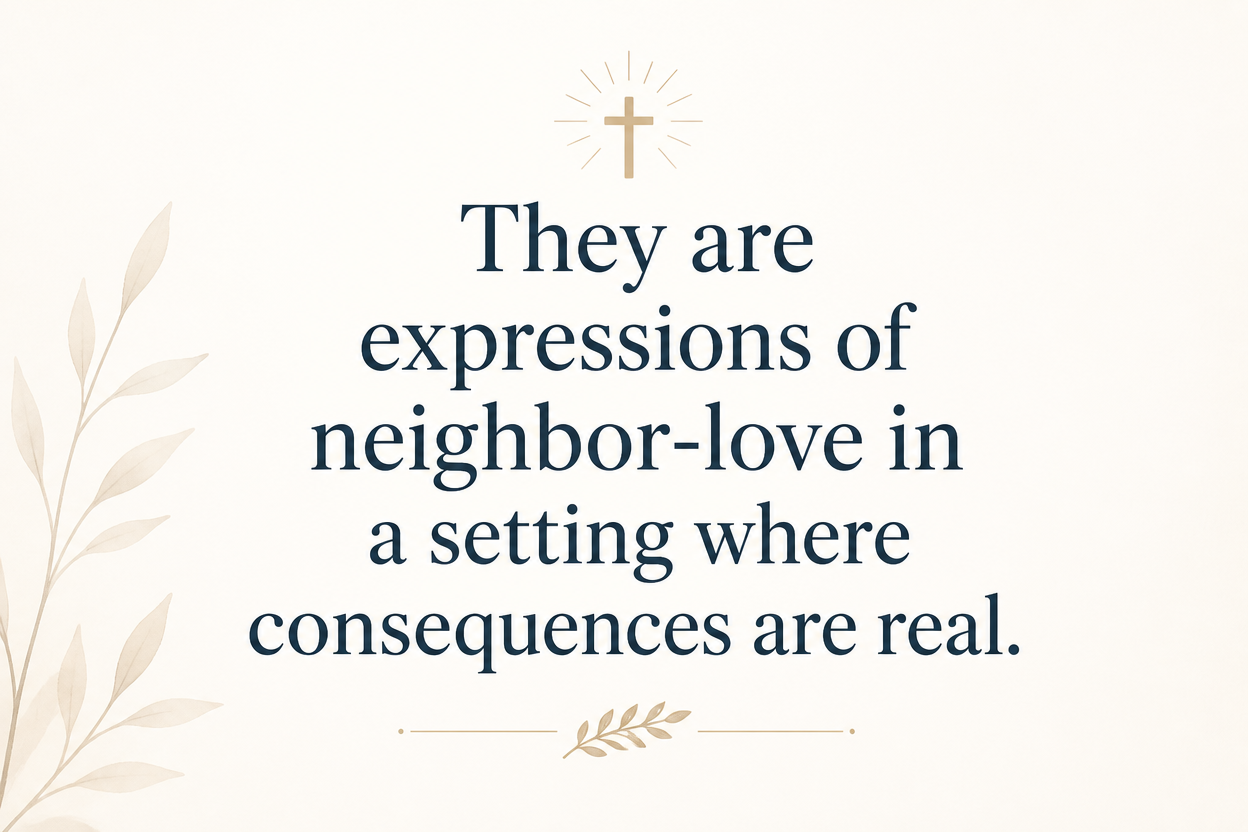
Donors can also appreciate why chaplains look for ministries with clear written policies: codes of conduct, screening processes, training requirements, and incident response procedures. These are not signs of bureaucratic coldness. They are expressions of neighbor-love in a setting where consequences are real.
Vetted volunteers strengthen a chaplain’s mission without competing with it
The best partners understand pastoral authority and chain of command
Chaplains are responsible for religious support that serves a pluralistic force. Outside volunteers who arrive with a private agenda, a combative posture toward leadership, or an inability to work within guidance can quickly become a liability. Conversely, volunteers who respect pastoral leadership and military realities can extend care without displacing the chaplain’s role.
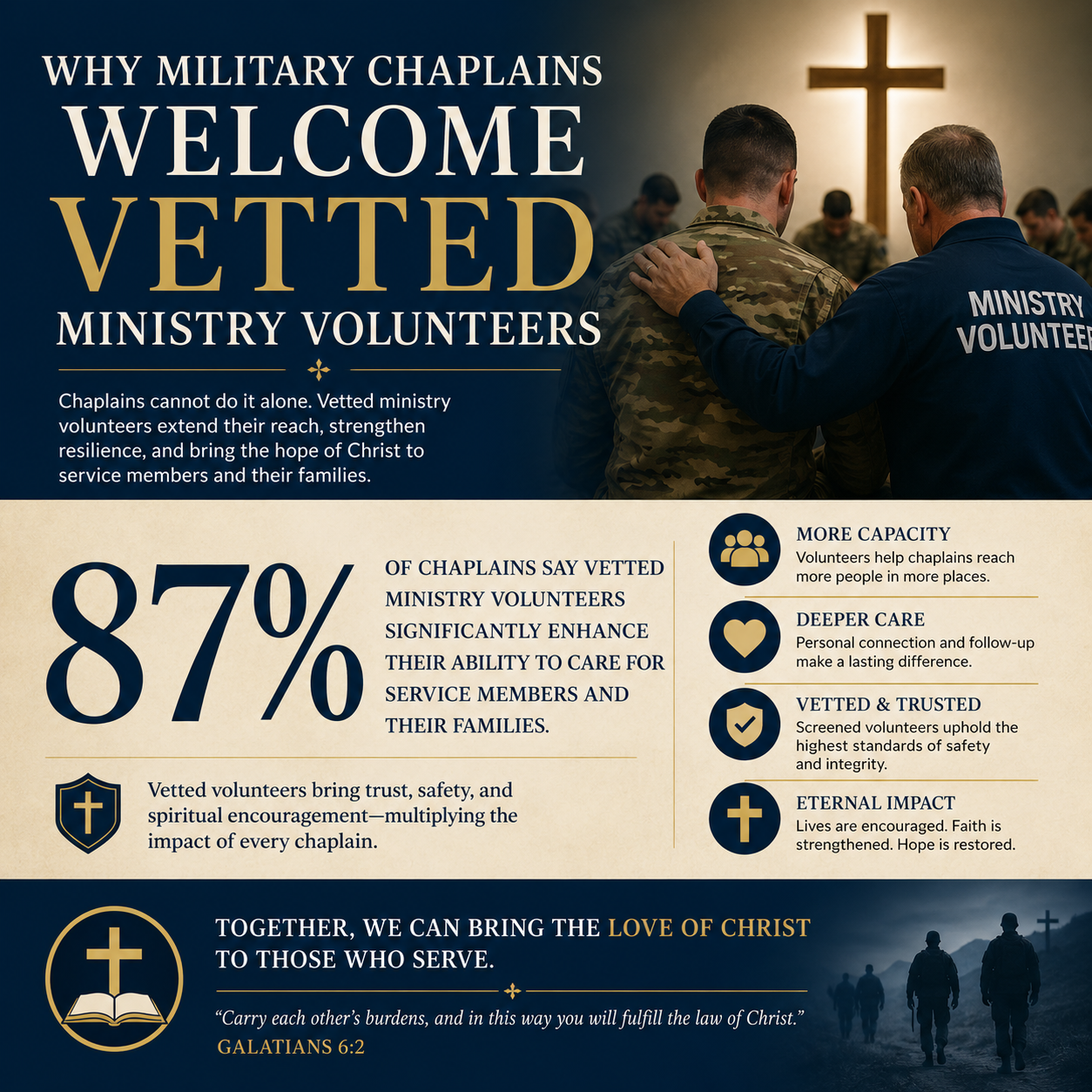
In our work evaluating Christian nonprofits at Most Trusted, we see a consistent pattern: the ministries that meet The Most Trusted Standard tend to articulate their role with restraint and clarity. They can describe what they do, what they do not do, and how they coordinate with responsible authorities. That posture is precisely what chaplains look for when they open doors to volunteers.
They bring specialized capacity the chaplain cannot scale alone
Even strong chaplaincies have limits. Installations can include thousands of service members and families, multiple units, and constant turnover. Vetted volunteers can expand capacity in ways that remain appropriate: hospitality for newcomers, peer support groups under chaplain oversight, marriage enrichment alongside command-approved programming, or practical care during deployments.
Donors often ask whether volunteer-driven work is “efficient.” Efficiency is the wrong first question here. The better question is whether the ministry’s added capacity is accountable, coordinated, and demonstrably beneficial to the community it serves.
For donors, vetting is a proxy for governance, integrity, and theological seriousness
Good intentions do not substitute for accountable systems
Military chaplains are rarely impressed by claims of impact that cannot be verified. They have seen high-enthusiasm efforts fade, and they have seen ministries fracture under avoidable governance failures. Donors should share that sobriety. The Overhead Myth—articulated in the public letter signed by GuideStar, BBB Wise Giving Alliance, and Charity Navigator—warned donors not to treat low overhead as a stand-in for effectiveness, but to ask harder questions about outcomes and transparency (Candid/GuideStar).
Vetting, in the chaplain’s context, is one of those harder questions. It is a way of asking: Does this ministry have the structures to steward access to people under pressure? Does it train volunteers consistently? Does it supervise them? Does it correct problems without defensiveness?
The Most Trusted Standard helps donors evaluate ministries serving military communities
Most Trusted exists to help donors give with confidence by evaluating ministries against The Most Trusted Standard, a 15-criteria framework spanning faith foundation, financial integrity, governance and leadership, and transparency and effectiveness. Those categories are not abstract ideals; they show up concretely in military outreach work. A ministry that cannot document financial controls, clarify spiritual authority, or communicate honestly about results is unlikely to be a stable partner for chaplains.
Donors exploring Military Outreach Ministries often find that the most credible organizations are the ones most willing to be examined. They can provide audited or professionally reviewed financials when appropriate to their size, maintain independent oversight, and communicate volunteer expectations in writing. That posture tends to align with chaplains’ expectations as well.
What chaplains often mean by vetted and what donors should ask
Vetting usually includes screening, training, supervision, and clear limits
“Vetted” is sometimes reduced to a background check. In serious chaplaincy partnerships, it is broader. It includes selection, formation, and accountability over time. Screening can include references, interviews, and conduct standards; training can include trauma awareness, boundaries, and cultural competence; supervision includes reporting lines and corrective processes; limits clarify what volunteers are not authorized to do.
A donor does not need to master military policy to ask sound questions. The ministry should be able to answer them plainly, without evasiveness or inflated claims.
- How are volunteers screened, and who makes the final approval decision?
- What training is required before a volunteer serves, and how often is it refreshed?
- What is the ministry’s policy on confidentiality, mandated reporting, and recordkeeping?
- How does the ministry coordinate with chaplains and respect installation requirements?
- How does the ministry handle complaints, discipline, or removal of volunteers?
Volunteer care matters because secondary trauma is real
Military communities carry burdens that are not always visible in public narratives: grief after loss, chronic stress during deployments, relational strain, and the moral complexity of warfare. Volunteers who enter that world can experience secondary trauma or compassion fatigue if they are not prepared and supported. The National Center for PTSD describes how helpers can be affected by exposure to others’ trauma and emphasizes the importance of organizational practices that support resilience (U.S. Department of Veterans Affairs).
This is another reason chaplains value vetted volunteers: vetting is not only about protecting service members; it is also about protecting the volunteers from taking on burdens without the support and supervision that faithful care requires.
Donors who are specifically interested in Volunteering with Military Outreach Ministries should consider whether the ministry treats volunteer formation as discipleship and stewardship, not as a recruitment funnel. Ministries that burn through volunteers tend to burn through trust as well.
FAQs for Why military chaplains welcome vetted ministry volunteers
Do chaplains prefer volunteers from one denomination or tradition?
Chaplains serve a pluralistic force and are trained to facilitate religious support across traditions. When chaplains welcome vetted volunteers, they are typically prioritizing maturity, boundaries, and reliability over denominational label. In practice, chaplains may seek volunteers whose ministry posture fits the setting: respectful of religious liberty, clear about what they offer, and committed to serving without coercion.
What if a ministry has strong passion but limited documentation or formal policies?
Passion can be a sign of genuine calling, but it is not a substitute for governance and clear practice. In military contexts, chaplains often need written policies because accountability must be explainable to commanders and defensible under scrutiny. Donors can encourage promising ministries to mature: adopt volunteer screening standards, clarify supervision, improve financial transparency, and communicate measurable goals. Those steps are often what move a ministry from well-intentioned to reliably trustworthy.
A credible partnership is a form of pastoral care
Military chaplains welcome vetted ministry volunteers because they are responsible for more than access; they are responsible for the spiritual welfare of people who carry weighty obligations. Vetting is one way chaplains protect trust, strengthen care, and ensure that ministry presence is governed by wisdom rather than impulse.
For Christian donors, the same logic applies. Giving to military outreach should honor both compassion and discernment. The ministries most worth supporting are usually those most prepared to be examined, most careful with people, and most willing to serve under accountable authority.



