
What service roles donors can fill in military outreach is not a secondary question; it is often the decisive one. Many Christian donors can fund a ministry’s work, but a smaller number can shoulder the quiet, long-term responsibilities that make outreach to service members credible, safe, and spiritually fruitful.
Military communities carry distinctive pressures: repeated relocations, moral injury, grief, operational security constraints, and an institutional culture that prizes competence and discretion. Service roles must therefore be defined with unusual clarity. A well-placed volunteer can strengthen a chaplain’s care network or a local church’s continuity for military families. A mismatched volunteer can unintentionally compromise trust, confidentiality, or mission focus.
Start with vocation and boundaries before you start with need
Service in military settings is pastoral before it is programmatic
Many donors approach service roles as an extension of generosity: “Where can we help?” The wiser question is, “What can we do that builds trust without confusing our role?” In military outreach, credibility is earned through consistency and restraint. Outreach that treats service members as projects, or treats the military as a political symbol, will fail the test of neighbor-love.
Scripture sets a framework for service that is neither sentimental nor transactional. “Let us not love in word or talk but in deed and in truth” (1 John 3:18). Deed and truth require boundaries: truth about what we can sustain, and deed that does not overpromise.
Distinguish donor authority from volunteer authority
Donors can inadvertently assume that giving confers decision-rights in ministry operations. In military outreach, that assumption can create spiritual and organizational harm, especially when it pressures staff to accept a volunteer in a sensitive role. Ministries that are healthy will separate philanthropic influence from pastoral and operational authority, and they will be able to articulate why.
Across our verification work at Most Trusted, the ministries that meet The Most Trusted Standard tend to define volunteer roles with written expectations, training pathways, and clear supervision. That is not bureaucracy for its own sake. It is protection for the people being served, for the volunteers, and for the ministry’s witness.
Frontline care roles that strengthen spiritual and relational support
Confidential, consistent presence matters more than occasional intensity
Some of the most valuable service roles are not public-facing. They are the steady “ministry of presence” roles that support service members and families over time. Military life is shaped by change of station, deployment cycles, and long stretches of waiting. Care that is consistent and discreet communicates respect.
One practical implication: short, episodic volunteer engagements can be less helpful than donors expect, especially when they create repeated attachment and detachment. The more relational the role, the more it should be long-term, supervised, and carefully matched to the service member’s context.
Examples of high-value frontline roles for donors
Not every donor should serve in direct pastoral care, but many can serve in roles that make pastoral care possible. Common roles include:
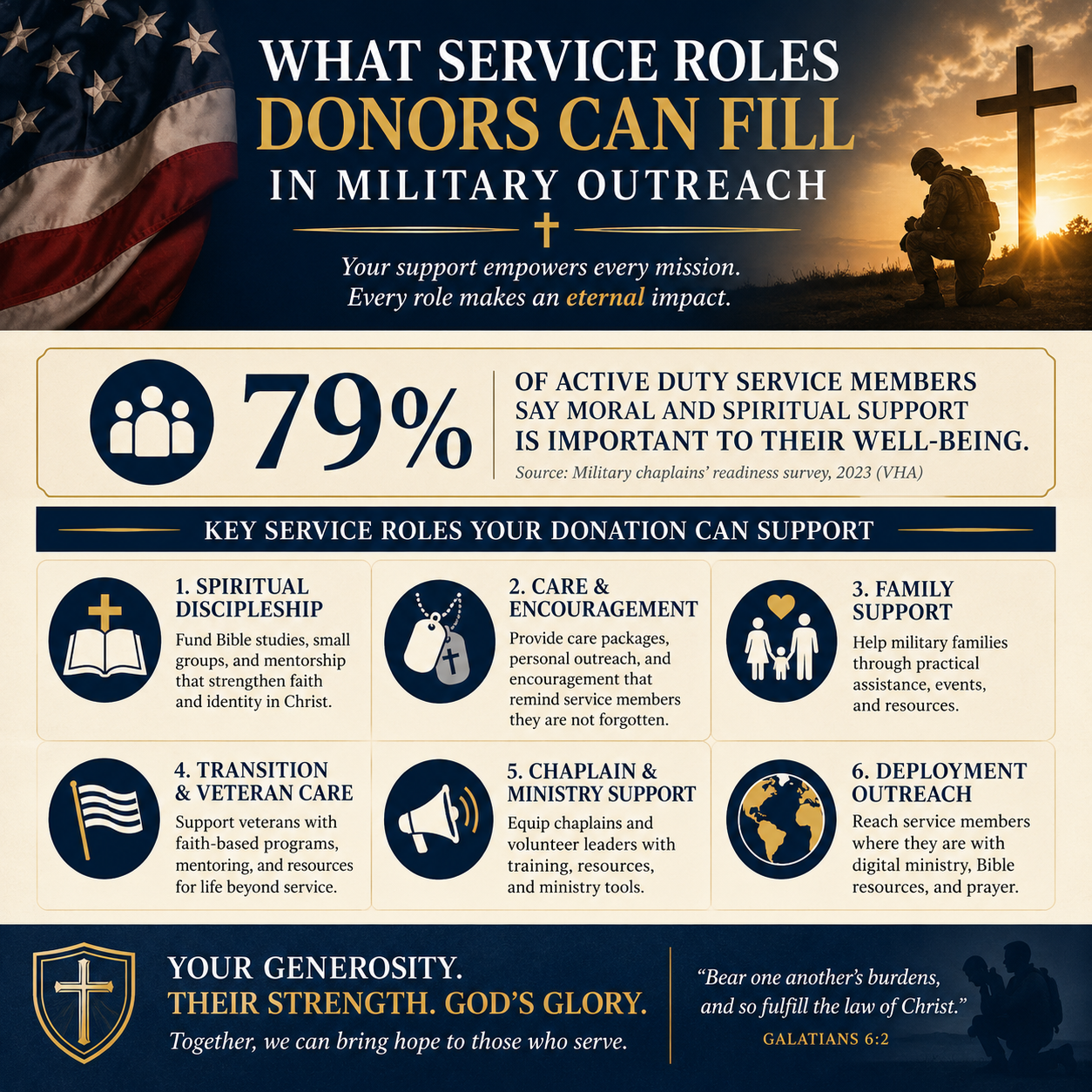
- Hospitality and home-front support for military spouses and children during deployments, coordinated through vetted local teams.
- Mentoring and life-skills coaching for transitioning service members, where expectations are clear and referrals to professional help are established.
- Chaplain support roles that provide logistical assistance for events, retreats, or resiliency programming without crossing into counseling.
- Peer community facilitation for small groups where confidentiality standards and referral pathways are formalized.
- Crisis-response coordination at the administrative level, supporting communication trees, meals, childcare coordination, and follow-up care.
Donors assessing these roles should ask whether the ministry trains volunteers in trauma awareness, mandatory reporting, confidentiality, and appropriate spiritual care. Where ministries operate on or near installations, donors should also expect an explicit commitment to comply with base policies and security requirements.
Behind-the-scenes roles that protect trust, safety, and stewardship
Operational excellence is a form of love of neighbor
Christian donors sometimes undervalue administrative service, yet Scripture repeatedly ties faithfulness to practical stewardship. Jesus’ teaching assumes accountable management (Luke 16:10). In military outreach, operational discipline also protects the vulnerable: mishandled data, poorly supervised volunteers, or informal financial practices can quickly erode trust.
Many ministries need skilled donors to serve in roles that are quiet but decisive: finance committee service, internal controls support, data privacy oversight, volunteer screening administration, or policy drafting. These roles rarely appear in newsletters, yet they are often the difference between a ministry that scales safely and one that eventually injures people through preventable failures.
Why donors should not equate low overhead with integrity
A recurring donor instinct is to pursue the lowest overhead ratio. The nonprofit field has had to reckon with how misleading that approach can be. The “Overhead Myth” letter—signed by GuideStar, BBB Wise Giving Alliance, and Charity Navigator—argues that overhead ratios alone do not measure nonprofit performance and can pressure organizations to underinvest in necessary infrastructure and evaluation Charity Navigator.
In military outreach, underinvestment in screening, supervision, and secure systems is not a virtue. It is a risk factor. Donors can fill service roles that normalize responsible infrastructure: serving on audit committees, helping implement secure donor and participant data practices, or funding and advising professional training for staff and volunteer leaders.
Specialized professional roles where expertise must be governed
Clinical, legal, and security-adjacent roles require formal safeguards
Some donors bring professional expertise that is genuinely scarce: mental health credentials, medical expertise, legal counsel, cybersecurity, or HR compliance. These contributions can be invaluable in outreach to military members experiencing PTSD, moral injury, family strain, or transition stress. Yet these are also the roles most prone to boundary confusion if not carefully governed.
Military-adjacent ministry should not treat clinical care as interchangeable with pastoral care, and it should not treat volunteer credentialing as a substitute for supervision. When a ministry invites a donor into a specialized professional role, donors should expect formal agreements, supervision structures, and clear lines between professional services and spiritual discipleship.
Discernment questions donors should press
Christians genuinely disagree about how ministries should integrate counseling models, trauma therapies, and spiritual formation. The disagreement is not inherently a red flag. The absence of clarity is. Donors can serve well by asking questions that force clarity without suspicion:
How do you define the difference between pastoral counseling and clinical counseling? What is your referral policy? Who supervises licensed professionals? How do you handle dual relationships and confidentiality? A ministry that answers these questions plainly is more likely to protect service members and families.
For donors seeking a broader view of this field, we track patterns and risk factors across Military Outreach Ministries as part of our verification work, with particular attention to safeguards that sustain trust over years rather than months.
Governance and accountability roles that strengthen credibility
Some of the most strategic service happens at the board level
Many donors are qualified to serve on boards or advisory councils, but military outreach boards require particular maturity. They must resist the temptation to collapse ministry into partisan identity, and they must insist on ethical fundraising, careful storytelling, and respectful engagement with military culture.
Good governance also requires a sober view of power. Service members—especially those junior in rank or in crisis—can be vulnerable to spiritual pressure, social pressure, and institutional pressure. Donors serving in governance roles should ensure that spiritual care is invitational, never coercive, and that services are not conditioned on participation in explicitly religious activities.
What accountability should look like for donors who serve
Accountability is not merely financial. It includes how outcomes are defined, how stories are told, and how leaders are evaluated. The U.S. Department of Veterans Affairs reports elevated suicide risk among veterans compared with non-veteran adults, underscoring the stakes for responsible care and referral networks U.S. Department of Veterans Affairs.
Donors can serve by helping a ministry articulate what “effectiveness” means in a spiritually faithful way that does not reduce people to metrics. They can also support evaluation that is honest about limits: discipleship outcomes are real, but they are not always quickly measurable; mental health outcomes can improve, but ministries should not claim clinical results without evidence.
Donors considering a service role should also understand what volunteer screening entails. The FBI notes the volume and purpose of fingerprint-based background checks in identity history summaries, a reminder that screening is a standard protective practice, not an expression of distrust Federal Bureau of Investigation.
For donors discerning where to serve, it can be helpful to compare volunteer expectations across Volunteering with Military Outreach Ministries, noting which organizations train volunteers, document supervision, and demonstrate transparent governance.
FAQs for What service roles donors can fill in military outreach
Should donors volunteer directly with service members, or stay in support roles?
Either can be faithful, but the role should match calling, competence, and the ministry’s safeguards. Direct-service roles require consistent availability, training in confidentiality and trauma awareness, and clear supervision. Support roles can be equally strategic when they strengthen screening, logistics, follow-up care, and financial integrity.
What should we look for before accepting a board or advisory role with a military outreach ministry?
We recommend confirming that the ministry has clear boundaries between pastoral care and clinical care, written policies for confidentiality and mandatory reporting, transparent financial reporting, and a governance culture willing to say no to unsafe or coercive practices. A healthy organization will welcome these questions and answer them without defensiveness.
A faithful service role is one you can sustain with integrity
Military outreach requires more than goodwill. It requires disciplined compassion: clear roles, protected confidentiality, accountable leadership, and a theology of service that treats each person as a neighbor rather than a narrative. Donors can fill service roles that make that kind of ministry possible, especially when they choose steadiness over visibility and governance over impulse.
When donors serve with appropriate boundaries, their giving and their labor converge into a single witness: a church that does not merely applaud sacrifice from a distance, but bears burdens in ways that are prudent, accountable, and faithful.



