
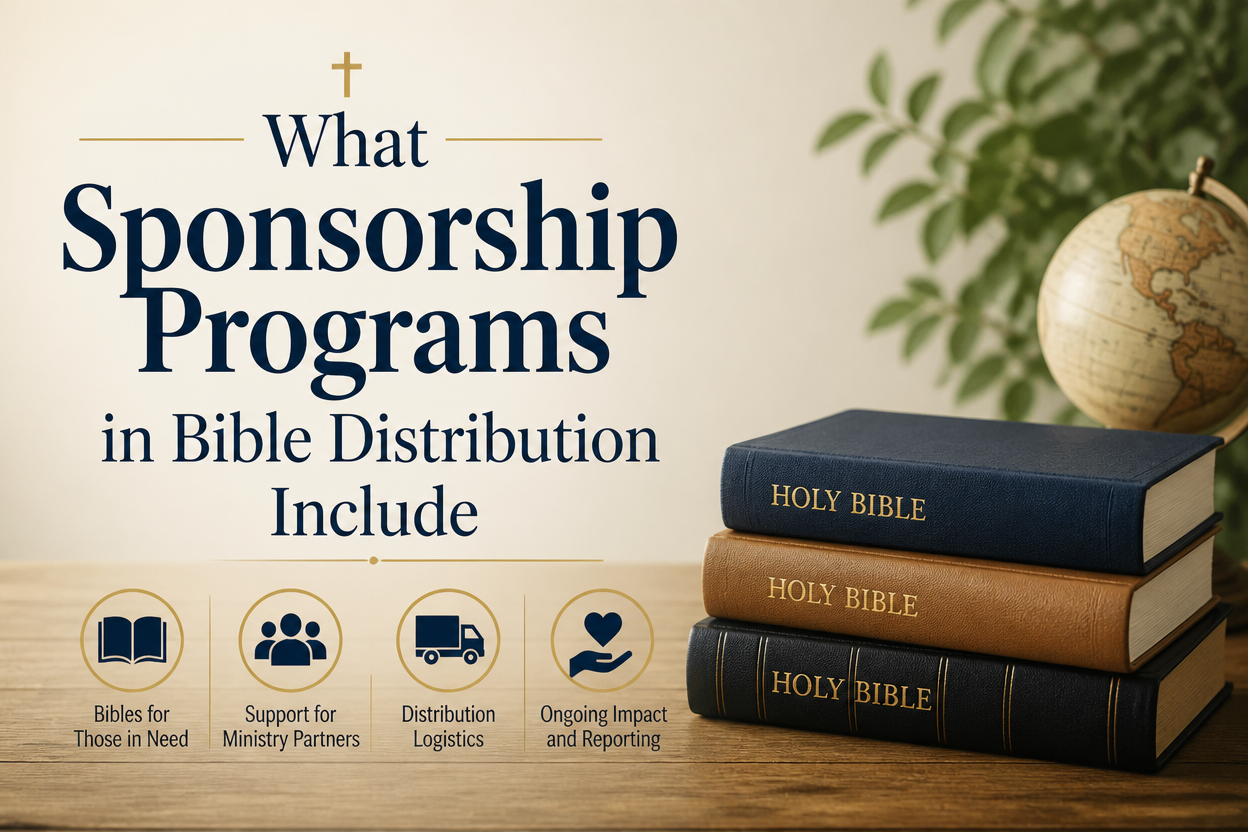
What sponsorship programs in Bible distribution include is rarely as simple as “a Bible for a person.” The best programs do more than fund printing; they carry Scripture across the last mile with integrity, local partnership, and clear proof that the Word actually arrived and is being used.
Christian donors often give to Bible distribution because they believe, with Scripture, that “faith comes from hearing, and hearing through the word of Christ” (Romans 10:17). That conviction is sound. The harder question is how a sponsorship structure translates a donor’s gift into faithful, transparent ministry without drifting into marketing claims that cannot be verified.
1 A sponsorship program is a funding model with spiritual claims attached
Sponsorship is not the same as a one time gift
A Bible distribution sponsorship program typically invites a donor into an ongoing relationship: a recurring gift, a defined outcome (Bibles delivered, New Testaments printed, audio devices deployed), and periodic reporting. That structure can be a strength because it stabilizes funding for translation, printing schedules, and logistics. It can also introduce pressure to over promise, especially when outcomes are framed as one sponsor to one recipient.
Across our verification work at Most Trusted, we see that strong ministries clarify what is and is not literally “sponsored.” Some sponsorships underwrite a share of a larger distribution campaign rather than assigning a specific individual. Others sponsor a discrete unit: a case of Scriptures, a literacy class that uses Scripture, or an audio Bible device. The defining feature is not sentimental proximity; it is verifiable stewardship.
The more precise the claim, the higher the documentation burden
A program that claims “your sponsored Bible went to Maria in village X” assumes a chain of custody that can be audited. If a ministry cannot responsibly maintain recipient level documentation, it should not make recipient level claims. Mature donors should treat that as a matter of truthfulness, not merely record keeping.
Healthy sponsorship programs also name the limits of measurement. The ministry can usually document printing counts, shipping manifests, warehouse records, partner receipts, and distribution event logs. It cannot guarantee spiritual fruit in any mechanistic way. Scripture itself makes that distinction: “I planted, Apollos watered, but God gave the growth” (1 Corinthians 3:6).

2 Most Bible distribution sponsorships fund a sequence of costs
Translation and publishing decisions shape downstream stewardship
Many donors picture sponsorship as paying for paper and ink. In practice, Bible distribution often depends on upstream work: translation, typesetting, licensing, and approvals with local church networks. Some ministries distribute public domain translations; others partner with Bible societies or publishers for specific versions, which introduces licensing or printing constraints. These choices are not merely operational. They affect readability, doctrinal alignment, and whether the local church recognizes the edition as trustworthy.
Where translation is involved, donors should look for credible processes: trained translators, consultant checks, and community review. The field has long relied on structured approaches to translation quality control, including the kind of multi stage review pioneered by major Bible translation organizations. The underlying principle is straightforward: accuracy is an act of love toward the church receiving Scripture.
Printing, shipping, and last mile delivery are often the largest variables
Physical distribution carries practical risks: customs delays, storage loss, diversion, and political volatility. Sponsorship dollars may cover any of the following: printing contracts, freight, inland transport, secure warehousing, partner grants, or local distribution events. Audio Bible sponsorships add device procurement, firmware management, battery replacement, and sometimes solar charging kits.
Even in sophisticated operations, last mile delivery is where plans break. When donors evaluate a ministry under Bible Distribution Ministries, the question is not whether obstacles exist, but whether the ministry plans for them, budgets for them, and reports candidly when they occur.
3 Strong programs pair distribution with church based access and use
Distribution without discipleship can become religious inventory
Christians genuinely disagree about how tightly Bible distribution should be integrated with discipleship programming. Some insist that the ministry’s calling is distribution and the local church will handle the rest. Others argue that handing out Bibles without training in reading, narrative context, and basic hermeneutics can leave recipients vulnerable to confusion or distortion.
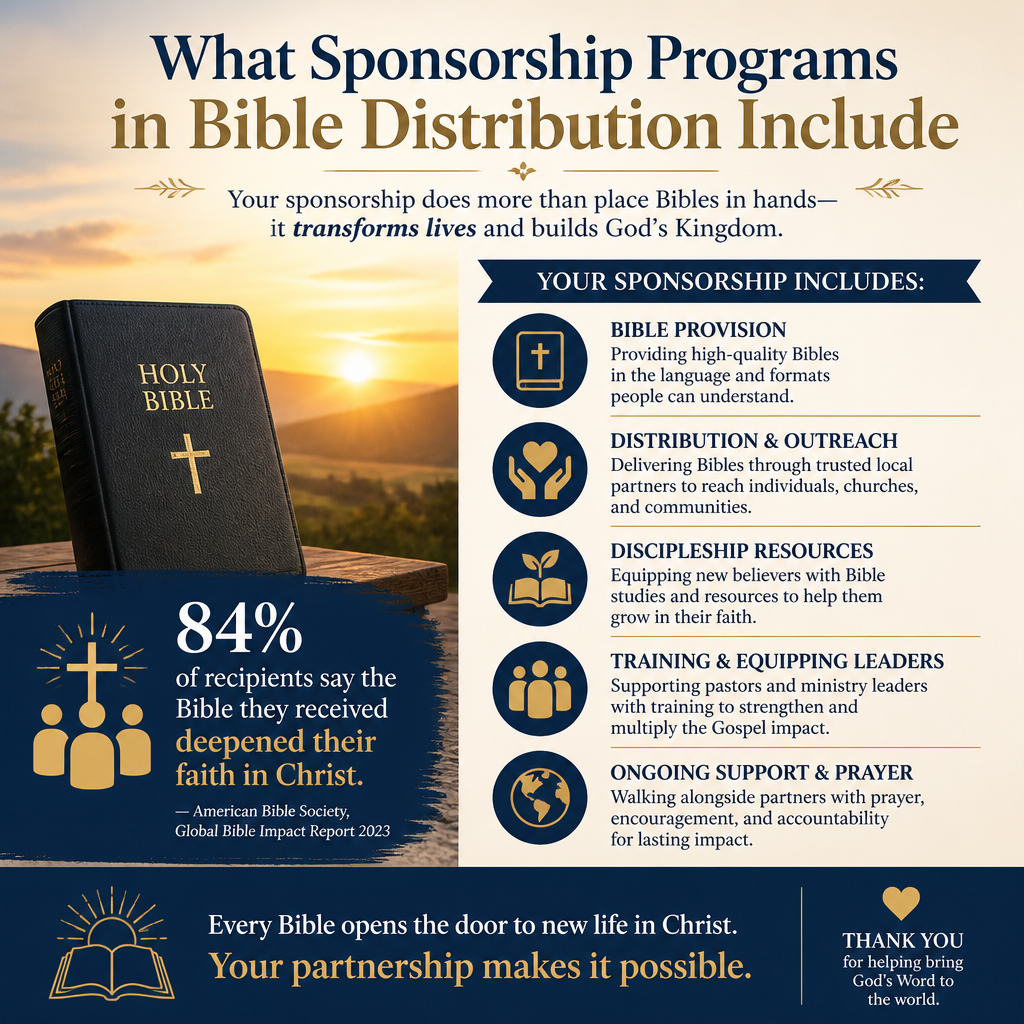
What this means in practice is that many sponsorship programs include more than materials. They may fund pastor training, small group curricula, literacy efforts that use Scripture, or follow up visits in partnership with local churches. The goal is not to control outcomes, but to support faithful use. Jesus’s Great Commission includes teaching, not only delivering content (Matthew 28:19–20).
Audio and digital strategies widen access and add new accountability questions
In oral cultures and low literacy contexts, audio Scripture can be a wise stewardship choice. Digital distribution can also be strategic where smartphones are common and physical shipment is restricted. Yet digital distribution brings different questions: how are downloads counted, how is repeat access measured, and how is user privacy protected, especially in restricted environments?
Donors should not dismiss digital reporting as “less real” than boxes of books. But donors should insist that ministries explain their methodology. A “download” is not the same as sustained engagement, and ministries that speak plainly about that difference tend to be more trustworthy over time.
4 Credible sponsorship includes honest reporting and disciplined restraint
What good reporting usually contains
Because sponsorship appeals can become emotionally charged, reporting is a primary test of integrity. The ministries that meet The Most Trusted Standard tend to provide reports that are specific enough to be checked and modest enough to be believed. They do not treat donors as a funding source to be managed; they treat donors as stewards who deserve truthful accounting.
A well governed sponsorship report commonly includes:
- What was funded and what was not funded, with clear definitions
- Counts tied to documentation such as print runs, shipment records, or partner receipts
- Geographic specificity that matches security realities
- Delivery timelines and any material delays
- Partner information, including church or network involvement, when appropriate
Financial credibility requires more than a low overhead narrative
Donors are often taught to equate faithfulness with the lowest administrative percentage. The sector itself has pushed back on that simplistic logic. The “Overhead Myth” statement from Charity Navigator, Candid, and BBB Wise Giving Alliance argues that overhead ratios alone are a poor measure of nonprofit performance and can harm organizational effectiveness Candid. For Bible distribution, under investing in controls can increase diversion risk and weaken reporting.
A stronger question is whether spending aligns with mission and safeguards: competent finance staff, appropriate audits, secure procurement, and governance that is independent enough to ask hard questions. Sponsorship programs should be evaluated within the broader stewardship system of the ministry, not as a standalone fundraising product.
5 Donors should test sponsorship programs against The Most Trusted Standard
Faithful intent does not remove the need for verification
Bible distribution is a sacred trust. It is also a supply chain and a set of claims about where resources went. Scripture commends wise stewardship and sober assessment. “It is required of stewards that they be found faithful” (1 Corinthians 4:2). Faithfulness includes truth telling, financial probity, and leadership integrity.
Most Trusted exists to help donors give with confidence by evaluating ministries against The Most Trusted Standard, a 15 criteria framework across Faith Foundation, Financial Integrity, Governance and Leadership, and Transparency and Effectiveness. The framework is not designed to reward clever storytelling. It is designed to surface whether a ministry can support its claims with evidence and whether its leadership culture is stable enough to steward sponsorship commitments over time.
Common risk areas mature donors should name directly
Across Bible distribution sponsorships, recurring risk patterns are recognizable. They do not mean a program is unfaithful; they mean a program needs stronger controls or more careful claims. Donors who care about the credibility of Christian witness should be willing to ask about these areas without cynicism.
Examples include: recipient assignment language that cannot be documented, heavy reliance on unverified partner reporting, restricted country claims without clear explanation of what can be verified, and fundraising materials that imply guaranteed conversions or church growth. These are not merely technicalities. They shape truthfulness, donor expectations, and the integrity of public Christian testimony.
Donors comparing sponsorship options often begin with programs listed under Sponsorship and Giving Programs for Bible Distribution. The decisive question is whether the ministry’s reporting, governance, and theology of stewardship match the weight of what it is asking donors to fund.
FAQs for What sponsorship programs in Bible distribution include
Does Bible sponsorship usually mean one donor equals one recipient?
Sometimes, but not always, and donors should not assume it. Many credible programs use “sponsorship” language to describe underwriting a portion of a broader distribution effort rather than assigning a named individual. The key is whether the ministry states the model clearly and can document distribution in a way that matches the claim.
What documentation should a donor reasonably expect from a sponsorship program?
At minimum, donors should expect clarity on what their gift funds, reporting tied to verifiable records such as print runs, shipments, and partner receipts, and candid disclosure of delays or access limitations. Recipient level documentation is appropriate only when the ministry can maintain a reliable chain of custody and protect recipients where security is a concern.
A sponsorship program is most credible when it is modest in claims and strong in proof
Bible distribution sponsorships can be a faithful way to place Scripture into the hands of people and churches who lack access. The programs that deserve a donor’s long term confidence are those that treat truth as sacred: they describe what is funded with precision, invest in governance and controls, and report with restraint rather than spectacle. That combination strengthens both stewardship and witness.



