

Sponsorship and giving programs for Bible distribution can be a faithful way to place Scripture into the hands of people who have little or no access. They can also become an arena where donor expectations, ministry communication, and theological convictions about stewardship collide. Mature Christian donors tend to ask the right question: not only whether Bibles are being sent, but whether the program design honors the dignity of recipients, tells the truth about impact, and handles restricted gifts with integrity.
Scripture commends purposeful generosity—planned, accountable, and directed toward spiritual good (2 Corinthians 8–9). Yet Scripture also warns against appearances without substance. When giving is mediated through sponsorship language, the ministry bears an added responsibility: to avoid sentimentalized claims, to communicate plainly about what a gift does and does not do, and to maintain financial controls that withstand scrutiny. Across our verification work at Most Trusted, the ministries that meet The Most Trusted Standard tend to treat donor trust as a form of stewardship, not a marketing asset.
Why Bible distribution sponsorship exists and what donors are actually buying
Many Bible distribution ministries use sponsorship because it makes an abstract problem concrete. “A Bible costs X” or “a family receives Y resources” gives donors a unit they can understand, budget for, and repeat. That clarity is not inherently manipulative. It becomes problematic when the unit is treated as a literal transaction that the ministry cannot truly guarantee—especially when supply chains, local church partners, or security constraints make one-to-one tracing impossible.
Sponsorship language should not outpace the ministry’s operational reality
In Bible distribution, real-world constraints matter: customs delays, shifting persecution risk, currency volatility, and the need to protect local believers. Donors should expect responsible ministries to say, without embarrassment, that programs sometimes pool gifts to meet needs across a region or across multiple distribution channels. That is not a defect; it is often the only way to operate safely and effectively. The ethical issue is whether the ministry’s language implies individualized fulfillment when the program functions as a shared fund.
Restricted giving is a theological and governance issue, not merely an accounting category
Christian donors often intend sponsorship gifts as restricted funds: “for Bibles,” “for a specific country,” or “for families.” The ministry’s obligation is to honor donor intent as far as it has been represented. That requires clear gift acceptance policies, board-level oversight of restricted fund handling, and procedures for what happens if a project becomes infeasible. A ministry that quietly reclassifies restricted gifts to general use, without disclosure, is not merely creating financial risk; it is eroding the moral seriousness of giving itself.
Sponsorship can be healthy when it strengthens local church distribution
Some of the best sponsorship and giving programs strengthen a local church’s ability to disciple new believers, not just distribute books. Bible provision and discipleship are not competitors. The question for donors is whether the ministry treats Bible distribution as an end in itself or as a means serving the Word’s ordinary path: proclamation, reading, catechesis, worship, and obedience within the Body of Christ. That is why many donors rightly ask how a ministry chooses partners, trains local leaders, and follows up after distribution.

What credible Bible distribution giving programs include
Christian donors have learned to look beyond emotive storytelling and ask for verifiable markers of integrity. In Bible distribution, those markers show up in program design, financial controls, security practices, and honest communication. Not every ministry can disclose the same details publicly, especially in hostile contexts. But every ministry can show that it is governed, audited, and accountable.
Clear definitions of what a gift accomplishes
A credible program defines what “providing a Bible” means. Is the gift funding translation, printing, shipping, local distribution, or all of the above? Does it include study helps, literacy tools, or discipleship materials? The ministry should be able to explain cost drivers without hiding behind “overhead” language. The sector has broadly recognized that simplistic overhead ratios are a poor proxy for effectiveness. The joint “Overhead Myth” statement by nonprofit evaluators made this case directly, arguing that administrative and fundraising costs can be necessary for impact and integrity https://www.charitynavigator.org/.
Donors should not demand a false precision. But donors should require honest boundaries: if a gift is pooled, the ministry should say so; if an average cost is used, the ministry should explain how that average is calculated and what it includes.
Financial integrity and controls that match the ministry’s claims
Because Bible distribution often involves international partners and in-kind goods, ministries face specific risks: double-counting in-kind contributions, weak inventory controls, and opaque pass-through grants. A credible program has a recognizable control environment: audited financial statements, board finance oversight, conflict-of-interest policies, and documentation for in-kind valuation. For donors who are serious about the stewardship of their capital, these are not secondary details.
Many donors also care about the broader trust environment of the nonprofit sector. Public confidence in charities has been under strain for years. Gallup has tracked historically low confidence levels in key institutions, including the nonprofit sector in some years https://news.gallup.com/. That context does not indict faithful ministries; it does mean transparent governance is now part of effective witness.
Safety, dignity, and the ethics of communication
In Bible distribution, dignity includes not exposing recipients or local partners to harm. Responsible ministries avoid publishing identifiable photos, names, or locations when that could endanger believers. They also resist the pressure to create “sponsor letters” or individualized profiles where the underlying relationship does not exist. Donors can receive meaningful reporting—regional updates, distribution totals, partner training progress—without turning recipients into content.
Christians genuinely disagree about how personal donor communication should be in missions-related giving. Some donors find individualized stories spiritually motivating; others find them ethically fraught. A credible ministry does not resolve that debate with sentiment. It resolves it with truthfulness, consent, and a documented safeguarding posture.
Common tensions donors face with family sponsorship, matching gifts, and church-based fundraising
Sponsorship programs are often where donors feel both the joy of generosity and the discomfort of uncertainty. That discomfort is not always cynicism; it is a recognition that funds can be restricted, promises can be implied, and administrative realities can be complicated. The stronger ministries build programs that can survive mature questions.
Family sponsorship gifts and the temptation to imply direct support
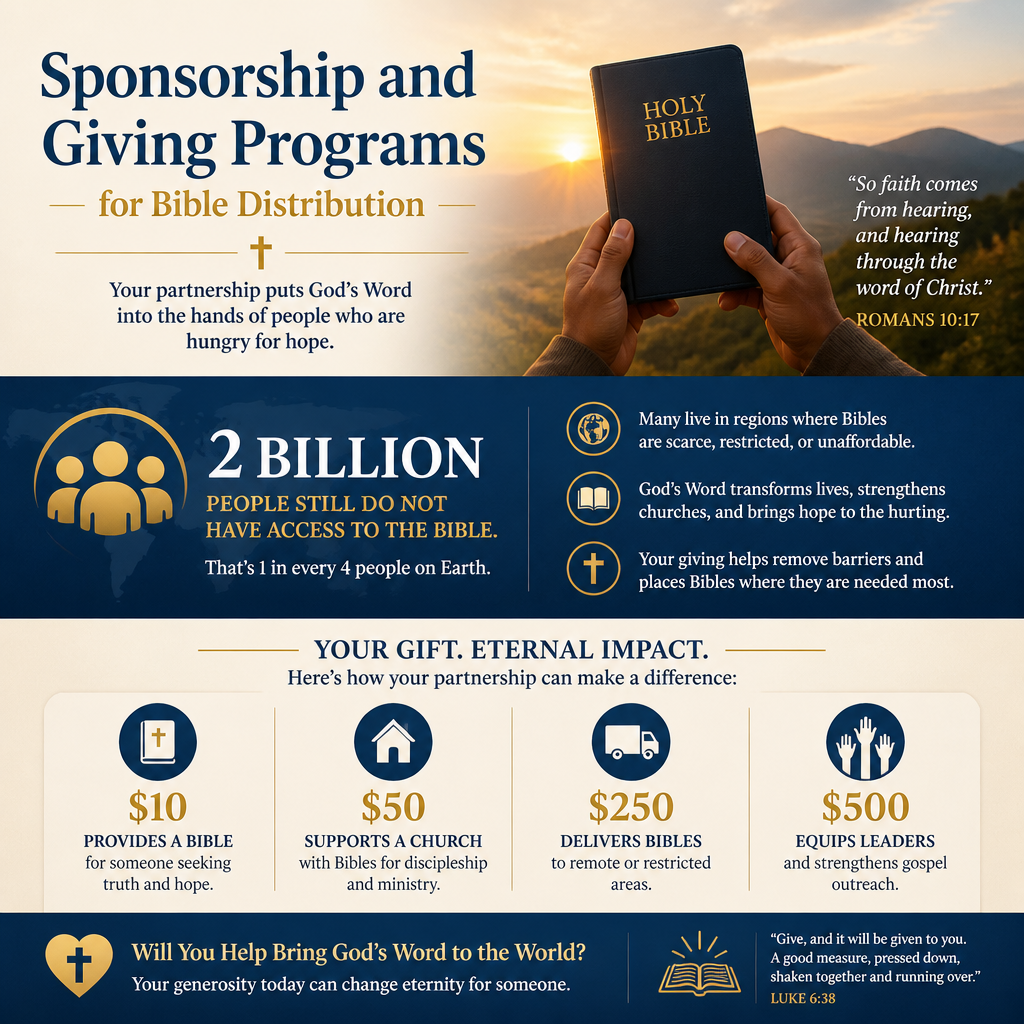
Some Bible distribution programs describe “sponsoring a family” or “adopting a village.” Donors should ask what, precisely, is being sponsored. If the program is actually funding Bible access through a local church or network, that can be excellent. The risk is language that implies direct cash transfer to a family, individualized tracking, or guaranteed receipt when the program is not structured that way.
A truthful approach might sound less emotionally satisfying, but it is ethically stronger: “Your gift supports Bible distribution and discipleship for households in this region, through vetted local partners.” That kind of statement honors donor intent without making promises the ministry cannot keep, and it respects recipients by refusing to commodify their need.
Matching gifts can multiply impact, but they also invite fuzzy claims
Matching gift campaigns can be legitimate. They can also create confusion. Donors should ask: Who is the matching donor? Is the match truly incremental, or is it a pledged gift that would have been given anyway? Is there a cap, a deadline, and a clear accounting method? When the match is real and incremental, it can catalyze participation without distorting truth.
Responsible ministries avoid implying that a match changes the effectiveness of the underlying work. A matched dollar is still governed by the same operational constraints: translation timelines, print runs, logistics, partner capacity, and security considerations. A match does not suspend reality; it only increases available funding.
Church-based fundraisers should reinforce ecclesial formation, not bypass it
Many donors encounter Bible distribution giving through church fundraisers: special offerings, youth group drives, or missions weekends. These can be fruitful when they teach believers to connect generosity to discipleship. They can also drift into competition and spectacle—especially when children are used to generate giving pressure, or when fundraising promises more certainty than the ministry can responsibly provide.
Church leaders can protect the moment by asking the ministry for straightforward language, by insisting on truthful reporting after the fundraiser, and by framing giving as worship rather than consumption. Scripture’s call is not merely to give, but to give as those who belong to Christ and will give an account (Romans 14:12).
How Most Trusted evaluates Bible distribution giving programs
Not every donor has time to parse audited statements, governance documents, and program disclosures. That is one reason Most Trusted exists. We evaluate ministries against The Most Trusted Standard, a 15-criteria framework that addresses faith commitments, financial integrity, governance and leadership, and transparency and effectiveness. The aim is not to replace donor discernment, but to strengthen it with verifiable evidence.
Questions we expect credible ministries to answer
- What exactly does a sponsorship gift fund? We look for precise program definitions and avoidance of misleading one-to-one claims.
- How are restricted gifts handled? We look for documented policies, appropriate accounting treatment, and disclosure of contingencies.
- What oversight exists? We look for active board governance, audited financials, and conflict-of-interest safeguards.
- How does the ministry report impact? We look for reporting that is meaningful, not inflated—distribution outputs placed within a broader account of discipleship, partner health, and contextual constraints.
Red flags that deserve careful scrutiny
Some patterns repeatedly correlate with donor disappointment and, in severe cases, with misrepresentation. These are not automatic verdicts, but they are signals to slow down and ask for documentation.
- Guarantees the ministry cannot reasonably control (for example, promising that a particular named family will receive a gift in a high-risk area).
- Vague accounting for pooled funds, especially when sponsorship language strongly implies individualized fulfillment.
- Inconsistent impact numbers across reports, newsletters, and financial disclosures.
- Defensiveness toward basic governance questions, such as board independence, audit availability, or executive compensation transparency.
Where to go next in evaluating Bible distribution ministries
Donors who want the broader context—how ministries translate Scripture, choose distribution partners, operate in restricted nations, and report outcomes—should situate sponsorship questions within the wider ecosystem of Bible work. We maintain ongoing analysis across Bible Distribution Ministries, with attention to the practical and theological realities that shape this field.
Giving that honors the Word and the donor’s trust
Sponsorship and giving programs for Bible distribution work best when they are modest in their claims and rigorous in their governance. The gospel does not require embellishment, and Christian donors should not have to choose between compassion and caution. When ministries tell the truth about what a gift does, protect recipients, and steward restricted funds with integrity, they treat donor trust as a sacred responsibility. That is the kind of giving environment that sustains faithful generosity over decades, not merely over a campaign cycle.



