

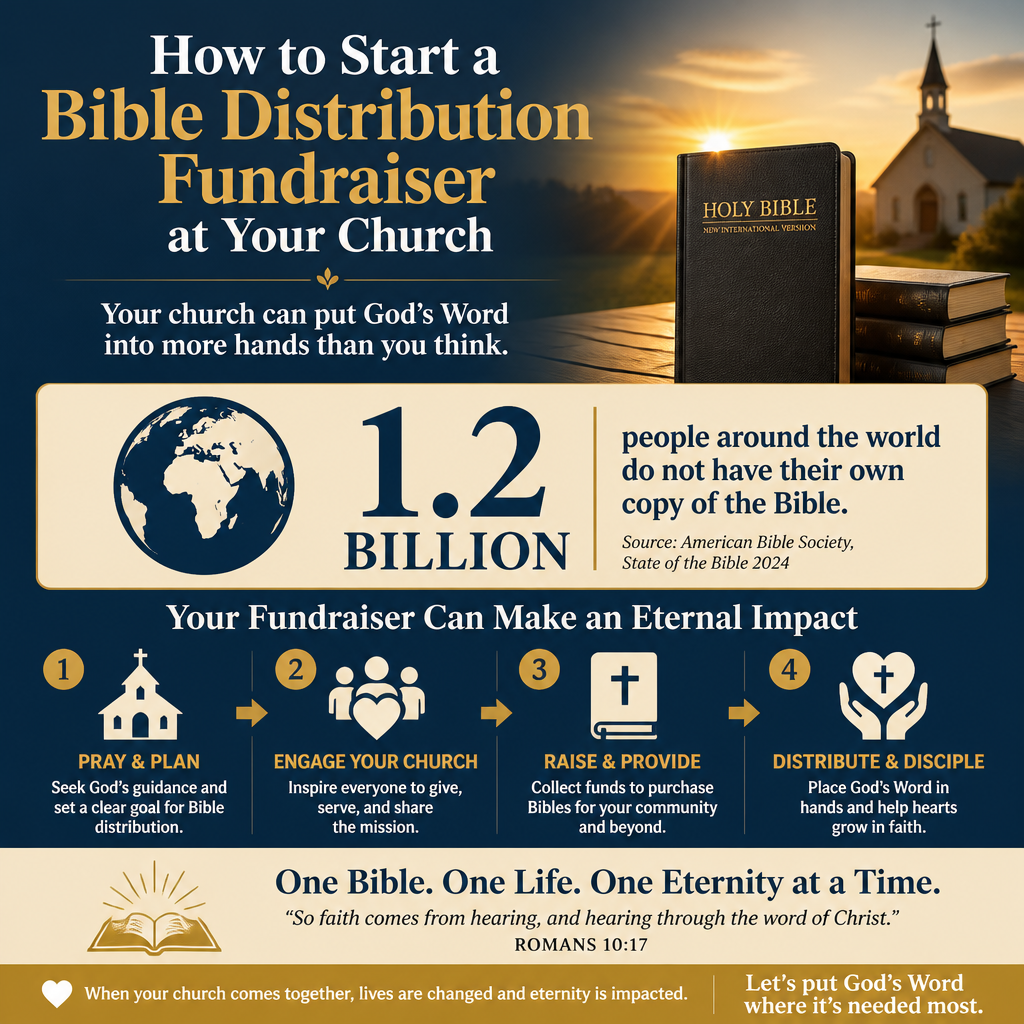
How to start a Bible distribution fundraiser at your church is not primarily a question of tactics. It is a question of stewardship: whether the church will fund the right work, in the right way, for the right reasons. Scripture is unembarrassed about the power of God’s Word to awaken faith and sustain endurance, and it is equally direct about the moral weight of how Christians handle money.
Yet Bible distribution is not a sentimental cause immune from hard questions. Christians genuinely disagree about the wisest forms of distribution, the role of local church structures, and how to measure fruit without turning Scripture into a metric. Mature donors should welcome that complexity. Fundraising done carefully can honor the Word, protect the church’s unity, and send resources to ministries that operate with integrity.
Begin with theology and a clear ministry claim
Anchor the fundraiser in the mission of the church
Bible distribution can serve evangelism, discipleship, pastoral care, literacy, prison ministry, and refugee ministry. Those are not interchangeable aims. A church fundraiser should state plainly what it is funding and why that aligns with the church’s vocation: making disciples, teaching obedience to Christ, and sustaining the ministry of the Word among those with limited access.
The New Testament pattern assumes the Word is proclaimed, taught, and embodied in a community. Funding Bibles without concern for translation quality, local language comprehension, or pastoral follow-up can become a token of concern rather than a form of spiritual care. The stronger claim is modest and verifiable: that providing faithful Scripture in a person’s language, coupled with local ministry, is a concrete act of love.
Define what counts as faithful distribution
Churches often underestimate the number of legitimate choices involved: translation philosophy, whether to distribute full Bibles or New Testaments, how to serve children and new readers, and how to avoid creating parallel systems that undercut local congregations. It is wise to name the principle guiding your choice, not only the project’s emotional appeal.
For churches that want a broader view of the field, we maintain editorial coverage of Bible Distribution Ministries, including recurring questions donors raise about scale, local partnership, and accountability.

Choose a partner ministry with verifiable integrity
Do not outsource discernment to a compelling story
Bible distribution organizations can be exemplary, and they can also be uneven. Some are theologically careful and operationally rigorous. Others are vague about what they print, where they distribute, and what safeguards govern money, procurement, and local partnerships. The church should treat this as a due diligence matter, not merely a marketing choice.
Across our verification work at Most Trusted, the ministries that meet The Most Trusted Standard tend to treat transparency as a spiritual discipline, not a concession to skeptical donors. They explain governance, disclose financials in intelligible terms, and offer credible descriptions of outputs and limits. Donors are not served by secrecy baptized as “faith.”
Use a short set of non-negotiables
Before your church announces any campaign, decide what you must be able to verify. A simple checklist prevents later embarrassment and protects donors who are giving in good faith.
- Doctrinal clarity: a clear faith foundation and alignment with historic Christian confession
- Translation and sourcing clarity: which translations, where printed, and why those choices
- Financial integrity: recent audited financials or strong financial review practices and clear revenue sources
- Governance and leadership: an accountable board, conflict-of-interest policies, and transparent leadership structure
- Transparency and effectiveness: credible reporting on distribution channels and what the ministry can and cannot measure
Churches often ask whether they should focus on “low overhead.” The sector has had to reckon with how that framing can mislead. The “Overhead Myth” letter, signed by GuideStar (now Candid), Charity Navigator, and the BBB Wise Giving Alliance, argued that overhead ratios are a poor proxy for effectiveness and can push nonprofits toward unhealthy reporting incentives Candid. A better question is whether financial decisions are coherent, governed, and transparent.
Build the campaign around trust, not pressure
Keep the church’s unity intact
Fundraising in a congregation always carries spiritual risk. Money can produce cynicism, competition, or quiet resentment, especially when people feel manipulated. A Bible distribution fundraiser should be marked by a tone of invitation rather than compulsion, and by careful protection of those with limited resources.
The New Testament commends generosity that is voluntary and proportionate, not coerced. It also assumes integrity in handling gifts. If your church is accustomed to benevolence or missions giving, treat this campaign as part of that established moral ecology rather than as a special exception that needs new rules.
Offer giving pathways that fit mature donors
Many Christian donors want more than a one-time emotional response. They want to understand what their gift does, how risks are managed, and how ongoing support will be communicated. Present tiers only if they correspond to real costs and are not artificially engineered to create guilt. If the partner ministry can responsibly explain cost drivers such as printing, shipping, local warehousing, customs, and training materials, donors will typically respect a candid account.
If you are collecting gifts through the church, communicate plainly how funds are handled, when they will be disbursed, and how donors will receive receipts. If you are sending donors directly to the ministry, clarify whether gifts are restricted to a project or given to general support, and what that means in practice. Restriction can protect intent, but it can also harm a ministry if it starves the operational capacity required to distribute well.
Design distribution goals that are honest about outcomes
Distinguish outputs from spiritual fruit
Counting Bibles is an output, not a proof of discipleship. Churches should avoid implying that distribution numbers equate to conversions, church growth, or revival. God’s Word does not return empty, but human reporting is limited and subject to incentives. A wiser posture is to celebrate faithful inputs and to seek credible indicators of responsible practice: distribution through accountable local networks, avoidance of black-market diversion, and thoughtful follow-up materials where appropriate.
Even in well-run programs, downstream outcomes are difficult to quantify. That does not excuse vagueness; it calls for careful definitions. Ask the ministry what it can measure without inflating claims. Trust grows when leaders resist the temptation to tell donors what they want to hear.
Use realistic timeframes and reporting
Logistics for Bible distribution can be slow: printing schedules, shipping constraints, customs delays, and local security concerns are real. When churches promise rapid impact, they often set up mistrust later. Mature donors can accept delay when leaders name it upfront and provide periodic, specific updates.
We also recommend establishing from the start what your church will receive in reporting and when. Churches should not accept a post-campaign silence. Clear expectations are part of honoring the gift.
Execute the fundraiser with disciplined communication
Make the ask specific and the follow-through meticulous
A disciplined campaign typically includes three moments: a clear announcement that names the purpose and partner, a defined giving window, and a final report that accounts for funds and early results. The report should include the total raised, the date and method of disbursement, and any administrative costs the church retained (ideally none, unless clearly communicated in advance).
Church donors have learned, sometimes painfully, that good intentions do not prevent financial confusion. A simple internal control practice helps: two-person counting, written deposit logs, and board-level oversight for restricted gifts. These are not secular intrusions; they are ordinary expressions of honesty.
Invite deeper engagement without turning donors into spectators
Some churches want to add an educational component: a Sunday evening forum on translation work, a missions update from local partners, or a class on stewardship and generosity. That can be fruitful when it serves formation, not spectacle. Churches should be cautious about promoting “distribution trips” that unintentionally center outsiders, especially in contexts where local pastors and believers are already carrying the work with far greater cost.
For churches that want to situate Bible distribution giving within broader, accountable patterns of generosity, our coverage of Sponsorship and Giving Programs for Bible Distribution addresses common donor questions about restricted gifts, recurring support, and trustworthy reporting.
FAQs for How to start a Bible distribution fundraiser at your church
Should our church collect the funds or send donors directly to the ministry?
Either can be appropriate, but the decision should be made for accountability rather than convenience. If the church collects funds, it must manage receipting, internal controls, and clear disbursement timing. If donors give directly to the ministry, the church should still complete due diligence and communicate whether gifts are restricted or unrestricted. The best practice is whichever option produces clearer stewardship and fewer misunderstandings.
How do we evaluate a Bible distribution ministry if outcomes are hard to measure?
Start with what can be verified: doctrinal clarity, translation and sourcing transparency, governance, financial reporting quality, and credible descriptions of distribution channels and safeguards. Then ask for honest limits: what the ministry does not claim to know, and how it avoids overstating fruit. Across our work at Most Trusted, ministries that meet The Most Trusted Standard tend to offer this kind of disciplined candor, which is often a stronger indicator of integrity than impressive numbers.
A fundraiser that honors the Word and protects the giver
A church can raise money for Bible distribution in a way that strengthens faith rather than weakening trust. The path is not complicated, but it is demanding: theological clarity, verifiable integrity, restrained claims, and careful financial practice. When churches take those requirements seriously, donors are free to give with confidence, and the ministry of the Word is served without unnecessary scandal.



