
What questions donors should ask about orphan care finances is not a secondary matter for Christians; it is a test of whether our compassion is governed by truth. Scripture binds together mercy and integrity. The same God who commands, “Defend the cause of the fatherless” also condemns dishonest weights and measures, because exploitation often hides behind religious language.
Orphan care is a category where financial questions carry unusually high moral stakes. The field has had to reckon with uncomfortable realities: institutional care can be more fundable than family strengthening, dependency can be easier to photograph than long-term healing, and good intentions can subsidize structures that separate children from family. Donors do not have to become forensic accountants to give responsibly, but we do have to ask the questions that protect children and honor the church’s witness.
Start with the child and work backward to the budget
What definition of orphan and vulnerable child is the ministry using
A foundational financial question is also a definitional one: whom is the ministry counting, and why? In many contexts, “orphan” is used as a fundraising category that does not match the child’s actual family situation. Global child-welfare literature has repeatedly documented that many children in residential institutions have at least one living parent or extended family who could potentially care for them with appropriate support. The donor question is not, “Is the ministry lying,” but, “What is the ministry’s operational definition, and what safeguards keep financial incentives from driving family separation?”
We recommend asking for clarity on intake pathways. Who refers children, what due diligence is required, and what documentation is collected? If the ministry cannot articulate a written process for preventing unnecessary separation, the financial model may be quietly shaping program decisions.
How does the ministry decide between residential care and family based care
Christians genuinely disagree about the place of residential care in contexts where foster systems are limited, where children have acute disabilities, or where family networks have collapsed. Yet the direction of mainstream child-welfare policy is clear: family-based care is generally preferred, and institutions should be a last resort. UNICEF’s guidance emphasizes that poverty alone should never be a reason to separate a child from parents, and that strengthening families is a core protective strategy for children UNICEF.
Ask the financial question that follows: what percentage of the budget is committed to reintegration, kinship care support, foster care development, or family preservation? A ministry can operate a residential program while still structuring finances toward family outcomes; the budget will reveal whether that intention is real.

Follow the money into incentives and constraints
What revenue streams create pressure to keep beds full
In orphan care, the hardest integrity questions often arise from incentives rather than from explicit fraud. Child sponsorship models, for example, can create a structural pressure: when the donor expectation is tied to a particular child “in the home,” the organization may be reluctant to celebrate reunification, because reunification reduces the inventory of compelling stories. This does not mean sponsorship is inherently wrong; it means donors should require a model that can rejoice in family restoration without financial penalty.
Ask directly: if a child is reunified, does the donor funding continue in some form to support the family’s stability, education, or follow-up care? If the answer is no, the ministry should be able to explain how it avoids the temptation to retain children for revenue.
How does the ministry handle restricted gifts and designated sponsorship funds
Many donors assume restricted gifts always increase accountability. In practice, heavy restriction can force ministries into artificial accounting that obscures real costs, or it can distort operations so that “fundable” line items grow while less visible needs go unmet. A mature organization can explain how it tracks restricted funds, how it allocates shared costs, and how it ensures donor designations do not override the best interests of children.
The ministries that meet The Most Trusted Standard tend to treat restriction as a stewardship responsibility, not as a marketing device. They will explain their policies in plain language, align designations with real program units, and provide documentation that an independent auditor would recognize as coherent.
Evaluate financial integrity without worshiping overhead ratios
Is there an independent audit and what does it actually cover
For many donors, the most basic question is still the most revealing: does the organization undergo an independent financial statement audit, and is the audit firm reputable and truly independent? An audit is not a guarantee of virtue, but it is a meaningful discipline. Ask for the most recent audited financial statements, not just a summary, and ask whether there were any material weaknesses or significant deficiencies identified in internal controls.
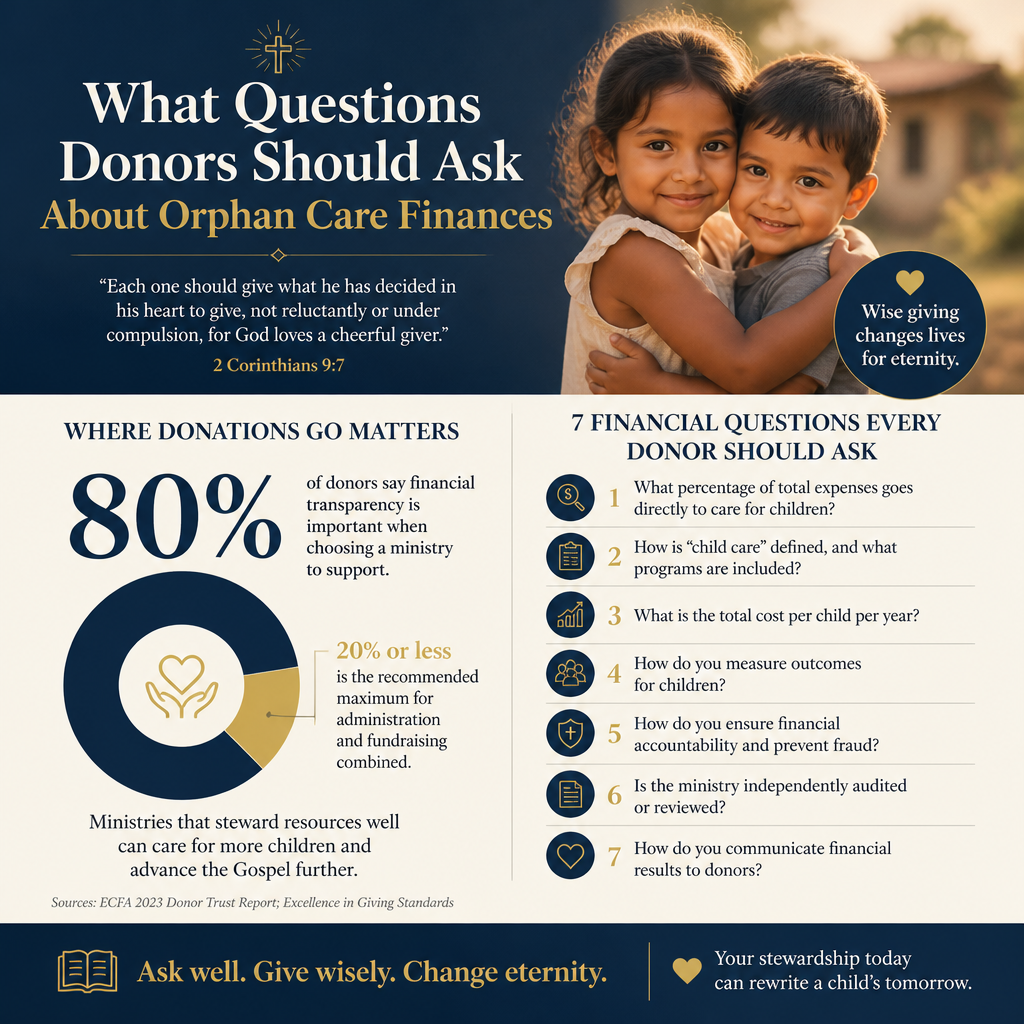
Also ask what parts of the operation are included. In cross-border orphan care, funds often move through multiple entities: a U.S. charity, foreign affiliates, implementing partners, or local ministries. Donors should ask whether the audit consolidates related entities or whether substantial activity sits outside the audited scope.
What is the ministry doing to avoid the starvation cycle
Christian donors have been trained to celebrate low overhead, but the sector has increasingly recognized that underinvestment in administration can become a form of fragility. The “nonprofit starvation cycle,” described by Ann Goggins Gregory and Don Howard, names the pattern where funders pressure organizations to keep overhead artificially low, resulting in weak systems and poorer outcomes Stanford Social Innovation Review.
Ask questions that honor both prudence and realism: Are staff paid fairly enough to retain competent social workers and caregivers? Is there budget for training, safeguarding, and monitoring? Are technology and financial controls treated as mission-critical rather than as embarrassing necessities? Financial integrity in orphan care often requires investment.
- What percentage of costs are direct child care versus casework and family reintegration services?
- What safeguarding and child-protection costs are budgeted annually?
- How are shared costs allocated across programs and countries?
- What reserves exist, and what is the policy for using them?
- How is staff training funded and tracked over time?
Ask whether spending aligns with safeguarding and the ministry’s theology
How are child protection policies funded and enforced
Orphan care ministries carry heightened safeguarding obligations because children without stable family advocates are at increased risk of abuse. Donors should treat safeguarding as a financial question, not merely a policy question. Ask whether the ministry budgets for background checks where legally possible, training, incident reporting systems, independent investigations when needed, and regular audits of safeguarding practice.
In U.S.-based operations, donors can also consult publicly available information on the scale of child maltreatment and the importance of protective systems. The U.S. Department of Health and Human Services publishes annual reporting on child maltreatment, which underscores how common harm is when systems are weak U.S. Department of Health and Human Services. The point is not to cast suspicion on every ministry; it is to remember that protection requires funded systems.
Does the ministry’s financial model reflect a Christian view of the child
Scripture speaks of children not as projects but as image-bearers entrusted to our care. That theological conviction should shape financial decisions: staffing ratios, caregiver stability, education quality, medical care, and the patience required for family reunification. Donors should ask whether budgets reflect the ministry’s stated commitments or merely its fundraising narratives.
Across our verification work at Most Trusted, we observe that organizations with the strongest theological foundations tend to resist sensationalism in both storytelling and spending. They are willing to fund the slow, costly work that restores family systems, even when it produces fewer dramatic photos and more quiet faithfulness.
Require transparency that a serious steward can verify
Can the ministry show program level financials and credible outcomes
Transparency is not the same as volume. A ministry can publish glossy annual reports and still leave donors unable to answer basic questions. Ask for program-level financial reporting that connects dollars to specific activities: family tracing, reunification support, foster care development, caregiver training, education partnerships, or disability services.
Outcomes also need to be commensurate with the mission. For family-based strategies, ask for reunification rates, stability follow-up, school retention, and safeguarding indicators. For residential care, ask about length of stay, transition planning, caregiver continuity, and independent child-protection monitoring. Not every outcome will be easily quantifiable, but a serious ministry will have defined measures and will acknowledge limitations without defensiveness.
How does the ministry communicate trade offs and respond to critique
Orphan care has undergone significant debate, including critiques of institutionalization, short-term volunteer models, and fundraising practices that unintentionally reward harmful systems. The question for donors is not whether a ministry has faced hard questions; it is whether leadership can engage them with humility and evidence.
When donors want broader context on how ministries handle donations in this space, our coverage of How Orphan Care Ministries Use Donations is designed to help donors ask better questions without assuming bad faith. For a wider view of what faithful, verifiable practice can look like across the field, see Orphan Care Ministries.
FAQs for What questions donors should ask about orphan care finances
Is it wrong to support an orphanage if it is the only option in a community
Not necessarily. Some contexts lack functional foster systems, and some children have needs that require intensive care. The donor responsibility is to ask whether residential care is treated as a last resort, whether family tracing and reintegration are funded and pursued, and whether safeguarding systems are strong. A ministry can provide temporary residential care while still orienting its finances toward family-based outcomes.
What financial documents should a responsible orphan care ministry provide
At minimum, donors should expect recent audited financial statements if the organization is large enough to warrant an audit, a current Form 990 for U.S. nonprofits, and clear explanations of how restricted gifts are handled. For cross-border work, donors should also ask how funds are transferred, what controls exist over foreign partners, and whether reporting connects spending to specific child-welfare activities and outcomes.
Stewardship that protects children and honors the church
The questions donors should ask about orphan care finances are not designed to paralyze generosity. They are designed to ensure generosity does not subsidize incentives that harm children. Christian giving is meant to be both compassionate and ordered, grounded in truth, accountable in practice, and attentive to the real lives behind the stories.
Most Trusted exists to help donors give with confidence by evaluating ministries against The Most Trusted Standard, a 15-criteria framework that treats faithfulness, financial integrity, governance, and transparency as inseparable. In orphan care, that inseparability is not theoretical; it is often the difference between funding a child’s restoration and funding a system that quietly keeps restoration out of reach.



