

How pastoral support ministries handle confidential pastor care is not a secondary operational detail. It is the moral center of the work. A pastor in crisis will rarely seek help if the cost is exposure, and a donor should not fund systems that depend on secrecy while lacking accountable safeguards. Christian ministry is called to walk in truth; it is also called to protect the bruised reed (Isaiah 42:3). Mature confidential care holds both.
For donors, the question is not whether confidentiality matters. It is whether a ministry’s confidentiality practices are strong enough to protect pastors and their families, clear enough to prevent misunderstandings, and accountable enough to resist the misuse of secrecy. Across our verification work at Most Trusted, we observe that the healthiest pastor-care ministries treat confidentiality as a formal discipline, not a reassuring promise.
Confidentiality is pastoral ethics, not public relations
Why pastors are uniquely exposed
Pastors live in a high-visibility vocation. Their livelihoods often depend on congregational trust, and their marriages and children can be pulled into the public square of church life. Confidentiality therefore functions as a form of protection for the vulnerable, not as a perk for leaders. The aim is not to shield sin from consequences, but to create a safe doorway into repentance, treatment, restoration, or, when necessary, a carefully governed exit from ministry.
The stakes are not theoretical. Many pastors report significant stress and isolation, and some leave ministry under the weight of burnout, conflict, or moral injury. Donors may see this only after a public collapse. Proper confidential care is designed to intervene earlier, when a pastor is still reachable.
The biblical tension that must be named
Scripture holds together confession and discretion. “Confess your sins to one another and pray for one another, that you may be healed” (James 5:16) is not a command to broadcast; it is a command to seek honest help in a context ordered toward healing. At the same time, “Whoever goes about slandering reveals secrets, but he who is trustworthy in spirit keeps a thing covered” (Proverbs 11:13) commends restraint and faithfulness with private information.
Christian donors sometimes fear that confidentiality becomes a mechanism for institutional self-protection. That concern is warranted in some historical cases. The answer is not to abandon confidentiality, but to insist on clear boundaries: confidentiality for care, transparency for governance, and reporting for credible allegations and legal obligations.

Sound confidential care begins with defined boundaries and informed consent
Clarity at the start prevents harm later
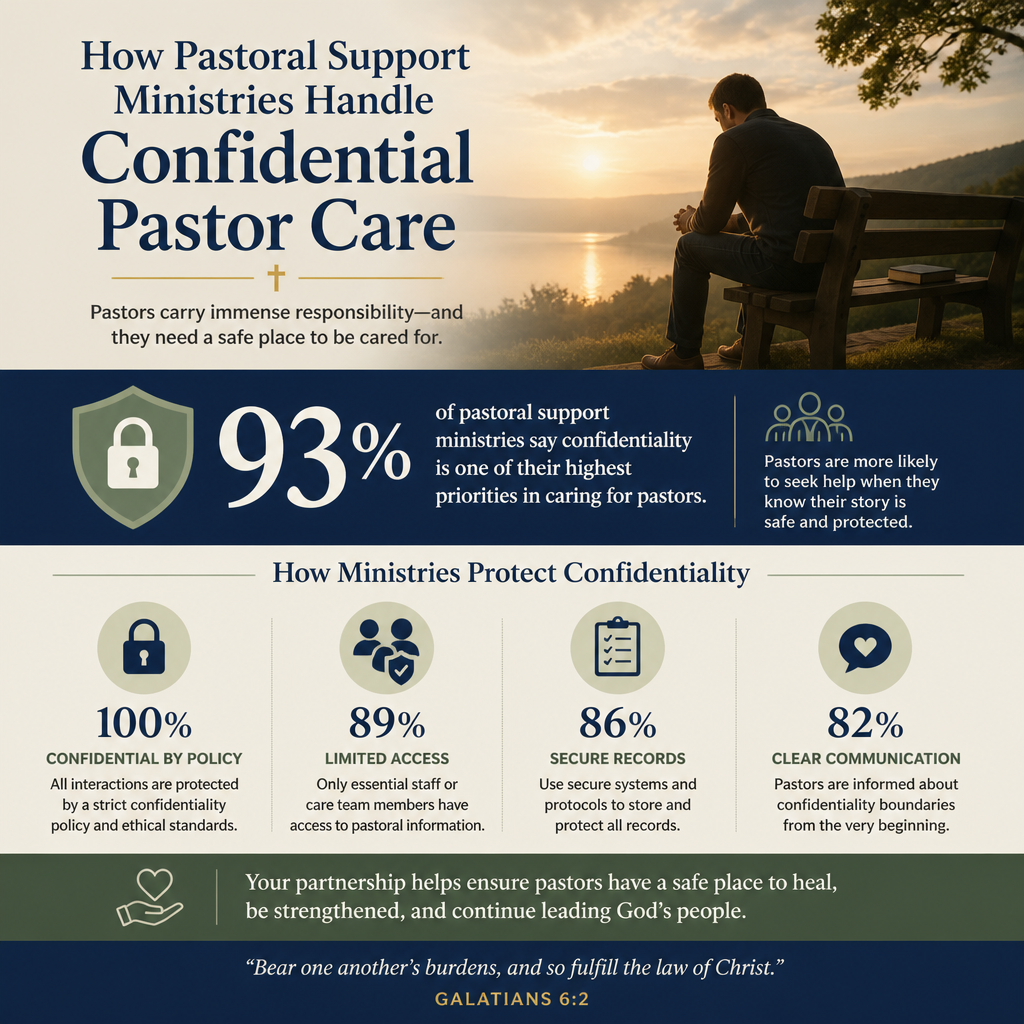
The most responsible pastoral support ministries explain confidentiality before care begins. They do not rely on implied expectations. They provide written policies, plain-language explanations, and explicit consent from the pastor or couple receiving care. Donors should expect this because vague promises can become coercive: a pastor may disclose under the assumption of privacy, only to learn later that staff interpret “confidential” differently.
In practice, strong ministries define what is confidential, who has access to information, how records are stored, and under what conditions information is shared. They also distinguish between spiritual counsel, coaching, and clinical counseling, because each carries different ethical and legal norms.
Mandatory reporting and safety exceptions are not optional
Confidentiality is never absolute. Any credible ministry will state its exceptions up front, including threats of self-harm, threats of harm to others, and allegations that trigger mandatory reporting laws (often including child abuse). Donors should not penalize ministries for having these exceptions; they should be wary of ministries that do not.
When a ministry offers licensed clinical counseling, it should also follow professional standards such as HIPAA-related privacy practices and the ethical codes of relevant licensing boards. When it is not a clinical provider, it should still adopt rigorous privacy and recordkeeping disciplines appropriate to the sensitivity of the information.
Confidentiality requires systems, not personalities
Role separation protects both the pastor and the ministry
Pastors often seek care from people they already know. Familiarity can lower the barrier to asking for help, but it can also increase the risk of gossip, conflicts of interest, or blurred boundaries. Strong pastoral support ministries anticipate this by separating roles. The person offering care should not be the person responsible for fundraising, promotional storytelling, or denominational discipline.
This is where donors can learn to ask better questions. Who can access the pastor’s file? Does the ministry have a written conflict-of-interest policy? Does a supervisor review care practice without reviewing identifying details? The point is not to mistrust staff; it is to reduce the temptation to misuse knowledge under pressure.
Data stewardship is a spiritual responsibility
Confidential pastor care produces some of the most sensitive records in Christian ministry: marital disclosures, addiction histories, trauma narratives, and suicidal ideation. Ministries that treat documentation casually are taking a moral risk. Secure storage, limited access, retention schedules, and careful deletion are part of neighbor-love in a digital age.
Donors who want a deeper view of how organizations build trustworthy systems will often find it helpful to review the broader landscape of Pastoral Support Ministries with an eye for governance and documented practice rather than stated intentions.
Accountability without exposure is possible, but it must be designed
Boards should govern the system, not the stories
A common donor fear is that confidentiality prevents oversight. In reality, mature organizations do oversight differently: boards and external reviewers evaluate policy, training, caseload boundaries, financial controls, and incident-response processes without requiring identifying details about a pastor’s life. They can ask whether staff are supervised, whether referrals are appropriate, and whether safety protocols were followed, while still protecting the pastor’s identity.
This distinction matters because Christian donors rightly expect accountability. Scripture’s warnings about partiality, secrecy used for self-protection, and leaders who prey on the flock are not abstract (Ezekiel 34). A ministry that says “trust us” while resisting any external review is asking donors to fund an environment where harm can multiply unseen.
When transparency is required, the ministry should not improvise
Some situations require disclosure to others: credible criminal allegations, imminent safety threats, or formal investigations by a church or denomination. The question is not whether disclosure can happen, but whether it happens with integrity and restraint. Responsible ministries have pre-written protocols for:
- Responding to allegations of abuse or criminal conduct, including mandatory reporting when applicable
- Coordinating with a pastor’s church leadership only with informed consent, unless safety or legal duties override
- Documenting decisions and the rationale for any disclosure
- Referring to independent investigators or licensed clinicians when the case exceeds the ministry’s competence
- Preventing retaliation against spouses, staff, or whistleblowers
The donor implication is straightforward: confidential care is not incompatible with accountability, but it does require disciplined governance and a sober understanding of risk.
What donors should look for when funding confidential pastor care
Signals of a trustworthy care model
Christian donors often want to support pastors without unintentionally underwriting dysfunction. The most reliable approach is to look for verifiable practices and clear documentation. Ministries aligned with The Most Trusted Standard tend to provide evidence in four areas: a Christian moral framework that shapes care, credible financial controls, governance that resists conflicts of interest, and transparent communication about what they do and do not promise.
Practically, donors can ask a ministry to provide its confidentiality policy, its exception list, its recordkeeping approach, and its supervision model. If a ministry says it cannot share anything at all because of confidentiality, that response confuses client privacy with institutional opacity. Confidentiality protects pastors; it should not prevent donors from evaluating whether basic safeguards exist.
Questions that respect both compassion and prudence
We recommend donors consider questions such as:
- Is care delivered by licensed clinicians, trained pastoral counselors, peer coaches, or a mix, and are roles clearly defined?
- What are the stated limits of confidentiality, and are they provided in writing before care begins?
- How is clinical supervision or case consultation handled without compromising identity?
- What is the process for responding to allegations of abuse, including reporting and referral?
- Does the ministry have policies that prevent fundraising or marketing staff from accessing care records?
For donors focusing specifically on counseling and crisis response, Pastoral Support Ministries for Counseling and Crisis Care is a useful context for comparing models, especially where ministries combine spiritual care with clinical services.
FAQs for How pastoral support ministries handle confidential pastor care
Should a donor avoid ministries that promise complete confidentiality?
We recommend caution. Complete confidentiality is rarely truthful, because most jurisdictions impose mandatory reporting in certain circumstances, and credible ministries will also reserve the right to act when there is imminent risk of harm. A responsible ministry will articulate confidentiality as a strong default with clearly defined exceptions, provided in writing.
How can a ministry be accountable if it cannot share stories or outcomes?
Accountability does not require identifying details. A ministry can publish policies, governance practices, financial statements, safeguarding protocols, and aggregated reporting that does not expose pastors. Donors can also look for independent verification, external audits where appropriate, and board oversight focused on system integrity rather than private narratives.
Confidential care is credible when it is both protective and accountable
Pastors need places where they can speak truth without fear, seek help without losing their livelihood overnight, and face sin and suffering under the light of the gospel. Donors, in turn, need confidence that confidentiality is not being used as cover for poor governance or avoidable risk. The ministries most worthy of support build confidentiality into their operating system: clear boundaries, disciplined documentation, qualified care, and accountability that protects the vulnerable while refusing secrecy as a substitute for truth.



