
Asking the right questions donors should ask pregnancy resource centers is not suspicion dressed up as diligence. It is Christian stewardship applied to a ministry category that carries moral weight, public scrutiny, and deep personal vulnerability for the women and families it serves. If we give in the name of Christ, we should be able to explain what we funded, how it was governed, and whether it treated people as image-bearers rather than as projects.
Pregnancy resource centers sit at a contested intersection. Christians genuinely disagree about public policy, medical regulation, and the boundaries between evangelism and social services. But Scripture is not ambiguous about integrity. “We aim at what is honorable not only in the Lord’s sight but also in the sight of man” (2 Corinthians 8:21). The work is too important for vague assurances, and donors should not accept them.
1. Begin with clarity about mission and what services are actually provided
Pregnancy resource centers often describe themselves in overlapping terms: “clinic,” “medical center,” “resource center,” “life-affirming ministry,” “family support.” Those labels can signal real differences in staffing, licensing, and scope of practice. The first donor responsibility is to understand what the center actually does, not only what it intends.
Ask what the center does and does not offer
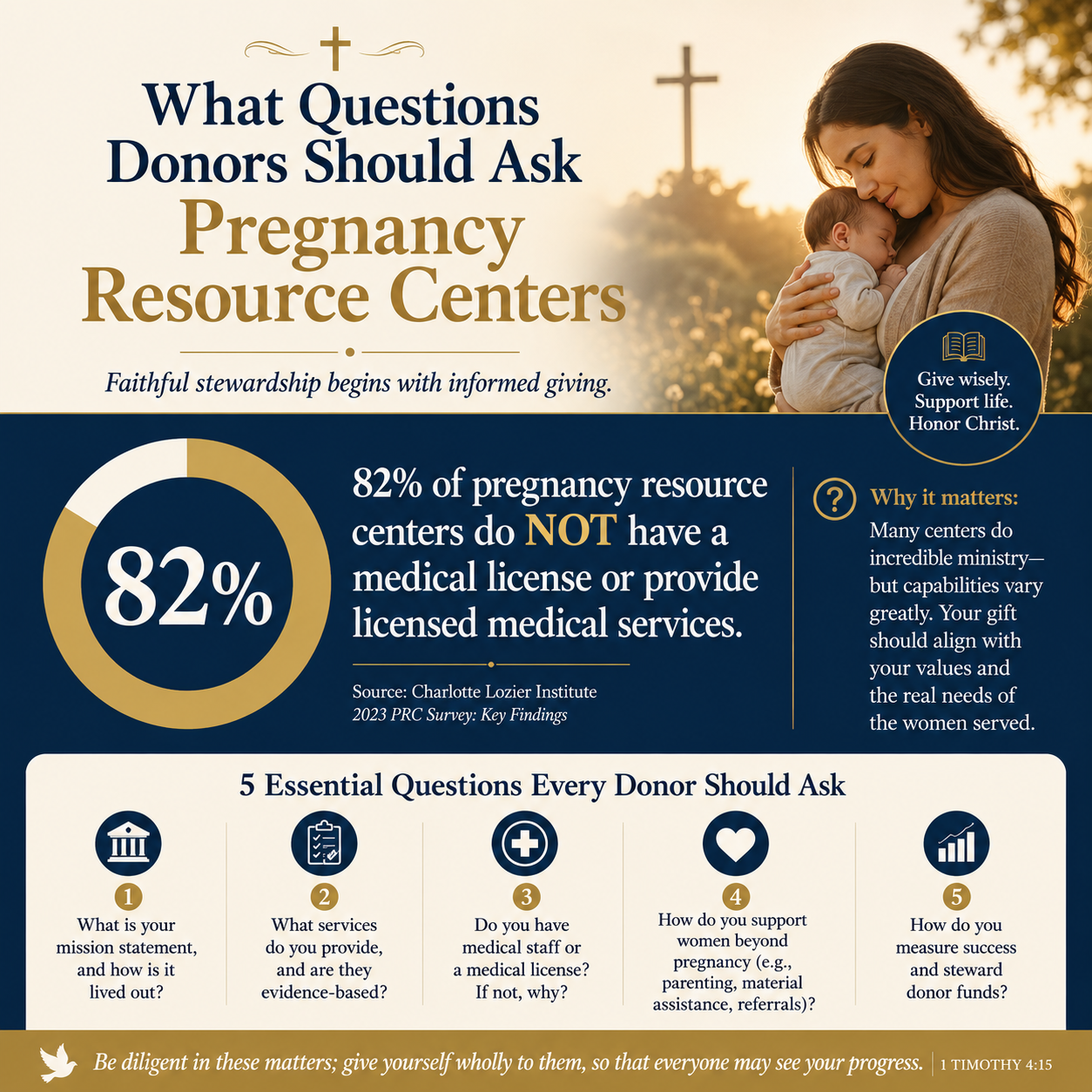
A careful center will state plainly whether it provides medical services, and which ones. If ultrasounds are offered, ask who performs them and under what clinical oversight. If STD testing is offered, ask what tests are used and whether there is a medical director. If the center does not provide certain services, ask how it handles referrals for prenatal care, OB-GYN services, housing, or mental health counseling. Clarity here protects women and protects the ministry from overstating its capacity.
Ask how evangelism relates to service
Christian ministry has always held together word and deed, but the relationship must be honest. Ask whether clients are required to participate in prayer, Bible study, or spiritual conversations to receive services. If the center offers discipleship, ask how it distinguishes voluntary spiritual care from implied pressure. A center can be unapologetically Christian and still be transparent about consent and client choice.

2. Ask about truthfulness, informed consent, and client dignity
The pro-life cause is weakened when any ministry is careless with truth. Donors should ask questions that illuminate whether a center’s communication is accurate, its consent practices are clear, and its posture toward clients reflects the patience and gentleness of Christ.
Ask how information is reviewed for accuracy
Some centers provide education on fetal development, parenting, adoption, sexual health, and abortion procedures. Ask who reviews educational materials and how often they are updated. If the center is medical, ask whether a licensed medical professional reviews medical claims. If the center is not medical, ask how it avoids presenting non-medical counseling as medical advice.
It is appropriate to ask whether the center differentiates between what it knows, what it believes, and what it cannot claim. The donor’s goal is not to litigate every disputed question in bioethics; it is to ensure the ministry is committed to truthfulness as a matter of Christian witness.
Ask about privacy protections and data handling
Centers often hold sensitive information: pregnancy test results, ultrasound images, disclosures of abuse, immigration concerns, and family instability. Ask what data is collected, why it is collected, how it is stored, and who has access. If the center is a medical clinic, ask how it complies with applicable health privacy standards. If it is not a medical provider, ask what privacy policy governs client records and whether clients can review or request deletion of their information where applicable.
Across nonprofit best practice, donors are increasingly attentive to privacy because data misuse can become a second trauma. The Federal Trade Commission has emphasized that privacy promises must match actual practices, especially for sensitive health information Federal Trade Commission.
3. Examine governance, accountability, and conflict of interest controls
Many pregnancy resource centers are local, volunteer-driven, and stretched thin. That reality deserves sympathy, but it does not reduce the need for governance. In fact, thin staffing makes governance more important, because a single leader’s judgment can shape everything.
Ask who governs the ministry and how decisions are made
Ask whether the organization is governed by an independent board with meaningful oversight. Request basic information: board size, meeting frequency, and whether members are financially independent from the executive director. Ask how the board evaluates the executive director and how major program decisions are approved.
Where possible, donors should review IRS Form 990 filings for governance disclosures and key compensation. The IRS provides the public rationale for Form 990 transparency and how the form functions as a compliance and accountability tool Internal Revenue Service.
Ask about conflicts of interest and related-party transactions
Healthy organizations can name their controls without defensiveness. Ask whether there is a written conflict-of-interest policy, whether board members sign it annually, and whether the organization documents recusals when a potential conflict arises. Ask whether the ministry does business with board members, family members, or companies owned by insiders, and if so, how pricing is vetted and approved.
These questions are not accusations. They are guardrails. Scripture repeatedly warns about the corrosive power of partiality and unjust gain (Proverbs 11:1; James 2:1). A center that welcomes these questions is usually a center that has thought seriously about moral credibility.
4. Evaluate financial integrity without reducing stewardship to overhead ratios
Donors often default to simplistic metrics: “How much goes to programs?” That question is understandable, but the nonprofit field has repeatedly shown that overhead ratios do not reliably measure impact or integrity. The better questions examine whether financial reporting is intelligible, whether controls exist, and whether spending decisions align with mission.
Ask for clear financial statements and an explanation you can follow
Request the most recent annual report, audited financials if they exist, and a plain-language budget overview. Smaller centers may not have audits, but they should still be able to provide internally prepared statements and a coherent explanation. Ask what percentage of revenue is restricted (earmarked for specific purposes) and how restricted gifts are tracked.
When donors ask about overhead, we recommend using the reasoning articulated in the “Overhead Myth” letter, signed by Charity Navigator, BBB Wise Giving Alliance, and GuideStar: administrative and fundraising costs can be necessary investments in effectiveness and accountability Charity Navigator.
Ask about financial controls that prevent misuse
Responsible centers can describe their basic controls in concrete terms. A short list of questions often reveals whether stewardship is operationalized or merely asserted:
- Who has authority to sign checks and approve electronic payments, and is there dual approval for large expenses?
- How are donations receipted, deposited, and reconciled, and who reviews the reconciliation?
- Are credit card expenses documented with receipts and reviewed by someone independent of the spender?
- Does the organization have a whistleblower policy and a process for handling complaints?
- How does the ministry handle cash assistance or material aid to ensure it is distributed fairly and recorded accurately?
These questions serve both donors and staff. A ministry with good controls is protecting its people from temptation, misunderstanding, and reputational collapse.
5. Insist on evidence of effectiveness that fits the mission and respects the client
Pregnancy resource centers are sometimes asked to prove “impact” in ways that do not fit the work or that flatten human complexity. At the same time, donors should not accept impact claims that cannot be defined, measured, or responsibly narrated. The goal is faithful effectiveness, not marketing metrics.
Ask what outcomes the center tracks and why
Ask what the ministry counts as fruit and how it avoids manipulating numbers. Does it track repeat visits, completion of parenting classes, referrals to prenatal care, adoption support outcomes, material aid distribution, or connections to housing and employment services? If the center offers ultrasound, what is the purpose of that service in the broader continuum of care, and how is it evaluated?
Some outcomes are difficult to measure without intruding on privacy. Mature ministries will say so. They may track aggregate patterns, use anonymous surveys, or assess program completion rates without forcing personal disclosures. The guiding question is whether the ministry can demonstrate responsible learning and improvement over time.
Ask how the center handles hard cases and long-term care
A credible center can describe what happens when a client miscarries, experiences domestic violence, faces homelessness, or chooses an outcome the ministry would not prefer. Ask about referral networks, partnerships with churches, and professional counseling resources. Ask whether the ministry has written protocols for suspected abuse, coercion, or trafficking, and whether staff are trained to respond appropriately.
In this work, the test of seriousness is rarely the easy story. It is whether the ministry remains present when the situation is morally complex, emotionally costly, and resistant to tidy narratives.
How Most Trusted approaches verification for pregnancy resource centers
Donors often feel caught between two risks: funding carelessly and funding cynically. Most Trusted exists to reduce that burden by evaluating Christian nonprofits against The Most Trusted Standard, a 15-criteria framework spanning faith commitments, financial integrity, governance, and transparency and effectiveness. Across our verification work, the ministries that meet The Most Trusted Standard tend to welcome scrutiny, document their practices, and address weak points directly rather than hiding behind spiritual language.
For donors who want broader context on the ministry landscape, we maintain coverage of Pregnancy Resource Centers as a category, including recurring accountability questions donors raise. We also address common patterns and safeguards in Accountability and Transparency in Pregnancy Resource Centers, where the field’s tensions are treated with the seriousness they deserve.
FAQs for What questions donors should ask pregnancy resource centers
Should donors only give to pregnancy centers that are medical clinics?
Not necessarily. Medical services can strengthen care when they are properly licensed, supervised, and ethically delivered. But non-medical centers can also serve women well through material assistance, parenting education, mentoring, and church-based support—provided they communicate clearly about what they are and are not. The decisive question is not the label; it is whether the center is transparent, accountable, and competent for the services it offers.
What if a center is reluctant to answer donor questions?
Some reluctance can reflect understaffing or a lack of administrative maturity. But persistent evasiveness is a warning sign, especially on governance, finances, privacy, or the accuracy of claims. Donors are not obligated to fund uncertainty. A reasonable expectation is that a ministry receiving charitable gifts in Christ’s name can explain its practices and provide documentation proportionate to its size and risk profile.
Stewardship that strengthens the witness
The questions donors should ask pregnancy resource centers are not an obstacle to compassion; they are part of it. When donors insist on truthfulness, governance, financial integrity, and measured effectiveness, we help ministries serve women with greater competence and fewer hidden harms. The credibility of pro-life ministry is not secured by volume of conviction alone. It is secured by the kind of integrity that can withstand light.



