
How churches can support local pregnancy resource centers is not mainly a question of program design. It is a question of whether a congregation will bear credible, costly witness to the dignity of mother and child, and whether that witness will be matched by the kind of practical mercy that Scripture treats as non-negotiable (James 2:15–17). In many communities, pregnancy resource centers sit at the intersection of pastoral care, public controversy, and urgent material need. Churches that want to help must decide what faithfulness looks like when the work is emotionally complex and publicly scrutinized.
The harder reality is that support can be sincere and still be misdirected. Some partnerships drift into political symbolism, others reduce women to “cases,” and others fail basic standards of governance and accountability. Mature Christian donors generally understand this tension: compassion without wisdom can wound, and scrutiny without compassion can harden. The churches that serve well tend to hold both together.
Begin with a theologically serious view of neighbor and agency
Mercy ministry is not optional, and neither is truthful speech
Pregnancy resource work is often framed narrowly as an “issue.” Scripture frames it as neighbor-love, truth-telling, and protection for the vulnerable. Jesus’ teaching about mercy in Matthew 25 is not about abstract alignment; it is about concrete service given to people whose dignity the world easily ignores. In that light, a church’s relationship to a local center should not start with a donation line item. It should start with a shared commitment to treat women and families as image-bearers, not as rhetorical leverage.
Truthfulness matters because the field is contested. Christians genuinely disagree about how public policy, crisis intervention, and evangelism should relate. Those disagreements do not relieve the church of the duty to speak carefully about what a center does and does not do. If a congregation is going to recommend a center from the pulpit or through its giving channels, it should be able to describe services accurately and respectfully, without caricature of critics and without overstating outcomes.
Support that honors agency will feel slower than a campaign
Many centers do their best work through long accompaniment: listening, stable relationships, and practical problem-solving. Churches often excel at short bursts—drives, events, seasonal appeals. Those can help, but they are not the same as walking with a woman through housing instability, relational pressure, or a high-risk pregnancy. The church’s distinctive contribution is the capacity for sustained, dignifying presence through the local body of Christ.

Clarify what the center is built to do and what it is not
Map services, referral boundaries, and risk points
Some pregnancy resource centers provide medical services such as limited ultrasound under appropriate licensure and oversight; others focus on peer counseling, parenting education, and material support. Churches should not assume every center operates the same way. A wise first step is a sober review with the center’s leadership: what services are offered, what medical protocols and supervision exist where relevant, how clients are referred to public benefits or healthcare, and what safeguarding policies govern volunteers.
Research and public debate often focus on accuracy and transparency in client-facing communications. Churches can help by encouraging a culture where informed consent is clear, expectations are honest, and referral relationships are documented. That protects clients, strengthens credibility, and lowers reputational risk for the church as a partner. The objective is not defensive posturing; it is moral seriousness about the vulnerability of the people being served.
Distinguish material support from relational support from institutional support
Centers typically need three categories of help, and churches should decide which they are equipped to provide. Material gifts without relational care can become impersonal. Relational care without institutional strength can leave a center unstable. And institutional support without pastoral awareness can become overly managerial. The healthiest partnerships name these categories explicitly and allocate support accordingly.
Support financially in ways that strengthen integrity, not dependency
Prefer unrestricted giving when governance and reporting warrant it
Many donors instinctively restrict gifts to visible items—diapers, formula, baby clothing—because the impact feels concrete. Those items matter, but a center’s effectiveness also depends on rent, staff supervision, training, client follow-up systems, and compliance costs. The “overhead” versus “program” split is a false moral hierarchy. Charity Navigator, Candid, and the BBB Wise Giving Alliance have urged donors to avoid using overhead ratios as a proxy for effectiveness in their “Overhead Myth” statement, which warns that simplistic overhead thinking can harm nonprofits and mislead donors about real performance.Charity Navigator
What this means for a church is straightforward: where a center demonstrates strong governance and transparent reporting, unrestricted support often serves the mission best. Where those foundations are unclear, restricted support may be prudent while the church asks better questions. Financial generosity is not diminished by discernment; it is strengthened by it.
Build multi-year predictability, and do not confuse urgency with health
Short-term funding spikes can destabilize ministries, especially if they expand staff or services and then face a cliff. Stanford Social Innovation Review has described the “Starvation Cycle” in which funders’ pressure to appear low-cost leads nonprofits to underinvest in capacity, reducing effectiveness over time.Stanford Social Innovation Review Churches can resist this by giving predictably, encouraging realistic budgeting, and affirming necessary investments in training, supervision, and evaluation.
For donors in the pews, this is also a pastoral point: generosity should mature beyond reacting to emergencies. Pregnancy resource work is often urgent, but the ministry’s health is measured in years, not weeks.
Offer people, not only projects, and guard the work with clear standards
Volunteer pipelines require training, supervision, and safeguards
Churches frequently have willing volunteers but uneven readiness. A pregnancy resource center cannot be strengthened by goodwill alone. Volunteers must be trained for confidentiality, trauma-informed care, spiritual sensitivity, and appropriate boundaries. Churches can support by supplying mature members who will submit to the center’s supervision rather than treating the partnership as an independent church program.
A practical way to serve without overwhelming the center is to provide teams that fill clearly defined roles—client advocates, administrative support, baby boutique logistics, transportation coordination—only where the center has capacity to train and supervise. Churches should also ask directly about safeguarding policies: background checks, reporting pathways, and how the center handles high-risk situations such as domestic violence or coercion.
Four to six concrete ways churches can help responsibly
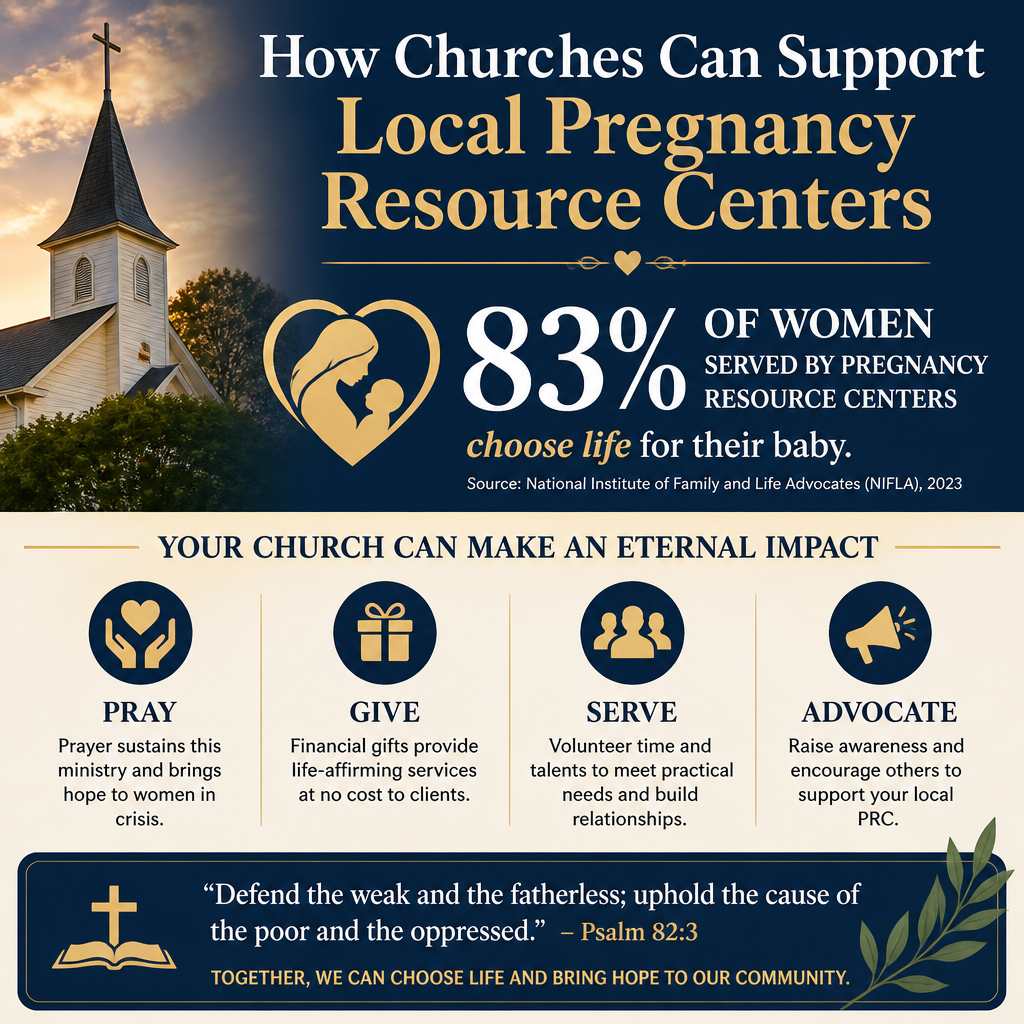
- Commit to a predictable monthly gift aligned with the center’s budget priorities, not only with donor preferences.
- Provide trained volunteers under the center’s supervision, with explicit confidentiality and boundary standards.
- Offer church facilities for classes or support groups when the center requests it and privacy can be protected.
- Develop a referral directory for wraparound needs such as housing, employment coaching, childcare, and counseling.
- Recruit professional services pro bono when appropriate, including legal counsel, HR support, and clinical supervision.
Each of these forms of support assumes the church is willing to treat the center as a ministry partner with real constraints, not as a receptacle for church activity.
Verify trustworthiness before you amplify and fund
Ask questions that match the moral weight of the work
Because pregnancy resource centers serve people in vulnerable moments, trust is not a sentimental category. It is an ethical requirement. Churches should normalize due diligence before platforming a center in congregational communications or steering donor dollars toward it. This is especially important when the center’s reputation will become, in the public mind, part of the church’s testimony.
Across our verification work at Most Trusted, we observe that ministries that meet The Most Trusted Standard tend to share a set of measurable practices: a clear faith foundation expressed without coercion, transparent financial reporting, accountable governance, and honest communication about outcomes and limitations. That posture does not guarantee perfection, but it does reduce predictable forms of harm.
Due diligence can be pastorally framed, not adversarial
Church leaders sometimes fear that asking hard questions signals distrust. The opposite is often true. Serious ministries welcome scrutiny because it protects those they serve and strengthens donor confidence. A church can say plainly: we ask these questions because we want to give with integrity, and because we want the center to be resourced for sustainable faithfulness.
Churches that want broader context for partnership often begin by reviewing the wider landscape of Pregnancy Resource Centers and then narrowing to the specific practices that characterize durable local relationships. That approach keeps the conversation from collapsing into personalities or controversies.
Similarly, churches that are building long-term collaboration benefit from studying patterns in How Pregnancy Resource Centers Build Community Partnerships—not to imitate a formula, but to learn what tends to protect clients and strengthen trust across a community.
FAQs for How churches can support local pregnancy resource centers
Should our church only give to centers that provide medical services?
Not necessarily. Some centers provide limited medical services under appropriate oversight; others focus on education, peer counseling, material support, and referrals. The question is not whether the model is medical or non-medical, but whether the center is transparent about what it offers, operates within legal and ethical boundaries, and demonstrates accountable governance and clear client safeguards.
How can we support a center without turning the partnership into a political statement?
Churches can keep the focus on faithful service by describing the center’s work accurately, centering the dignity and agency of women and families, and prioritizing practical support that strengthens care: predictable funding, trained volunteers, and wraparound referrals. Public advocacy may have a place, but the partnership should be defined first by mercy and truth, not by the congregation’s need to signal identity.
A partnership that bears credible witness
Pregnancy resource centers ask the church to bring moral clarity into direct contact with human vulnerability. The most constructive partnerships combine generous support with verifiable integrity: churches give money and people in ways that strengthen care, and centers demonstrate the governance, transparency, and safeguarding that serious ministry requires. When that alignment holds, donors can give with confidence, and churches can serve without manipulation or naivete.



