
What questions donors should ask pastoral support ministry leaders begin with a simple conviction: pastors are not spiritual machines, and the church’s mission is not sustained by burnout. Christian donors often feel the weight of competing responsibilities—supporting local congregations, funding global missions, responding to crisis—while also watching headlines about moral failure, mental health strain, and leadership collapse. Wise giving asks not only whether a ministry’s intention is good, but whether its practices are sound, its theology is clear, and its outcomes are credible.
Pastoral support is also a complex category to assess. Much of the work is quiet by design: counseling, coaching, spiritual direction, marriage support, crisis triage, retreat and renewal rhythms, and in some cases clinical referrals. Confidentiality can limit what a ministry can disclose, yet donors still need enough transparency to discern whether a program is actually strengthening shepherds and protecting the flock. The goal is not suspicion; it is stewardship.
1. What is your theological understanding of pastoral care and pastoral failure
Pastoral support ministries inevitably embody a doctrine of the church. Some emphasize resilience and skill-building; others emphasize holiness, repentance, and restoration; still others focus on systemic dysfunction in leadership cultures. Each may have a place, but donors should not assume these emphases are interchangeable. The health of the shepherd is inseparable from the health of the people entrusted to him, and Scripture treats that reality with gravity.
Ask how they define faithfulness and fruitfulness
The first test is theological clarity. Ask leaders to articulate what “health” means for a pastor: spiritual vitality, marital fidelity, emotional maturity, financial integrity, accountable leadership, and enduring love for Christ’s people. A ministry that treats pastoral health as merely professional performance is likely to miss the heart. Jesus’ charge to Peter—“feed my sheep”—assumes both love for Christ and sustained care for others, not merely competence (John 21).
Ask what they do when a leader has disqualified himself
Christians genuinely disagree about how restoration should function after moral failure, and different ecclesial traditions have different practices. Donors should ask whether the ministry has clear categories: discipline, repentance, restitution, and when relevant, permanent removal from office. A program that only restores “platform” without attending to repentance and protection of the vulnerable may enable further harm.

2. Who is accountable and how is power constrained
Pastoral support ministries sometimes sit adjacent to influence: networks of churches, prominent speakers, denominational leaders, and major donors. That proximity can pressure leaders to conceal problems or rush outcomes. Donors should ask about governance not as a technicality, but as a moral architecture that protects people when incentives bend toward image management.
Ask how board oversight actually works
Request a clear explanation of who hires and fires the executive leader, how conflicts of interest are handled, and how the board evaluates effectiveness. The most credible ministries can describe oversight processes without defensiveness. They will also be able to name what they will not do—such as placing themselves above local church authority or using spiritual language to bypass ordinary accountability.

Ask how they handle safeguarding and mandatory reporting
Where counseling, mentoring, or crisis response is involved, ask about written safeguarding policies, training, and reporting protocols. Donors should also ask how the ministry relates to local law enforcement and child protection requirements when abuse is alleged. A ministry can be deeply compassionate and still firm about reporting obligations and victim care.
3. What exactly is the program model and why should we expect it to work
Pastoral support is not a single intervention. It can mean subsidized counseling, confidential hotlines, peer cohorts, retreats, executive coaching, spiritual formation intensives, sabbatical planning, or family systems support. Donors should ask for specificity: inputs, processes, outputs, and intended outcomes. Vagueness is not spiritual; it is usually a sign that evaluation will be difficult.
Ask what is clinical, what is pastoral, and what is peer support
Many ministries blend categories, and donors should understand the boundaries. Are licensed mental health professionals involved? Are pastors serving as peer coaches? How do they decide when to refer out for clinical care? If the ministry offers counseling, ask about licensure, supervision, and ethical standards. If it offers spiritual direction, ask about training, oversight, and doctrinal alignment.
Ask how they respond to the most common pressures pastors face
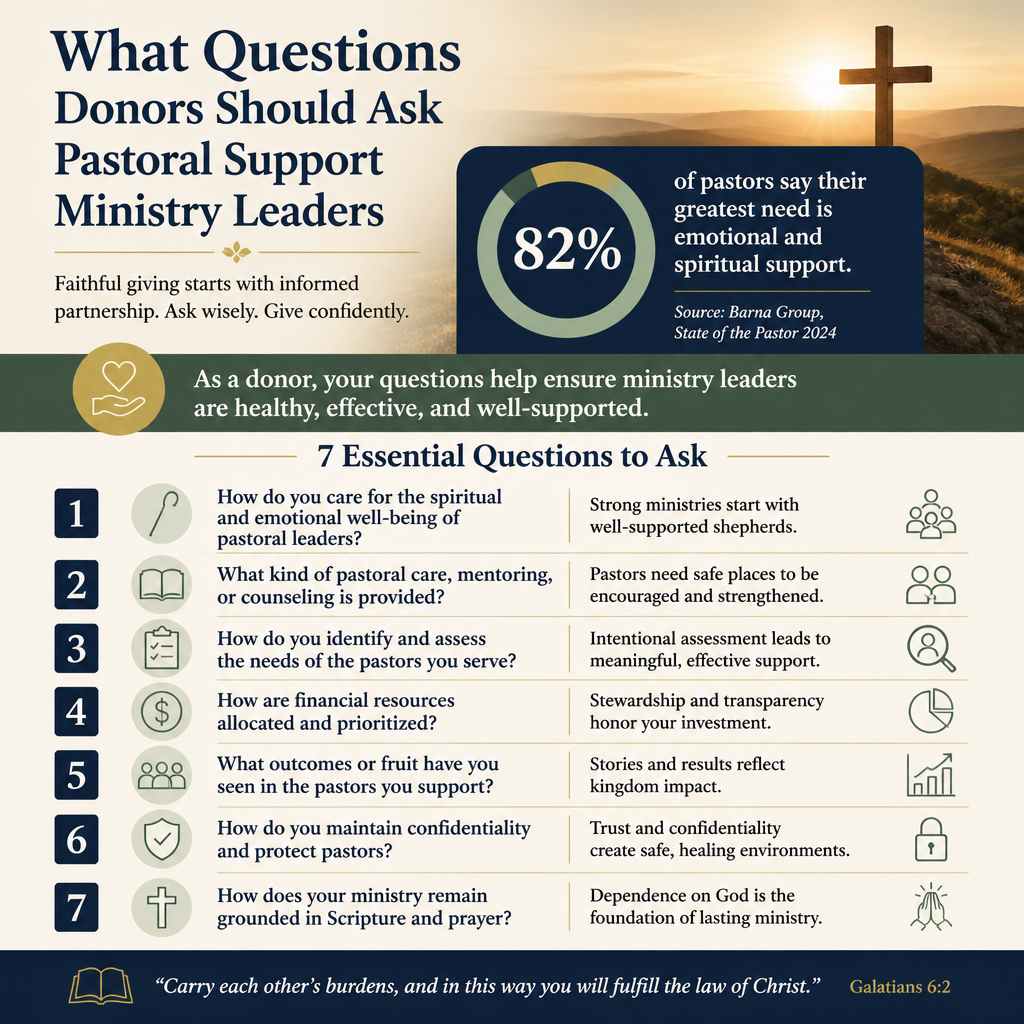
Pastors regularly name stressors that are not solved by a retreat alone: chronic conflict, isolation, financial strain, ministry-family boundary collapse, and sometimes trauma from betrayal or public controversy. The evidence base on clergy well-being is sober. For example, Barna has reported high levels of burnout and contemplation of leaving ministry among pastors in recent years (Barna). Donors should ask how the ministry’s model addresses root causes rather than offering only temporary relief.
- What problem are you primarily solving: prevention, crisis response, or restoration after failure?
- What does a typical participant journey look like over 6–12 months?
- How do you assess readiness for deeper interventions such as marital counseling or trauma care?
- What role does the local church or denomination play in the plan?
- What would make you recommend a pastor step away from ministry for a season?
4. How do you measure impact without violating confidentiality
Pastoral support creates a real measurement challenge: confidentiality is often essential, but donors still need to know whether resources are producing durable good. The mature approach is not to pretend that everything can be reduced to metrics, nor to hide behind privacy as an excuse for opacity. Good ministries learn to measure in ways that protect people while still honoring stewardship.
Ask what outcomes they track and what evidence they can share
Donors should ask for concrete indicators: retention in ministry where appropriate, reduced crisis escalation, improved marital stability, strengthened spiritual disciplines, increased use of accountable structures, and healthier leadership culture in participating churches. Some outcomes will be self-reported; others can be aggregated from participation data, follow-up assessments, and referrals completed. Ask what is independently verifiable and what is not—and whether the ministry is candid about that distinction.
Ask how they avoid perverse incentives
Impact claims can create pressure to overstate success or to keep leaders in roles that should end. Donors should ask how the ministry defines success when outcomes are uncomfortable: removing an abusive leader, recommending clinical care, or requiring restitution. The church’s credibility is not advanced by outcomes that look impressive but conceal harm. For a broader view of how ministries think about evidence and accountability, see How Pastoral Support Ministries Measure Impact.
5. How is money handled and what does transparency look like
Pastoral support ministries can be unusually sensitive about finances because the work can involve scholarships, emergency assistance, and counseling subsidies. Yet Scripture’s teaching on stewardship does not permit financial ambiguity. Donors should expect clear financial statements, clear policies about restricted gifts, and a transparent explanation of how administrative costs support the mission rather than compete with it.
Ask for the basic financial disclosures and how to interpret them
At minimum, donors should be able to access recent audited financial statements when available, Form 990s for U.S. nonprofits, and a clear description of major revenue sources. Ask how the ministry sets executive compensation, whether related-party transactions exist, and what internal controls protect against misuse. The presence of administration is not automatically suspect; the question is whether spending patterns align with mission delivery and prudent oversight.
Ask how they report to donors without turning pastors into marketing content
Pastoral support can be exploited by storytelling that commodifies pain. Donors should ask what consent practices exist for testimonies, whether identities are protected, and how the ministry avoids pressuring vulnerable leaders to perform gratitude. Ministries that meet The Most Trusted Standard tend to communicate with restraint: enough detail to support accountability, not so much disclosure that it violates dignity or confidentiality. Donors exploring the broader landscape can also review Pastoral Support Ministries to compare models and transparency practices across organizations Most Trusted evaluates.
FAQs for What questions donors should ask pastoral support ministry leaders
Is it reasonable to expect measurable outcomes from pastoral support work?
Yes, with appropriate humility about what can be quantified. Donors can reasonably expect ministries to define intended outcomes, track participation and follow-up, report aggregated results, and describe limits created by confidentiality. What donors should resist is either extreme: pretending pastoral care is immeasurable, or demanding simplistic metrics that pressure ministries to overstate success.
What if a ministry refuses to share details because of confidentiality?
Confidentiality can be legitimate, but it should not eliminate accountability. Donors can ask for written policies, governance documents, safeguarding protocols, aggregated outcome reporting, and audited financials. A trustworthy ministry will explain what it cannot share and what it can share, and it will welcome careful questions without treating them as a lack of faith.
Giving that strengthens shepherds and protects the flock
Christian donors are not called to cynicism, but we are called to discernment. Pastoral support is holy work because it serves the church’s worship, witness, and endurance. The questions above do not reduce ministry to a checklist; they help align compassion with accountability, and generosity with truth. When donors ask these questions with steadiness and care, they participate in the kind of stewardship that Scripture commends and the church requires.



