

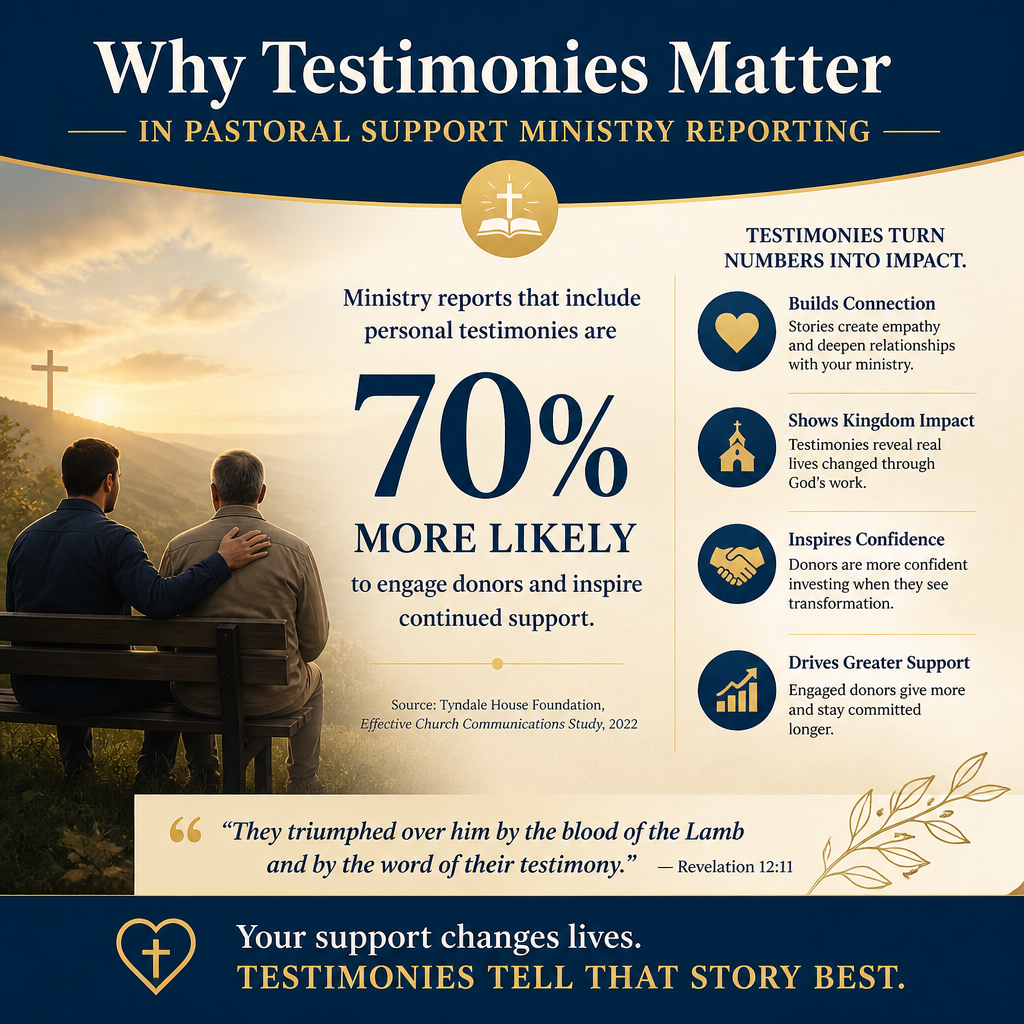
Why testimonies matter in pastoral support ministry reporting is not primarily a communications question. It is a stewardship question: how donors, churches, and boards can hear truthfully what God is doing through pastoral care without turning suffering into marketing or reducing souls to metrics.
Pastoral support ministries often serve in the most private corridors of life: grief, addiction, marital fracture, vocational burnout, confession of sin, relapse, reconciliation, and the slow work of spiritual formation. Donors rightly ask for evidence of faithfulness and fruit. Yet the work itself resists the kinds of simple counting that fit spreadsheets. Testimonies, handled with care, become one of the few reporting tools that can be both morally appropriate and spiritually intelligible.
Testimonies translate pastoral care into donor accountable evidence
Pastoral support is real work, but it is not always countable work
Some ministries can report impact through outputs and outcomes that are comparatively easy to quantify: meals served, beds provided, students graduated. Pastoral support ministries operate differently. A single conversation may avert self-harm, prevent a family’s collapse, or reopen a person’s capacity to pray. Those are not minor results, but they rarely show up as clean numbers.
Scripture itself models the importance of truthful narration. When the man born blind is questioned, he does not offer a theory of transformation; he offers a testimony: “One thing I do know. I was blind but now I see” (John 9:25). The point is not that testimony replaces evidence, but that it is a form of evidence appropriate to a personal, relational work.
Donors need more than reassurance, they need interpretive clarity
Christian donors tend to give with a double desire: compassion for people and confidence that a ministry is operating with integrity. That confidence is not sentimental. It is the moral weight of stewardship. Jesus’ teaching on faithful stewardship assumes accounting, trustworthiness, and real responsibility (Matthew 25:14–30). The donor’s question is not “Is this story moving?” but “Is this ministry faithful, and is it bearing fruit consistent with its calling?”
When testimonies are specific, bounded, and corroborated by program reality, they help donors interpret what they would otherwise only imagine. They show what pastoral support looks like in practice: the cadence of care, the kind of counsel offered, the role of Scripture and prayer, the guardrails around crisis situations, and the limits of what the ministry claims it can do.

Testimonies protect against shallow metrics and spiritualized vagueness
Numbers can mislead when they reward activity rather than shepherding
The temptation in reporting is to substitute what is measurable for what is meaningful. A ministry can report “contacts made” or “sessions delivered” and still miss the question of whether those sessions were wise, biblically grounded, and handled with appropriate safeguards. Quantity is not the same as care.
Christian ministry leaders also face the opposite temptation: to report in spiritual generalities that sound faithful but cannot be evaluated. “Lives were touched” can conceal weak supervision, inconsistent theology, or poor boundaries. Testimonies help hold a middle ground: concrete enough to be examined, reverent enough not to trivialize holy work.
Serious reporting names tensions rather than hiding them
Pastoral care frequently involves ambiguity. People backslide. Marriages reconcile slowly or not at all. Trauma has physiological consequences. Medication and counseling can be appropriate alongside spiritual disciplines. Christians genuinely disagree about the boundaries between pastoral counseling, clinical therapy, and medical care. Mature reporting does not pretend those tensions do not exist; it shows how the ministry navigates them.
A testimony can do this without becoming a case study for public consumption. A well-handled narrative can acknowledge, for example, that the ministry referred a person to a licensed clinician, coordinated with a local church, and maintained accountability, while still preserving confidentiality and dignity.
Credible testimonies require ethical guardrails and verifiable context
Consent, privacy, and power dynamics are not secondary concerns
Pastoral support involves spiritual authority and vulnerability. That makes testimony collection ethically complex. A person may feel pressured to share because they are grateful, because a leader asks, or because they fear appearing uncooperative. Ministries that treat testimonies as a fundraising asset risk exploiting pain, even unintentionally.
Responsible practice includes clear, revocable consent; options for anonymity; and time separation between receiving care and being asked to share. Where minors or sensitive situations are involved, safeguards must be even stricter. Many donors have grown cautious after watching public failures in Christian leadership. They do not want compelling stories purchased at the cost of integrity.
What this means in practice is a testimony should be tethered to reality
A credible testimony is never a free-floating narrative. It sits within a reporting environment that includes governance, financial accountability, and transparency about what the ministry actually does. This is one reason donors turn to independent verification services like Most Trusted. Across our verification work, we observe that ministries that meet The Most Trusted Standard tend to pair narrative reporting with clear policies: theological commitments, pastoral care protocols, referral pathways, and documented oversight.
When donors review Pastoral Support Ministries, the question is not whether testimonies are present, but whether they are responsibly gathered and presented in a way that withstands scrutiny. Trustworthy testimonies align with what the ministry’s leadership claims, what its budget can sustain, and what its public materials consistently describe.
Testimonies can be assessed for reliability without reducing them to marketing
Markers of trustworthy testimony
Donors do not need cinematic storytelling. They need narratives that sound like real life, where repentance is not instantaneous, sanctification is not a slogan, and outcomes are described with humility. A testimony can be emotionally compelling and still be weak evidence if it lacks specificity or overstates causality.
We recommend that donors look for a few markers that can be evaluated without invading private details:
- Specificity about the intervention: what the ministry actually provided (mentoring, support groups, pastoral counseling, crisis referral, spiritual direction).
- Clarity about timeframe: whether change occurred over weeks, months, or years, rather than implying instant transformation.
- Appropriate humility: credit given to God’s work, the local church, family systems, and professional care when involved, not only to the ministry.
- Boundaries respected: no voyeuristic details, no identification of abusers, and no unnecessary exposure of children.
- Consistency with the ministry’s stated model: the story matches the program described elsewhere and does not introduce surprise services.
Donors can ask for corroboration that does not compromise confidentiality
Confidentiality is not a reason to avoid accountability. Ministries can corroborate impact in ways that protect identities: aggregate trends from intake categories, anonymized case summaries vetted by leadership, supervision notes reviewed in governance processes, and clear documentation of referral partnerships. Donors can also ask whether the ministry has written policies for mandatory reporting, suicide risk protocols, and boundaries around counseling competencies.
The harder question is how ministries and donors avoid turning stories into a substitute for evidence. The answer is not to abandon testimonies, but to treat them as one strand in a larger fabric of transparency: budgets that make sense, boards that govern, leaders who can be questioned, and reporting that does not flinch from limitations.
Testimonies belong within a wider account of effectiveness and faithfulness
Faithful reporting is not the same as persuasive reporting
Christian ministry reporting has always faced a tension between proclamation and accountability. The New Testament includes both: the public declaration of what God has done and the sober insistence on integrity. Paul can speak boldly of fruit while also taking pains to avoid any suspicion regarding financial handling (2 Corinthians 8:20–21).
Pastoral support ministries should report in the same spirit. The goal is not to win attention. The goal is to tell the truth in a way that honors the people served and invites responsible partnership. Many donors have seen “impact” language used to mask instability or to excuse poor governance. Mature donors increasingly ask for the kind of transparency that can be audited, not merely admired.
Effectiveness includes spiritual integrity and institutional trustworthiness
What donors fund in pastoral support is not only a service but a moral environment: doctrinal commitments, leadership character, safeguarding culture, and the ability to withstand crisis without hiding. This is why reporting should connect testimonies to concrete ministry practices: how mentors are trained, how pastors are supervised, how conflicts of interest are handled, and how finances are stewarded.
For donors evaluating How Pastoral Support Ministries Measure Impact, the most constructive posture is neither suspicion nor naivete. It is disciplined attention: receiving testimony as a meaningful witness while insisting on the surrounding conditions that make such witness credible.
FAQs for Why testimonies matter in pastoral support ministry reporting
Are testimonies reliable evidence for donors, or are they mainly anecdotal?
Testimonies are anecdotal in the technical sense, but they are not therefore unreliable. In pastoral support, many of the most important outcomes are personal, relational, and spiritually textured, which makes narrative evidence appropriate. The credibility question turns on how the testimony is gathered and framed: consent, privacy protections, specificity, and alignment with verifiable ministry practices. Mature ministries treat testimonies as witness, not as proof-texts for fundraising.
How can a donor evaluate impact when confidentiality limits what can be shared?
Confidentiality should limit exposure, not accountability. Donors can look for written care protocols, training and supervision practices, referral partnerships, governance oversight, and financial transparency that fits the ministry’s stated model. Ministries can also report anonymized themes and aggregate categories without identifying individuals. When testimonies sit within that broader transparency, donors can give with confidence without demanding disclosure that would harm the people being served.
Conclusion
Testimonies matter in pastoral support ministry reporting because they are one of the few ways to speak truthfully about work that is sacred, private, and often resistant to simple measurement. When ministries gather testimonies with ethical restraint and place them within transparent, verifiable practices, donors receive more than inspiration. They receive a credible account of shepherding that honors both stewardship and the dignity of those who seek care.



