

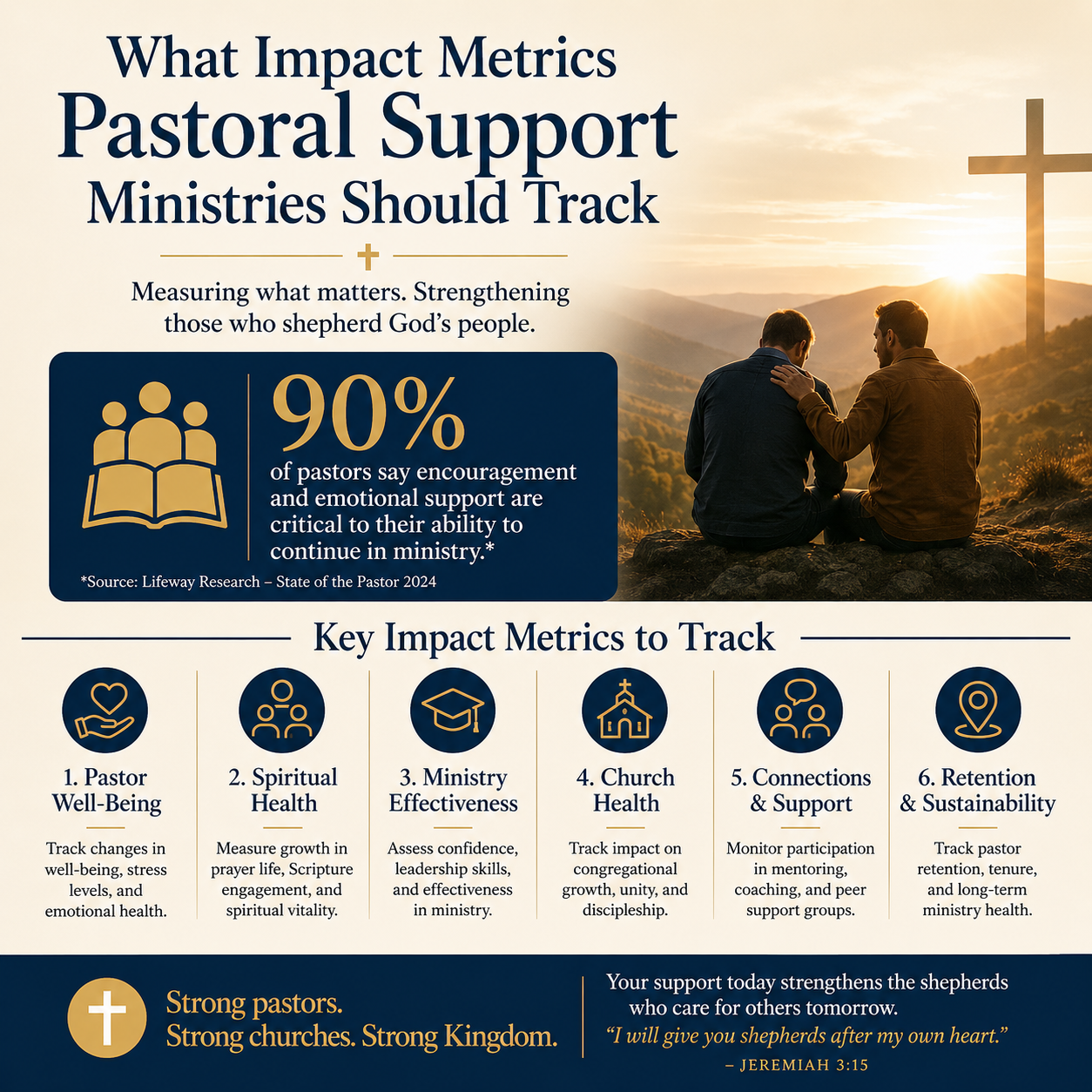
Choosing what impact metrics pastoral support ministries should track is not a technical exercise. It is a stewardship decision about what we will call “good,” what we will ignore, and what we will unintentionally pressure pastors to become. For Christian donors, the question is particularly weighty because pastoral care is both deeply spiritual and unavoidably human: souls, marriages, burnout, loneliness, and the slow work of perseverance rarely fit into simple dashboards.
Scripture does not treat shepherding as sentimental work. Elders are charged to “shepherd the flock of God… not for shameful gain, but eagerly… not domineering… but being examples” (1 Peter 5:2–3). The spiritual health of pastors affects congregations over decades. The harder question is how donor-facing measurement can honor that reality rather than reduce it, while still providing verifiable evidence that support ministries are faithful, competent, and accountable.
1. Begin with a theological theory of change
Most pastoral support ministries fail at measurement before they start because they measure what is easiest to count rather than what the ministry is actually called to do. If the mission is “encouraging pastors,” then “number of encouragement emails” may be a process metric, but it is not evidence of pastoral flourishing or of restored capacity for ministry. A credible measurement approach begins by stating, in plain terms, what the ministry believes God is doing through its work and what would constitute faithful outcomes in a pastor’s life and calling.
Across our verification work at Most Trusted, the ministries that meet The Most Trusted Standard tend to connect metrics to explicit pastoral risks: isolation, moral compromise, burnout, financial strain, ministry conflict, and family pressure. When ministries are forced to name the pastoral harms they are trying to prevent, their measurement becomes more honest and more useful to donors.
Define what “pastoral health” means in your context
Christians genuinely disagree about how to describe pastoral health. Some emphasize resilience and endurance; others emphasize emotional wholeness; others highlight accountability and holiness. Responsible ministries make these assumptions explicit. They describe which dimensions they measure: spiritual disciplines, relational stability, ethical safeguards, vocational sustainability, and ministry fruitfulness, while acknowledging that “fruitfulness” cannot be reduced to attendance or giving.
Separate outputs, outcomes, and safeguards
Pastoral support is particularly vulnerable to “metric confusion,” where outputs are mistaken for outcomes. A ministry can host retreats and provide counseling while pastors continue to deteriorate. Metrics should be intentionally layered: outputs that prove service delivery, outcomes that indicate change, and safeguards that reduce the risk of harm (for example, clinical referral pathways for trauma and suicidality).

2. Track reach and depth without rewarding volume
Donors should expect pastoral support ministries to show whom they serve and how intensively they serve them. But a fixation on “more pastors reached” can incentivize shallow touchpoints. The goal is not a larger mailing list; it is appropriate support for real pastors in real conditions.
Coverage metrics that describe who is being served
Coverage metrics help donors understand whether the ministry serves pastors who are at higher risk and often less visible to donor networks: bivocational pastors, rural pastors, pastors in small churches, church planters, and pastors serving in high-conflict environments. Ministries can responsibly report the composition of their participants without exposing identities.
For donors thinking about vocational strain, it is relevant that bivocational ministry is common in the United States. The National Congregations Study has reported that a substantial share of congregations are led by bivocational clergy, with variation by tradition and size (National Congregations Study).
Engagement intensity that reflects pastoral realities
Depth metrics include: average counseling sessions per participant, average time to first response for crisis requests, percentage of participants receiving a full care plan rather than a single resource, and completion rates for cohort-based programs. These are not “impact” by themselves, but they guard against an inflated story built on light engagement.
- Time to care: median time from intake to first human contact
- Depth of care: percentage receiving multi-session counseling or structured mentoring
- Continuity: percentage with consistent caregiver assignment across the care episode
- Completion: completion rate for cohorts, retreats, or recovery pathways
- Appropriate referral: percentage referred to licensed clinical care when indicated
These measures also reduce the temptation to report only inspirational stories. Stories have a rightful place in Christian philanthropy, but they must be supported by evidence that the ministry’s care is real, timely, and sustained.
3. Measure pastor and family outcomes with disciplined humility
Pastoral support ministries can measure outcomes. They simply must do so with moral seriousness. The aim is not surveillance or forced disclosure; it is a disciplined attempt to discern whether care is helping pastors remain faithful, healthy, and present to their people and families. The tension is that the most important outcomes are sensitive, slow-moving, and sometimes known only to the pastor and spouse.
Validated instruments and careful confidentiality
When ministries use standardized assessments, they should favor instruments that have peer-reviewed support and clear scoring rules, administered with informed consent and a confidentiality policy that protects pastoral dignity. Many ministries use burnout and wellbeing measures such as the Maslach Burnout Inventory or the Oldenburg Burnout Inventory, though the choice should match the population and the ministry’s clinical competence (Mind Garden).
What this means in practice is not that donors should demand raw psychological data. Donors should expect aggregated reporting: baseline to follow-up changes, sample sizes, response rates, and attrition. Ministries should also disclose what they do when assessment indicates acute risk.
Outcomes donors can reasonably expect to see
Useful outcome metrics often include:
1) Reduction in burnout symptoms. Reported as changes on a validated scale, with timeframes (for example, intake vs. three months post-program).
2) Pastoral retention and vocational sustainability. This is not a simplistic “stayed in ministry” number. Pastors sometimes leave for faithful reasons, and sometimes stay at great cost. Still, tracking whether participants remain in ministry, take restorative sabbaticals, or move into healthier placements can be informative when interpreted with context.
3) Marital and family stability indicators. Ministries should handle these with great care, but it is legitimate to measure whether spouses report improved communication, reduced conflict, or greater support, using agreed and confidential tools.
4) Help-seeking behavior and accountability practices. A ministry’s impact may be seen in pastors adopting ongoing mentoring, peer groups, spiritual direction, or accountable rhythms rather than operating alone.
Donors should also ask what outcomes a ministry will not claim. Any promise of guaranteed moral protection, guaranteed church growth, or immediate spiritual renewal should be treated with caution. Faithfulness is measurable in some respects, but it is not mechanical.
4. Track ministry practices that protect the vulnerable and preserve integrity
Pastoral support ministries carry a particular set of risks: confidentiality breaches, unlicensed counseling, spiritual manipulation, and inappropriate dependency. Metrics should therefore include safeguards. These are not secondary. They demonstrate whether the ministry’s care is structured to protect pastors and families, and whether it operates in a way donors can trust.
Clinical and pastoral boundaries
Ministries should report the proportion of counseling provided by licensed clinicians versus lay counselors, supervision practices, continuing education expectations, and referral pathways. If the ministry is not clinical, it should say so clearly and show how it avoids functioning as an unregulated therapy provider. Donors should expect alignment with widely accepted ethical standards in counseling and pastoral care (American Association of Christian Counselors).
Governance and grievance indicators
Some of the most meaningful indicators of integrity are unglamorous: a documented complaint process, response timelines, and board-level review of serious incidents. Ministries should track and report (in appropriate aggregate form) the number of formal complaints received, resolution time, and any systemic changes made as a result. Mature ministries do not fear accountability; they formalize it.
Donors evaluating this space should also be alert to the difference between “confidentiality” and “secrecy.” Protecting pastors’ privacy is righteous. Concealing patterns of harm is not. The point of safeguards is to ensure that confidentiality serves care, not concealment.
5. Report results in a way donors can verify and compare
Even strong metrics can be presented in ways that mislead. Pastoral support ministries should report in a manner that allows a serious donor to understand the scale, the limits, and the credibility of the findings. This includes clarity about who was measured, how data was gathered, and what proportion responded.
Transparency about methods and limitations
Responsible reporting includes: sample sizes, response rates, the timeframe of measurement, and what was done with non-responders. If only highly satisfied participants complete follow-up surveys, reported outcomes will be inflated. Ministries should name that risk rather than pretend it does not exist.
Donors are increasingly aware of the “overhead ratio” distortion and the broader call to measure effectiveness rather than punish administrative capacity. The joint statement often referred to as the Overhead Myth argued that financial ratios alone are poor indicators of nonprofit performance (Charity Navigator). Pastoral support ministries should apply the same principle internally: do not reduce credibility to a single percentage, whether it is “program expense” or “pastors reached.”
How Most Trusted reads pastoral support metrics
At Most Trusted, we do not treat metrics as a marketing accessory. Under The Most Trusted Standard, we look for a coherent relationship between mission, evidence, governance, and transparency: whether the ministry measures outcomes that match its calling, whether it protects the vulnerable through clear policies, and whether it reports results with candor that respects donors and pastors alike.
Donors who want broader context on this ministry type can review Pastoral Support Ministries and then consider how different approaches to evidence and accountability appear across How Pastoral Support Ministries Measure Impact.
FAQs for What impact metrics pastoral support ministries should track
Should pastoral support ministries measure church growth outcomes?
Church growth can be a downstream effect of healthy pastoral leadership, but it is a blunt and often misleading proxy for pastoral wellbeing. Growth can occur alongside moral compromise or family collapse, and faithful ministry can occur in hard fields without visible expansion. We advise donors to treat church growth, if reported at all, as context rather than as the primary impact claim, and to prioritize direct measures of pastoral health, integrity safeguards, and sustained care.
How can donors evaluate impact when confidentiality limits reporting?
Confidentiality should not eliminate accountability; it should shape it. Donors can ask for aggregated outcomes with clear methods: sample sizes, response rates, timeframes, and validated instruments where appropriate. Donors can also evaluate the ministry’s integrity measures: clinical supervision, referral pathways, grievance processes, and governance oversight. When confidentiality is paired with disciplined transparency, it protects pastors while still giving donors reasonable evidence of faithful effectiveness.
Stewardship metrics that honor the pastor
The most credible pastoral support ministries track more than activity. They track whether care is timely and deep, whether pastors and families experience measurable restoration, and whether the ministry’s practices protect those it serves from avoidable harm. Donors do not need perfect measurement to give faithfully, but we do need honest evidence that aligns with Scripture’s seriousness about shepherding, stewardship, and truthfulness.



