
What is the best way to give to Christian anti-trafficking ministries is not primarily a question about emotion, urgency, or even scale. It is a question of faithful stewardship under conditions of real complexity: hidden crime, deep trauma, contested tactics, and sincere Christians trying to do good work without doing harm.
Scripture does not allow Christ’s people to avert our eyes from exploitation. The God who “executes justice for the oppressed” also condemns those who “sell the righteous for silver, and the needy for a pair of sandals.” Faithful giving in this space should be neither naïve nor cynical. It should be discerning, patient, and verifiable.
Start with a theology of justice and a doctrine of the person
Anti-trafficking is not a brand but a work of neighbor love
Christian donors often enter anti-trafficking giving through a moment of moral clarity: a story, a film, a survivor testimony, a sermon on justice. That clarity is not misplaced. Yet clarity can be weaponized by poor methods, shallow metrics, or ministries that confuse publicity with protection. The best way to give begins by refusing to reduce victims and survivors to symbols.
Trafficking involves force, fraud, or coercion, but it also sits inside broader vulnerabilities: poverty, homelessness, prior abuse, addiction, immigration precarity, and foster-care involvement. The more donors understand trafficking as an ecosystem rather than a single “rescue moment,” the more naturally our giving will support the long work of protection, restoration, and prevention.
Distinguish rescue claims from restoration capacity
Christians genuinely disagree about the most effective balance between “front-end” operations and “back-end” care. Some emphasize law enforcement partnerships and proactive investigations; others emphasize survivor care, trauma counseling, job readiness, and long-term housing. The field has had to reckon with the fact that dramatic claims can outpace real capacity, and that rescues without durable aftercare can compound harm.
A mature theology of the person treats survivors as image-bearers with agency, not projects to complete. This matters in program design: voluntary services, informed consent, survivor-led feedback loops, clinical safeguards, and data privacy are not optional extras. They are moral requirements.
Follow the evidence and name what is contested
Be cautious with big numbers and simplified narratives
Trafficking statistics circulate widely, often without clarity about definitions, sampling, or time frame. We recommend treating “headline numbers” as a starting point for humility, not a basis for allocating funds. Even government and multilateral estimates come with caveats because the crime is hidden and measurement is difficult.
For donors who want a grounded baseline, the International Labour Organization’s estimates remain widely cited, with careful methodological notes about forced labor and forced marriage. The ILO has estimated tens of millions of people in “modern slavery,” including forced labor and forced marriage, while emphasizing uncertainty and methodological limits; see the ILO resources here: International Labour Organization.
Prioritize ministries that can demonstrate harm reduction
Evidence in anti-trafficking rarely looks like a clean laboratory study. It more often looks like practice-based indicators: reductions in missing episodes among high-risk youth, improved housing stability, increased engagement in trauma therapy, successful completion of diversion programs, improved conviction rates with survivor protection intact, and measurable prevention outcomes in a defined community.
Donors should also be aware that some tactics are debated. For example, “raid and rescue” models have been criticized for risking collateral harm and for conflating trafficking with consensual adult sex work in ways that can increase arrests of vulnerable people. The best ministries can explain their stance, cite safeguards, and show why their approach protects dignity and reduces harm rather than merely producing dramatic stories.
Give for what works in practice, not what markets well
Fund the full continuum of care
Many Christian donors instinctively fund visible interventions. Yet trafficking is often sustained by unmet needs and unstable environments; effective response therefore requires a continuum. Prevention and restoration are typically less cinematic than rescues, but they are frequently where long-term outcomes are won or lost.
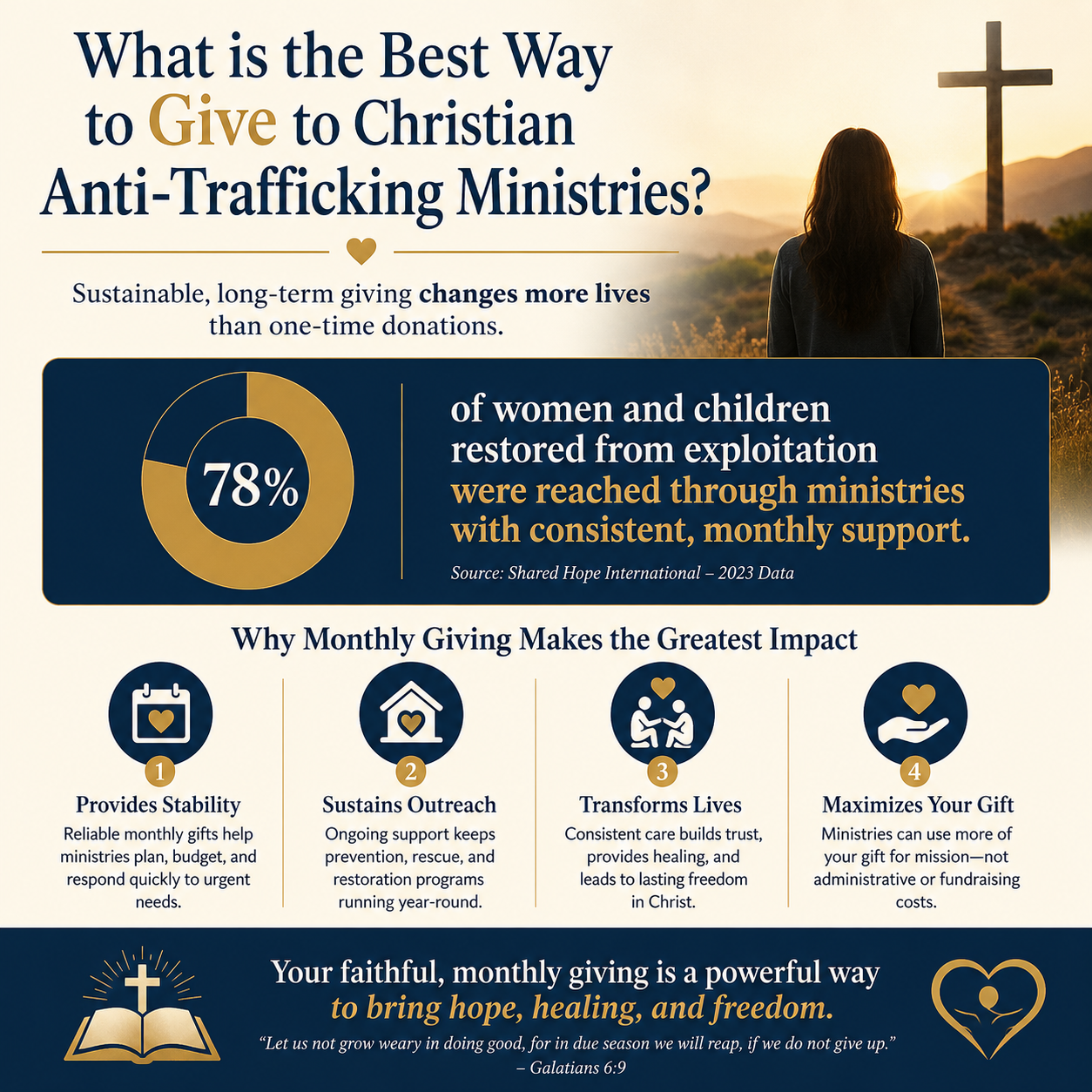
In practice, we recommend looking for a ministry’s clarity on where it operates in the continuum and whether it partners appropriately where it does not. A ministry that does one piece well and collaborates humbly can be more effective than a ministry that claims to do everything.
- Prevention: school-based education, foster-care supports, mentoring, family strengthening, and safe housing stabilization
- Identification and outreach: trauma-informed street outreach, hotline coordination, and credible referral networks
- Protection: crisis beds, safety planning, legal advocacy, and coordination with trained professionals
- Restoration: long-term housing, clinical counseling, discipleship that respects agency, and workforce development
- Systems change: training for hospitals, schools, and law enforcement; policy advocacy with measurable objectives
Ask for specificity on partnerships with law enforcement and clinicians
When ministries work alongside law enforcement, donors should ask how the ministry guards against retraumatization, protects survivor data, and avoids using spiritual pressure to secure cooperation. When ministries provide clinical services, donors should ask about licensure, supervision, evidence-informed modalities, and referral protocols for complex cases.
For donors new to the field, it can help to see how federal agencies frame the problem. The U.S. Department of State’s annual Trafficking in Persons Report offers country-level analysis and policy categories, and it also reflects ongoing debates about enforcement and victim protection; see: U.S. Department of State Trafficking in Persons Report.
Verify the ministry, not only the message
Trafficking work requires unusually strong governance and ethics
Anti-trafficking ministries often handle extraordinary levels of risk: vulnerable minors, confidential locations, sensitive records, and high-stakes coordination with public systems. That reality raises the bar for governance, internal controls, and ethical boundaries. Donors should not treat “security” as a blanket excuse for opacity. Appropriate confidentiality can coexist with meaningful transparency.
Across our verification work at Most Trusted, the ministries that meet The Most Trusted Standard tend to be clear about what they do, what they do not do, how referrals flow, and how they guard survivors from being used as fundraising proof. They are also willing to be evaluated. They provide policies, financial statements, board documentation, and evidence of leadership accountability without hostility toward scrutiny.
Apply The Most Trusted Standard as a donor discipline
The Most Trusted Standard is a 15-criteria framework across Faith Foundation, Financial Integrity, Governance and Leadership, and Transparency and Effectiveness. Donors do not need to become auditors to benefit from a disciplined approach. A few well-chosen questions can surface whether a ministry is formed by Christian integrity or driven by pressure to perform.
When a ministry is hesitant to share basic information—board oversight, safeguarding policies, audited or reviewed financials, how it counts “rescues,” what outcomes it tracks, and whether it has independent evaluation—donors should interpret that as a risk signal, not as persecution.
For donors comparing organizations in this space, it can be helpful to consult the broader context of Christian Anti-Trafficking Ministries to see the range of models, from survivor care to prevention to policy work.
Give in ways that strengthen the local church without bypassing expertise
Support healthy partnerships, not parallel kingdoms
Christian donors often hope anti-trafficking work will be explicitly connected to the church. That instinct is good: the local church is called to mercy, hospitality, and justice. Yet trafficking response also requires specialized competence. The best way to give is to strengthen partnerships where churches offer durable community, mentoring, and belonging, while trained professionals provide clinical care, legal advocacy, and case management.
A mature ministry will welcome the church’s presence while resisting the temptation to treat church volunteers as crisis responders. Volunteer engagement can be deeply meaningful when it is bounded, trained, and supervised. It can be damaging when it is improvisational.
Choose funding structures that match the work
Trauma care and safe housing do not conform to neat quarterly narratives. They require patient capital: multi-year general support, reserves for emergencies, staff retention, and clinical supervision. Restricted gifts can be valuable when they fund well-defined programs, but overly narrow restrictions can force ministries to chase donor preferences rather than survivor needs.
Many sophisticated donors also ask about “overhead.” The healthier question is whether the ministry is appropriately resourced for safeguarding, compliance, and competent staff. The sector has publicly warned against treating overhead ratios as a proxy for effectiveness; see the joint letter often referred to as the “Overhead Myth” statement from major charity evaluators and standards bodies here: GuideStar.
Donors who want to deepen their overall discernment in this area may also find the broader category of How to Give Wisely to Christian Anti-Trafficking Ministries helpful for comparing approaches and recognizing common risk patterns.
FAQs for What is the best way to give to Christian anti-trafficking ministries
Should donors prioritize rescue operations or survivor aftercare?
The wisest giving aligns resources with verified capacity. Some organizations are competent in investigation support and law enforcement coordination; others are competent in long-term housing, clinical care, and employment pathways. Because rescues without durable aftercare can leave survivors vulnerable, donors should ask how a ministry ensures continuity of care, informed consent, and safe referrals. A ministry that does one part well and partners credibly can be a better stewardship choice than a ministry that claims to cover the entire continuum without evidence.
What should a credible Christian anti-trafficking ministry be able to show donors?
At minimum, it should be able to describe a coherent model, safeguarding policies, governance oversight, and financial accountability, while protecting survivor confidentiality. It should explain how it counts outputs and outcomes, what it does to prevent harm, and how it works with qualified professionals and public systems. If “security” is used to avoid basic transparency about leadership, finances, or methodology, donors should treat that as a material concern.
Give with courage, and give with verification
Christian donors are right to feel the moral weight of trafficking. The best way to give is to insist that compassion be joined to truth: that ministries be theologically grounded, professionally competent, and accountable for both outcomes and ethics. When we give patiently, verify carefully, and fund what genuinely protects and restores image-bearers, our generosity becomes a form of justice that can endure.



