

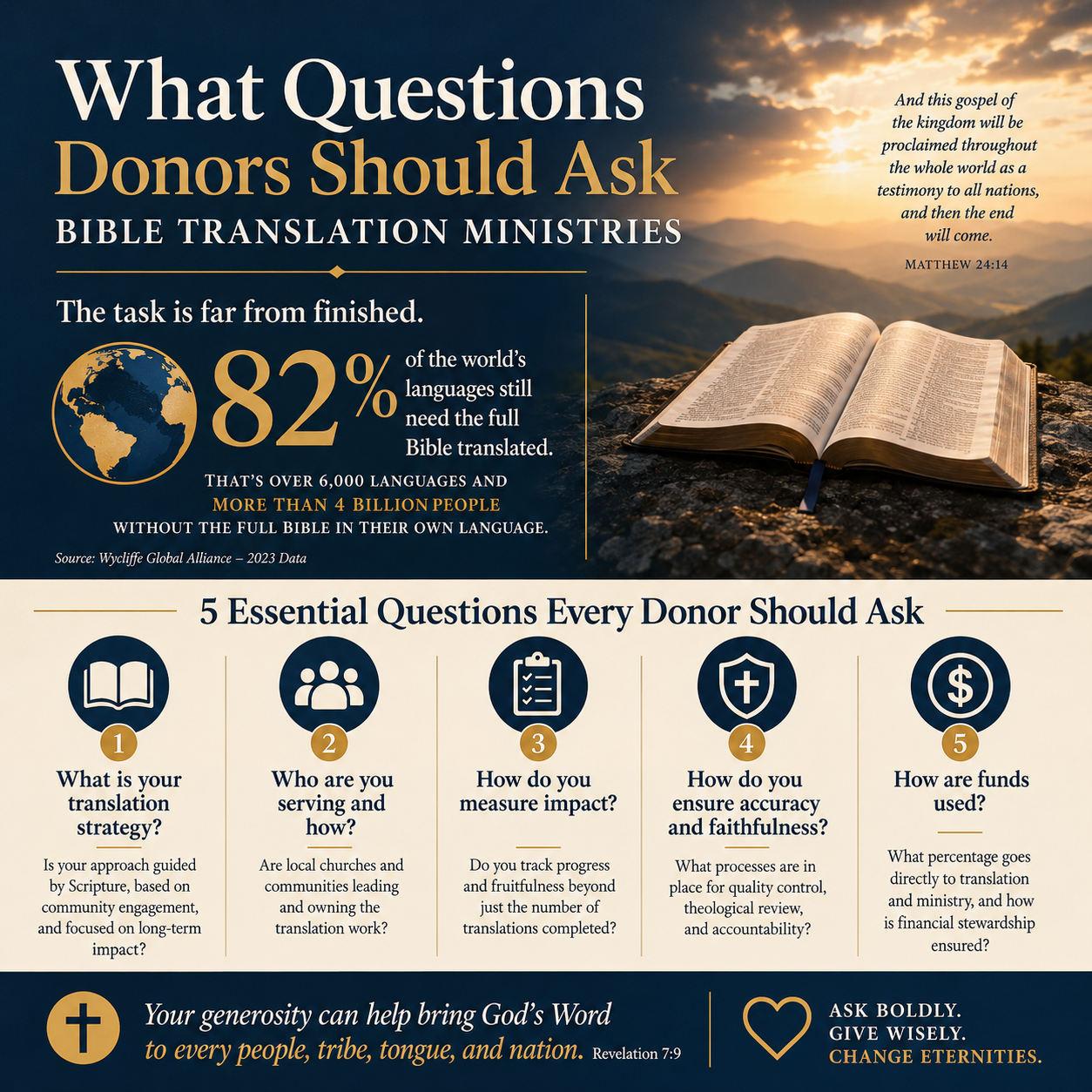
Wise giving to Bible translation ministries begins with questions. Not because the work is suspect, but because translating Scripture is a long, complex act of stewardship that blends theology, linguistics, pastoral formation, and institutional trust. The church receives the Word as a gift, yet donors still bear responsibility to discern whether a ministry’s methods, partnerships, and leadership are worthy of that trust.
Christian donors also carry a particular burden here: the outcomes are often difficult to measure, the timelines are long, and the stories can be emotionally compelling. Mature stewardship resists cynicism without surrendering discernment. “Test everything; hold fast what is good” is an apostolic instruction for the church’s life together, not only its doctrine (1 Thessalonians 5:21).
1. What authority does this translation serve
Ask where Scripture sits in the ministry’s theology
Bible translation is never merely a technical task. It is a ministry under authority: the authority of Scripture, the authority of the church catholic, and the authority of accountable leadership. A donor should ask whether the ministry’s doctrinal commitments are explicit, accessible, and operational. Do they affirm the inspiration and trustworthiness of Scripture in a way that shapes real decisions, or only in language designed to reassure?
We also recommend asking how the ministry understands the relationship between translation and the local church. Some organizations build directly for church planting and discipleship; others focus on supporting existing churches and denominations; others operate as linguistic service providers. These can all be faithful, but they are not interchangeable. A coherent model will be stated plainly and reflected in partnerships, staffing, and resource allocation.
Ask who is accountable for contested decisions
Christians genuinely disagree about translation philosophy, the boundaries of contextualization, and how to handle terms that carry theological freight across languages. A donor should not expect uniformity, but should expect transparent process. Who decides when an issue is disputed: local church leaders, a translation committee, expatriate consultants, a board, or an external review body? When a ministry cannot articulate decision authority, the risk is not only theological drift but also relational harm in the communities being served.
Across our verification work at Most Trusted, the ministries that meet The Most Trusted Standard tend to treat doctrinal clarity and accountable governance as a form of pastoral care. Scripture gives sobering warnings about teachers (James 3:1), and translation ministries are, in a meaningful sense, teaching ministries through the text they publish.

2. How does the ministry translate and who participates
Ask for a clear translation philosophy in ordinary language
Some donors have learned to ask whether a ministry translates “word-for-word” or “thought-for-thought.” Those categories are limited, but the instinct is sound: translation philosophy shapes the final product. A credible organization should be able to explain its approach without slogans. Does it prioritize formal correspondence where possible? Does it aim for naturalness and oral clarity? How does it handle poetry, idioms, and theological terms?
It is also appropriate to ask how the ministry treats the original languages and textual criticism. Donors do not need a seminar in Greek and Hebrew, but they should hear evidence of serious engagement with source texts and a documented process for resolving textual questions. Vague assurances are not enough when a community may live with a translation for generations.
Ask whether local voices are central, not symbolic
A translation that is not truly owned by local believers can become an artifact rather than a living Scripture for the church. Donors should ask who is on the translation team and what roles local translators and church leaders hold. Are local believers trained and paid fairly? Is their work reviewed with respect? Are women’s voices included where culturally and ecclesially appropriate, especially in domains like family life, lament, and community care where language often carries different registers?
A useful diagnostic question is whether the ministry can describe how the translation is tested with ordinary speakers. Does the organization do community checking, back translation, and comprehension testing? When comprehension problems emerge, is there humility to revise, or institutional pressure to publish?
- Who are the translators, and what training do they receive?
- Who reviews drafts, and what qualifications do reviewers hold?
- How does the ministry test comprehension with non-elite speakers?
- What is the plan for revisions and second editions over time?
- How does the ministry guard against political or factional capture in the local church?
3. What does faithfulness require beyond the printed text
Ask how translation connects to the life of the church
Donors sometimes assume the finish line is “a Bible in the language.” That is a necessary milestone, but not the whole ministry. Scripture is given to be read, heard, prayed, sung, and preached among God’s people. A wise donor asks how the ministry supports the church’s use of the translation: literacy programs, audio Scripture, training for pastors, Scripture engagement initiatives, and appropriate distribution.
Research has consistently highlighted that access alone does not guarantee engagement. The American Bible Society has documented long-term declines in Bible reading in the United States, a reminder that Scripture availability and Scripture use are distinct realities (American Bible Society). If access and engagement can diverge in a highly resourced context, donors should expect the same possibility in emerging contexts and ask how the ministry addresses it.
Ask how the ministry avoids creating dependency
Translation organizations often bring technical expertise, software, funding, and connections to printing and distribution. Those can serve the church well, but they can also unintentionally concentrate power. Donors should ask what happens when an outside organization leaves. Is there local capacity to maintain the translation, steward copyrights appropriately, train new translators, and integrate the work into local theological education?
This is where Christian donors benefit from broader wisdom in mission and development. The When Helping Hurts framework, articulated by Steve Corbett and Brian Fikkert, has shaped many Christian organizations’ thinking about paternalism and healthy partnership (When Helping Hurts). Bible translation is not exempt from these dynamics, even when intentions are faithful and the need is real.
4. How is the ministry governed and financed
Ask what financial integrity looks like in a long project
Bible translation projects are multi-year undertakings with legitimate costs: personnel, training, travel, review, technology, and at times literacy and distribution. Donors should resist simplistic rules of thumb that treat low overhead as synonymous with faithfulness. The stronger question is whether spending is coherent, documented, and honestly explained.
The nonprofit sector has publicly warned against reducing nonprofit quality to overhead ratios. Charity Navigator, Candid, and the BBB Wise Giving Alliance have argued that overhead-focused pressure can distort nonprofit behavior and reporting, which should concern Christian donors who care about truthfulness (Charity Navigator). A translation ministry should be able to explain what administrative costs actually support, how it allocates shared expenses, and how it prevents donor restrictions from undermining the real needs of the work.
Ask about governance, conflicts of interest, and spiritual authority
Translation ministries often operate across borders and denominational lines, which can complicate accountability. Donors should ask about board independence, conflict-of-interest policies, executive compensation oversight, and whether related-party transactions are disclosed. These questions are not secular distractions. They are practical expressions of biblical warnings about partiality, dishonest gain, and unchecked power.
We recommend reviewing whether the ministry publishes audited financial statements or, at minimum, reviewed statements by a qualified external firm, and whether it files and makes available required disclosures such as the Form 990 when applicable. When a ministry resists basic transparency, donors are left with branding rather than evidence.
5. What can be verified and what must be trusted
Ask for evidence that matches the stories
Bible translation ministries rightly tell stories: a first New Testament, a community hearing Scripture in its heart language, a pastor preaching from a text people understand. Stories are part of Christian testimony. Yet donors should also ask for verifiable indicators that the ministry is telling the whole truth. How many projects are in active translation, in review, in publication, and in revision? What delays are most common, and how does the ministry report them? What percentage of projects are paused, and why?
Some measures will be approximate, but credible organizations name limitations and still provide concrete reporting. They differentiate between “language has some Scripture,” “New Testament completed,” “full Bible completed,” and “Scripture engagement underway.” They do not inflate claims through ambiguous definitions.
Ask what the ministry discloses when outcomes disappoint
Faithfulness includes truthful speech when results are slower than hoped. Translation work can be disrupted by conflict, displacement, government restriction, team turnover, and local church division. Donors should ask whether the ministry reports setbacks in a way that invites prayer and accountability rather than concealing risk. A ministry that never admits to failure is not necessarily exceptional; it may simply be unaccountable.
For donors comparing organizations, it also helps to consult independent verification. Most Trusted exists to help Christian donors evaluate ministries against The Most Trusted Standard, examining doctrinal clarity, financial integrity, governance, and transparency in ways that move beyond marketing. Donors seeking broader context can also review the landscape of Bible Translation Ministries to understand common models and accountability signals across the field.
FAQs for What questions donors should ask Bible translation ministries
Should donors prefer one translation philosophy over another
Not automatically. Christians disagree about where the balance should fall between formal correspondence and functional clarity, and different audiences in the same language community may need different forms. The stronger donor question is whether the ministry can explain its philosophy, document its process, involve qualified local and external reviewers, and demonstrate that the final text serves the church’s teaching and worship without avoidable distortion.
Is it a red flag if a ministry spends heavily on administration or fundraising
High administrative or fundraising expense is not inherently disqualifying, but it requires explanation. Long-term translation work demands competent management, compliance, and cross-cultural coordination. Donors should ask whether costs are accurately reported, whether compensation and contracts are overseen with independence, and whether the ministry’s disclosures allow a reasonable person to understand how donor funds are used. For additional due diligence principles in this category, many donors consult How to Give Wisely to Bible Translation Ministries as a reference point for common questions and warning signs.
Stewardship that honors the Word and the church
Donors should ask Bible translation ministries questions that are equal to the weight of the work: questions about authority, process, local ownership, governance, and truthful reporting. The aim is not suspicion; it is faithfulness. The church has always received Scripture through providential means and human labor, and Christian stewardship treats that labor with reverence, accountability, and clear-eyed love for the people who will live under the Word.



