

Setting up recurring giving for Bible translation ministries is one of the most practical ways to align Christian generosity with the long horizons of Scripture work. Translation is rarely a one-season project; it is patient labor across years, teams, and communities, often in places where political uncertainty and economic fragility can disrupt progress overnight.
Recurring giving can also be spiritually clarifying. Jesus warned against anxious striving over money and trained his disciples in steady dependence and faithful stewardship (Matthew 6:19–34). A monthly commitment is not a badge of maturity, but it is a disciplined way to make room in the budget for what we say we value: that every people should hear “the mighty works of God” in their own language (Acts 2:11).
Why recurring gifts fit the realities of Bible translation work
Translation is a long obedience with many costs
Most donors first picture the final product: a printed New Testament, an audio Bible, a dedication service. The harder reality is that translation requires sustained inputs that are not optional. Teams need linguistics work, community testing, consultant checks, literacy training, Scripture engagement, and often audio and digital distribution. These are sequential and interdependent; gaps in funding can slow a project or force a ministry to shift staff time from translation into fundraising.
The ministries that endure over decades tend to be those that plan with sober realism. Recurring giving helps a ministry forecast cash flow, keep trained staff, and avoid reactive decision-making that can compromise quality. In our verification work at Most Trusted, we often see that strong ministries can articulate not only what they are doing, but why the sequence matters and what it costs to do it well.
Donor formation matters as much as donor convenience
Christians genuinely disagree about whether recurring giving risks turning generosity into an automatic transaction. That concern deserves respect. Yet Scripture commends regularity and intentionality in giving. Paul instructs the Corinthians to set something aside “on the first day of every week” so the offering is not a last-minute scramble (1 Corinthians 16:2). Recurring giving can be a modern equivalent of ordered generosity: planned, accountable, and integrated into ordinary life.
What this means in practice is that recurring giving works best when it is paired with ongoing prayer, attention to outcomes, and periodic reevaluation. The goal is not a frictionless donation. The goal is durable partnership in the gospel.

Choose the right ministry before you choose the right monthly amount
Start with theological and ecclesial clarity
Bible translation is not merely a humanitarian information project. It is a church-serving work that aims at worship, discipleship, and obedience. Donors should ask how the ministry understands Scripture’s authority, the role of the local church, and the relationship between translation and evangelization. A ministry can publish impressive numbers and still lack theological coherence or accountability to the Body of Christ.
We encourage donors to ground their discernment in the broader landscape of Bible Translation Ministries, including how different organizations define “reached,” how they partner with local believers, and how they handle contested questions such as contextualization and church planting strategy.
Then evaluate verifiable stewardship signals
Some donors have been trained to judge a nonprofit primarily by overhead ratios. The sector has had to reckon with how misleading that can be. Charity Navigator, Candid (formerly GuideStar), and BBB Wise Giving Alliance publicly cautioned that “overhead ratios” are a poor proxy for impact and can pressure organizations into unhealthy underinvestment in staff, systems, and evaluation Charity Navigator. Translation work, in particular, requires skilled labor and quality control; artificially low administrative spending can be a warning sign rather than a virtue.
At Most Trusted, we evaluate ministries against The Most Trusted Standard, a 15-criteria framework across four areas: Faith Foundation, Financial Integrity, Governance and Leadership, and Transparency and Effectiveness. For recurring givers, the key question is not “Is this ministry perfect?” It is “Is this ministry demonstrably trustworthy across the essentials, especially where incentives can distort reporting?”
How to set up recurring giving with integrity and staying power
Build a gift that you can keep through ordinary disruption
Recurring giving fails most often for mundane reasons: a bank change, a card expiration, a job transition, medical expenses. The remedy is not guilt; it is prudence. A recurring gift should be meaningful but not precarious. For some households, that will be a modest monthly amount with an annual increase. For others, it will be a quarterly or semiannual cadence that matches income patterns.
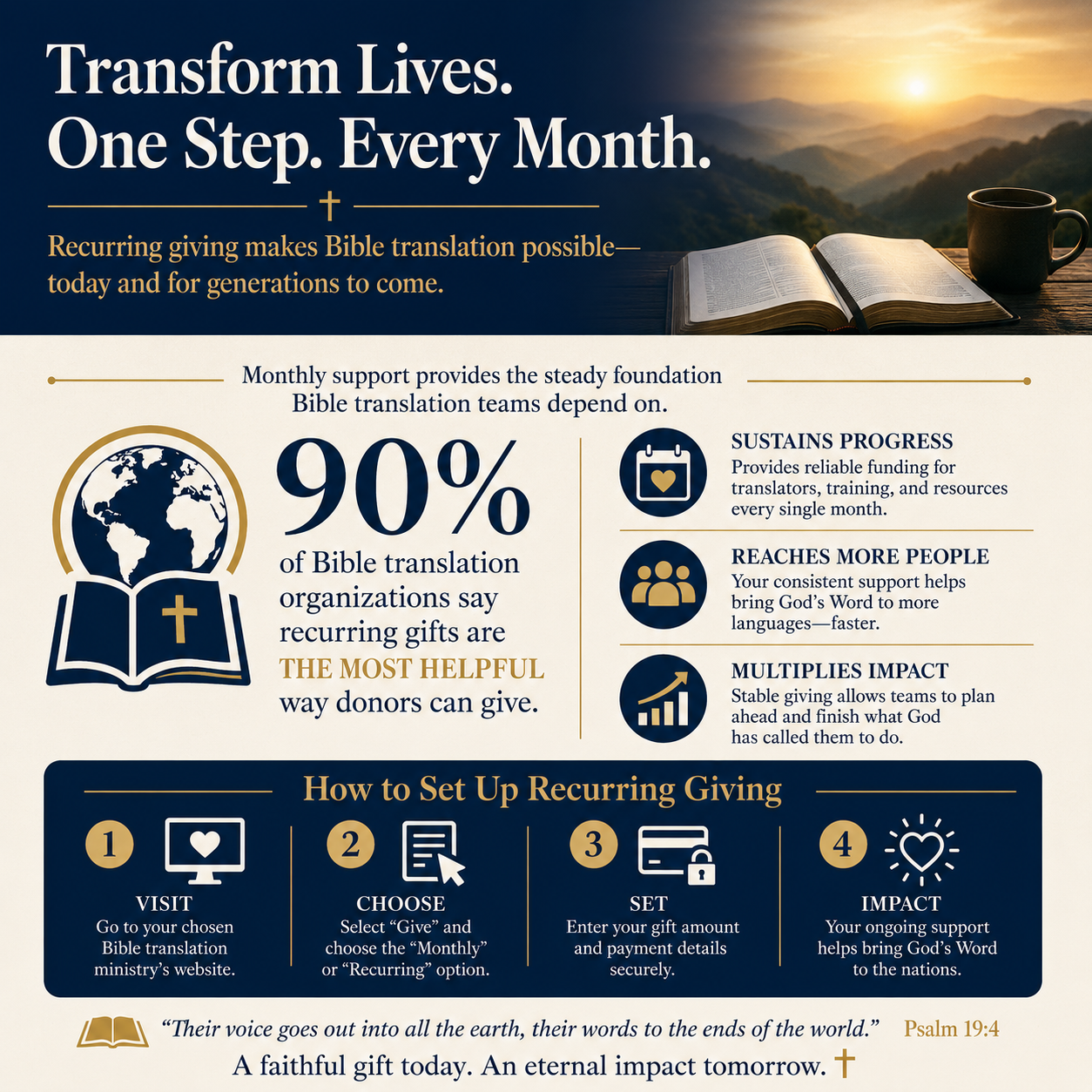
We recommend establishing a cadence that fits your household’s financial rhythms and your church commitments. If your giving plan competes with basic obligations, it is unlikely to be durable, and it may produce the very anxiety Scripture warns against.
Use guardrails that prevent drift
The discipline of recurring giving is strengthened by simple safeguards. A well-structured recurring gift is not merely automated; it is reviewed.
- Choose a date aligned with your budget cycle, not a random calendar day.
- Set a reminder for an annual review of the ministry’s reporting and doctrinal clarity.
- Confirm whether your gift is restricted to a fund or given to general operations, and understand the trade-offs.
- Prefer bank transfer or ACH when available, since it reduces card-expiration churn and processing costs.
- Designate a secondary contact email for receipts if one spouse manages household finances.
Restrictions deserve particular care. Donors often want to fund “a specific language” or “a specific project,” and that can be appropriate. Yet overly narrow restrictions can burden a ministry with fragmented funds that cannot cover core staffing or unexpected needs. General giving is not less faithful; it is often more realistic.
What to look for after you begin giving monthly
Reporting that respects donors without performing for them
Bible translation ministries face a genuine tension: donors want transparent reporting, but security and dignity concerns limit what can be publicly disclosed in sensitive contexts. Strong ministries handle this tension with clear categories: what they can share openly, what they can share privately with verified partners, and what they cannot share at all. Vagueness is not the same as security; donors should still expect coherent descriptions of methods, timelines, and independent checks on quality.
Across our work, ministries that meet The Most Trusted Standard tend to publish audited financials or clear financial statements, define outcomes beyond raw distribution counts, and explain how they collaborate with local churches and leaders. They do not treat donor communications as marketing. They treat them as accountability.
Impact that is measured with appropriate humility
Counting “Bibles printed” is straightforward. Measuring “Scripture received” is harder. The field has learned that access does not guarantee comprehension, and comprehension does not guarantee transformation. Yet it is still possible to report responsibly: literacy rates in the community, Scripture engagement initiatives, audio usage, church uptake, and the presence of trained local facilitators who can teach and disciple.
For perspective, many translation leaders reference the scale of remaining need through estimates on the number of languages without a full Bible or New Testament. These figures shift as language research improves and as projects begin and finish. Donors who cite such numbers should treat them as directional rather than as a scoreboard. One widely referenced set of global statistics comes from Wycliffe Global Alliance Wycliffe Global Alliance.
Prudence also includes watching for overconfident claims. When a ministry implies that translation alone will “reach a people group” or that a single product will produce predictable revival outcomes, we recommend caution. Scripture is powerful, and the Spirit gives life; ministries serve faithfully, but they do not control results (Isaiah 55:10–11; John 3:8).
How to integrate recurring giving into a wise Christian giving strategy
Hold together church, mercy, and mission without competition
Some donors hesitate because they feel pulled between local church giving, immediate needs, and long-term mission work like translation. The New Testament pattern is not a zero-sum competition among faithful commitments. The Jerusalem collection shows churches supporting distant believers in material need (2 Corinthians 8–9). The sending church at Antioch supported mission work beyond its region (Acts 13:1–3). A mature giving plan can honor local church priority while still participating in the global work of Scripture access.
For donors working through these allocations, How to Give Wisely to Bible Translation Ministries is a helpful frame for comparing ministries without reducing discernment to brand familiarity or emotional appeal.
Use verification to strengthen trust without outsourcing conscience
Independent evaluation is not a substitute for prayer, counsel, and theological conviction. Yet donors should not have to rely on impressions or polished storytelling when making recurring commitments. The purpose of verification is to make trust more evidence-based: governance that restrains conflicts of interest, financial practices that withstand scrutiny, doctrinal commitments that are stated plainly, and outcomes that are reported with integrity.
Most Trusted exists for this reason. Our aim is to help donors give with confidence by evaluating ministries against The Most Trusted Standard. For recurring giving in particular, the question is not only whether a ministry is doing good work today, but whether its structures make faithful work more likely tomorrow.
FAQs for How to set up recurring giving for Bible translation ministries
Should our recurring gift be restricted to a specific translation project?
Sometimes. Restricting to a specific project can connect donors to a clear outcome and can be appropriate when a ministry has a defined budget and credible timeline. But restrictions can also create operational strain when realities change: staffing turnover, security concerns, or shifting community needs. Many of the most prudent recurring gifts are given to general operations or to a broad translation fund, paired with regular reporting and an annual review.
How often should we reevaluate a monthly commitment?
We recommend an annual review as a baseline, with earlier review if there is a major life change or if the ministry’s reporting becomes unclear. An annual cadence is long enough to see meaningful progress in translation work and short enough to prevent drift. The review should include financial transparency, governance signals, and the ministry’s explanation of outcomes and challenges, not only celebratory stories.
A recurring gift is a form of long-term stewardship
Recurring giving for Bible translation ministries is not chiefly about convenience. It is a way to participate in work that requires patience, fidelity, and accountability over time. When donors choose a trustworthy ministry, set a sustainable cadence, and review their commitment with sober attention, monthly giving becomes a quiet form of Christian perseverance in the global work of the Word.



