

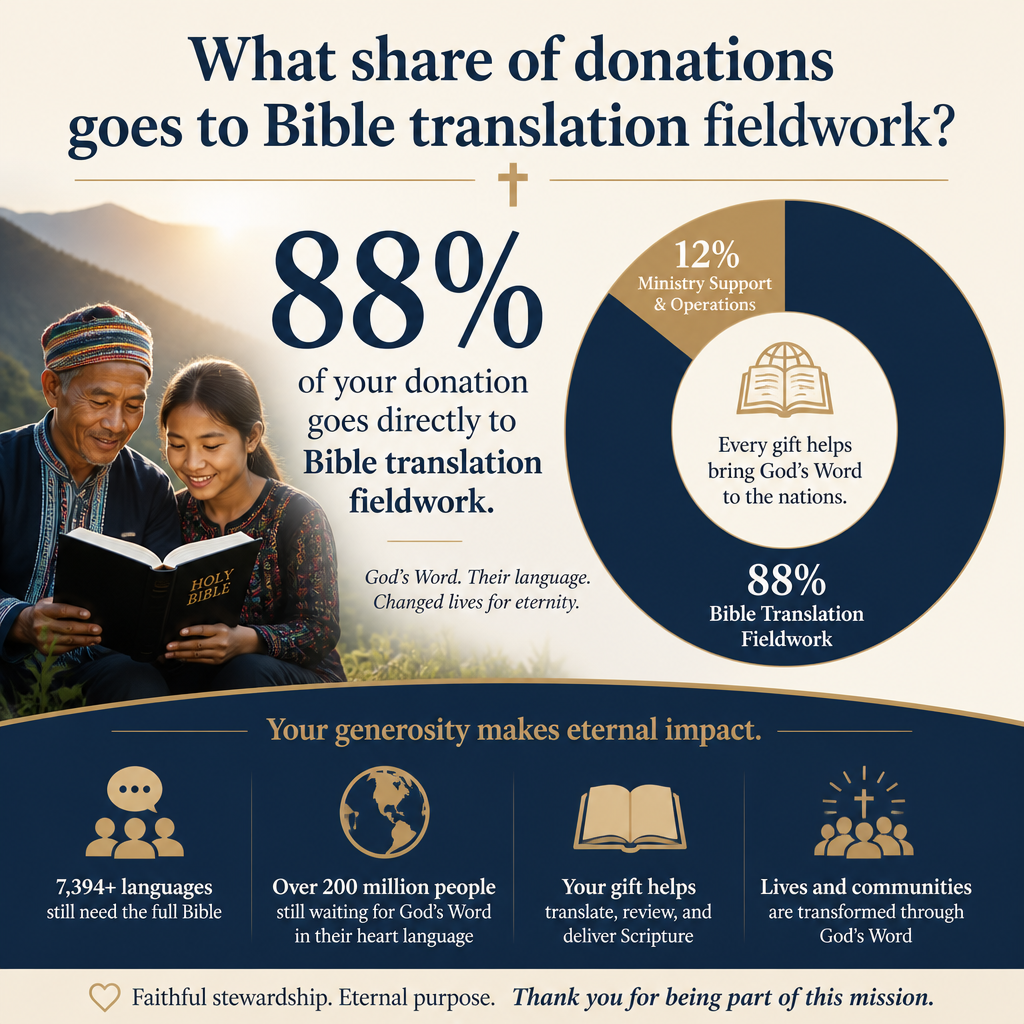
When donors ask what share of donations goes to Bible translation fieldwork, they are usually asking two questions at once: how much reaches the people doing on-the-ground translation work, and whether the ministry’s financial story is morally coherent. For Christian donors, that second question matters as much as the first. Scripture treats stewardship as worship, and Christian giving as an act accountable to God rather than a private preference (Luke 16:10–13).
The uncomfortable reality is that “fieldwork” is not a standardized accounting category. Translation organizations allocate costs differently, field teams are supported through different channels, and some essential work happens far from a village setting. The goal is not to chase a single percentage. The goal is to discern whether a ministry’s spending patterns match its stated mission and whether its reporting is sufficiently clear to be trusted.
Why the question is harder than it sounds
Most donors intuitively want a clean ratio: a high share to “fieldwork,” a low share to “overhead.” That instinct is not wrong. Waste and self-dealing are perennial temptations. Yet the field has also had to reckon with a modern error: treating administrative costs as inherently suspect, as though effective ministry could be sustained without finance, compliance, safeguarding, and honest measurement.
A widely cited corrective came in the “Overhead Myth” statement, signed by major nonprofit evaluators, which argued that overhead ratios are a poor proxy for impact and can pressure organizations into underinvesting in capacity and accountability. That statement is worth reading because it explains why mature donors ask better questions than “How low is overhead?” GuideStar
Fieldwork is a ministry reality, not a line item
In Bible translation, “fieldwork” can include community language development, literacy efforts tied to Scripture engagement, translator training, exegetical checking, consultant review, and Scripture testing with local speakers. Some of that work happens in remote settings; some happens in regional centers; some happens through digital collaboration. A ministry can be genuinely field-centered while still carrying meaningful costs in member care, security protocols, and quality assurance.
Different organizational models produce different percentages
Some organizations employ field staff directly. Others partner with national Bible translation organizations or church networks. Some operate as grantmakers that fund in-country teams. Each model changes what the audited financial statements will show. A grantmaking model may look “less field-heavy” if grants are categorized under program while field staffing sits inside partner organizations’ books, or it may look “more field-heavy” if most expenditures are direct grants to translation teams. The percentage is not irrelevant; it is simply not self-interpreting.
What a responsible percentage conversation can and cannot tell you
A credible discussion of “share to fieldwork” begins with clarity about what the donor is evaluating. Is the question about the portion of total expenses dedicated to mission programs? Is it specifically about expenses incurred in the country of translation? Or is it about the direct costs of translators and translation consultants as distinct from supporting functions?
Program expense ratios are a starting point, not a verdict
Many donors use Form 990 program-service percentages as an initial screen. That can be reasonable. Yet even here, donors should recognize the limits: the IRS categories are broad, and two organizations with equally faithful work may code similar expenses differently. A high program percentage can also be achieved by starving governance, underfunding internal controls, or failing to invest in safeguarding.
The wiser use of the ratio is comparative and contextual. If a Bible translation ministry reports unusually low program spending relative to peers, that warrants further questions. If it reports unusually high program spending, that also warrants questions: how are they funding risk management, finance, and field care, and are those costs being pushed into categories that obscure what is actually happening?
Christian donors should ask what faithfulness requires
In Acts 6, the early church created a governance solution so that daily distribution would be handled fairly and transparently, protecting both the vulnerable and the church’s witness. That passage is not about “overhead.” It is about integrity in operations. Translation work similarly requires structures that protect local communities, donors, and field teams, especially in complex contexts where security and cultural dynamics are real.
How to evaluate fieldwork spending without falling for the overhead trap
The strongest ministries do not ask donors to accept vague assurances. They publish enough detail to let serious readers follow the logic of their spending, including what they classify as fieldwork and why. Across our verification work at Most Trusted, the ministries that meet The Most Trusted Standard tend to treat financial transparency as part of discipleship rather than as a marketing tactic.
Ask for definitions that match ministry reality
A useful first step is requesting a clear definition of “fieldwork” from the organization. Does it include only in-country salaries and travel? Does it include translation consultants and quality review? Does it include Scripture engagement tied to the translation process? Mature organizations can answer plainly and consistently across annual reports, audited financials, and Form 990 narratives.
Look for evidence of disciplined transparency
When donors evaluate Bible translation ministries, we recommend reviewing several documents together: audited financial statements, Form 990, annual report, and project-level reporting where available. Consistency matters. If the story changes depending on the audience, that should reduce confidence.
- Clear definition of program categories and what is included in “field” spending
- Audited financials that align with donor-facing summaries
- Disclosure of related-party transactions and conflict-of-interest safeguards
- Specific reporting on progress and quality assurance, not only stories
- Evidence of appropriate investment in finance, governance, and safeguarding
Donors should also remember that credible watchdogs have urged the sector away from simplistic overhead fixation. Charity Navigator, BBB Wise Giving Alliance, and GuideStar jointly emphasized that overhead ratios do not capture impact or organizational health. Charity Navigator
Translation fieldwork includes real costs donors do not always anticipate
Some donor disappointment comes from a mismatch between expectations and the operational realities of translation. Bible translation is not only a spiritual endeavor; it is also a long, technical, community-embedded process. The question is not whether there are support costs. The question is whether those costs are ordered toward faithful, durable outcomes.
Quality and safeguarding are not optional
Faithful translation requires expertise, review, and accountability. Consultant checking, back-translation review, and theological consultation prevent avoidable errors that can harm churches for generations. Safeguarding policies and training protect local communities and field teams from misconduct and exploitation. These activities may not be labeled “fieldwork” in a donor’s imagination, but they are integral to field integrity.
Security and member care can be mission-critical
Translation in restricted environments introduces real risk. Responsible organizations invest in security protocols, crisis response, and pastoral care for workers under sustained stress. A low “support” budget in such settings is not a virtue. It may be a warning sign that a ministry is courting failure or placing people in avoidable danger.
For donors seeking a broader view of how to assess this sector without reducing everything to a single ratio, Bible Translation Ministries provides the wider ministry context in which financial questions should be interpreted.
What we look for when verifying Bible translation ministries
Most Trusted exists because donors should not have to choose between zeal for the Great Commission and prudence in stewardship. The Most Trusted Standard evaluates ministries across faith commitments, financial integrity, governance, and transparency with effectiveness. A percentage can prompt a question, but it cannot answer the deeper question of trustworthiness.
Spend patterns should align with the mission claim
If a ministry emphasizes “frontline translation,” we expect program descriptions and spending categories that reflect translation activity: local collaboration, translation personnel, checking and review, and in-context testing. If an organization emphasizes mobilization or advocacy, its expense profile may look different, and that can be legitimate if the messaging is honest and the outcomes are clear.
Weigh concentration, incentives, and clarity
Serious donors also ask about incentives. Does the organization’s funding model push it to overstate how much goes “to the field”? Does it have governance structures that reduce the temptation to manipulate categories? Do board oversight and audited statements show independence and rigor?
For donors comparing multiple organizations, How to Give Wisely to Bible Translation Ministries frames the kinds of questions that tend to distinguish marketing claims from verifiable stewardship.
FAQs for What share of donations goes to Bible translation fieldwork
Is there a healthy benchmark for what percentage should go to fieldwork?
A single benchmark is rarely responsible because “fieldwork” is not defined uniformly, and Bible translation organizations operate with different models. A more reliable approach is to compare an organization to similar peers, then test whether its definitions are consistent across audited financials, Form 990 reporting, and donor communications. High program spending can be healthy, but it should not come at the expense of governance, internal controls, safeguarding, and quality assurance.
What should raise concern when a ministry talks about fieldwork spending?
We become concerned when a ministry cannot define “fieldwork” clearly; when its donor-facing percentages do not reconcile with audited statements; when it treats questions as disloyalty rather than stewardship; or when it presents administrative and accountability functions as spiritually inferior. Mature organizations welcome scrutiny because they understand that Christian trust is strengthened by light, not by slogans (John 3:21).
A faithful answer is clearer than a single percentage
Christian donors are right to care what share of donations goes to Bible translation fieldwork, because money is never merely technical in Scripture. Yet the most faithful giving is not driven by an isolated ratio. It is driven by a clear account of what the ministry does, how it measures and reports, how it protects people, and whether its governance and finances can sustain the work with integrity. When those elements are present, donors can give with confidence that “fieldwork” is not being used as a rhetorical shortcut, but as a truthful description of mission carried out in the light.



