

What questions donors should ask Bible study ministry leaders is not a matter of skepticism for its own sake. It is a stewardship discipline: testing what is claimed, discerning what is actually being formed, and giving in a way that strengthens the church rather than subsidizing confusion. Bible study ministries can produce durable fruit—reverence for God, obedience shaped by Scripture, and humble love of neighbor—but they can also drift into content consumption, personality-driven teaching, or quiet doctrinal erosion.
Christian donors are not only funding curriculum, events, or platforms. We are funding formation. Scripture treats teaching as weighty work, and warns that those who teach will be judged with greater strictness (James 3:1). That sober reality does not require cynicism; it requires clarity. The most responsible ministries welcome serious questions because they share the same concern: that Christ’s people be built up in truth.
Begin with the gospel and doctrinal boundaries
What is the ministry’s doctrinal center of gravity
Many Bible study efforts can recite an orthodox statement of faith while operating with a different functional theology. Donors should ask leaders to define the gospel they proclaim and to describe, concretely, what doctrines are treated as essential, what is held with charitable conviction, and what is left to local church teaching. A ministry that cannot articulate its doctrinal boundaries will eventually borrow them from cultural pressure, market incentives, or the preferences of a charismatic teacher.
Useful questions sound like: What does this ministry affirm about Scripture’s authority, the person and work of Christ, salvation by grace through faith, and the nature of the church? How do leaders handle disputed issues among faithful Christians without turning secondary questions into tests of belonging? Christians genuinely disagree about interpretive frameworks, spiritual gifts, and certain questions of women’s roles. Mature leadership names those disagreements, teaches with conviction, and refuses to recruit donors by caricaturing other Christians.
How is Scripture handled in practice
Bible engagement is not merely quoting verses. Donors should ask how leaders interpret Scripture: whether they teach the genre, context, authorial intent, and canonical flow, or whether Scripture functions mainly as a source of inspirational lines. It is appropriate to ask for a sample of recent teaching and to evaluate whether the ministry models careful exposition or trains participants to treat the Bible as a mirror for self-affirmation.
It is also wise to ask how leaders guard against common distortions: prosperity teaching that turns faith into technique; therapeutic moralism that reduces Christianity to self-improvement; and politicized proof-texting that baptizes partisan identities. The question is not whether a ministry addresses money, anxiety, sexuality, justice, or public life. The question is whether Scripture governs the ministry’s conclusions, or whether Scripture is recruited to bless conclusions reached elsewhere.

Ask how the ministry relates to the local church
Does the ministry strengthen pastors and elders or compete with them
Some Bible study ministries are healthiest when they operate as servants of the church—equipping leaders, resourcing small groups, and honoring the pastoral office. Others, often unintentionally, pull Christians away from pastoral care by implying that the real feeding happens elsewhere. Donors should ask whether the ministry has formal accountability to a church or network of churches, and how it encourages participants to remain under shepherding.
When a Bible study leader is treated as the primary spiritual authority for thousands of people without meaningful oversight, the risk is not theoretical. Scripture assumes that teaching and authority are exercised within accountable structures. Donors should ask who can correct the ministry publicly, who can remove a leader if necessary, and what happens when controversy arises.
How does the ministry handle communion, baptism, and membership realities
Many Bible study initiatives serve Christians across traditions, and that breadth can be a gift. But donors should listen for theological coherence: does the ministry treat the church as a mere delivery channel for content, or as the body of Christ where Word and sacrament, discipline, and pastoral care shape believers over time? A ministry can be interdenominational without being ecclesially thin.
For donors who want to understand the wider landscape of this work, we maintain editorial coverage and verification categories under Bible Study and Engagement Ministries. The point is not to replace pastoral discernment, but to help donors ask better questions with integrity and charity.
Clarify what fruit is expected and how it is measured
Are leaders aiming at knowledge, obedience, or both
Bible literacy matters. Yet Scripture does not treat knowledge as an end in itself. Donors should ask what outcomes the ministry is seeking: increased understanding of the biblical storyline, disciplined habits of prayer and Scripture reading, growth in holiness, reconciliation in relationships, endurance in suffering, and engagement in mercy and evangelism. A ministry that cannot articulate outcomes beyond “more content consumed” may be training people to mistake familiarity for discipleship.
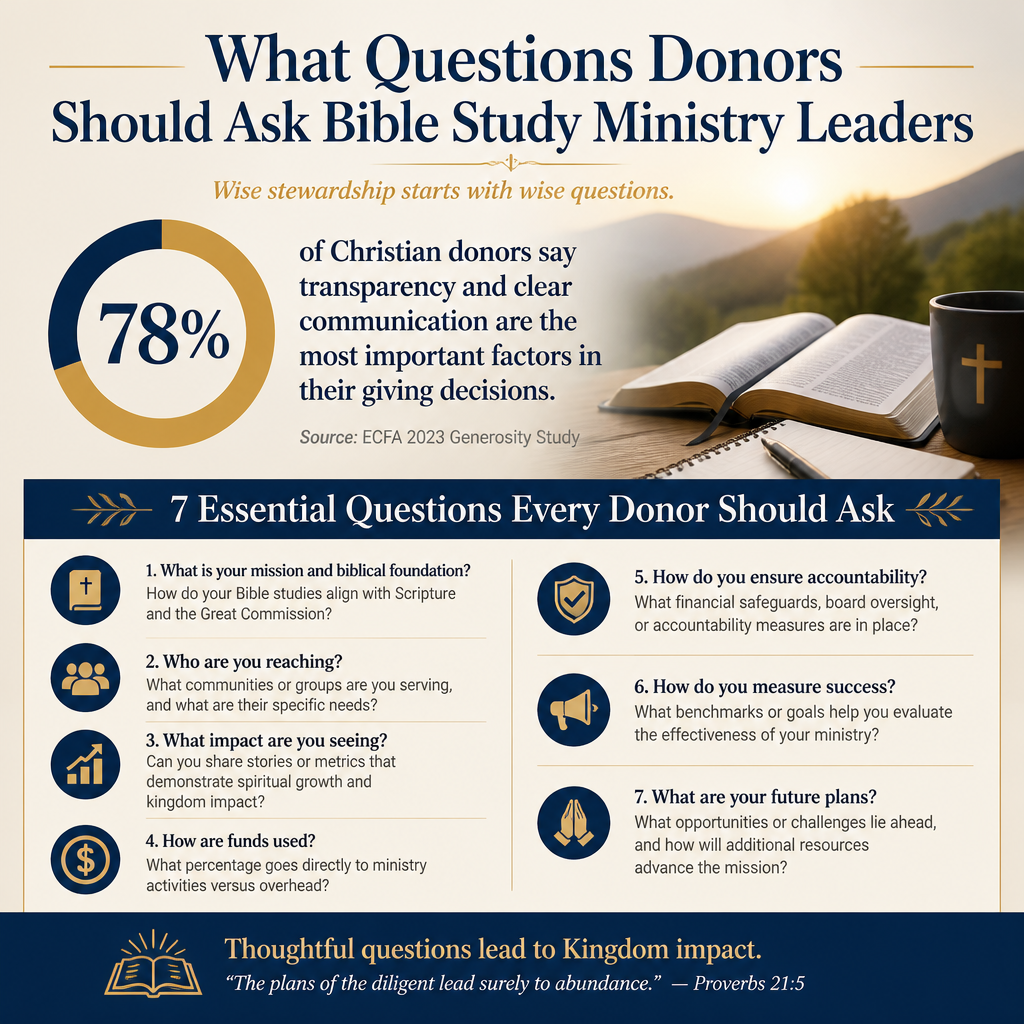
Measurement in spiritual formation is complex. Not everything worth counting can be counted well, and not everything that can be counted is worth counting. Still, donors can ask for credible signs of effectiveness. What does follow-up look like? Are participants connected to churches and accountable relationships? Does the ministry track completion rates, retention, and downstream engagement, while acknowledging the limitations of metrics?
What evidence is offered beyond platform scale
It is easy for ministries to present growth as proof of faithfulness. Scale can indicate real demand, but it can also indicate marketing sophistication. Donors should ask for evidence that content is understood and applied, not merely downloaded or attended. For digital Bible teaching in particular, leaders should be candid about the formation risks of one-way media and the need for embodied discipleship.
Broader patterns in American Bible engagement show why careful questions matter. In its annual State of the Bible research, the American Bible Society has documented significant shifts in Bible engagement in recent years, including declines in regular Scripture use among U.S. adults American Bible Society. Ministries addressing Bible engagement should be able to describe how their work responds to this reality with more than content volume.
Examine safeguards for leadership, money, and public trust
Who governs the ministry and how are leaders held accountable
Donors should ask about governance with the same seriousness they apply to doctrine. Who sits on the board, and are they independent of the founder? How often does the board meet, and what decisions require board approval? Is there a conflict-of-interest policy, and is it enforced? Healthy ministries do not treat governance as a technicality. They treat it as protection for the mission, the staff, and the credibility of the gospel before a watching world.
When leadership is concentrated in one personality, donors should ask what succession planning exists and how the ministry would respond to moral failure, doctrinal controversy, or financial crisis. The question is not whether leaders are imperfect. The question is whether the ministry is structured to tell the truth when truth is costly.
How transparent is the ministry about finances and fundraising practices
Christian donors should not be trained to accept vague assurances where Scripture commends honest dealing. Donors can ask for recent audited financial statements, the name of the audit firm, and a clear explanation of how funds are allocated across programs, administration, and fundraising. The field has learned to resist simplistic overhead fixation, especially after the Overhead Myth statement endorsed by major nonprofit evaluators argued that overhead ratios alone are a poor proxy for effectiveness Charity Navigator. Still, the rejection of overhead fixation is not a license for opacity. Mature transparency includes audited reporting, clear revenue sources, and plain explanations of major cost drivers.
It is also appropriate to ask how leaders communicate need. Do they use manipulative urgency, exaggerated claims, or guilt as a tool? Or do they invite generosity in a way that honors donors as stewards before God? A Bible teaching ministry should be especially careful that its fundraising reflects its theology.
- Can we review the last annual report and the most recent audited financials?
- Is there an independent board with relevant expertise and real authority?
- What related-party transactions exist, and how are they disclosed?
- How are staff compensation decisions made and documented?
- What is the policy for handling allegations, whistleblowers, and misconduct?
Probe the ministry’s approach to people, culture, and spiritual care
How does the ministry treat women, volunteers, and vulnerable participants
Bible study ministries often rely on volunteers, small-group leaders, and lay teachers. Donors should ask how these leaders are trained and cared for. Are they equipped in basic hermeneutics and pastoral sensitivity? Are they supported when participants disclose abuse, addiction, or severe mental health needs? A ministry that invites deep personal sharing must have referral pathways, safeguarding practices, and humility about what it can and cannot provide.
Donors should also ask how women are treated and represented, both theologically and organizationally. Faithful Christians differ on complementarian and egalitarian convictions, but there is no faithful Christian position that justifies coercion, silencing of legitimate concerns, or the use of power to protect reputations. A ministry’s internal culture will eventually surface in public.
Does the ministry handle controversy with truthfulness and repentance
Every ministry will face critique, missteps, and seasons of conflict. Donors should ask for examples of how leaders have responded when they were wrong: what they corrected, what they learned, and what structural changes followed. A pattern of deflection, secrecy, or adversarial posture toward questions is itself information. Ministries that prize Scripture should welcome the light.
For donors who want a framework for comparing ministries across these questions, Most Trusted evaluates organizations against The Most Trusted Standard, a 15-criteria framework that examines faith foundation, financial integrity, governance and leadership, and transparency and effectiveness. Many donors find it clarifying to separate sincere intentions from verifiable practices, especially in ministries built around teaching influence and donor trust. For giving decisions in this specific field, see How to Give Wisely to Bible Study and Engagement Ministries.
FAQs for What questions donors should ask Bible study ministry leaders
Is it uncharitable to press ministry leaders with detailed questions
Serious questions can be an expression of love for the church and respect for the ministry’s calling. Scripture commends testing what we hear and practicing wise stewardship, and sound leaders usually welcome clarity because it protects their mission. The tone matters: we can be direct without being accusatory, and humble without being passive.
What if a Bible study ministry has clear fruit but limited transparency
Visible fruit should be taken seriously, and donors can give thanks for it. Yet limited transparency is a real risk factor in any organization handling money, influence, and spiritual authority. A prudent approach is to ask for concrete documentation—governance policies, audited financials, accountability structures—and to scale giving according to what can be verified, not merely what is admired.
Giving that honors the Word and guards the witness
Wise support for Bible study ministries begins with a clear conviction: God’s Word is not a product, and discipleship is not a brand. Donors serve the church best when we ask questions that align theology with practice—doctrine with governance, teaching with accountability, and public claims with verifiable evidence. The goal is not to burden faithful leaders, but to strengthen the ministries that teach Scripture with integrity, handle money with honesty, and submit themselves to the kind of oversight that protects Christ’s people.



