
Why governance matters in Bible study and engagement ministries is not a bureaucratic question. It is a discipleship question, because governance shapes whether a ministry’s teaching, methods, and money remain accountable to the Lord it proclaims. A Bible ministry can have faithful content, talented communicators, and strong distribution, and still drift into patterns that harm donors, staff, local churches, and—most seriously—those being formed by Scripture.
Christian donors often want to fund what is spiritually fruitful and operationally competent. Yet Bible distribution and engagement work carries distinctive temptations: celebrity-driven platforms, rapid scale through media, cross-border delivery in hard contexts, and donor urgency created by real spiritual need. Governance is the ordinary means by which a ministry stays tethered to truth, submits power to accountability, and treats stewardship as a moral obligation rather than a technical requirement.
Governance protects doctrine and mission from drift
Bible teaching requires accountable authority
Many Christian donors assume governance is mainly about finances. For Bible study and engagement ministries, governance also functions as doctrinal ballast. Scripture warns that teachers will be judged with greater strictness (James 3:1). That warning is not only for the individual communicator; it presses on the structures that amplify and monetize teaching at scale.
A board that is independent, engaged, and spiritually mature helps a ministry hold its center when growth brings pressure to broaden message, avoid costly convictions, or chase engagement metrics. Christians genuinely disagree about secondary doctrines and ministry models. Governance cannot eliminate those differences, but it can require clarity: a defined statement of faith, a documented theory of ministry, and a decision process that does not allow a single founder or donor bloc to redefine the mission without scrutiny.
Mission clarity is how ministries say no
Bible engagement work is rarely short of opportunities: new translations, new platforms, new curricula, new partnerships. The harder discipline is restraint. Governance matters because it enables faithful “no” decisions—declining restricted gifts that would distort priorities, refusing partnerships that compromise integrity, and resisting expansion that a ministry cannot sustain responsibly.
Across our verification work at Most Trusted, ministries that meet The Most Trusted Standard tend to treat mission statements as operational boundaries, not marketing copy. They document what they do, who they serve, and what outcomes they expect, then review programs against that defined intent. The point is not to reduce spiritual work to spreadsheets; it is to prevent the quiet substitution of what is impressive for what is faithful.

Governance makes stewardship verifiable
Donor funds are a trust, not a revenue stream
Scripture frames stewardship in moral categories. “It is required of stewards that they be found faithful” (1 Corinthians 4:2). Donors give to Bible ministries because they believe the Word of God is living and active, and because they want their resources to serve that end without waste or misuse. Good governance turns that desire into verifiable practice: clear budgets, documented internal controls, conflict-of-interest policies, and independent financial oversight.
For U.S. nonprofits, IRS rules and public disclosures are part of this accountability. The IRS requires tax-exempt organizations to file an annual information return and specifies that most are publicly available, which is a baseline transparency expectation for donors who want to examine governance and finances firsthand IRS. A ministry’s willingness to be examined—without defensiveness or selective disclosure—often reveals more about its culture than any single number.
Overhead is not the enemy, opacity is
Christian donors sometimes equate governance with “overhead,” and overhead with unfaithfulness. That instinct is understandable, but it can mislead. Board development, financial audits, cybersecurity, and safeguarding policies cost money. The mature question is whether those costs are proportionate, supervised, and clearly explained, and whether they serve the ministry’s mission rather than insulating leaders from accountability.
The broader nonprofit sector has pushed back against simplistic overhead ratios for years. The “Overhead Myth” statement signed by GuideStar, Charity Navigator, and BBB Wise Giving Alliance argued that administrative and fundraising costs alone do not measure nonprofit performance, and urged donors to evaluate transparency, governance, and results instead Charity Navigator. For Bible ministries, this is especially important: the “efficient” ministry can still be spiritually reckless if it refuses oversight or lacks controls appropriate to its scale.
Governance disciplines power in leader-centered ministries
Charisma scales faster than character
Bible engagement ministries often grow through a powerful teacher, a compelling digital platform, or a recognizable brand. That is not inherently unhealthy; God gives gifts, and the church has always benefited from faithful teachers. The risk is that organizational authority becomes fused to a personality. When that happens, staff learn that loyalty matters more than truth-telling, and boards become ceremonial rather than supervisory.
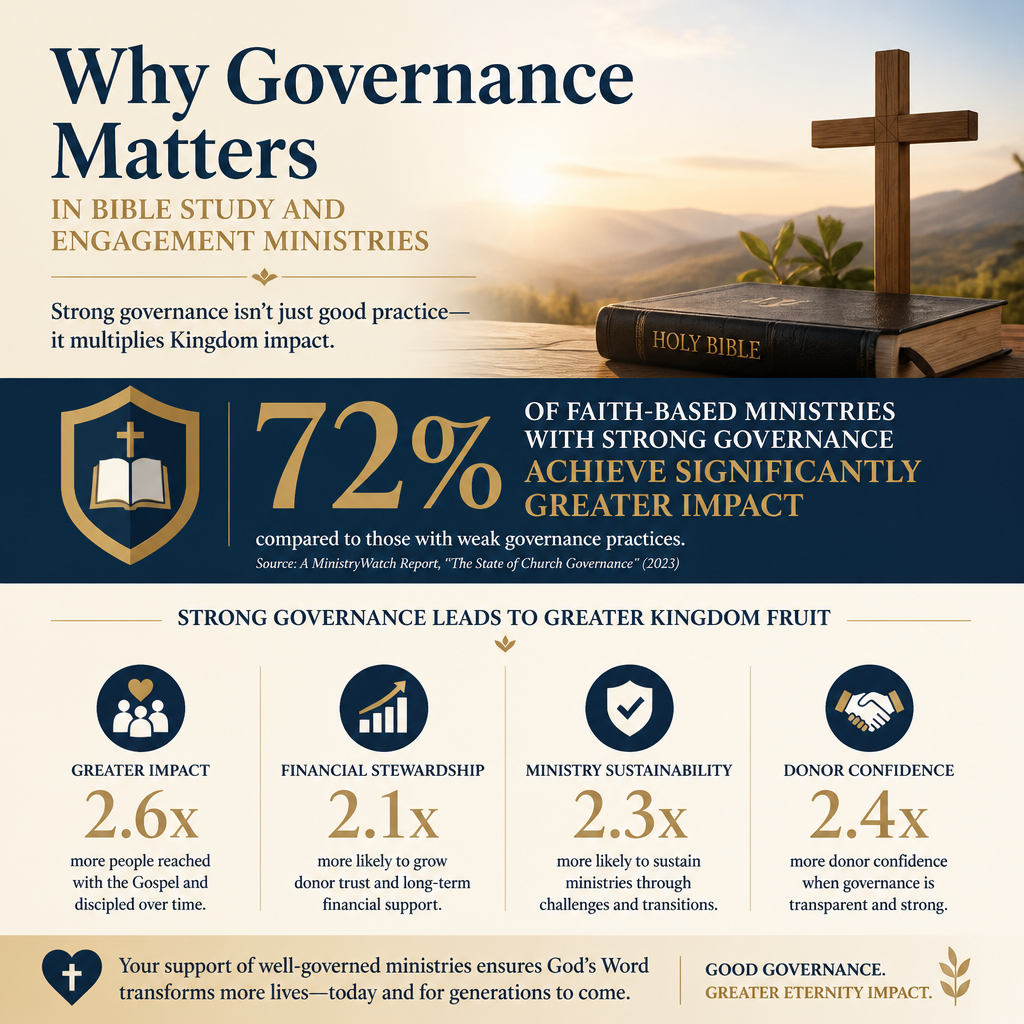
Good governance is not distrust; it is the institutional form of humility. It assumes leaders are finite, tempted, and capable of self-deception—precisely the anthropology Scripture teaches. A board that can evaluate the CEO, set compensation responsibly, and require independent review creates conditions where gifted leaders can serve without becoming untouchable.
Conflicts of interest must be treated as pastoral issues
In Bible-related ministries, conflicts of interest are often relational before they are financial: family members on staff, business dealings with friends, honoraria routed through affiliated entities, or board members who depend on the founder for influence. These realities do not automatically imply wrongdoing. But they are predictable pressure points, and governance exists to address predictable pressure points before they become scandals.
Donors should expect written conflict-of-interest policies, regular disclosures, board minutes that show deliberation, and clear boundaries around related-party transactions. When leaders resist these practices, it is rarely because they are too busy. It is usually because they do not want to submit authority to shared oversight.
Governance strengthens the ministry’s relationship with the local church
Para-church work needs real ecclesial humility
Bible study and engagement ministries often serve across denominational lines and outside formal church authority. That can be a gift: resources can be created once and distributed broadly; translation can reach places no single congregation could sustain; digital tools can equip scattered believers. Yet para-church reach can also create theological vagueness and a functional independence from pastoral accountability.
Governance helps clarify whether a ministry is positioned as a servant to the church or a substitute for it. Boards that include church leaders, or at least maintain meaningful relationships with local congregations, are better able to detect when programming inadvertently undermines pastoral discipleship. For donors who care about long-term formation, this question is central.
Healthy governance clarifies what the ministry can and cannot claim
Christian donors want to hear that “people are reading the Bible” and “lives are changed.” Those are appropriate hopes. The governance question is whether the ministry measures what it can responsibly measure, and avoids claiming more than it can substantiate. It is possible to distribute millions of Bibles and still have limited insight into whether recipients have access, literacy support, or community to sustain engagement. The gap between distribution and discipleship is not a reason to stop giving; it is a reason to govern claims carefully.
We encourage donors to spend time with the broader landscape of Bible Study and Engagement Ministries and ask how a particular ministry defines “engagement.” Mature governance will show up in honest reporting that distinguishes outputs (Bibles printed, lessons delivered, app downloads) from outcomes (habits formed, comprehension improved, sustained participation), and that names limitations without spin.
What donors should look for in governance
Signals of a board that actually governs
Many governance failures are not spectacular frauds. They are slow patterns: a board that never challenges management, vague policies, recurring “exceptions,” and a culture that treats questions as disloyalty. Donors do not need to become auditors, but they should know what healthy oversight generally looks like.
- Independent board composition with clear separation between governance and paid staff authority
- Documented conflict-of-interest practices with regular disclosures and enforcement
- Financial oversight that includes review of budgets, reserves, and restricted funds
- Leadership accountability including CEO evaluation and transparent compensation governance
- Safeguarding and reporting mechanisms for misconduct, retaliation, and serious complaints
How Most Trusted evaluates governance for donor confidence
Most Trusted exists to help Christian donors give with confidence. We evaluate ministries against The Most Trusted Standard, a 15-criteria framework spanning faith commitments, financial integrity, governance and leadership, and transparency and effectiveness. In governance specifically, we look for evidence that a ministry’s board is independent enough to supervise leadership, competent enough to understand risk, and spiritually serious enough to treat stewardship as obedience before God rather than mere compliance.
Donors sorting through options in How to Give Wisely to Bible Study and Engagement Ministries often ask for a simple shortcut: “Is this ministry safe?” Governance rarely allows that kind of simplicity. But it does allow clarity. A ministry either has structures that constrain power, document decisions, and submit to scrutiny, or it does not. The former does not guarantee fruit. The latter reliably increases the odds of drift and eventual harm.
FAQs for Why governance matters in Bible study and engagement ministries
Is governance still important if the ministry’s doctrine is sound?
Yes. Sound doctrine is essential, but it does not replace accountability structures. Governance is how a ministry ensures that doctrine remains operative when money, growth, and public pressure intensify. It also protects against ethical and financial failures that can discredit faithful teaching and wound the church.
What is a reasonable way for donors to assess governance without overstepping?
Donors can review publicly available filings, ask for annual reports, and read board and leadership disclosures when they are provided. It is also reasonable to ask a ministry how conflicts of interest are handled, whether financial statements are independently reviewed, and how serious complaints are reported and investigated. The goal is not suspicion; it is responsible stewardship.
Governance is a ministry of truth
Bible study and engagement ministries exist to bring people under the Word of God. Governance matters because it brings the ministry itself under the discipline of truth: truth about power, truth about money, truth about results, and truth about the limits of human leaders. Christian donors should expect that kind of accountability, not as a secular add-on, but as an expression of faithfulness to the God who sees and judges rightly.



