

What makes a Bible engagement ministry accountable is not primarily the polish of its materials or the size of its reach. Accountability is the disciplined willingness to be measured—spiritually, financially, and operationally—against claims a ministry makes about Scripture’s role in forming lives and communities. For Christian donors, that question is not abstract. Giving to Bible engagement is a vote of confidence that God’s Word will be taught faithfully, handled reverently, and stewarded responsibly.
Accountability is also harder here than it appears. Bible engagement ministries often work through local churches, schools, prisons, digital platforms, and translation partners, which means outcomes are partly shared and partly indirect. Christians genuinely disagree about what “success” should look like: doctrinal accuracy, literacy, daily habit formation, repentance, evangelism, justice, church renewal, or all of the above. Mature accountability does not flatten those debates; it names them, sets boundaries, and reports honestly within a coherent theology of Scripture.
Accountability begins with a serious doctrine of Scripture
Faithful teaching requires more than good intentions
A Bible engagement ministry should be accountable first for what it is asking people to believe about the Bible. Ministries that treat Scripture as the living and active Word of God (Heb. 4:12) should be able to articulate how their content is grounded in historic Christian orthodoxy, not in novelty or ideological fashion. That includes clarity on the gospel, the authority of Scripture, the role of the local church, and how the ministry handles contested interpretive questions.
In practice, doctrinal accountability looks like published statements of faith, transparent content standards, and identifiable theological oversight. A ministry may serve a broad coalition, but coalition work should still have boundaries: what is non-negotiable, what is secondary, and where the ministry grants freedom. When oversight is vague—“trusted leaders review our materials”—donors are left to trust a brand rather than a standard.
Translation and contextualization require guardrails
Many Bible engagement efforts now cross languages and cultures at scale. That is a gift to the global church, but it also raises real risks: theological drift in contextualization, weak partner vetting, or content exported without pastoral wisdom. The best ministries state how they select translation partners, how they resolve doctrinal disputes, and how they prevent local political pressures from bending biblical teaching.
Donors should not assume that “contextual” automatically means “faithful,” nor that “global” automatically means “healthy.” Accountability asks for evidence that the ministry can say no—to funding opportunities, influential partners, or viral distribution—when faithfulness is at stake.

Financial integrity is a theological issue, not a technical one
Money reveals what a ministry truly values
Scripture does not treat financial stewardship as a neutral administrative task. Jesus’ warnings about money are pastoral because money has formative power (Matt. 6:21). A Bible engagement ministry that teaches the Word should be especially committed to financial practices that can bear public scrutiny: clear budgeting, conflict-of-interest controls, truthful fundraising, and audited financials when scale warrants it.
At minimum, donors should expect current, accessible financial reporting and a coherent explanation of how funds flow from donors to programs. For ministries of meaningful size, an independent audit or review is often the responsible norm. The credibility of Christian witness is damaged when ministries speak of truth while obscuring financial reality.
Donors should reject both secrecy and simplistic ratios
Christians sometimes ask, “What percentage goes to overhead?” That instinct is understandable, but the modern nonprofit field has learned why overhead ratios can mislead. The “Overhead Myth” letter—signed by GuideStar, BBB Wise Giving Alliance, and Charity Navigator—warned that fixation on overhead can starve organizations of the infrastructure needed for effectiveness and accountability itself, including evaluation, security, and financial controls. See the letter on the Charity Navigator website.
What this means in practice is that donors should look for transparent explanation rather than a single benchmark. Healthy accountability reports what is spent on programs and why, what is spent on administration and fundraising and why, and how those costs serve mission rather than self-protection.
Governance and leadership must withstand the pressures unique to Bible engagement
A credible board is not a formality
Bible engagement ministries often grow quickly when content resonates or distribution channels open. Rapid growth amplifies risk: charismatic leadership becomes centralized, internal dissent is silenced, and donor confidence is leveraged to avoid scrutiny. Governance exists to prevent that. An accountable ministry has a functioning board with real independence, documented oversight, and the courage to correct leadership when necessary.
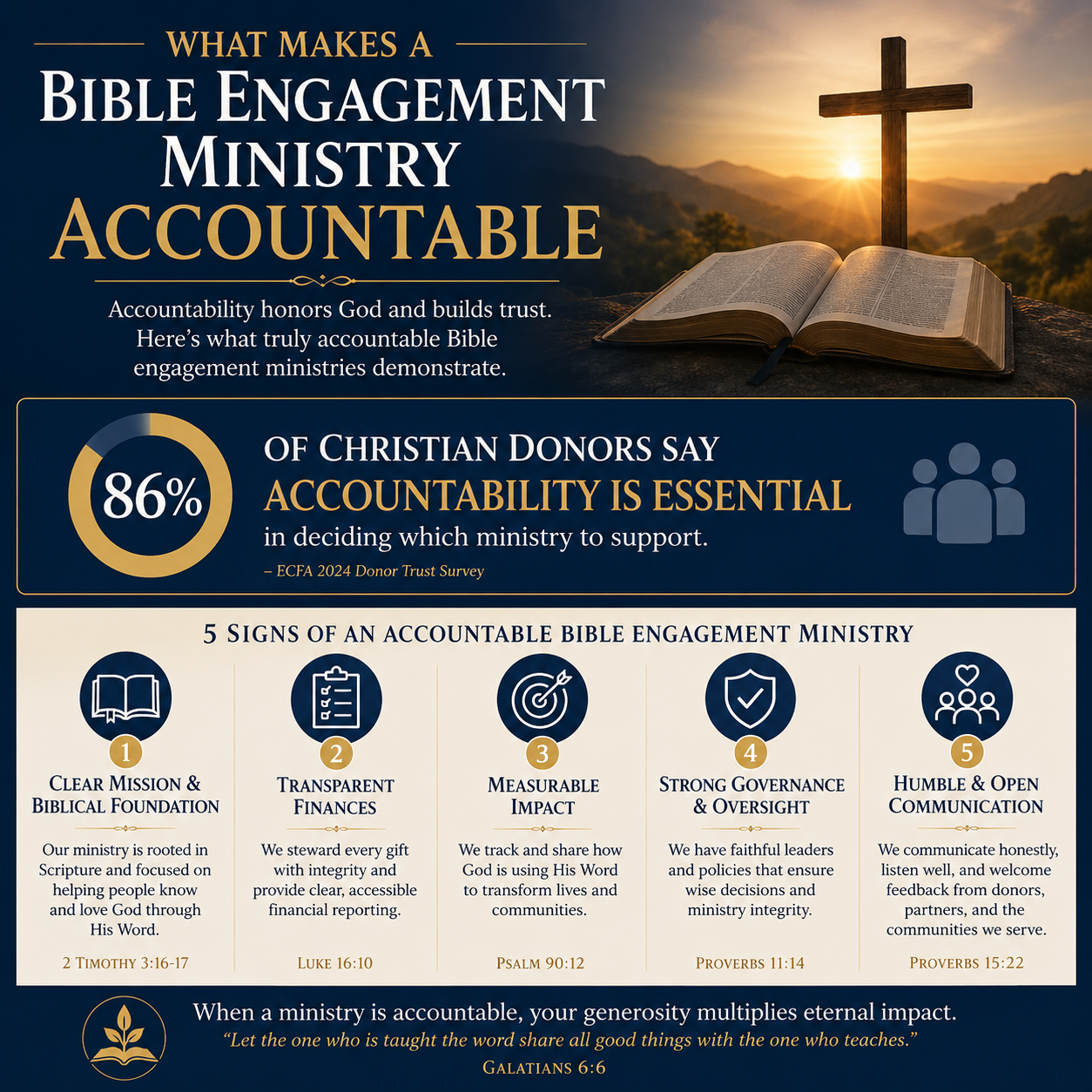
Donors should be able to identify who governs the organization, whether there are meaningful term limits, how conflicts of interest are handled, and whether executive compensation is set with independent review. These details are not distractions from ministry. They are part of loving one’s neighbor through institutional honesty.
Safeguarding people is part of biblical leadership
Many Bible engagement efforts involve children, vulnerable adults, incarcerated populations, and online communities. Accountability includes safeguarding policies, background checks where appropriate, reporting protocols, and training for those who teach and disciple. A ministry that cannot describe how it prevents spiritual abuse, misconduct, or manipulative fundraising has not yet faced the realities of ministry in a fallen world.
Donors should also watch for spiritualized language used to evade accountability: “touch not the Lord’s anointed,” “we are under attack,” or “questions undermine unity.” Scripture’s warnings about false teachers and the abuse of authority are direct, not delicate (2 Pet. 2:1–3). The mature ministry invites scrutiny because it fears the Lord more than reputational damage.
Transparency is the donor’s window into truthfulness
Clear public information is a baseline, not a bonus
Accountability is not only internal. It is also what a ministry is willing to make visible. An accountable Bible engagement ministry publishes clear leadership information, financial documents, program descriptions, and outcomes that match the claims made in fundraising. The donor’s ability to verify should not depend on personal connections.
For U.S. nonprofits, one practical check is whether required filings are available and current. The IRS requires most tax-exempt organizations to file annual information returns (commonly Form 990) and allows the public to review them. The IRS provides guidance on this public-disclosure expectation at IRS.gov.
Truthful fundraising avoids inflated stories and selective reporting
Bible engagement is vulnerable to a particular kind of exaggeration. It is easy to count distributions rather than actual use: Bibles shipped, app downloads, study guides printed, “decisions” recorded. Those numbers may describe activity without describing discipleship. An accountable ministry distinguishes outputs from outcomes and tells donors what it can and cannot claim.
The field has also had to reckon with testimonial storytelling that can slide into manipulation. Donors should expect consent practices, care for dignity, and restraint in using images or stories of children and vulnerable people. Christian witness should never require the commodification of suffering.
Effectiveness means measurable formation, not merely measurable reach
Accountable ministries define outcomes theologically and operationally
The Bible’s purpose is not merely information transfer. Scripture aims at worship, repentance, wisdom, and endurance (2 Tim. 3:16–17). An accountable ministry should therefore define outcomes that make sense both biblically and practically: increased Scripture literacy, sustained reading habits, integration into local church life, trained leaders who handle the text faithfully, and observable fruit consistent with the gospel.
Not every ministry can measure deep formation with scientific precision, and donors should be wary of ministries that pretend otherwise. But a ministry can still be accountable by stating the limits of measurement, collecting credible evidence, and resisting the temptation to make data serve marketing rather than truth.
What accountable evaluation often includes
Across our verification work at Most Trusted, the ministries that meet The Most Trusted Standard tend to treat evaluation as part of discipleship stewardship. Common indicators include the following:
- Clear theory of change connecting activities to intended spiritual and community outcomes
- Outcome measures that go beyond distribution counts, such as sustained engagement over time
- External feedback loops from churches and partners, not only internal staff reporting
- Integrity in reporting that includes setbacks, limits, and lessons learned
- Safeguards for data ethics in digital products, including privacy and consent
What this means for donors is that accountability is not the enemy of faith. It is a discipline of truthfulness. When ministries report only wins, they train supporters to fund narratives rather than realities.
FAQs for What makes a Bible engagement ministry accountable
Is a ministry accountable if it has a strong statement of faith but limited financial disclosure?
A strong statement of faith is necessary but not sufficient. Scripture binds truthfulness to the whole life of the church, including money and governance. When financial disclosure is limited, donors cannot reasonably assess whether the ministry’s practices align with its teaching. Mature accountability integrates theological fidelity with transparent stewardship.
What outcomes should donors expect a Bible engagement ministry to measure?
Donors should expect measures that distinguish reach from formation. Counting distributions, downloads, or attendance can be appropriate, but accountable ministries also look for sustained engagement, comprehension, leader development, and integration with local church discipleship where applicable. The most credible reporting explains what is being measured, why it matters biblically, and what the ministry cannot honestly claim.
Giving with confidence requires verification, not intuition
Christian donors give because they believe God’s Word accomplishes what he intends (Isa. 55:11). That conviction should not produce naïveté about institutions. Accountability is the practiced readiness to be examined: doctrine that can be tested, finances that can be traced, governance that can correct, transparency that can be verified, and effectiveness claims that can be supported.
For donors seeking to compare ministries in this space, we recommend starting with the broader landscape of Bible Study and Engagement Ministries and then applying practical discernment through How to Give Wisely to Bible Study and Engagement Ministries. Most Trusted exists to serve that work of stewardship by evaluating ministries against The Most Trusted Standard, so giving can proceed from confidence grounded in truth.



