
What prison ministry programs help incarcerated mothers most are the ones that treat motherhood as both a spiritual calling and a disrupted relationship that can be repaired with patient, accountable support. Donors often ask for “what works,” but the deeper question is what is faithful to Scripture and credible in practice when trauma, addiction, court timelines, and child welfare systems all intersect.
When Jesus names “I was in prison and you visited me” as a mark of discipleship, he places prison ministry among the Church’s core works of mercy, not its optional interests (Matthew 25:36). For mothers, visitation is rarely only presence; it is also advocacy for reconciliation where possible, protection where necessary, and a long road of formation in Christ that does not collapse into sentimentality.
Start with the actual problem a mother faces in prison
A mother’s incarceration is not a single crisis. It is a chain of losses: daily contact with her children, authority to make decisions, stable housing, employment history, and often a sense that she has any rightful claim to hope. Programs that help must respond to this layered reality rather than offering only a general Bible study or only a general reentry plan.
Across our verification work at Most Trusted, we see that strong ministries name the hard constraints plainly: limited visiting hours, facility lockdowns, restrictions on physical contact, and the presence of unresolved domestic violence, substance use disorders, or mental illness. They do not promise more than the justice system and family systems can deliver, and that restraint is part of their integrity.
Motherhood in prison includes legal and relational complexity
Some mothers can reunify; others should not. Christians genuinely disagree about how strongly a ministry should advocate for reunification in every case, but the field has had to reckon with the reality that “family preservation” language can be misused when it ignores child safety. The best programs cooperate with child welfare professionals and insist on truth-telling, not simply positive messaging.
What a donor should look for before program descriptions
Before a ministry describes its classes or events, it should be able to explain its theory of change in ordinary language: what it believes needs to change in a mother, what supports are required, what outcomes it tracks, and what it will not do. Ministries that meet The Most Trusted Standard tend to be clear about spiritual formation and equally clear about safeguards, partnerships, and measurable follow-through.

Prioritize programs that protect the mother child bond without romanticizing it
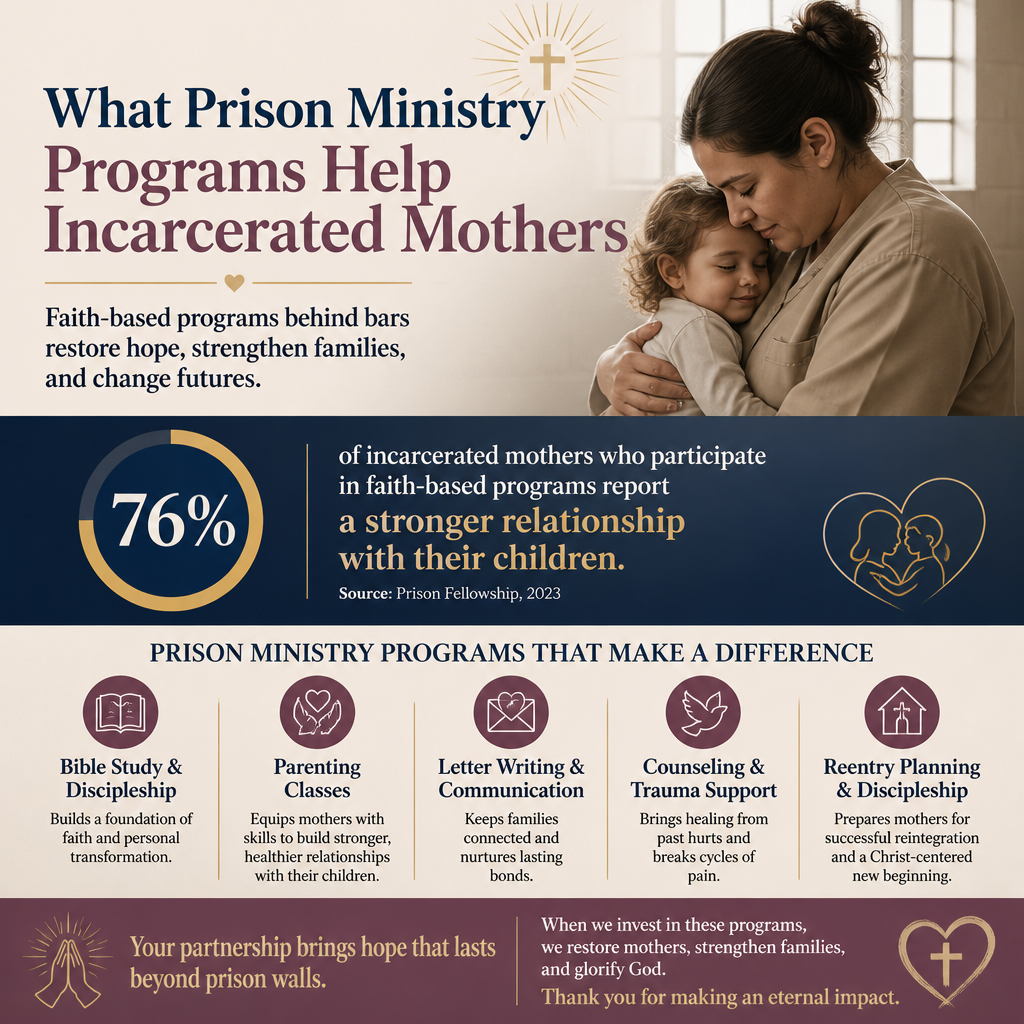
Programs focused on parenting and family connection are often the most immediately relevant for incarcerated mothers, but not all “parenting programs” are equal. The most helpful approaches address attachment, trauma responses, and practical communication in ways that fit incarceration’s constraints.
Evidence based parenting education with a trauma lens
Donors should favor ministries that deliver established parenting curricula in collaboration with correctional staff or licensed providers, especially when those curricula are paired with pastoral care. Parenting classes alone cannot undo years of instability, but they can give mothers shared language, concrete skills, and a pathway to accountability. When programs are credible, they can also be recognized by courts or child welfare agencies, which may matter for a mother’s case plan.
Supported contact with children when appropriate
In some facilities, programs help facilitate child-friendly visiting spaces, structured family days, or coached letter-writing and phone calls. These efforts matter because maintaining family connection is associated with lower recidivism. The Bureau of Justice Assistance has summarized research indicating that incarcerated people who receive visits can be less likely to reoffend and more likely to succeed in reentry, though results vary by context and study design (Bureau of Justice Assistance).
Where reunification is unsafe, ministries serve mothers by helping them grieve honestly, pursue repentance, and seek the child’s good without manipulation. Christian compassion is not permissiveness. It is love ordered toward truth.
Support spiritual formation that is durable under pressure
Many prisons offer religious programming; fewer offer discipleship that is deep enough to withstand the pressures of incarceration and the shock of reentry. For incarcerated mothers, spiritual formation must speak to shame, identity, and the long work of rebuilding trust with children and caregivers.
Gospel centered discipleship with clear ecclesiology
Programs that help most are explicit about the gospel and connected to the local church. A ministry can be active inside a facility and still leave a woman isolated after release if it does not build bridges to congregations that will receive her with wisdom and boundaries. Donors should ask how the ministry understands baptism, membership, pastoral authority, and ongoing discipline and care.
Pastoral care that integrates repentance and repair
For mothers, repentance is often not an abstract doctrine. It includes making amends, accepting consequences, and learning to give children what they need rather than what the mother wants to feel. Programs that hold together confession, forgiveness, and restitution reflect the moral seriousness of Scripture without denying grace.
When donors want a framework for avoiding harm, the “helping” literature is instructive. The When Helping Hurts framework, articulated by Steve Corbett and Brian Fikkert, has shaped many Christian approaches by warning that assistance can reinforce dependency or paternalism if it is not rooted in dignity and mutual responsibility (When Helping Hurts).
Invest in reentry support designed for mothers not generic returning citizens
Reentry is where many prison ministry efforts fail, not because the gospel is insufficient, but because the practical obstacles are severe. Mothers frequently return to unstable housing, limited employment options, and family systems that have adapted to life without them. If their children are in kinship care or foster care, the timelines and requirements can be unforgiving.
Housing and employment pathways that account for custody realities
Programs help when they coordinate transitional housing, job readiness, and employer partnerships with the mother’s custody and visitation plan. A job that requires night shifts may conflict with supervised visitation schedules. A housing placement may be disqualifying if it is near a victim or violates parole restrictions. Donors should look for ministries that do detailed case management rather than offering only inspirational events.
Recidivism is shaped by many variables, but the scale of the challenge is well documented. The U.S. Bureau of Justice Statistics reported that people released from state prisons had high rates of rearrest over the years following release, underscoring why reentry supports must be realistic and sustained (Bureau of Justice Statistics).
Family reunification support coordinated with child welfare systems
Where reunification is the goal, credible programs help mothers understand case plans, attend required classes, comply with supervision, and communicate appropriately with caregivers and caseworkers. They also help churches understand the difference between hospitality and naivete. For donors concerned about effectiveness, this is a key question: does the ministry have a disciplined process for coordinating with agencies that hold legal authority, or does it operate as if spiritual sincerity alone resolves custody barriers?
For broader context on the ecosystem of prison and reentry work, we maintain coverage of Prison and Post-Prison Ministries that helps donors compare models without flattening the differences among them.
Choose programs with safeguards, partnerships, and verifiable accountability
Prison ministry to mothers attracts deep donor sympathy, and sympathy can be manipulated. Programs can overstate outcomes, blur boundaries with vulnerable families, or operate without adequate governance. Mature giving asks not only whether a ministry’s mission is moving, but whether it is trustworthy.
Safeguarding children and honoring victims
Some incarcerated mothers are also victims of abuse; some have perpetrated harm. Ministries should have policies that address mandated reporting, domestic violence dynamics, and appropriate communication with minors. Donors should expect written safeguarding practices and training, not verbal assurances. Where ministries facilitate family contact, they should be explicit about who approves contact and how they document it.
What to ask a ministry before funding
- How do you define success for incarcerated mothers, and what outcomes do you track over time?
- How do you coordinate with prison chaplains, correctional leadership, parole, and child welfare agencies?
- What safeguards protect children and caregivers, especially when reunification is contested?
- How is your program staffed, supervised, and trained for trauma and boundary-setting?
- What financial reporting and governance practices can you share without qualification?
At Most Trusted, we evaluate ministries against The Most Trusted Standard, a 15-criteria framework across faith foundation, financial integrity, governance and leadership, and transparency and effectiveness. Donors do not need perfection, but they should insist on clarity, accountability, and evidence that a ministry’s compassion is matched by operational maturity.
Donors especially focused on mothers and women can also review our coverage of Prison Ministry for Incarcerated Women and Mothers, where we distinguish between common program types and the oversight practices that tend to keep them healthy.
FAQs for What prison ministry programs help incarcerated mothers
Are parenting classes in prison actually helpful for mothers?
They can be, when they are more than generic encouragement. The most helpful programs use established curricula, account for trauma and addiction, and connect the mother’s learning to real steps required by supervision or child welfare case plans. Donors should ask whether the ministry can describe how skills are practiced and reinforced after release.
Should Christian donors prioritize reunification programs above all else?
Not in every case. Reunification can be a faithful goal when it serves the child’s safety and long-term flourishing, but Christian compassion also requires protecting children and honoring lawful authority. The best ministries neither idolize reunification nor dismiss it; they pursue what is possible with sobriety, and they provide pastoral care when reconciliation cannot occur.
Faithful help is measurable, patient, and accountable
Prison ministry programs that help incarcerated mothers combine spiritual seriousness with practical competence: discipleship that addresses shame and repentance, parenting support that respects child safety, and reentry care that anticipates the constraints of housing, employment, and custody. Donors serve these mothers well by funding ministries that can demonstrate disciplined partnerships, safeguarding practices, and outcomes consistent with their claims. That is not a secular demand for proof; it is Christian stewardship applied to a work of mercy Jesus himself commended.



