
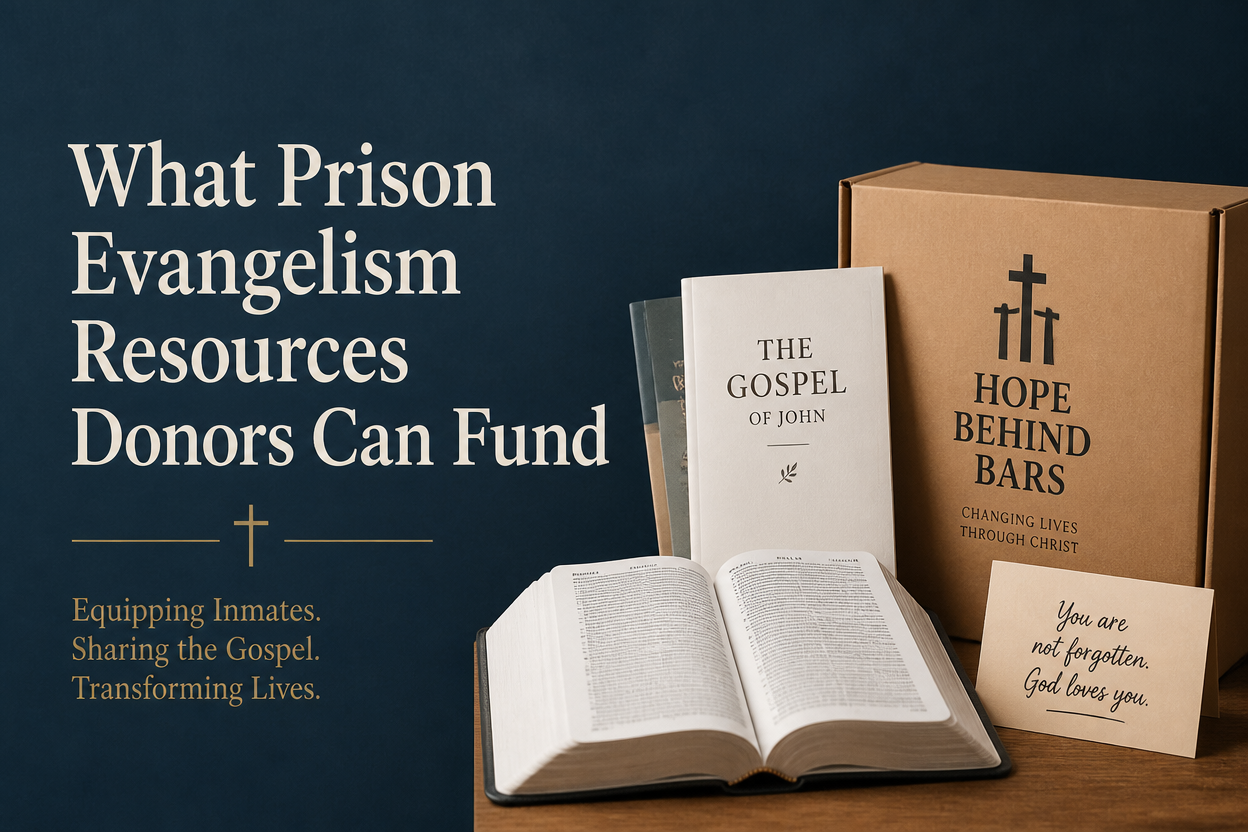
When Christian donors ask what prison evangelism resources donors can fund, they are often trying to honor two biblical imperatives at once: the Great Commission and Jesus’ insistence that going “to those in prison” is a mark of discipleship (Matthew 25:36). The question is not whether prison evangelism matters. The harder question is what kinds of resources actually serve incarcerated men and women with integrity, theological seriousness, and measurable care.
Prison ministry also sits inside a system with real constraints. Access varies by state and facility. Programs can be suspended without warning. Contraband concerns and security protocols shape what can be distributed and how volunteers can serve. Faithful funding does not ignore these realities; it chooses resourcing strategies that respect the institution, protect incarcerated people from manipulation, and keep the gospel central rather than transactional.
1. Fund evangelism that treats the local church as the center of gravity
Christian prison outreach is strongest when it is not a standalone “event ministry,” but an extension of the church’s ordinary life: proclamation, discipleship, sacraments where possible, and long obedience in the same direction. Many facilities allow outside volunteers precisely because they offer stability and reduce disorder; donors should prioritize ministries that can demonstrate consistent presence and accountable leadership.
Across our verification work at Most Trusted, ministries that meet The Most Trusted Standard tend to describe their evangelism goals with doctrinal clarity and practical humility: they can explain what they mean by conversion, how they teach Scripture over time, and how they avoid confusing emotional response with spiritual regeneration.
Support chaplain partnership and facility credibility
In many prisons, the chaplain’s office is the gatekeeper for religious programming. Effective ministries do not treat chaplains as obstacles to bypass but as institutional partners to honor. That means resourcing staff time for volunteer coordination, background checks, training, and communication practices that reduce burdens on already thin prison staff. Donors should ask whether a ministry can name the facilities it serves, how long it has served them, and how it handles program suspension or disciplinary issues.
Prefer year-round discipleship over one-time rallies
Large evangelistic gatherings can be appropriate, but they are rarely sufficient. Recidivism is shaped by many factors beyond faith commitments, and the research community remains cautious about attributing outcomes to a single spiritual intervention. What donors can responsibly fund are the steady inputs: Scripture engagement, mentoring, and pastoral care over months and years.
2. Resource Scripture access and theological formation that can endure transfer and lockdown
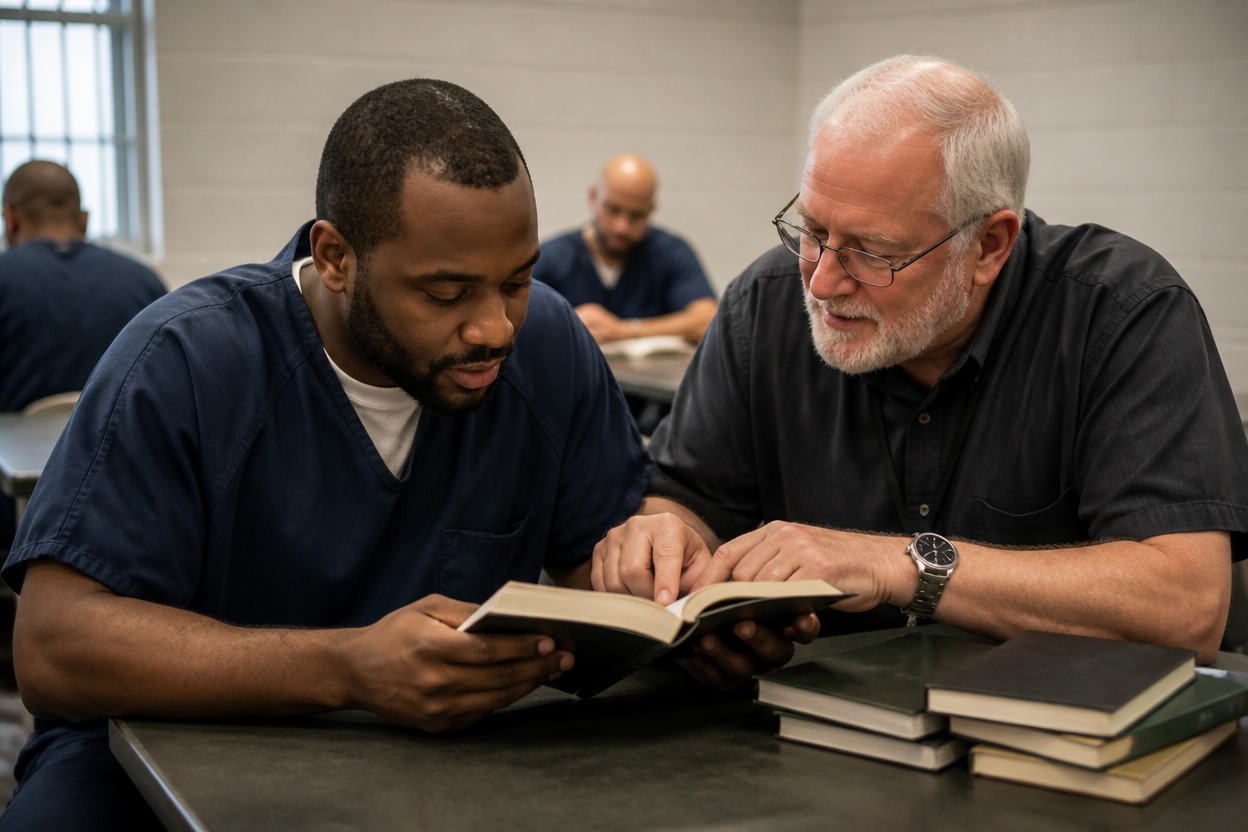
Incarceration is often marked by dislocation: transfers, lockdowns, and restricted movement. Prison evangelism resources that endure those disruptions are disproportionately valuable. Bibles, correspondence discipleship, and structured curricula can continue even when group meetings are canceled. The aim is not merely distribution; it is formation rooted in the Word of God.
Provide approved Bibles and study materials that match prison regulations
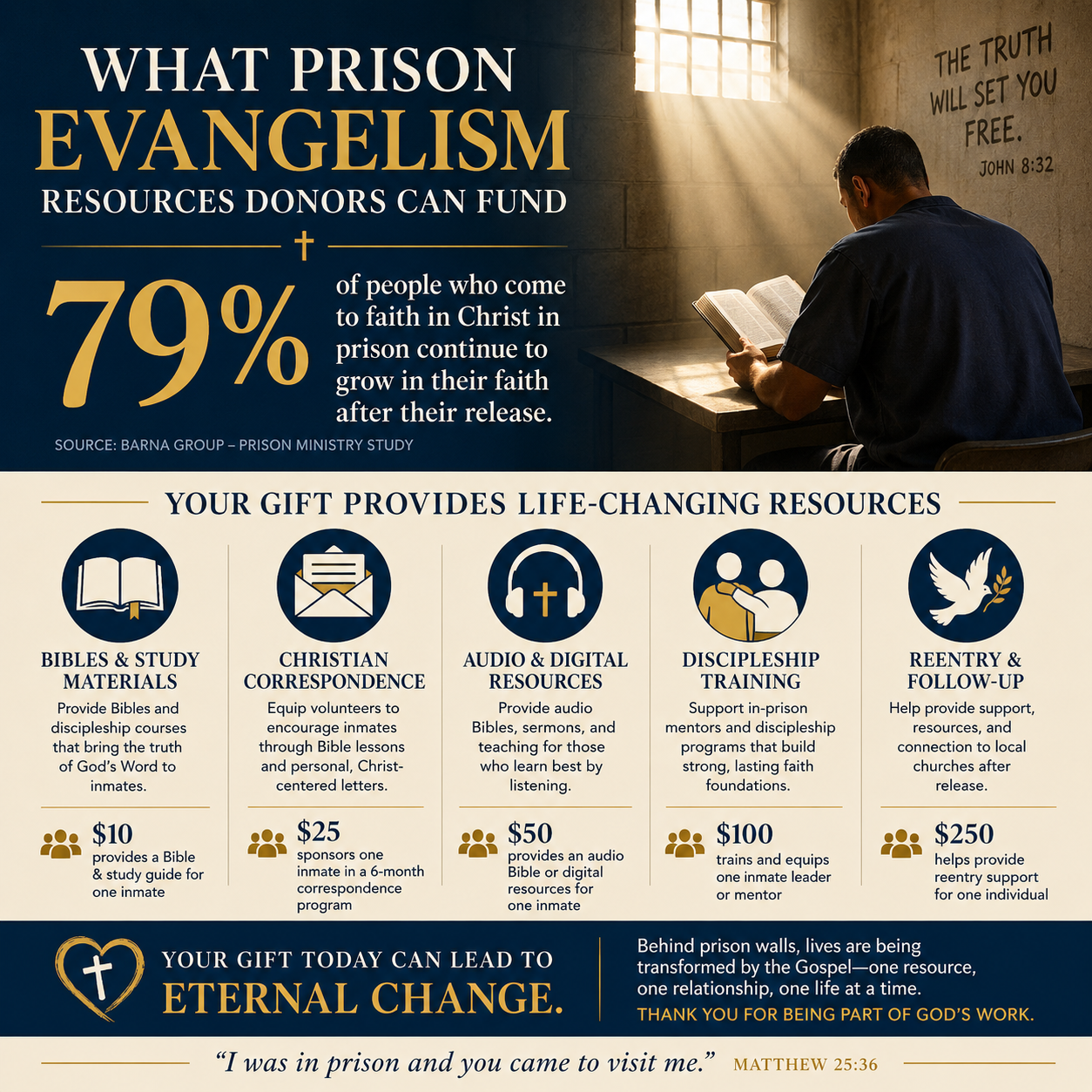
Facilities may restrict hardcovers, adhesives, metal bindings, or certain inks. Ministries with mature operational competence know the rules and purchase materials that will not be rejected at intake. Donors can fund:
- Facility-approved Bibles in durable formats
- Workbooks designed for limited outside access
- Language-specific materials for non-English speakers
- Large-print editions for aging prison populations
- Replacement inventory for confiscations, transfers, and wear
As donors evaluate options within Faith-Based Prison Outreach and Evangelism, it is worth asking whether a ministry tracks distribution by facility, follows up with recipients, and safeguards against coercive “sign-up” tactics that treat Bible receipt as a compliance reward.
Invest in correspondence and in-cell discipleship pathways
Letter-based discipleship and structured courses can be among the most resilient resources in prison settings. They also require careful boundaries: privacy protections, content screening, and policies that prevent inappropriate dependency between volunteers and inmates. The best programs train volunteers to respond pastorally while remaining disciplined, consistent, and accountable.
Donors should also insist on theological care. Prison populations include people with limited biblical literacy and a high exposure to manipulative spirituality. Resources should be anchored in historic Christian orthodoxy and avoid sensationalism, conspiracy thinking, or prosperity teaching that distorts suffering into a simplistic equation.
3. Fund volunteer training that protects the vulnerable and honors the institution
Volunteer labor is a defining feature of prison evangelism. It is also a risk surface. Poorly trained volunteers can unintentionally create security incidents, violate boundaries, or convey a gospel that is more therapeutic than biblical. Donors can do significant good by funding the unglamorous elements that make ministry safe and durable: training, supervision, and compliance.
Prioritize trauma awareness and spiritual abuse prevention
Incarcerated people have high rates of trauma exposure, including childhood abuse, violence, addiction, and family rupture. Christians disagree about the best vocabulary for trauma, but serious prison ministries have had to reckon with how trauma shapes memory, trust, and emotional regulation. Volunteer training should include how to listen without prying, how to avoid triggering interrogations, and how to refer to qualified mental health care when appropriate.
Spiritual authority inside prison can also be exploited. Donors should ask what safeguards exist against spiritual abuse: rules on one-on-one contact, restrictions on gift-giving, reporting mechanisms, and oversight by staff leadership. Ministries that treat these safeguards as “worldly” tend to create preventable harm.
Support reentry-aware discipleship without turning evangelism into social work
Evangelism in prison does not need to become a substitute probation office. Yet wise evangelism anticipates reentry pressures: housing, employment, fractured family systems, and the temptations that accompany renewed freedom. Volunteer training can include a basic map of reentry realities so that discipleship remains spiritually focused while still being honest about the path ahead.
For donors seeking the broader landscape of prison and reentry work, Prison and Post-Prison Ministries provides a fuller context for how evangelism, pastoral care, and practical support intersect.
4. Invest in inside-the-walls leadership development and peer disciple-making
Some of the most consequential evangelism work in prison happens through incarcerated believers discipling other incarcerated people. This is not a romantic notion; it is a practical reality in environments where outside access is limited. Donor funding can strengthen these indigenous leadership pathways, provided ministries implement careful theological oversight and avoid creating informal hierarchies that mimic gang structures.
Support cohort-based Bible teaching and vetted inmate leadership
Resources that train incarcerated men and women to handle Scripture responsibly—basic hermeneutics, doctrinal foundations, and pastoral ethics—can yield compounding fruit. Effective programs vet participants, coordinate with chaplains, and maintain curriculum accountability. Donors should look for clear criteria on who can lead, how leaders are supervised, and what happens when misconduct occurs.
Consider technology where permitted, with a sober view of limitations
Some correctional systems permit secure tablets, educational platforms, or closed-network media libraries. These tools can expand access to sermons, courses, and Scripture resources without relying entirely on in-person meetings. The limitations are substantial: vendor lock-in, shifting policies, fees that may burden inmates’ families, and uneven access across facilities. Donors should fund technology as a means to discipleship, not as a novelty, and should ask whether the ministry has evaluated unintended consequences for families and the incarcerated.
5. Fund measurement and accountability that respects spiritual realities
Donors rightly want evidence of faithful stewardship. Prison evangelism, however, cannot be evaluated only by counting decisions or baptisms. Scripture itself warns against superficial measures; fruit can be slow, hidden, and contested. Yet the absence of perfect spiritual metrics does not excuse opacity, inflated claims, or vague reporting.
Ask for outcomes that are honest and appropriately modest
Strong ministries can report what they actually control: program delivery, participation rates, curriculum completion, volunteer training completion, facility retention, and documented follow-up pathways. When ministries cite recidivism reductions, donors should require careful attribution and transparent methodology rather than anecdotes presented as proof.
For example, the Bureau of Justice Statistics has documented how common re-arrest is following release, underscoring the complexity of reentry and the caution required when ministries promise simple causal outcomes (Bureau of Justice Statistics).
Use trusted verification to reduce avoidable donor risk
Prison ministries can be spiritually compelling and operationally fragile. Donors should not have to choose between compassion and diligence. Most Trusted exists to help donors give with confidence by evaluating Christian nonprofits against The Most Trusted Standard, a 15-criteria framework spanning faith foundation, financial integrity, governance and leadership, and transparency and effectiveness. In prison evangelism work, these criteria matter in concrete ways: doctrinal clarity, safeguarding policies, clean financial controls, board oversight, and reporting that can be substantiated.
FAQs for What prison evangelism resources donors can fund
Should donors prioritize Bibles, programs, or people
Wise funding usually includes all three, sequenced for durability. Bibles and approved study materials create a baseline of access to Scripture. Programs create a disciplined pathway for teaching and pastoral care. People—trained volunteers and accountable staff—sustain the ministry over time. Donors can start by asking which of these is currently the bottleneck in a given ministry’s context and fund accordingly.
How can donors avoid funding coercive or manipulative evangelism in prison
Donors should look for ministries that separate spiritual ministry from material benefits, maintain clear safeguarding and boundary policies, and coordinate with chaplains and facility rules. Reporting should avoid inflated claims and should describe discipleship practices, not only decision counts. Independent evaluation, including verification against The Most Trusted Standard, can further reduce the risk of funding ministries that confuse control with conversion.
Funding that strengthens the church in prison
The most constructive prison evangelism resources donors can fund are those that keep the gospel central and the ministry accountable: Scripture access that survives disruption, discipleship that forms durable habits, training that protects the vulnerable, leadership development that multiplies faithful witness, and reporting that is honest about what can and cannot be measured. When donors fund that kind of work, they are not merely sponsoring programs. They are strengthening the church’s presence among those Christ explicitly named, and they are doing so with stewardship that withstands scrutiny.



