
What a prison worship service includes is not a matter of religious preference or musical style; it is a practical expression of the Church’s obedience to Christ among people the world has set aside. Jesus did not treat incarceration as a footnote to discipleship. He named those “in prison” among the people he identifies with in judgment and mercy (Matthew 25:36).
Donors often ask whether prison worship is “real church” under restrictive conditions, or whether it becomes a thin program that cannot sustain long-term transformation. The answer is that the most faithful prison worship services hold two truths together: the gospel is fully sufficient, and the environment is uniquely constrained. Healthy ministries build services that are reverent, simple, and accountable—because any public gathering inside a correctional facility must serve both spiritual formation and institutional safety.
Worship inside prison is both pastoral and regulated
A prison worship service is never only a church decision. It is also a regulated gathering inside a security institution, with rules around movement, materials, volunteer access, and interpersonal contact. The mature ministries learn to honor those constraints without allowing them to hollow out the gospel content.
Why the setting changes the service without changing the faith
Prison chaplaincy sits at an intersection of constitutional rights, institutional policy, and pastoral care. In the United States, the National Institute of Corrections has long framed prison religion through the lenses of security, program management, and the legitimate religious needs of people in custody, which shapes what services can include and how they operate under facility procedures. National Institute of Corrections
What this means in practice is that prison worship tends to be more structured than many free-world services. There is less improvisation, fewer moving parts, and a heavier reliance on clear liturgy, short teaching units, and predictable volunteer roles. That structure is not a concession to bureaucratic culture; it is often what allows ministry to happen at all.
Why donors should care about structure and accountability
Some prison ministries drift toward emotional intensity without durable discipleship, especially when services are built around “big moments” rather than ongoing pastoral oversight. Other ministries become overly cautious and reduce worship to a thin motivational talk. Donors serve incarcerated men and women well by funding ministries that can demonstrate a coherent theology of the Church and a credible plan for spiritual care within institutional constraints.
Across our verification work at Most Trusted, we observe that the ministries best positioned for long-term fruit tend to show evidence of clear pastoral accountability, volunteer training, and transparent partnership with chaplains. Those are not secondary governance details; they are part of what protects worship from becoming either disorderly or performative.
Core elements most prison worship services include
While policies vary, most prison worship services include a recognizable set of elements that correspond to historic Christian worship: Scripture, prayer, proclamation, and a call to repentance and faith. The service must also account for trauma, shame, and the complex social ecology of incarceration, where public vulnerability can carry real costs.
Scripture reading and Christ-centered teaching
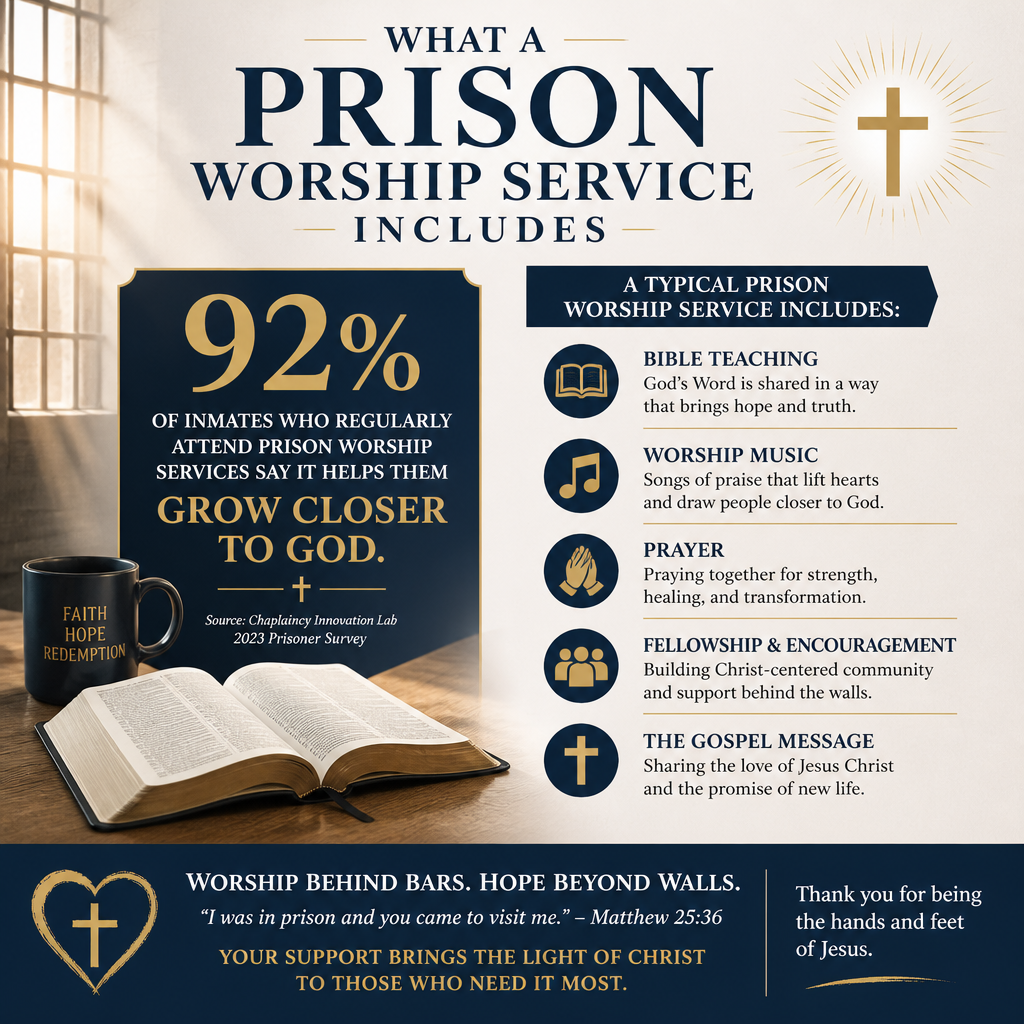
At its center, prison worship must put the Word of God in front of people. Many incarcerated Christians have had inconsistent access to sound teaching, and some have experienced predatory spirituality—religion used for control or self-advancement. Faithful services read Scripture plainly and preach Christ clearly: sin named without despair, grace offered without denial, and obedience framed as the fruit of new life.
In well-run services, teaching is often shorter and more focused than a typical Sunday sermon, with a careful emphasis on intelligibility. When reading ability varies, leaders may read longer passages aloud and summarize with clarity rather than assume prior biblical literacy.
Prayer, confession, and intercession
Prayer in prison is rarely abstract. It is shaped by court dates, family separation, addiction recovery, unresolved grief, and the daily strain of confined life. Healthy worship services make room for confession of sin and intercession for others, but they do so with discernment about what is safe to share publicly.
- Structured opening prayer that acknowledges God’s holiness and mercy
- Guided confession that does not demand public disclosure of sensitive details
- Intercession for families, victims, staff, and those facing legal decisions
- Pastoral prayer that names hope in Christ without promising quick outcomes
- Clear closing prayer that sends participants back to their units with peace
Donors sometimes ask why services do not always include open-mic testimonies or extended group sharing. In many facilities, that format can create status dynamics, manipulation, or targeting. Wisdom here is not a lack of faith; it is a form of love.
Music and participation depend on facility policy and pastoral wisdom
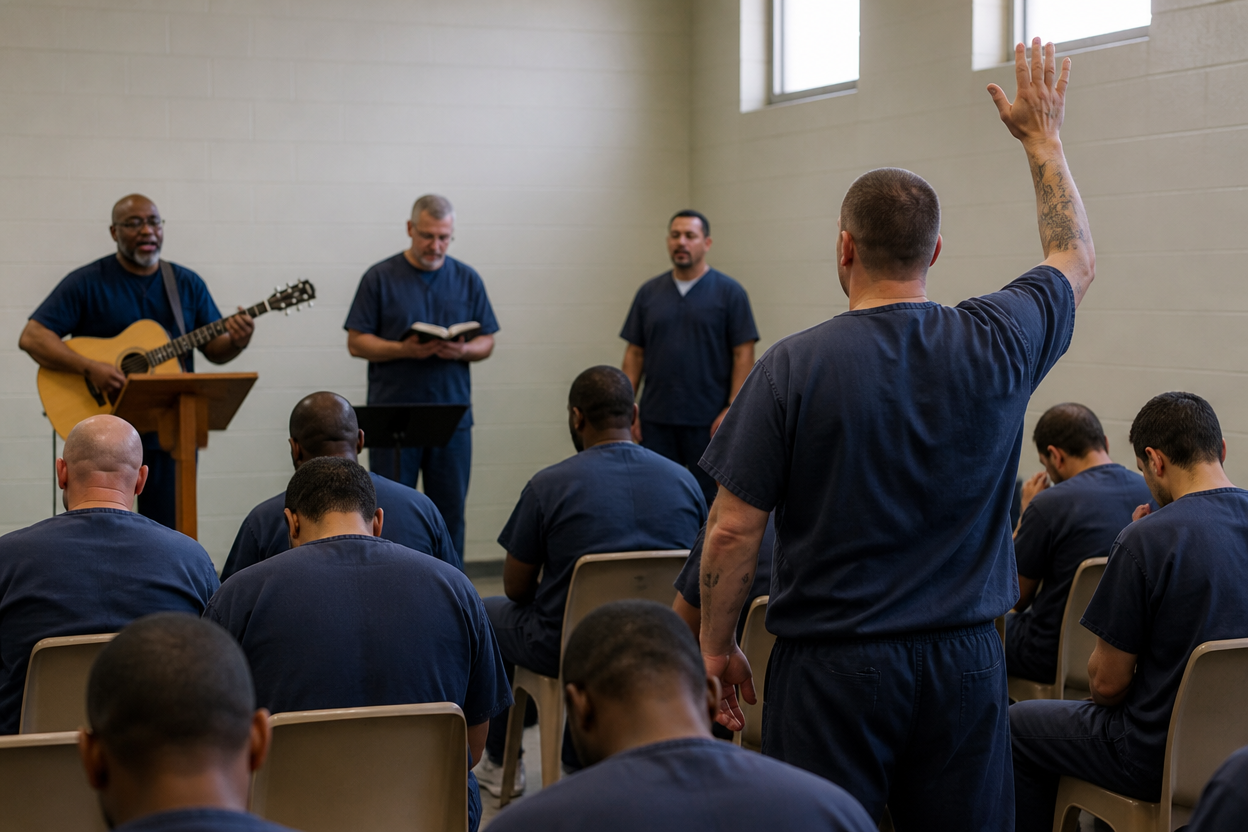
When donors picture prison worship, they often imagine singing behind bars with a guitar in the corner. Sometimes that is accurate. Sometimes it is not permitted. The goal is not to reproduce a particular worship style; the goal is to enable congregational participation and reverence within the boundaries that chaplains and administrators allow.
What music may look like when instruments and technology are limited
Some facilities allow a volunteer-led worship team, basic instruments, or an a cappella choir; others restrict instruments, projection, or amplification. A mature ministry prepares multiple formats: a cappella singing, call-and-response hymns, printed lyric sheets when allowed, or simple choruses that can be learned without screens.
Participation matters because it forms identity. People in prison are often reduced to an ID number and a charge. A worship service that enables a man or woman to sing the truth of the gospel with others is not sentimental; it is counter-formation. Yet wise leaders also guard against music choices that inflame rivalry, mimic gang identity, or center performers rather than the congregation.
Why volunteers must be trained for the specific setting
Volunteer enthusiasm is a gift, but in prisons it must be disciplined. Training should cover boundaries, manipulation risks, contraband awareness, and how to respond when someone discloses abuse, suicidal ideation, or illegal activity. Donors should ask whether a ministry provides written policies and ongoing supervision, not only a one-time orientation.
For donors seeking broader context on the field and what healthy practice tends to look like, we track patterns across Faith-Based Prison Outreach and Evangelism with an eye toward credibility, theological fidelity, and operational integrity.
Sacraments, counseling, and follow-up are often the hardest questions
The more serious question is not whether a prison worship service can happen, but whether it connects to the fuller life of the Church: baptism, communion, discipline, pastoral care, and long-term discipleship. Christians genuinely disagree about some of the details, especially where denominational practice intersects with prison policy.
Communion and baptism under supervision
Some facilities permit communion with pre-approved elements; others restrict bread, juice, or distribution methods. Baptism may require additional permissions, specific locations, or medical review. Faithful ministries do not treat sacraments as pageantry. They treat them as ecclesial acts that require accountability, clarity about membership and repentance, and submission to lawful authority.
Where sacraments are not possible, services can still be spiritually substantive. The absence of communion in a given week does not imply the absence of Christ. But donors should value ministries that have thought through sacramental theology rather than improvising under pressure.
Pastoral counseling, trauma care, and the limits of a group service
A worship service cannot carry every pastoral need. Incarcerated people have higher rates of serious mental illness than the general population, and services sometimes become the only place where pain surfaces publicly. The Bureau of Justice Statistics has reported significant prevalence of mental health problems among people in state and federal custody, underscoring why ministries need referral pathways and clear boundaries. Bureau of Justice Statistics
Wise prison ministries coordinate with chaplains and, where appropriate, with prison mental health services. They train volunteers not to practice beyond competence and not to promise confidentiality they cannot keep. Donors should treat this as a spiritual integrity issue: love does not confuse zeal with qualification.
For donors, the service itself is only part of what should be evaluated
A prison worship service can be faithful and still be attached to an organization that lacks transparency, sound governance, or financial clarity. Donors who care about spiritual fruit should care about institutional integrity as well, because ministries are embodied in budgets, boards, and policies—not only in preaching.
What credible prison worship ministries tend to demonstrate
In our work evaluating ministries against The Most Trusted Standard, we look for evidence that the ministry is not merely active but accountable: a clear statement of faith, appropriate oversight, documented safeguarding practices, and reporting that allows donors to understand what is happening and why. Prison settings intensify the need for clarity because the public cannot easily observe programs firsthand.
Donors should also ask how the worship service connects to post-release realities. Recidivism is shaped by multiple factors well beyond spiritual formation—housing, employment, supervision conditions, addiction treatment, and family systems. The National Institute of Justice summarizes research and program evaluations related to reentry and recidivism, which can help donors separate plausible claims from inflated promises. National Institute of Justice
How worship connects to discipleship and reentry
Some prison worship services function as an on-ramp into deeper discipleship: small groups, Bible studies, mentoring, and connections to churches for reentry. Others remain isolated events. Both may have a place, but donors should fund with eyes open. A service that calls people to follow Christ should also offer a pathway, as feasible, for ongoing formation, restitution, and reintegration into the life of the Church.
For donors weighing where to give within this field, we maintain editorial coverage across Prison and Post-Prison Ministries because stewardship requires more than sincere intentions; it requires trustworthy organizations that can sustain ministry over time.
FAQs for What a prison worship service includes
Is a prison worship service mainly evangelism or mainly discipleship?
It is often both, and the balance depends on the facility context and the ministry’s mandate. In many prisons, a single service includes seekers, new believers, and mature Christians in the same room. Faithful leaders preach the gospel clearly while also teaching obedience, prayer, and the life of the Church, without assuming everyone shares the same starting point.
What should donors ask before funding a ministry that leads prison worship?
Donors should ask about theological accountability, volunteer training, safeguarding policies, coordination with chaplains, financial transparency, and how the service connects to ongoing discipleship and reentry support. The strongest ministries can explain what happens in the room, how they protect participants and volunteers, and how they measure faithfulness and effectiveness without reducing the work to simplistic metrics.
Worship that is reverent, accountable, and enduring
What a prison worship service includes is ultimately a test of whether the Church believes Christ is present and authoritative behind prison walls. The most faithful services are not impressive because they are elaborate. They are compelling because they are coherent: Scripture read and preached, prayers offered with sobriety, praise given without performance, and pastoral care carried out with boundaries and integrity. Donors who fund such work are not sponsoring an event; they are strengthening a witness that the gospel is for the imprisoned, the wounded, and the guilty—and that the Church intends to remain when the moment passes.



