

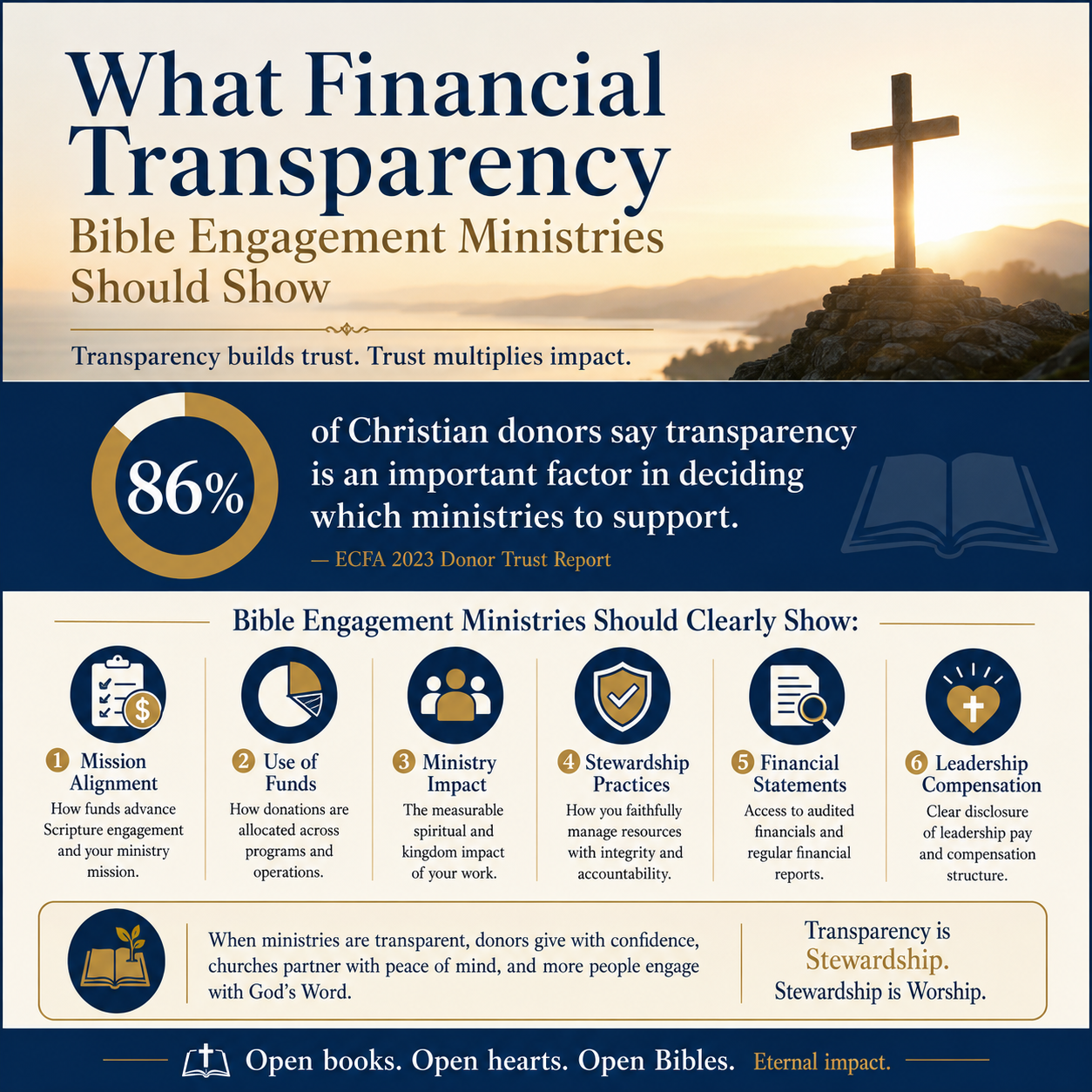
What financial transparency Bible engagement ministries should show is not a secondary concern for Christian donors; it is part of the moral substance of stewardship. Scripture ties the handling of money to the condition of the heart with unsettling consistency, and ministries that teach and translate God’s Word must be willing to be examined in the light (Luke 16:10–11). Financial opacity may be common in the sector, but it is not spiritually neutral.
The harder question is how to ask for transparency without drifting into suspicion or reducing ministry to spreadsheets. Bible engagement is often difficult to quantify, and some financial details require discretion. Yet the call to “walk properly… not in… quarreling and jealousy” (Romans 13:13) includes how organizations conduct themselves publicly. Donors are not asking ministries to replace faith with metrics; they are asking for verifiable evidence that funds are handled with integrity and directed toward stated mission.
Across our verification work at Most Trusted, we find that the ministries most worthy of donor confidence treat transparency as a form of discipleship. They do not merely comply with filing requirements; they help the public understand what they do, what it costs, and what they are learning. That posture aligns with The Most Trusted Standard, which evaluates ministries across faith foundation, financial integrity, governance and leadership, and transparency and effectiveness.
Start with audited, accessible, complete financial statements
The baseline for transparency is simple: donors should not have to hunt for basic financial documents, nor interpret them without context. If a ministry raises funds from the public, it should publish current financial statements, explain them in plain language, and make them easy to locate.
Independent audit and the scope that matters
When a ministry is large enough, an independent audit is a normal expectation. An audit is not a spiritual badge, and it does not guarantee wisdom, but it does create an external check on whether financial statements fairly represent reality. Ministries should publish the audit report, name the auditing firm, and be clear about any qualifications or material weaknesses identified.
For U.S. ministries, donors also benefit from the organization’s IRS Form 990 or 990-EZ when applicable, because it provides standardized disclosure across compensation, governance, and related-party transactions. Not every organization files a 990 (churches and certain religious organizations are exempt), but a ministry that is exempt can still publish financial statements that offer comparable clarity. Donors can verify 990 filings through the IRS Tax Exempt Organization Search IRS.
Budget transparency that clarifies, not obscures
Transparent ministries publish an annual budget with meaningful line items, not a single “program” bucket that swallows everything. Bible engagement work includes translation, publishing, curriculum development, digital platforms, training, content distribution, pastoral resourcing, and often international partnerships. Donors deserve a view that is granular enough to confirm that spending matches the mission they believe they are funding.
What this means in practice is that a ministry should be able to answer, in writing, what proportion of its budget supports content creation versus distribution, what it spends on technology versus direct training, and what overhead categories actually include. Christians have been shaped by simplistic overhead talk for decades, but the sector has had to reckon with the “overhead myth” critique articulated by Charity Navigator, Candid, and the BBB Wise Giving Alliance Charity Navigator. Mature transparency does not pretend overhead is irrelevant; it explains what administrative and fundraising costs are accomplishing and whether they are proportionate.

Disclose how restricted gifts are handled and honored
Bible engagement ministries commonly raise restricted funds: “Give to sponsor Bible distribution,” “Support translation for this language group,” “Fund a curriculum for youth.” Restrictions can honor donor intent and focus a ministry’s work. They also create temptation to blur categories when cash flow gets tight.
Restricted fund accounting and clear donor intent
Donors should look for ministries that explain how restricted gifts are tracked, how long funds are expected to remain restricted, and what happens when a project is completed under budget or becomes infeasible. Transparent organizations state whether they will seek donor permission to redirect funds, or whether gift language explicitly allows reallocation within a defined ministry purpose.
The discipline here is not merely administrative. It is a matter of truthfulness. If an organization invites donors to give for a stated purpose, it has taken on an obligation that should be honored with care. Ministries that handle restrictions well also reduce internal pressure to “raise for what sells” rather than for what is strategically needed.
Grantmaking, pass-through funds, and international work
Many Bible engagement ministries work through partners, especially internationally. That can be faithful and effective, but it increases the importance of transparent pass-through accounting. Donors should be able to see how much funding is granted to partner organizations, what oversight exists, what due diligence is performed, and how impact and compliance are monitored.
We recommend donors evaluate partner funding with the same seriousness they would apply to the primary organization: written agreements, reporting expectations, and clear documentation of how funds are used. When a ministry states that gifts support Bible distribution in a particular country, it should be able to explain the chain of custody for funds and materials without vague assurances.
For donors seeking broader orientation to this field, we maintain a dedicated resource on Bible Study and Engagement Ministries, where transparency and governance questions are considered alongside theology and effectiveness.
Make leadership compensation and related-party transactions plain
Christian donors often feel tension here. On one hand, “the laborer deserves his wages” (Luke 10:7). On the other, the Church has seen too many scandals tied to secrecy, excess, and conflicts of interest. Transparency does not require embarrassment; it requires candor.
Compensation philosophy and how it is set
Ministries should disclose how senior leader compensation is determined and approved, including the role of the board, the use of comparability data, and the presence of any independent members in the decision. Donors should not be left to infer the ministry’s posture toward money from rumors or partial disclosures.
Where a 990 is filed, donors can review reported compensation and governance practices. Where a 990 is not filed, a ministry can still publish a compensation philosophy statement and disclose ranges or figures for top roles in a manner consistent with its polity and legal context. The objective is not to enforce uniform salary levels across diverse contexts; it is to ensure that a ministry is not using spiritual language to shield financial decisions from accountability.
Conflict of interest and related-party disclosures
Bible engagement ministries frequently involve publishing, media production, events, and technology—areas where vendor relationships are common and sometimes personal. A transparent organization publishes a conflict of interest policy, states how disclosures are collected, and explains what happens when a conflict exists.
Related-party transactions are not automatically corrupt, but they are inherently high-risk. Donors should expect explicit disclosure when board members, executives, or their family members are paid as contractors, when facilities are leased from insiders, or when a ministry purchases services from entities controlled by leadership. These arrangements require documented board oversight and market-rate justification.
Report outcomes with integrity, not marketing pressure
Financial transparency is incomplete without candor about what the spending is producing. Bible engagement is both spiritual and measurable in limited ways. The sector has to resist two errors: reporting nothing because results are “only God’s business,” or reporting inflated numbers that treat attention as transformation.
Define what counts and what does not
Ministries should distinguish between reach, engagement, and formation. “Downloads” are not “people discipled.” “Bibles shipped” are not “Scripture read.” “Event attendance” is not “lives changed.” Transparent reporting can include all of these, but it must label them honestly and avoid spiritualizing metrics into guarantees.
When research is cited, donors should expect named sources and clear claims. For example, the American Bible Society’s State of the Bible reporting has documented measurable shifts in Scripture engagement patterns in the United States and provides definitions and survey methodology donors can evaluate American Bible Society. Wise ministries can use such research to contextualize need without claiming that a single program can reverse multi-decade cultural trends.
Program cost realism and the refusal to starve operations
Transparent ministries explain what faithful work costs. Translation, editorial review, licensing, printing, secure distribution in closed contexts, software development, and safeguarding policies are not inexpensive. Some donors have been trained to expect unrealistically low “overhead,” which can push ministries toward understaffing, weak controls, and underinvestment in security and compliance.
The ministries that meet The Most Trusted Standard tend to present costs with sobriety: they show unit economics where appropriate (cost per trained leader, cost per curriculum set distributed), disclose major assumptions, and acknowledge when a cost is rising due to paper, freight, security, or technology changes. That candor protects donors from manipulative appeals and protects ministries from unsustainable expectations.
Publish the governance and transparency practices that prevent misuse
Financial transparency is sustained by governance, not by goodwill. Donors are not only funding programs; they are trusting a system of oversight. Scripture’s warnings about partiality and hidden dealing (James 2; 2 Corinthians 8:20–21) press ministries toward structures that can withstand temptation and scrutiny.
Board oversight, controls, and accessible policies
A ministry should publish the names of its board members and officers, identify leadership roles, and make clear whether the board is meaningfully independent. It should also communicate basic control practices: separation of financial duties, review and approval thresholds, and how whistleblower reports are handled.
Donors should expect key policies to be available upon request or publicly posted: conflict of interest, whistleblower, document retention, and gift acceptance. These do not guarantee righteousness, but their absence often indicates that a ministry has not built disciplined habits of accountability.
A donor checklist that respects both faith and verification
The following items are not a substitute for prayerful discernment, but they are the ordinary marks of a ministry that expects to be accountable:
- Current audited financials or reviewed statements, with clear explanations of any exceptions
- Clear disclosure of restricted fund policies and whether restricted balances are material
- Board-approved executive compensation process, described in plain language
- Conflict of interest disclosures and transparent handling of related-party transactions
- Outcome reporting that separates reach from engagement and engagement from formation
When donors want a broader framework for evaluating ministries beyond financial documents, we recommend engaging our category-level approach in How to Give Wisely to Bible Study and Engagement Ministries, where questions of governance and effectiveness are treated as inseparable from financial integrity.
FAQs for What financial transparency Bible engagement ministries should show
Should a Bible engagement ministry publish its full IRS Form 990 and audit?
Where a ministry files a Form 990, publishing it is a straightforward act of transparency that reduces unnecessary friction for donors. An independent audit is also a strong signal of seriousness when an organization’s size and complexity warrant it. Some religious organizations are not required to file a 990, and smaller ministries may not be able to justify the cost of an audit; in those cases, donors should still expect clear financial statements, documented controls, and a willingness to answer reasonable questions in writing.
What if a ministry says financial details would endanger its work in hostile contexts?
Security concerns are sometimes legitimate, particularly for Bible distribution, training, or digital access work in restricted environments. Responsible transparency does not require publishing information that would expose partners, locations, or methods to harm. It does require the ministry to provide alternative forms of verification: aggregated financial reporting, independent board oversight, documented internal controls, and third-party review that can be summarized without compromising security. Secrecy should be narrowly tailored to protection, not broadly applied to avoid accountability.
Transparency as a form of Christian witness
Christian donors give not merely to achieve outcomes but to participate in work that bears the character of Christ. Financial transparency is one way ministries demonstrate that their public claims can withstand examination, that donor intent is honored, and that the Word they commend is not used to shield financial practices from scrutiny. When ministries invite careful verification, they do not weaken faith; they strengthen trust, and they guard the Church’s witness in a world already trained to doubt.



