
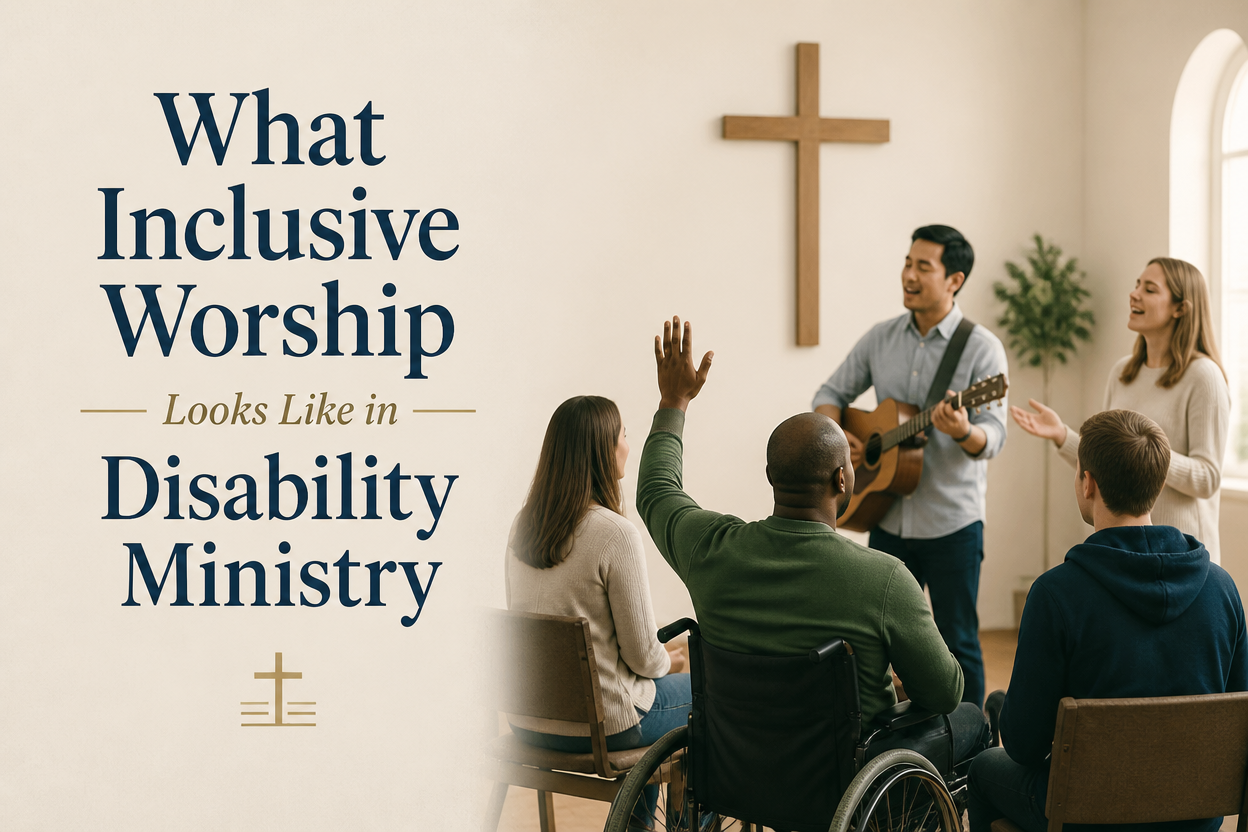
What inclusive worship looks like in disability ministry is not primarily a question of ramps, captioning, or sensory rooms, though those can matter. It is a question of ecclesiology: whether the church’s worship practices communicate that people with disabilities are full members of Christ’s body, called to offer spiritual sacrifices alongside everyone else.
Christian donors often carry a reasonable concern: we want to fund mercy that is genuinely merciful, not paternalistic; thoughtful, not performative; sustainable, not episodic. Disability ministry exposes the strengths and weaknesses of a church’s theology in public. When worship is designed around a narrow set of abilities, the church may unintentionally teach that some members are “guests” rather than family. When worship is genuinely inclusive, it bears witness to the gospel’s insistence that honor is given to the parts that seem weaker (1 Corinthians 12:22–24).
Inclusive worship begins with a theology of belonging
Many churches begin disability ministry with a program: a buddy system, a respite night, or a classroom. Those supports can be important, but worship is where belonging is tested. Worship is not a service delivered to consumers; it is the people of God gathered before God, hearing his Word and responding in praise, confession, prayer, and sacrament. If disability ministry never reaches the worshiping assembly, it can inadvertently segregate the very people it intends to welcome.
Scripture’s central images push us toward membership rather than accommodation. In Christ, we are “fellow citizens with the saints and members of the household of God” (Ephesians 2:19). That is not a sentimental metaphor. It is a covenantal reality with practical implications: shared liturgy, shared formation, shared accountability, shared joy, and shared suffering.
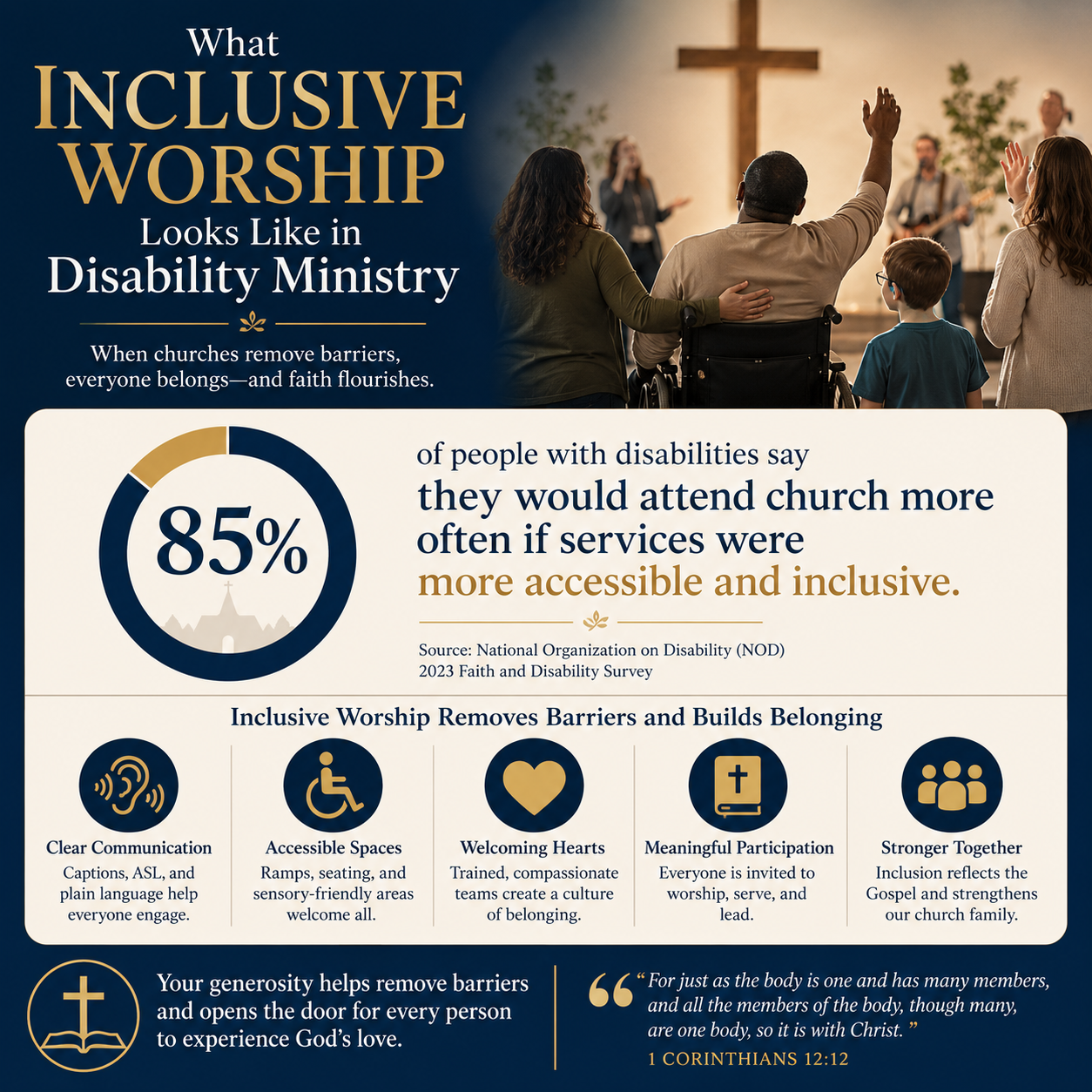
From access to participation
Access asks whether someone can enter the room. Participation asks whether they can meaningfully take part. A church can be technically accessible while still communicating, through pace, language, and expectations, that only certain kinds of bodies and minds are “normal” worshipers. Inclusive worship, at its best, moves from “Can you be here?” to “How will we worship with you?”
That shift requires humility. Churches need to learn from disabled Christians, not merely about them. The hardest adjustments are rarely architectural. They are social and spiritual: patience with noise, flexibility with routines, the willingness to receive leadership from people whose communication is atypical, and the refusal to measure worship by polish.
Honoring difference without romanticizing it
Disability ministry can swing between two errors: treating disability only as a deficit to be solved, or treating it as a spiritual mascot that makes the church feel compassionate. Inclusive worship resists both. It acknowledges real limitations, real suffering, and real need for support, without collapsing a person’s identity into their diagnosis. It also acknowledges gifts. Many congregations have discovered that members with disabilities often model dependence, perseverance, directness in prayer, and unselfconscious praise that exposes the congregation’s own formed preferences.
For donors, this theological framing matters because it affects what ministries build. Funding decisions can either reinforce segregated models or strengthen ministries that equip local churches for genuine belonging. For broader context on how churches and nonprofits structure disability engagement, see Disability Ministries.
Inclusive worship is built by careful, ordinary practices
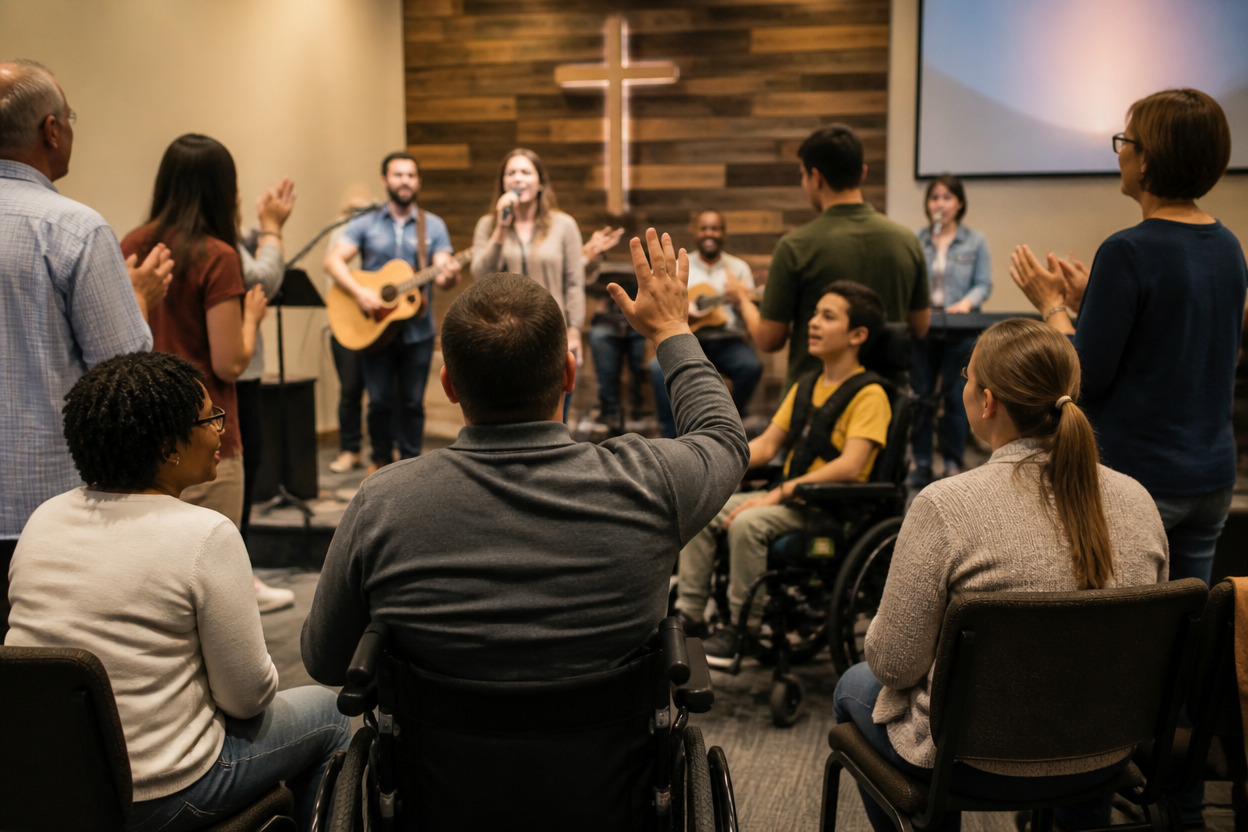
Inclusive worship is rarely achieved through a single dramatic change. It is built through ordinary practices sustained over time: communication that anticipates diverse needs, environments that reduce unnecessary barriers, and worship leadership that understands the difference between distraction and discipleship.
Communication that prepares rather than surprises
Many disability-related barriers are informational. Families often leave churches not because people were unkind, but because they could not predict what would happen. A simple service order, posted in advance, can lower anxiety for autistic worshipers and caregivers. Clear signage, expectations for children’s participation, and a visible plan for communion can make the difference between attending and staying home.
When churches provide multiple formats—printed, large-print, digital, audio—they communicate that different bodies are expected. This is not “special treatment.” It is the practical outworking of hospitality.
An environment that supports regulation and reverence
Some churches treat sensory needs as a marginal concern. Yet the worship environment is often where sensory load peaks: loud music, bright lights, crowded foyers, unpredictable transitions. Inclusive worship does not require turning every service into a quiet room. It requires reducing unnecessary intensity and providing options: a low-stimulation seating area, a space where a caregiver can step out without shame, and a culture where movement and vocalizations are not automatically read as rebellion.
It can also mean small adjustments to sound levels and lighting, or providing noise-reducing headphones. These supports do not reduce reverence. They protect it by helping worshipers remain present.
- Publish a predictable order of service, with clear transition cues.
- Offer lyrics and Scripture readings in multiple accessible formats.
- Normalize a “break space” without treating it as exile.
- Train greeters and ushers to assist without hovering or infantilizing.
- Create clear pathways for communion participation with dignity.
Donors should notice the difference between a church that offers these practices as a grudging exception and a church that integrates them as ordinary hospitality. The latter is usually a sign that leadership has done the slower work of cultural change.
Worship leadership and liturgy must account for disability
Inclusive worship is not only about the congregation’s posture; it also concerns who leads and how. Churches commonly assume that worship leadership requires a narrow band of skills: fast verbal processing, precise motor control, a certain stage presence. Some of those skills are useful, but the New Testament’s emphasis is on faithfulness, character, and the building up of the body.
Visible belonging through shared leadership
When members with disabilities read Scripture, serve in hospitality, participate in prayer, assist in communion, or contribute musically, the congregation receives a quiet but profound catechesis: these are not projects; these are co-worshipers. The goal is not tokenism. The goal is a truthful public witness that the Spirit distributes gifts across the whole body.
Prudence is required. Some roles demand safeguards—especially where vulnerability is high. Yet a blanket exclusion often reveals more about institutional convenience than about pastoral care. Churches should ask what supports are needed for participation, not whether participation is possible.
Preaching and prayer that resist ableist assumptions
Inclusive worship also requires careful language. Some ableist assumptions are subtle: equating spiritual maturity with independence, describing disability only as tragedy, or implying that faithful prayer always leads to physical healing. Scripture gives a more complex account. Jesus does heal. He also dignifies those who remain afflicted. Paul’s “thorn in the flesh” is not resolved by technique but met with grace sufficient in weakness (2 Corinthians 12:9).
Christians genuinely disagree about how to speak of healing in corporate worship, and wise churches do not force false certainty. What is non-negotiable is honoring disabled believers as whole persons in Christ and refusing spiritualized explanations that blame suffering on personal sin or insufficient faith.
For donors, this is an evaluative signal. Ministries that train churches in disability theology, pastoral care, and accessible liturgical practice often have a deeper, more durable impact than ministries that only provide episodic events.
Inclusive worship requires safeguarding, not sentiment
Disability ministry brings heightened responsibility. Many people with disabilities are at increased risk of abuse and exploitation, including within religious contexts. Inclusive worship must be paired with serious safeguarding and governance, not merely warm intentions.
Research consistently indicates elevated vulnerability. For example, the U.S. Department of Justice’s Bureau of Justice Statistics has reported that people with disabilities experience higher rates of violent victimization than people without disabilities in the United States; see BJS for documentation and updates over time https://bjs.ojp.gov/.
Safety in the sanctuary is a ministry outcome
Safeguarding is part of worship’s integrity. If a church invites people with disabilities into close relational proximity—greeters, volunteers, classrooms, transportation, prayer teams—then screening, training, and reporting processes become moral essentials. Churches should not treat these systems as liabilities to manage quietly. They are a form of neighbor-love.
This includes clear policies for one-to-one interactions, bathroom assistance, and physical touch. It includes caregiver communication and incident documentation. It also includes mechanisms for complaints to be heard without retaliation. In disability ministry, trust is both spiritual and administrative.
Respecting agency and consent
Inclusive worship respects agency. That means asking before assisting, addressing the person rather than only the caregiver, and resisting public spotlighting without consent. Testimonies and prayer moments can unintentionally expose private medical or developmental details. The desire to “celebrate” someone can become a way of taking their story.
Donors can help by funding ministries that do the less visible work: volunteer training, policy development, and caregiver support. These investments rarely produce dramatic photos, but they produce safer communities.
Donors should fund inclusion that is accountable and measurable
Disability inclusion is easy to praise and difficult to evaluate. Good intentions are common; durable capacity is rarer. Donors can bring clarity by asking for evidence of faithfulness over time: theological seriousness, financial stewardship, governance that protects the vulnerable, and transparent reporting on what is being built.
Across our verification work at Most Trusted, we observe that ministries meeting The Most Trusted Standard tend to treat disability inclusion as part of their core mission rather than an accessory. They also tend to document policies, training, and outcomes in ways that can be inspected, not merely asserted. This is particularly important where programs involve children, transportation, or one-to-one supports.
What accountability can look like
Not every ministry will measure outcomes the same way, and the field has had to reckon with the limits of simple metrics. Still, donors can reasonably ask for concrete indicators, such as volunteer training completion, safeguarding audits, caregiver retention, and pathways for disabled members into meaningful roles. Transparency is not a substitute for faithfulness, but it makes faithfulness more verifiable.
We also encourage donors to resist simplistic overhead assumptions. The joint statement commonly known as “The Overhead Myth,” issued by GuideStar, Charity Navigator, and BBB Wise Giving Alliance, explains why focusing narrowly on overhead can distort nonprofit health and effectiveness https://www.guidestar.org/. Disability ministry often requires staff time, training, and specialized supports that are not “extra”; they are part of competent care.
Supporting churches without displacing them
Many disability nonprofits exist to strengthen local churches, not replace them. Donors should prefer models that build congregational capacity: training modules, coaching for leadership teams, curated resource libraries, and networks for caregivers. The aim is not to create a parallel worshiping community that siphons away responsibility, but to help the local church become what it already confesses itself to be.
Those who want to direct giving toward concrete, church-connected disability efforts can also review Church Disability Ministry Programs Donors Can Support, where donors can compare approaches and look for signals of long-term health.
FAQs for What inclusive worship looks like in disability ministry
Does inclusive worship require changing our entire service style?
Not usually. Inclusive worship more often requires adding supports and removing unnecessary barriers than replacing a church’s historic form. The deeper change is cultural: making room for different kinds of participation without treating difference as disruption or embarrassment.
How can donors tell whether a disability ministry is truly inclusive and not merely visible?
Visibility can be meaningful, but donors should look for accountable practices: safeguarding policies, volunteer screening and training, caregiver communication, and pathways for disabled believers into non-token leadership and service. Ministries that report clearly on what they do, how they protect the vulnerable, and what outcomes they seek are easier to trust with long-term investment.
A credible witness in the worshiping assembly
Inclusive worship is one of the church’s clearest public statements about the gospel it proclaims. When disabled Christians are present and participating with dignity—hearing the Word, praying, singing, receiving the sacraments, and serving—the congregation is reminded that the kingdom does not belong to the strong but to the Lord who gives grace. Donors who fund disability ministry have an opportunity to strengthen that witness, not only through compassionate support but through accountable, theologically grounded work that helps the whole church worship as one body.



