

When Christian donors ask what homeless outreach ministries spend donations on, they are usually asking something deeper: whether their giving will become mercy that heals or money that disappears. Scripture treats that question as spiritually serious. God’s people are commanded to “open wide” a hand to the poor (Deuteronomy 15:11), and yet that same Scripture assumes stewardship, honesty, and weights-and-measures integrity (Proverbs 11:1). Faithful compassion and accountable administration are not rivals.
Most homeless outreach is also operating under pressure most donors never see: trauma, addiction, untreated mental illness, housing shortages, inflation, and regulatory requirements that can be both necessary and burdensome. Christians genuinely disagree about which approaches are most faithful or most effective. But donors do not need perfect consensus to give wisely. They need clarity about the primary cost drivers, the difference between emergency relief and long-term stabilization, and the marks of a ministry that is both gospel-grounded and verifiably responsible.
Donations underwrite both immediate mercy and sustained presence
Emergency services are not inexpensive when they are done safely
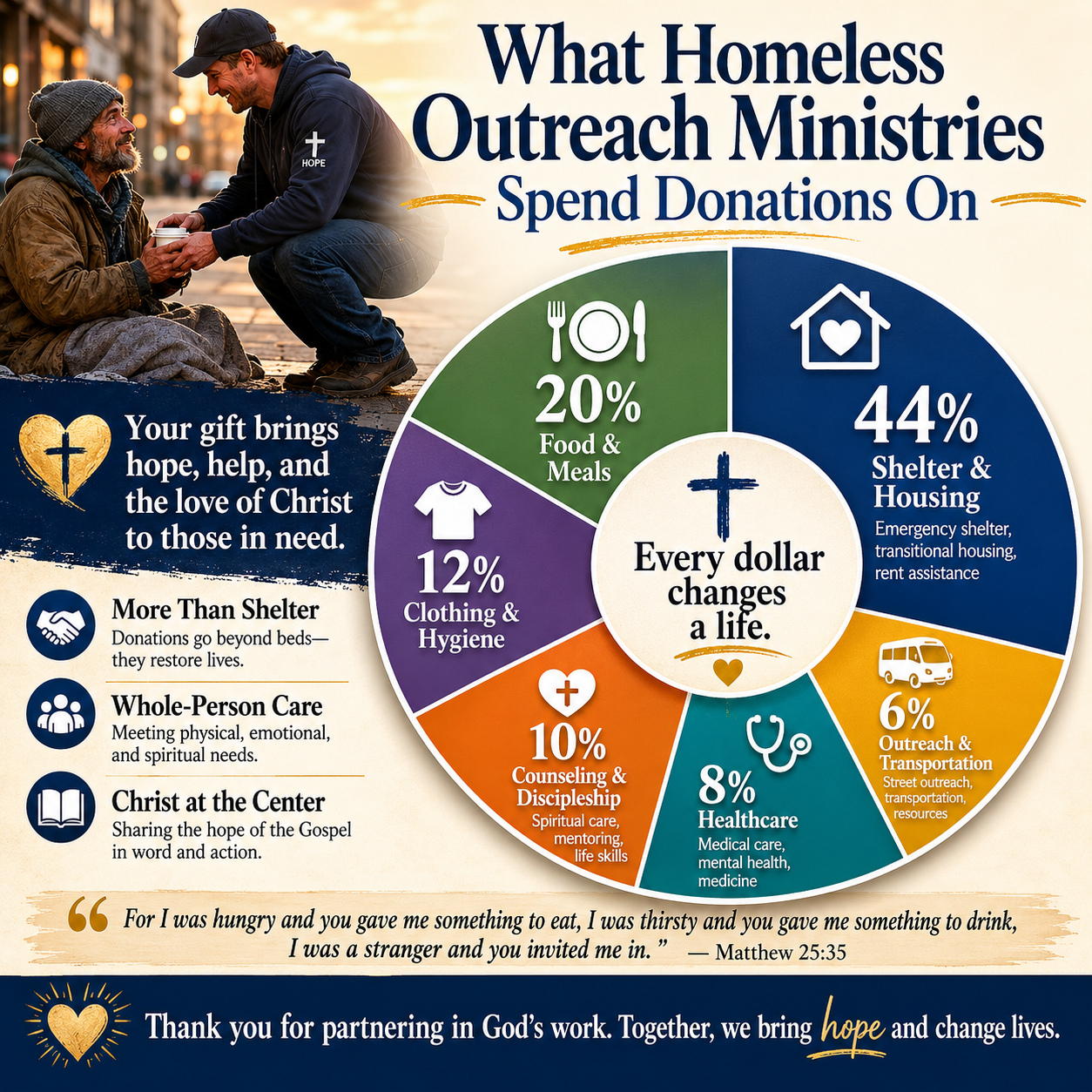
On the street or in a shelter line, the needs are immediate: food, water, hygiene, warm clothing, a safe bed, transportation to a medical appointment, a phone charger to keep a job lead alive. Donations fund those tangible goods, but also the infrastructure that makes distribution safe and dignified: vehicles, fuel, commercial kitchen inspections, food safety training, refrigeration, insurance, background checks, and secure storage. These “unseen” costs are not distractions from ministry; they are part of loving neighbors without exposing vulnerable people to harm.
Many donors instinctively want every dollar to go “straight to the person.” The field has had to reckon with the fact that direct aid without systems can become chaotic or unsafe. In practice, the same meal that nourishes also requires the mundane faithfulness of procurement and compliance. A ministry that feeds hundreds of people a day cannot operate like a small group potluck, and donors should not expect it to.
Relational ministry requires staffing, not only supplies
Homeless outreach is not merely a distribution problem. It is a ministry of presence: knowing names, returning week after week, de-escalating conflict, and connecting people to services. That kind of consistency is usually carried by staff and trained volunteers, and donations often fund salaries for outreach workers, case managers, chaplains, program directors, and overnight shelter teams.
This is one of the clearest places where the “overhead” conversation can become morally confused. The biblical vision of mercy is personal and patient; it does not treat people as projects. But personal care at scale typically includes payroll, supervision, training, and HR practices that protect clients and staff. The real question is not whether a ministry has staffing costs; it is whether staffing is appropriate to the model, transparently reported, and governed with integrity.

Most budgets are shaped by a small number of major cost drivers
Facilities, compliance, and safety often dominate shelter-based work
For rescue missions and ministries that operate shelters, the largest line items are frequently tied to buildings: rent or mortgages, utilities, maintenance, security, and capital repairs. Older facilities can be especially expensive, and safety requirements are rarely optional. Donations also fund licensing, inspections, and professional services that reduce risk for guests who already live with heightened vulnerability.
It is also worth naming the context that makes these costs heavier. Nationally, homelessness remains large-scale. On a single night in January 2024, 771,480 people were experiencing homelessness in the United States, the highest number recorded in the annual point-in-time count (U.S. Department of Housing and Urban Development). When need rises and housing costs remain high, the operational strain on frontline ministries increases, and facility costs rarely become more forgiving.
Program models determine spending patterns
Two faithful ministries can have very different budgets because they are doing different work. A street outreach team may spend more on vehicles, mobile supplies, and staff time in the field. A residential recovery program may spend more on trained counselors, curriculum, food service, and round-the-clock supervision. A transitional housing ministry may spend more on property management, tenant support, and partnerships with employers.

Donors can ask a simple clarifying question that often reveals the whole budget logic: “What is the ministry’s primary intervention?” If the answer is emergency shelter, expect higher facility and staffing costs. If the answer is long-term discipleship and stabilization, expect counseling, training, and program support. If the answer is prevention and rapid rehousing through partnerships, expect case management and rental assistance coordination. None of those are automatically better. They are different callings with different cost structures.
Effective ministries invest in people, not only in transactions
Case management and recovery services are labor-intensive by nature
The harder question is what it takes for a person not only to survive the week, but to regain stability. That path often involves documentation, medical care, sobriety supports, mental health services, employment readiness, debt resolution, family reconciliation where possible, and ongoing discipleship. Donations commonly fund case management, clinical partnerships, transportation, and program materials. They also fund the time it takes to coordinate care across fragmented systems.
Here the field’s debates matter. Christians disagree about the proper balance between accountability and compassion, about program requirements for sobriety, about harm reduction strategies, and about the limits of what a ministry should attempt versus what should be referred to specialized providers. Serious ministries do not pretend these tensions do not exist. They articulate a coherent theology of the person, a sober view of addiction and trauma, and an evidence-informed approach to change over time.
Discipleship is a real program cost, not a slogan
When a ministry is explicitly Christian, donors should expect the gospel to be more than branding. That often means funded chaplaincy, Bible studies, pastoral care, and partnerships with local churches. It can also mean staff development shaped by Christian formation, because a ministry’s culture is part of its care. This is not a substitute for professional standards; it is a reason to pursue them. The God who commands mercy also forbids partiality, exploitation, and dishonest gain.
Across our verification work at Most Trusted, the ministries that meet The Most Trusted Standard tend to document how spiritual care relates to services without coercion. They can explain what participation is required, what is voluntary, and how they protect the dignity of people who receive help, including those who are not ready to engage spiritually.
Transparency questions donors should ask, and why overhead is not the real issue
The overhead question is usually a proxy for trust
Many donors have learned to ask, “How much goes to programs versus overhead?” The instinct is understandable, but the question is often too blunt to be useful. The nonprofit sector has repeatedly warned donors that overhead ratios can mislead and can even pressure organizations to underinvest in the systems that prevent fraud and harm. In 2013, Charity Navigator, GuideStar, and the BBB Wise Giving Alliance jointly urged donors to move beyond overhead as the primary measure of nonprofit performance (Charity Navigator).
What this means in practice is that faithful, effective homeless outreach may include administrative spending that protects clients: background checks, training, data security, audits, internal controls, and qualified supervision. A ministry can keep overhead artificially low while quietly becoming unsafe, unaccountable, or brittle. Donors are not called to reward frugality that undermines integrity.
Five concrete indicators of responsible spending
A mature donor posture is not suspicion, but discernment. These are reasonable, non-technical indicators that a ministry is treating donations as sacred trust:
- Clear program definitions: a ministry can describe what counts as emergency relief, shelter, recovery programming, and outreach without shifting categories year to year.
- Board governance that is more than formal: board members are identifiable, meet regularly, and provide oversight rather than functioning as a rubber stamp.
- Transparent financial reporting: timely financial statements, a Form 990 where applicable, and plain-language explanations of major changes.
- Safeguarding practices: policies for incidents, mandated reporting where required, volunteer screening, and client protection protocols.
- Outcome clarity with humility: measures that fit the ministry’s model without promising what no one can guarantee in complex human change.
Donors who want a structured way to evaluate these questions often begin with the broader ecosystem of Rescue Missions and Homeless Outreach, where the models and trade-offs are easier to see in context.
How verified ministries tend to describe their spending
A credible budget narrative matches the ministry model
Ministries that handle donor dollars responsibly do not simply present numbers; they present a coherent story. If a rescue mission says its calling is emergency shelter, its spending should reflect staffing for 24/7 coverage, facility safety, meals, and guest care. If it says its calling is long-term restoration, donors should see meaningful investment in counseling, discipleship, workforce development, and case management. When the stated mission and the financial reality do not align, donors should ask why.
Across our work at Most Trusted, we find that the most credible organizations also show restraint in fundraising claims. They avoid implying that a small gift “solves homelessness,” and they avoid manipulating donors with simplified math that cannot be defended. They treat the poor as neighbors, not as marketing material.
Effectiveness is not only a number, but it must be more than a feeling
Measuring outcomes in homeless ministry is difficult. People cycle in and out of stability. Some outcomes depend on housing supply and local policy. Some of the most important spiritual outcomes are not quantifiable in a quarterly report. Yet mature ministries still measure what they can: program completion, job placements, housing transitions, recidivism where relevant, and referral follow-through. They also describe limitations honestly, because truthfulness is part of Christian witness.
Donors who want to see how ministries communicate impact and stewardship in comparable ways often explore How Rescue Mission Donations Make Impact, where the language of results and the realities behind it can be weighed more carefully.
FAQs for What homeless outreach ministries spend donations on
Do donations pay for administration, and should that concern Christian donors?
Donations often pay for administration, and Christian donors should not assume that is unfaithful. Administration can include financial controls, audits, HR, training, insurance, and compliance—systems that protect vulnerable guests and reduce the risk of misconduct. The question is whether those costs are transparent, appropriate to the ministry’s size, and governed with integrity, not whether they exist.
Is it better to give to direct aid like meals, or to long-term programs like recovery and job training?
Scripture commends both immediate mercy and long obedience. Meals and emergency shelter keep a person alive; long-term programs may address the conditions that make homelessness persistent. Wise donors match their giving to a ministry’s calling and competence, and they recognize that communities need a range of interventions. A faithful portfolio of giving can include both, especially when each ministry can clearly explain its model, safeguards, and results.
Giving with confidence requires clarity, not cynicism
Homeless outreach ministries spend donations on people, but also on the hard infrastructure of sustained love: staff, facilities, safety, and the patient work of restoration. The right donor question is not whether a budget is simple, but whether it is truthful—whether it reflects a coherent model, safeguards the vulnerable, and honors Christ in both compassion and stewardship. When we evaluate ministries against The Most Trusted Standard, our goal is to help donors give in a way that is both tenderhearted and clear-eyed, worthy of the God who sees the poor and judges with righteousness.



