
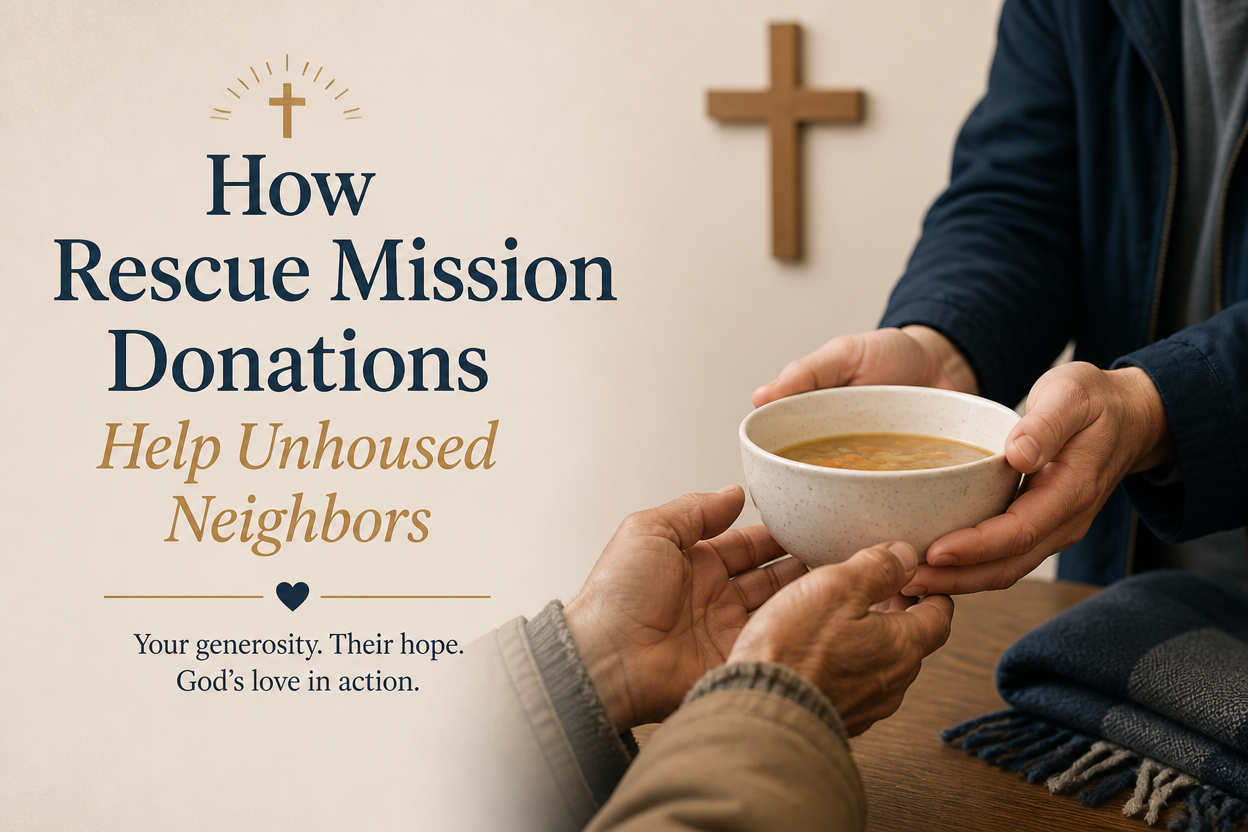
How rescue mission donations help unhoused neighbors depends on what a ministry is actually trying to do: relieve immediate suffering, restore dignity, and, where possible, help a person move from crisis toward stability. Christian donors often feel the weight of Matthew 25 here. Yet the same passage that sharpens our obligation also raises our responsibility to give wisely, because interventions that are well-intentioned can still be ineffective or even destabilizing when they are disconnected from long-term pathways.
Across the rescue mission sector, the best work is both merciful and clear-eyed. It treats a man or woman on the street as a neighbor made in God’s image, not as a fundraising story. It refuses the false choice between emergency aid and life change. And it can be examined—because faithful giving is not only generous; it is accountable.
Rescue missions exist for crisis, but they cannot stay there
The street is not a single problem with a single solution
Christians genuinely disagree about which strategies reduce homelessness at scale, and the broader field has had to reckon with competing models. Some approaches emphasize permanent housing as a first priority; others emphasize treatment and readiness; many combine elements of both. What is not contested is that homelessness is shaped by multiple pressures—housing costs, wages, family breakdown, disability, addiction, mental illness, and trauma—and ministries meet people where those pressures converge.
Federal definitions alone signal complexity. The U.S. Department of Housing and Urban Development distinguishes sheltered homelessness, unsheltered homelessness, and those at imminent risk, each with different service needs and risks to life and safety HUD.
Mercy ministries are not second-best
Scripture does not present works of mercy as optional add-ons to Christian maturity. The church’s historic witness has been that feeding the hungry and caring for the vulnerable are ordinary expressions of love of neighbor. Rescue missions sit directly in that stream. Their work is often hidden from public view: a bed offered at 11 p.m., a shower before a job interview, a warm meal without interrogation, a case manager’s patient follow-up after a relapse.
What this means in practice is that donors should evaluate whether a mission’s immediate services are connected to credible next steps. A meal line can be an act of love. It can also become a revolving door if it is not paired with relationships, assessment, and realistic pathways toward housing and income.

What donations actually fund when they are well stewarded
Basic needs delivered with dignity
Well-run rescue missions spend real money on ordinary, embodied care: food service, linens, utilities, security, laundry, showers, and staff trained to de-escalate conflict. These are not glamorous line items, but they are the difference between a chaotic environment and a setting where a traumatized person can sleep without fear. Donors sometimes pressure missions to minimize these costs, as though compassion could be delivered without infrastructure. That expectation usually produces fragility rather than faithfulness.
The sector has also had to learn from the wider nonprofit ecosystem that simplistic “low overhead” thinking distorts good governance. The leaders of Charity Navigator, Candid (formerly GuideStar), and the BBB Wise Giving Alliance publicly urged donors to stop using overhead ratios as a primary measure of performance, because it can punish necessary investment in staff, systems, and evaluation Candid.
Skilled staff and consistent presence
Donations also fund people: not only chaplains, but case managers, licensed counselors when a mission provides clinical care, employment specialists, and program directors. The presence of stable, trained staff is especially important because many unhoused neighbors have experienced repeated institutional failure—schools, foster care, family systems, employers, courts, hospitals. A mission’s credibility is often built in small increments over months, not in a single altar call or a single program milestone.
Donors can reasonably ask whether staffing is adequate for the mission’s stated program intensity. A residential program without meaningful case management is rarely more than shelter with a timetable.
From relief to restoration without coercion
Spiritual care must be real, not transactional
Christian rescue missions typically weave spiritual care into daily life through chapel services, pastoral counseling, Bible study, prayer, and church connections. The spiritual dimension is not a marketing feature; it is an expression of a conviction about the human person. People are not only bodies needing shelter. They are image-bearers whose lives are shaped by worship, community, repentance, hope, and meaning.
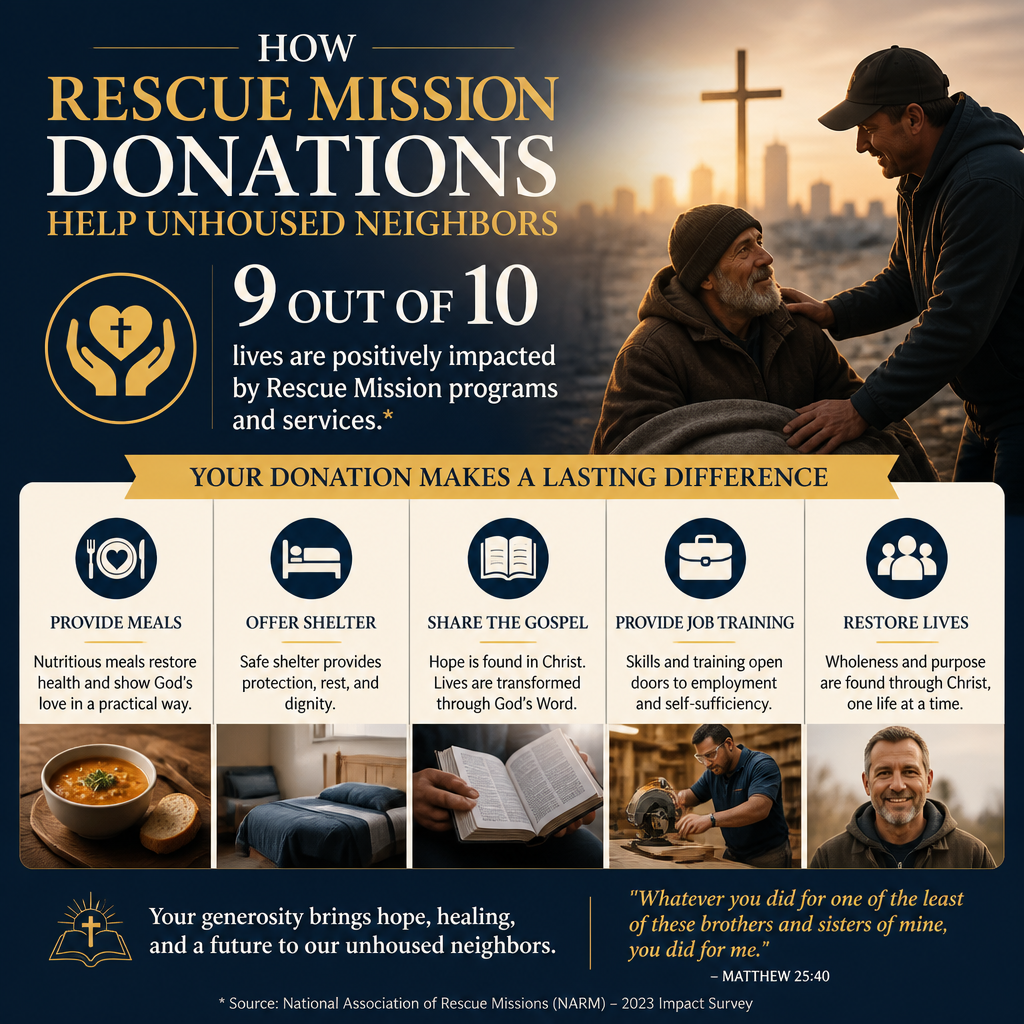
At the same time, donors should be attentive to a genuine ethical tension: religious ministry in crisis settings must avoid coercion. A meal should not be used as leverage for compliance with a spiritual performance. The best missions hold a principled line: they offer the gospel freely and clearly, they respect conscience, and they maintain rules that protect safety and program integrity without confusing rules with spiritual transformation.
Programs should aim at durable outcomes, not mere compliance
Many missions offer structured residential programs that address addiction recovery, life skills, employment readiness, and reunification with family when appropriate. Here the question is not whether a mission has rules; every congregate living environment must. The question is whether the rules serve restoration or merely preserve institutional order.
A mature donor asks for clarity about what “success” means. Some outcomes are measurable and appropriate: stable housing placements, job retention, completion of recovery milestones, reconnection to local church community. Other outcomes are harder to quantify but still real: a person keeping appointments, paying off debts, regaining contact with children, or remaining sober through a first holiday season. Missions that speak only in slogans often have not done the internal work to define outcomes honestly.
Within Rescue Missions and Homeless Outreach, we see that the strongest ministries resist both triumphalism and cynicism. They tell the truth about relapse, setbacks, and the long arc of trust-building, while still expecting real change over time.
What discerning donors should examine before giving
The questions that protect both the neighbor and the donor
Christian donors do not need to become homelessness policy experts to give responsibly, but we should insist on evidence of integrity. Donations carry moral weight. They should support ministries that can explain how money becomes care, and how care becomes credible progress.
- Clear program model: The mission can explain the pathway from street outreach or shelter to housing and income, including typical timelines and eligibility.
- Safety and safeguarding: The mission has documented policies for incident reporting, boundaries, and protection of vulnerable adults, with trained staff and clear enforcement.
- Financial transparency: Recent audits or financial statements are available, leadership compensation is disclosed appropriately, and restricted gifts are honored.
- Governance strength: A functioning board provides oversight, not merely affirmation, and conflict-of-interest policies are in place and followed.
- Outcome candor: The mission reports results without inflating numbers, distinguishes participation from completion, and names challenges.
Why verification matters in a compassionate space
Rescue mission giving is emotionally charged, and ministries sometimes feel pressure to communicate in ways that maximize urgency. Yet donors are not helped by vague promises, and neighbors are not served by ministries that cannot sustain responsible operations. This is where Most Trusted exists: to help donors give with confidence by evaluating Christian nonprofits against The Most Trusted Standard, a 15-criteria framework spanning faith commitments, financial integrity, governance, and transparency and effectiveness.
Across our verification work, we observe that ministries able to meet a rigorous standard tend to share certain habits: they document policy, they welcome scrutiny, they keep clear boundaries between restricted and unrestricted funds, and they can explain how their distinctively Christian identity shapes practice without turning faith into a branding layer.
Giving that strengthens the whole local care ecosystem
Rescue missions rarely succeed alone
Even excellent missions operate within limits. Many cannot build affordable housing. Some cannot provide psychiatric care at the intensity required for severe mental illness. Others can offer only short-term shelter because local funding or facility constraints dictate capacity. A wise donor looks for ministries that collaborate rather than compete—referring to medical clinics, partnering with workforce agencies, coordinating with churches, and working constructively with local government when appropriate.
National research reinforces the scale of the challenge and the need for coordinated responses. HUD’s annual Point-in-Time count reports hundreds of thousands of people experiencing homelessness on a given night in the United States, a sobering indicator of need that no single ministry can resolve alone HUD.
Different gifts serve different moments
Not every donor should give the same way. Some gifts are best directed to immediate relief: meals, shelter nights, winter supplies, and outreach vans. Others are best directed toward capacity that makes relief more effective: staff training, data systems, facilities maintenance, and program evaluation. Still others support long-term stability: job programs, transitional housing partnerships, and follow-up care.
Within How Rescue Mission Donations Make Impact, we emphasize a principle many donors already practice in other areas of life: the right kind of funding depends on the actual work being done. A mission that claims to change lives but cannot fund case management will predictably drift toward custodial shelter. A mission that provides excellent shelter but cannot fund follow-up will often lose people back to the street without calling it that.
Conclusion
How rescue mission donations help unhoused neighbors is not a mystery, but it is a discipline: relief offered with dignity, programs designed for durable change, and governance strong enough to protect both people and resources. Christian donors should expect spiritual seriousness and operational maturity in the same ministry, because love of neighbor deserves both compassion and competence. When giving is paired with verification and honest questions, donations become more than immediate aid; they become a steady contribution to restoration that does not collapse under scrutiny.
FAQs for How rescue mission donations help unhoused neighbors
Do rescue mission donations mostly pay for meals and beds, or do they support long-term change?
They often do both. Effective missions fund immediate care—food, shelter, hygiene, and safety—while also supporting case management, recovery programming, employment readiness, and connections to longer-term housing. Donors should ask how a mission links emergency services to next steps, and whether it can report outcomes without overstating results.
How can Christian donors avoid supporting ineffective or ethically troubling practices?
We recommend evaluating a mission’s transparency, governance, safeguarding policies, and financial reporting, along with the clarity of its program model and outcome definitions. Ministries serving people in crisis should be especially careful to avoid coercion in spiritual care and to maintain strong boundaries and incident reporting. Independent verification, such as assessment against The Most Trusted Standard, helps donors give confidently in a complex and high-stakes space.



