

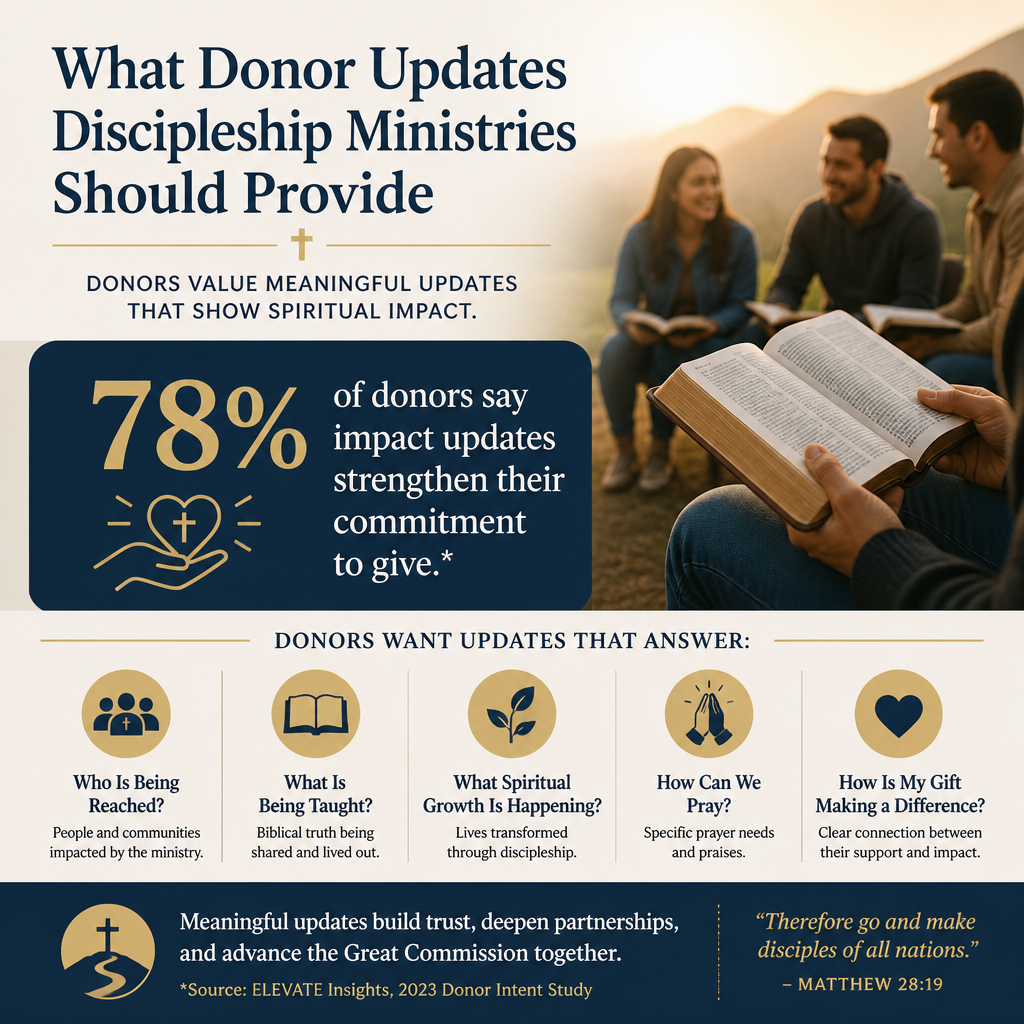
What donor updates discipleship ministries should provide is not primarily a question of marketing cadence. It is a question of spiritual stewardship: whether a ministry is treating donors as means to an end, or as fellow-laborers whose giving is part of their own formation. Mature Christian donors are not asking for constant reassurance; they are asking for truthful, theologically coherent reporting that honors both the people being served and the people funding the work.
The tension is real. Discipleship outcomes are often slow, relational, and difficult to measure without reducing persons to metrics. Yet donors have a moral obligation to practice discernment, and ministries have an obligation to communicate in ways that are verifiable, humble, and clear. The ministries that cultivate durable trust tend to report the same kinds of things: what they did, why they did it, what changed, what did not change, and what they learned.
Donor updates should show faithful alignment before they show activity
Clarify the ministry theology that governs methods
Discipleship ministries should begin updates with the spiritual commitments that govern their choices: their understanding of the gospel, the local church, the role of Scripture, and the means by which God ordinarily forms people over time. When donors understand a ministry’s theology of change, they can interpret both progress and setbacks without demanding shortcuts. This is especially important when a ministry resists the pressure to exaggerate numbers or to promise transformation on a timeline Scripture does not promise.
John the Baptist’s language about fruit “in keeping with repentance” grounds a basic expectation of evidence without turning repentance into a scorecard (Matthew 3:8). A donor update that is faithful will speak of fruit with sobriety: observable patterns of obedience, reconciliation, perseverance, and service—without pretending those patterns are uniform or linear.
Make ecclesial relationships explicit
Discipleship is not a freestanding product. Many donor concerns arise when a ministry operates in parallel to the local church, or when it has no accountable spiritual oversight. Responsible updates should name the ministry’s relationship to churches: referral pathways, pastoral involvement, safeguarding practices, and how the ministry avoids displacing the church’s own calling.
For donors who want a broader frame for evaluating ministries beyond narrative appeal, our work at Most Trusted applies The Most Trusted Standard across faith foundation, financial integrity, governance and leadership, and transparency and effectiveness. The point is not to replace spiritual discernment with a checklist, but to ask whether a ministry’s stated convictions are matched by accountable structures and clear reporting.

Donor updates should report outcomes without reducing discipleship to metrics
Use mixed evidence: stories, counts, and observable markers
Christian donors are accustomed to program dashboards, but discipleship requires a different kind of clarity. Mature updates use mixed evidence. They will include a limited set of counts (participants served, groups formed, leaders trained) alongside case narratives that are specific enough to be credible while still protecting dignity and privacy. They will also include observable markers that are not merely attendance: Scripture engagement patterns, reconciliation steps taken, sustained participation in church life, vocational faithfulness, and service to neighbors.
Ministries should also acknowledge what cannot be claimed. A person can be present and still be closed; a person can have a dramatic story and still be unstable. Reporting should resist triumphalism because Scripture does. Paul can speak of “watering” while refusing to claim ownership of growth (1 Corinthians 3:6–7).
Be honest about attribution and time horizons
Discipleship ministries often collaborate with pastors, parents, mentors, and small-group leaders. Updates should avoid implying that the ministry alone produced a change that is actually communal and cumulative. Donors can handle complexity. They are often more confident when a ministry names its role precisely: convening, training, coaching, resourcing, or providing a structured environment in which relationships can deepen.

What this means in practice is that donor updates should name time horizons. Some outcomes are expected within a quarter; others require years. If the ministry works with youth, it should acknowledge long arcs that continue beyond graduation. If it works with recovering addicts, it should acknowledge relapse risk and the reality that progress is often uneven. The update should frame those realities theologically, not defensively.
Donor updates should demonstrate stewardship of money with intelligible financial reporting
Provide a simple financial snapshot with context
Christian donors are not served by financial fog. A disciplined update includes a readable snapshot: year-to-date revenue and expenses, cash on hand, major variances from budget, and the sustainability of the operating model. This does not require publishing internal spreadsheets, but it does require providing enough information for donors to ask intelligent questions.
The charitable sector has had to reckon with the “overhead” fixation, and thoughtful donors increasingly recognize that administrative capacity is not inherently waste. The Overhead Myth statement, signed by GuideStar, Charity Navigator, and BBB Wise Giving Alliance, argues that overhead ratios are a poor proxy for performance and can incentivize underinvestment in staff and systems necessary for effectiveness (Candid/GuideStar). Discipleship ministries should address this directly when donors are tempted to treat low administration as spiritual virtue.
Explain key risks and controls, not only results
Financial integrity is more than good intentions. Updates should name the controls that protect a ministry: who approves spending, whether the ministry has independent board oversight, how conflicts of interest are handled, and how restricted gifts are tracked. When a ministry is growing quickly, donors should expect additional attention to systems: accounting practices, audit or review processes, and safeguarding policies.
Where a ministry is facing pressure—loss of a major donor, rising facility costs, currency volatility for international work—updates should say so plainly. The biblical call to walk in the light is not an invitation to indiscretion; it is a summons to truthful speech that does not manipulate support through fear or concealment.
Donor updates should treat transparency as discipleship, not as public relations
Report what did not work and what was learned
Ministries that are secure in Christ can speak about limits. Donor updates should include at least one meaningful learning: a program adjustment, an evaluation insight, a leadership development need, or a partnership that did not bear fruit. This is not performative humility. It is a sign that the ministry is attentive, teachable, and serious about stewardship.
Christians genuinely disagree about how much “failure” language belongs in donor communications. Some leaders fear that candor will be punished. Yet the alternative often produces fragile trust. Donors who give for the long term generally prefer ministries that can name problems early, before they become crises.
Protect dignity and privacy, especially with vulnerable populations
Discipleship ministries often work with minors, trauma survivors, incarcerated persons, or individuals escaping exploitation. Updates should reflect a doctrine of the image of God, which prohibits using people’s pain to secure funding. Stories should be shared with consent, anonymized when necessary, and framed in ways that do not expose individuals to risk or shame.
When photography is used, ministries should clarify their consent practices and child-protection standards. If the ministry works internationally, it should avoid “poverty pornography” and simplistic narratives about Western rescuers. The When Helping Hurts framework, articulated by Steve Corbett and Brian Fikkert, has pressed the Christian sector to consider how helping can unintentionally harm by reinforcing unhealthy dependency or misrepresenting local agency (When Helping Hurts Books).
Donor updates should make partnership concrete without turning donors into customers
Tell donors what faithfulness looks like in the next season
Discipleship ministries should not treat donor updates as a pipeline to the next ask. The update should define what faithfulness looks like in the next quarter or year: the specific work the ministry will pursue, why it matters, and what would count as progress. Clarity honors donors because it allows them to decide whether their priorities align.
One practical pattern we recommend is a short “commitments” section that reads like a set of accountable promises, not like a slogan. For example:
- We will train and coach a defined number of disciple-makers, and we will report completion and retention.
- We will deepen church partnerships in defined regions, and we will report what those partnerships change operationally.
- We will strengthen safeguarding and reporting systems, and we will disclose material updates to policies.
- We will evaluate one program component, and we will publish what we learned and what we changed.
- We will maintain financial discipline against budget, and we will explain significant variances plainly.
Invite appropriate involvement and clear next steps
Some donors want to pray; some want to introduce the ministry to their church; some want to fund a specific initiative; some simply want to continue giving quietly. A mature update offers several legitimate next steps without pressuring donors to prove their devotion through escalation.
For donors who are comparing multiple opportunities within Discipleship Ministries, the standard is not who communicates most frequently, but who communicates most truthfully. The ministries that deserve long-term partnership are those that treat truth as a spiritual discipline: they speak clearly, admit limits, and provide evidence proportionate to their claims.
FAQs for What donor updates discipleship ministries should provide
How often should a discipleship ministry send donor updates?
Quarterly updates are often sufficient for most discipleship ministries, with an annual report that provides fuller financials and outcomes. Some contexts require more frequent communication, such as rapid growth, a crisis, or a major program launch. The guiding principle is not volume but accountability: updates should arrive on a predictable rhythm and contain enough substance to support informed stewardship.
What should a donor do when a ministry reports strong stories but weak data?
Stories can be truthful and still be unrepresentative. We recommend asking for a modest set of consistent indicators over time: participation, leader development, retention, and any evaluation practices that test whether the ministry’s approach is working as intended. If the ministry cannot define what it tracks or why, that is not automatically disqualifying, but it should prompt careful questions about leadership discipline and transparency. Many donors find it helpful to apply a consistent framework—such as the kinds of accountability assessed in Donor Partnership with Discipleship Ministries—so that emotional resonance does not become the sole decision criterion.
Trustworthy updates are part of faithful discipleship
Donor updates for discipleship ministries should provide more than encouragement. They should provide truthful alignment with Scripture, credible evidence of ministry activity and outcomes, intelligible financial stewardship, and transparent learning. When ministries report this way, they honor donors as stewards and honor the people they serve as neighbors, not as fundraising assets. That kind of communication does not guarantee a ministry will avoid hardship, but it does establish the conditions under which partnership can endure.



