

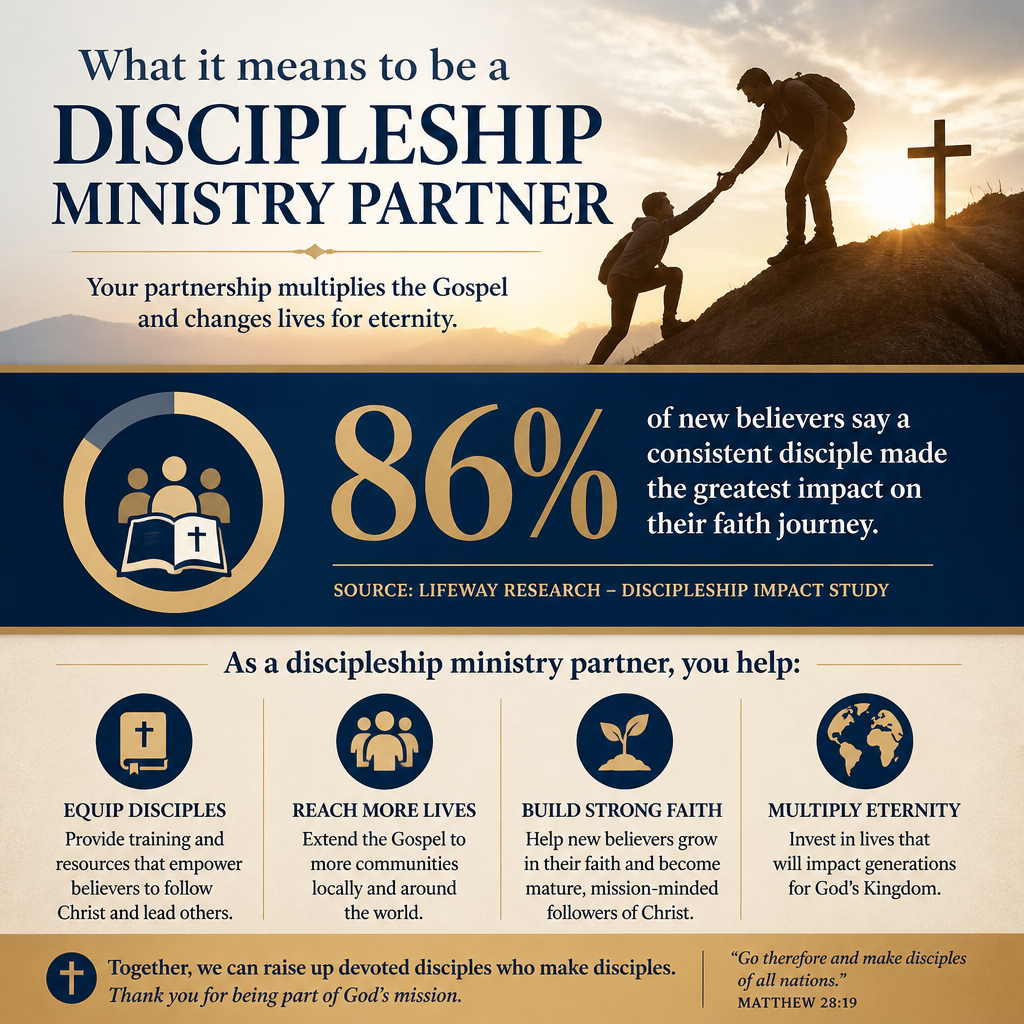
What it means to be a discipleship ministry partner is to align money, prayer, and accountability with the making of disciples over time. That partnership is not merely funding religious activity; it is participating in the church’s long work of formation, where the Holy Spirit uses ordinary means—Scripture, community, sacrament, obedience, and mission—to conform believers to Christ. Donors who have carried responsibility in business, family, and church often sense the difference between a program that attracts attention and a ministry that patiently produces spiritual fruit. Discipleship partnership asks for that same maturity in giving.
The biblical frame is straightforward: Jesus commanded his church to “make disciples” (Matthew 28:19–20). Yet the modern ecosystem of Christian fundraising can make discipleship feel like a slogan attached to almost anything. Some ministries use the word to describe content distribution. Others mean pastoral care. Still others mean evangelism, leadership development, or church planting. Christians genuinely disagree about models and measurements, and donor expectations can pressure ministries toward what is quickest to explain rather than what is truest to the mission.
A discipleship ministry partner funds formation, not religious consumption
Discipleship is a long obedience with measurable marks
In the New Testament, discipleship is not passive intake; it is apprenticing under Jesus, learning to obey all that he commanded. The clearest ministries articulate what obedience looks like in their context: habits of prayer and Scripture, participation in a local church, repentance and reconciliation, generosity, sexual integrity, vocational faithfulness, and witness. Donors should expect ministries to name these outcomes carefully, without promising speed or perfection.
Partnership means giving toward processes that are inherently slower than marketing. Formation is personal. It requires durable relationships, trained leaders, and a willingness to remain with people when growth is uneven. That makes discipleship ministries vulnerable to two distortions: counting only what is easy to count, or refusing measurement entirely because it feels “unspiritual.” A faithful partner resists both. We can honor the Spirit’s work while still asking whether a ministry’s strategy plausibly produces disciples rather than mere audiences.
Christian donors have to discern between reach and depth
Many donors are drawn to scale: more people reached, more content delivered, more events hosted. Reach can be a legitimate good, and digital tools have expanded it dramatically. Yet reach is not the same as discipleship. A sermon stream is not a shepherding relationship. A curriculum download is not a discipling community. A conference decision is not enduring repentance.
What this means in practice is that a discipleship ministry partner should ask the “depth questions” alongside the “reach questions.” How are people being known? Who is responsible for follow-up? What training and oversight exist for small-group leaders or mentors? How does the ministry encourage submission to local church authority rather than building a parallel church?

A discipleship ministry partner strengthens the local church without controlling it
The ministry’s ecclesiology shows up in its partnerships
Discipleship ministries often operate between churches: parachurch organizations, networks, training institutes, campus ministries, counseling and recovery programs, and leadership development initiatives. That “in-between” positioning can be a gift when it humbly equips churches. It can also become a threat when it competes with pastors for authority, donor dollars, or allegiance.
A mature partner looks for clarity about the ministry’s relationship to the local church. Does it affirm the church as the primary context for discipleship? Does it encourage participants to be accountable to pastors and elders? Does it partner with churches across denominational lines without flattening doctrinal differences that matter? These are not abstract questions; they shape the kind of disciples the ministry produces.
Donor partnership should reduce fragility, not create it
Some discipleship ministries become financially fragile because they depend on a few large donors or on event-driven revenue that rises and falls with cultural attention. A wise partner does not exploit that fragility to gain influence. Instead, donors can help ministries build resilient capacity: leadership development, careful budgeting, appropriate reserves, and governance structures that protect the mission even when charismatic founders age, retire, or fall into scandal.
Across our verification work at Most Trusted, we observe that ministries with clearer governance and healthier church relationships tend to weather transitions with less confusion and less public harm. That is not a guarantee of fruitfulness, but it is a consistent mark of institutional maturity. Readers exploring Discipleship Ministries should expect to see differences in how organizations define authority, accountability, and the church’s role.
A discipleship ministry partner insists on integrity as a spiritual matter
Money disciples both the giver and the organization
Scripture treats money as spiritually revealing. Jesus repeatedly ties treasure to the heart (Matthew 6:21). That means donors should not treat financial questions as distractions from “real ministry.” How a discipleship organization handles funds is part of its discipleship witness. A ministry cannot credibly teach holiness while practicing ambiguity in reporting, conflicts of interest in contracting, or pressure tactics in fundraising.
In the broader charitable sector, the temptation is often to reduce discernment to overhead ratios. But serious research and sector leaders have argued that this is a poor proxy for effectiveness and can even encourage harmful underinvestment in systems and staff. The joint “overhead myth” statement by GuideStar (now Candid), BBB Wise Giving Alliance, and Charity Navigator cautioned donors against using overhead as a primary measure of impact Candid. Christian donors should take the point without abandoning financial rigor: cost structure matters, but it must be interpreted in context.
The Most Trusted Standard offers a disciplined way to ask the right questions
Most Trusted exists to help donors give with confidence by evaluating ministries against The Most Trusted Standard, a 15-criteria framework spanning Faith Foundation, Financial Integrity, Governance and Leadership, and Transparency and Effectiveness. For discipleship ministries, this approach is particularly relevant because so much of the work is qualitative and relational. Verification cannot manufacture spiritual fruit, but it can clarify whether the ministry’s claims are accountable to evidence, whether leadership is appropriately overseen, and whether finances are handled in ways that protect the mission and the people served.
A donor partnership rooted in verification asks for more than compelling stories. It asks whether the ministry has policies for handling abuse allegations, whether it discloses related-party transactions, whether it reports program outcomes honestly, and whether it can explain how resources translate into discipling relationships. These are not secular intrusions; they are forms of neighbor-love and institutional humility.
A discipleship ministry partner expects transparency about outcomes and limits
Outcomes should be credible, not inflated
Discipleship leaders face a real tension: donors want simple metrics, but disciple-making is not reducible to a single number. Still, credible ministries can report meaningful indicators without claiming what they cannot know. Examples include leader-to-participant ratios, retention over time, completion rates for training pathways, patterns of church connection, and qualitative evidence gathered through interviews or surveys. The harder question is whether the ministry can explain why these indicators matter and what they do when the indicators are weak.
Transparency also includes acknowledging trade-offs. A ministry that goes deeper with fewer people may have less visible scale, but more durable formation. Another ministry may prioritize multiplying leaders across many churches, accepting that quality will vary. Christians may disagree about which approach is preferable in a given season. What donors should not accept is vagueness that prevents meaningful evaluation.
Partnering well includes asking for a theory of change
Many discipleship organizations implicitly operate with a “theory of change,” even if they do not use the term: if we do X, then over time God will use it to produce Y outcomes. Donors are right to ask for that logic in plain language. If a ministry trains mentors, how are mentors selected, supervised, and supported? If it distributes curriculum, how does it ensure the material is actually used in accountable communities? If it plants churches, what safeguards exist to prevent rapid expansion from outrunning pastoral formation?
One of the most practical ways to do this is to ask for a brief account of what the ministry has stopped doing and why. Pruning is often a sign of seriousness. Ministries that never change course may be hiding failure, or they may be insulated from learning because donors reward activity rather than truth-telling. Donors who want to partner in discipleship should reward honesty about limits.
A discipleship ministry partner gives in ways that promote health over dependence
Funding structures shape ministry behavior
The way donors give can unintentionally shape what a discipleship ministry becomes. Restricted gifts can protect mission focus, but they can also distort priorities if restrictions reflect donor preferences more than ministry strategy. Unrestricted giving can strengthen stability and leadership development, but it requires trust and verification. Multi-year commitments can allow slow, relational work to mature, but they can also prolong unhealthy patterns if accountability is absent.
Across the field, the “starvation cycle” described by Ann Goggins Gregory and Don Howard explains how nonprofit underinvestment in infrastructure can become self-reinforcing, harming effectiveness over time Stanford Social Innovation Review. Discipleship ministries are not exempt from this dynamic. If donors demand minimal administrative cost, ministries may underinvest in training, supervision, and safeguarding—precisely the areas that protect people and preserve trust.
Practices that tend to mark mature donor partnership
A discipleship ministry partner typically practices several disciplines that reflect both faith and prudence:
- Giving with a stated purpose that aligns with the ministry’s articulated discipleship outcomes
- Asking for clear financial reporting and leadership accountability, not merely inspiring stories
- Preferring multi-year support when the ministry demonstrates integrity and learning
- Resisting pressure tactics and refusing to reward exaggerated claims of impact
- Praying for leaders and participants while also expecting basic institutional safeguards
Donors who want this kind of partnership often find it helpful to focus their giving within a defined area of concern and to apply consistent evaluation standards. Within Donor Partnership with Discipleship Ministries, the central question is not whether a ministry can tell a compelling story, but whether it can sustain faithful disciple-making with integrity over time.
FAQs for What it means to be a discipleship ministry partner
How can donors evaluate discipleship results without reducing spiritual growth to numbers?
Donors can ask for outcomes that are appropriate to the ministry’s role: retention over time, leader training completion, supervision ratios, connection to local churches, and evidence of repentance and reconciliation gathered through interviews or pastoral feedback. The aim is not to quantify the Holy Spirit, but to test whether the ministry’s activities plausibly produce the kind of formation it claims to pursue.
Should donors prefer unrestricted giving to discipleship ministries?
Unrestricted giving can be a strong form of partnership because it funds the less visible work that sustains discipleship: leader development, safeguarding, financial controls, and honest evaluation. It is wisest when paired with verification and clear reporting expectations. Restricted giving can also be appropriate when it aligns with a ministry’s established strategy and does not force the organization into donor-driven priorities.
Partnership that reflects the weight of the mission
Discipleship is the church’s central task, and it deserves donors who treat it with corresponding seriousness. A discipleship ministry partner gives for formation rather than consumption, strengthens the local church rather than competing with it, and insists that integrity is part of the witness. The mature posture is neither suspicion nor naïveté. It is stewardship that honors Christ, protects people, and supports ministries that can be trusted to make disciples in truth.



