
How to start a discipleship ministry giving circle at church is not primarily a fundraising question. It is a formation question: how to align money, relationships, and mission so that generosity serves the making of disciples rather than competing with it. Done well, a giving circle can turn sporadic, personality-driven giving into a disciplined practice of prayer, discernment, and accountable support for ministries that actually form people in Christ.
The harder reality is that giving circles can also become a quiet engine of influence. Christians genuinely disagree about how much donor voice is appropriate in ministry direction, and churches have seen both the fruit and the damage of donor power. A giving circle for discipleship needs clear spiritual aims and clear governance, so that generosity remains a servant of the church’s calling rather than a substitute for it.
Begin with a discipleship theology of money and authority
Money is a discipleship matter, not an administrative afterthought
Jesus’ teaching makes money an arena of spiritual truth-telling. “Where your treasure is, there your heart will be also” (Matthew 6:21). A giving circle that funds discipleship ministry should therefore be explicit about the spiritual work it is doing in donors: training believers to give with humility, patience, and truthfulness about results.
American Christians often underestimate how counter-formational the broader financial culture can be. Giving commonly follows impulse, status signaling, or fear rather than mature discernment. The church has an opportunity to treat giving as part of catechesis—something taught, practiced, and corrected over time.
Authority must be clarified before dollars are collected
A giving circle sits at an intersection of authority: elders, staff, ministry leaders, and donors. If those lines remain implicit, the circle can drift into a parallel decision-making structure. We recommend stating plainly, in writing, that the giving circle does not direct the church; it serves the church. Its role is to support clearly defined discipleship aims under the church’s accountable leadership.
Practically, this means the circle’s charter should be approved by the appropriate church authority (session, elder board, council, or equivalent). It should also include a conflict-of-interest expectation, because donor influence is rarely malicious; it is more often unexamined. Mature governance anticipates that temptation and builds guardrails.

Define a funding focus that matches how discipleship actually happens
Fund the slow work, not only the visible outputs
Discipleship is ordinarily cultivated through Word, sacrament, prayer, relationships, and repeated obedience over time. That does not always yield quick metrics. A giving circle can either reinforce a pressure for impressive numbers or patiently fund the unglamorous work that forms saints.
Before selecting recipients, define the circle’s intended contribution to the church’s discipleship ecosystem. Is the goal to strengthen small group leadership? Support pastoral training and mentoring? Expand spiritual formation for youth and families? Each is legitimate, but they require different expectations, different time horizons, and different indicators of faithfulness.
Choose an eligibility screen that is theological and operational
Discipleship ministries can be local (within the church) or external (partner ministries). Either way, eligibility should address two realities: doctrinal alignment and operational integrity. The church is not obligated to fund every well-intentioned program, and donors should not confuse sincerity with readiness.
Across our verification work at Most Trusted, the ministries that meet The Most Trusted Standard tend to articulate a clear faith foundation, maintain coherent financial controls, and communicate outcomes without exaggeration. Donors do not need perfection, but they do need credible stewardship signals, especially when a circle is distributing funds on behalf of others.
Build the giving circle as a disciplined practice, not an event
Set a cadence of prayerful discernment and transparent decisions
A giving circle becomes spiritually weighty when it practices discernment together. That requires a predictable rhythm: prayer, review, discussion, decision, and reporting. It also requires minutes. Serious Christians should not treat financial decisions as too “spiritual” to document; Scripture consistently links faithfulness to integrity in concrete matters.
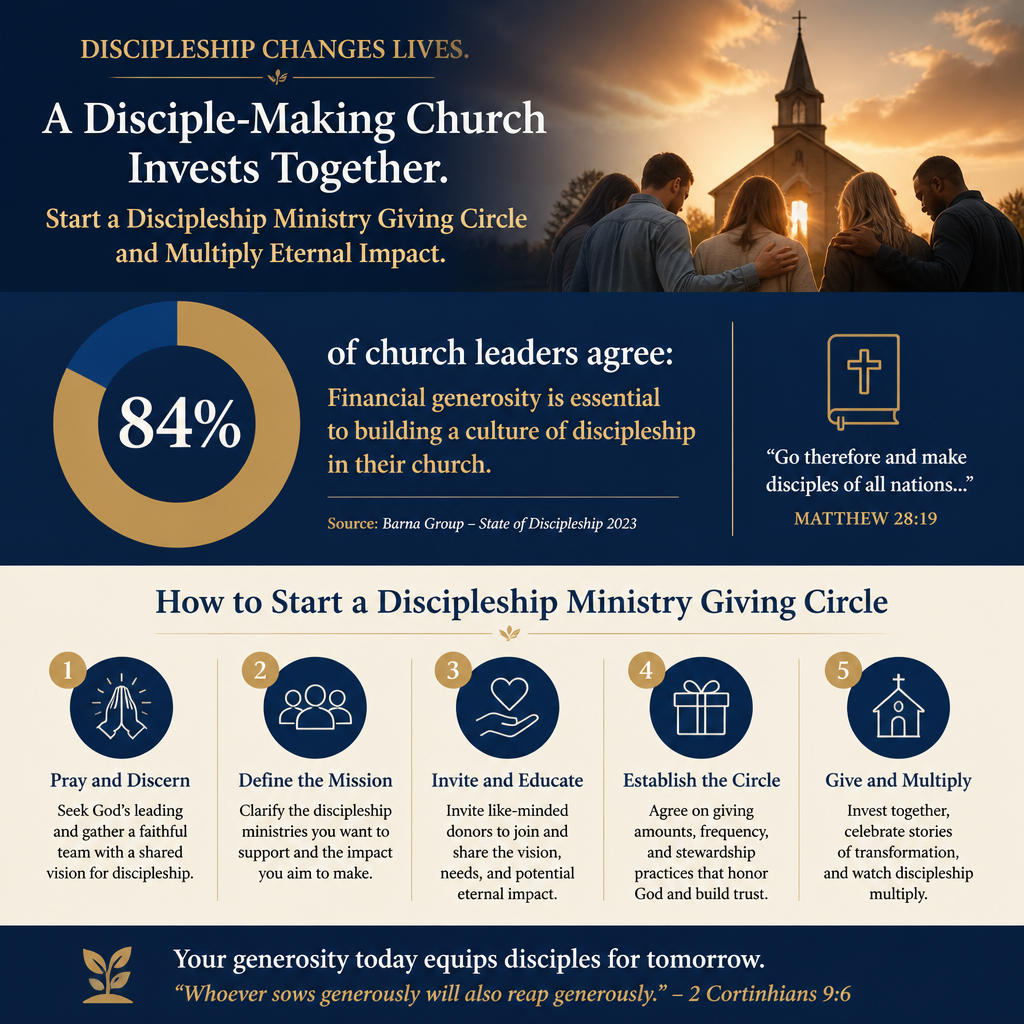
We recommend a simple annual cycle: a submission window, a review period, a decision meeting, and a reporting season. When donors can see the process, they are less likely to assume the decisions are driven by relationships, charisma, or internal politics.
Write down the operating commitments that protect unity
A short written charter prevents misunderstandings. It does not need legal complexity, but it should state membership expectations, decision rules, and where final accountability sits. The charter should also set a tone of pastoral restraint: donors are not spiritual directors of the ministries they fund, and ministry leaders are not performers for donor approval.
- Membership and minimum giving commitment stated plainly, with an option for confidentiality
- Decision method (consensus where possible; clear voting rule when needed)
- Conflict-of-interest policy including family and business relationships
- Grant size guidelines and whether multi-year commitments are permitted
- Reporting expectations focused on integrity and learning, not marketing
When a circle is connected to external ministry partners, donors often ask whether “overhead” is acceptable. The sector has had to correct the false assumption that low overhead equals faithfulness. The “Overhead Myth” statement by Charity Navigator, Candid, and the BBB Wise Giving Alliance explains why overhead ratios are a poor proxy for effectiveness and why context matters for responsible evaluation Charity Navigator.
Select and support discipleship ministries with verifiable due diligence
Require a small set of documents that signal integrity
A church-based giving circle is not a professional grantmaking office, but it can still practice serious due diligence. For external nonprofits, reasonable documentation includes recent financial statements, an annual report, board list, a statement of faith, and a clear description of programs and theory of change. For internal church ministries, it includes a budget, leader accountability, safeguarding policies where applicable, and a clear description of the ministry pathway.
When the circle cannot verify fundamentals, it should not compensate by trusting enthusiasm. Christians can be both warm-hearted and rigorous, because stewardship is a moral category. “It is required of stewards that they be found faithful” (1 Corinthians 4:2).
Use a common standard so decisions are not personality-driven
Many giving circles fail quietly because they do not name evaluation criteria. Decisions default to who tells the best story, who has the strongest relational ties, or what feels urgent in the moment. A common framework disciplines the group’s instincts.
Most Trusted exists to help donors give with confidence by evaluating ministries against The Most Trusted Standard, a 15-criteria framework across Faith Foundation, Financial Integrity, Governance and Leadership, and Transparency and Effectiveness. Even when a circle does not commission formal verification, adopting similar categories helps donors ask mature questions without becoming adversarial.
For donors who are building long-term partnerships, it also helps to understand the wider ecosystem of disciple-making work and how donors can support it with wisdom. The conversation is broader than one circle, and it often intersects with broader Discipleship Ministries in the church and beyond.
Integrate the circle into the church’s discipleship life without creating a parallel kingdom
Keep pastors and elders involved without making the circle clerical
A giving circle should not become a private society within the church, even if membership is limited. The church’s ordained or recognized leadership has a responsibility to guard doctrine, unity, and moral credibility. Their presence does not mean donors are coerced; it means the church remains one body with ordered accountability.
At the same time, the circle should not be absorbed into staff convenience. Donors are offering time, prayer, and resources. They deserve an adult relationship with ministry leaders: honest constraints, real trade-offs, and truthful reporting.
Report outcomes as discipleship fruit, not marketing success
Because discipleship is both visible and invisible, reporting must be careful. Numbers can matter (participation, retention, leader development), but numbers can also mislead. The New Testament’s language of fruit includes character, perseverance, and faithfulness under trial. A giving circle’s reporting should avoid exaggeration and keep the focus on what is credible and pastorally significant.
When the circle funds external partners, it is also prudent to clarify how the circle relates to the church’s broader giving priorities. Many churches already carry commitments to missions, benevolence, and local mercy. A giving circle can enrich those commitments or unintentionally compete with them. Wise design includes coordination with existing budgeted giving rather than fragmentation.
For donors who want to align generosity with mature partnership practices, the broader field of Donor Partnership with Discipleship Ministries is where many churches are doing their most thoughtful work: multi-year commitments, shared evaluation, and relationships that respect both donor stewardship and ministry autonomy.
FAQs for How to start a discipleship ministry giving circle at church
Should a discipleship giving circle fund internal church ministries or outside nonprofits?
Either can be appropriate, but the decision should be made explicitly. Funding internal ministries often strengthens pastoral oversight and unity, but it can also amplify internal politics if accountability is unclear. Funding outside nonprofits can extend the church’s disciple-making reach, but it requires more due diligence and clearer expectations about reporting and doctrinal alignment. Many circles begin internally for one year to establish practices, then add external partners once governance and evaluation are stable.
How much influence should donors have over discipleship ministry decisions?
Donors should have meaningful responsibility for the funds they steward, but not governing authority over the church. A healthy pattern is advisory influence within a defined scope: donors can recommend, deliberate, and decide among eligible options that have already been vetted for theological and operational integrity, with final accountability resting with the church’s recognized leadership structures. This protects unity and prevents the giving circle from becoming a shadow leadership body.
Generosity that forms disciples, not merely budgets
A discipleship ministry giving circle can become a quiet instrument of formation: donors learning patience, leaders practicing transparency, and ministries receiving support that strengthens long obedience rather than short-term impressiveness. The essential work is not the mechanics of collecting gifts, but the moral and theological clarity that governs them. When a church builds a circle with accountable authority, verifiable integrity, and a discipleship-shaped understanding of fruit, giving becomes one more way the body learns to follow Christ together.



