

Learning how to verify a military outreach ministry is legitimate is not a secondary concern for Christian donors; it is part of moral stewardship. Ministries that serve service members and veterans operate near real vulnerability—trauma, moral injury, family strain, transition stress, and, at times, public controversy. That proximity can produce extraordinary spiritual fruit. It can also attract ministries that are poorly governed, financially sloppy, or emotionally manipulative.
Scripture does not treat giving as sentiment. “It is required of stewards that they be found faithful” (1 Corinthians 4:2). Faithfulness includes the donor’s duty to test claims, ask sober questions, and give in ways that protect both the people being served and the witness of the Church.
Start with identity and authority, not messaging
Legitimate ministries can still communicate badly, and illegitimate ones can communicate well. The first layer of verification is therefore not whether the story “feels right,” but whether the organization can be identified, located in public records, and held accountable by a real governing structure.
Confirm legal existence and basic public filings
In the United States, the simplest starting point is whether the organization is a registered nonprofit and whether it is current on basic disclosures. The IRS Tax Exempt Organization Search can confirm whether an entity is recognized as tax-exempt and whether its status has been revoked for noncompliance. Use the IRS portal as a first-pass identity check, not as a full vetting tool: IRS Tax Exempt Organization Search.
If the ministry is a church or a church-integrated program that is not required to file a Form 990, donors should not assume that “exempt from filing” means “exempt from accountability.” In that case, we look for alternative transparency: audited financials, an independent board, clear conflict-of-interest policies, and credible oversight relationships.
Verify access to the military environment
Many military outreach ministries reference base access, chaplain partnerships, or work with particular units. Those claims can be real, but they can also be overstated in ways that trade on the credibility of the armed forces. Donors should ask for specifics that can be verified without compromising operational security: what installation, what kind of access, what role (volunteer, contractor, guest), and under whose authority.
Chaplains are often a key point of contact. The U.S. Department of Defense describes chaplains’ responsibilities as providing for the free exercise of religion and advising commanders on morale and ethical issues; their role also makes them a natural gatekeeper for faith-based support that is appropriate and lawful: U.S. Department of Defense.

Scrutinize financial integrity with more nuance than overhead ratios
Financial legitimacy is not the same as financial perfection. Military outreach can involve travel, counseling capacity, emergency assistance, and event-based ministry where costs are inherently variable. Mature donors should resist simplistic assumptions—both the “high overhead means corruption” myth and the “we are small, therefore pure” narrative.
Read the story the financials tell
If the ministry files a Form 990, donors can learn a great deal from it: governance disclosures, related-party transactions, compensation, fundraising practices, and whether revenue depends heavily on a single donor or a single event. Ministries that are legitimate are rarely threatened by thoughtful questions. They can explain their revenue mix, their reserves philosophy, and what they do when a major gift disappears.
We also recommend donors hold two ideas together. First, financial transparency is a biblical neighbor-love issue; hidden arrangements and unclear transactions harm the vulnerable. Second, the nonprofit sector has had to reckon with the inadequacy of overhead as a proxy for effectiveness. The “Overhead Myth” letter from Charity Navigator, Candid (formerly GuideStar), and BBB Wise Giving Alliance remains one of the clearest sector statements on why donors should evaluate outcomes and governance, not just administrative percentages: Charity Navigator.
Ask whether fundraising practices are truthful and restrained
Military communities are accustomed to honor, chain of command, and clear responsibility. Fundraising that exploits patriotic emotion, isolates donors from hard questions, or implies that dissent is disloyal should raise immediate concern. The more a ministry leans on guilt, urgency, and unverifiable “last chance” claims, the more donors should slow down and insist on documentation.
At minimum, donors should be able to obtain a recent annual report or financial summary, a clear description of how restricted gifts are handled, and a statement on whether any staff or board members benefit personally from vendor contracts or real estate arrangements.
Evaluate governance and leadership as a matter of discipleship
Christian donors sometimes treat leadership as a charisma question rather than a character-and-structure question. In military outreach, that mistake is costly. The people served may already struggle with trust due to betrayal, abuse of authority, or institutional failure. A ministry’s governance must therefore protect the flock from spiritual and organizational harm.
Look for accountable leadership, not celebrity leadership
We recommend asking direct questions about the board: How many members? How often do they meet? Are they independent of the founder? Do they review the executive director’s performance and compensation? Is there a conflict-of-interest policy, and is it enforced?
A founder-led ministry can be legitimate, but legitimacy requires real governance. When the founder controls the board, controls financial decisions, and is the sole public voice, donors should not interpret that as “strong leadership.” It is often simply unchecked authority.
Check safeguarding and pastoral care standards
Military outreach may involve counseling, spiritual direction, peer support groups, and ministry to families and children. Donors should ask about training and boundaries: background checks, mandatory reporting policies, trauma-informed care standards, and how the ministry responds to allegations.
Christians genuinely disagree about the best models for spiritual care in trauma contexts. Some emphasize licensed clinical counseling; others emphasize pastoral care and peer mentorship. What is not optional is clarity. A legitimate ministry can articulate what it provides, what it does not provide, and how it refers out when needs exceed its competence.
Test transparency and effectiveness without demanding impossible proof
Measuring ministry impact is complicated. Discipleship is not a lab experiment, and spiritual outcomes are not always reducible to metrics. Yet donors have a right to know whether the ministry’s claims are grounded in evidence, whether the organization learns from failure, and whether it can describe its work with precision rather than slogans.
Ask for outputs, outcomes, and learning
Outputs are what the ministry does: counseling sessions provided, retreat weekends hosted, Bibles distributed, chaplain support events conducted. Outcomes are what changes: reductions in isolation, strengthened marriages, reconnection to church, increased help-seeking, sustained participation in Christian community. A legitimate organization will be honest about which it can measure and which it can only testify to qualitatively.
Donors should also watch for claims that are too clean. Military and veteran support work is marked by relapses, setbacks, and slow rebuilding. When an organization promises quick transformation, it may be selling a narrative rather than doing the long obedience of care.
Watch for red flags in public communication
Transparency includes whether the ministry’s public materials match its internal reality. A ministry that routinely posts photos of service members without clear consent, or that uses identifiable stories in ways that could harm careers or privacy, is failing a basic duty of care. The same is true for ministries that use militarized rhetoric to brand spiritual warfare in ways that collapse complex pastoral questions into simplistic political categories.
Within Accountability and Transparency in Military Outreach Ministries, we often return to the same principle: transparency is not merely disclosure. It is truthful representation—of needs, results, costs, and limits.
Use a disciplined verification process before you give
Many donors want a single decisive test. In practice, verification works best as a set of disciplined checks applied consistently. The goal is not suspicion; it is fidelity—giving that honors Christ and protects neighbors.
A practical checklist for donors
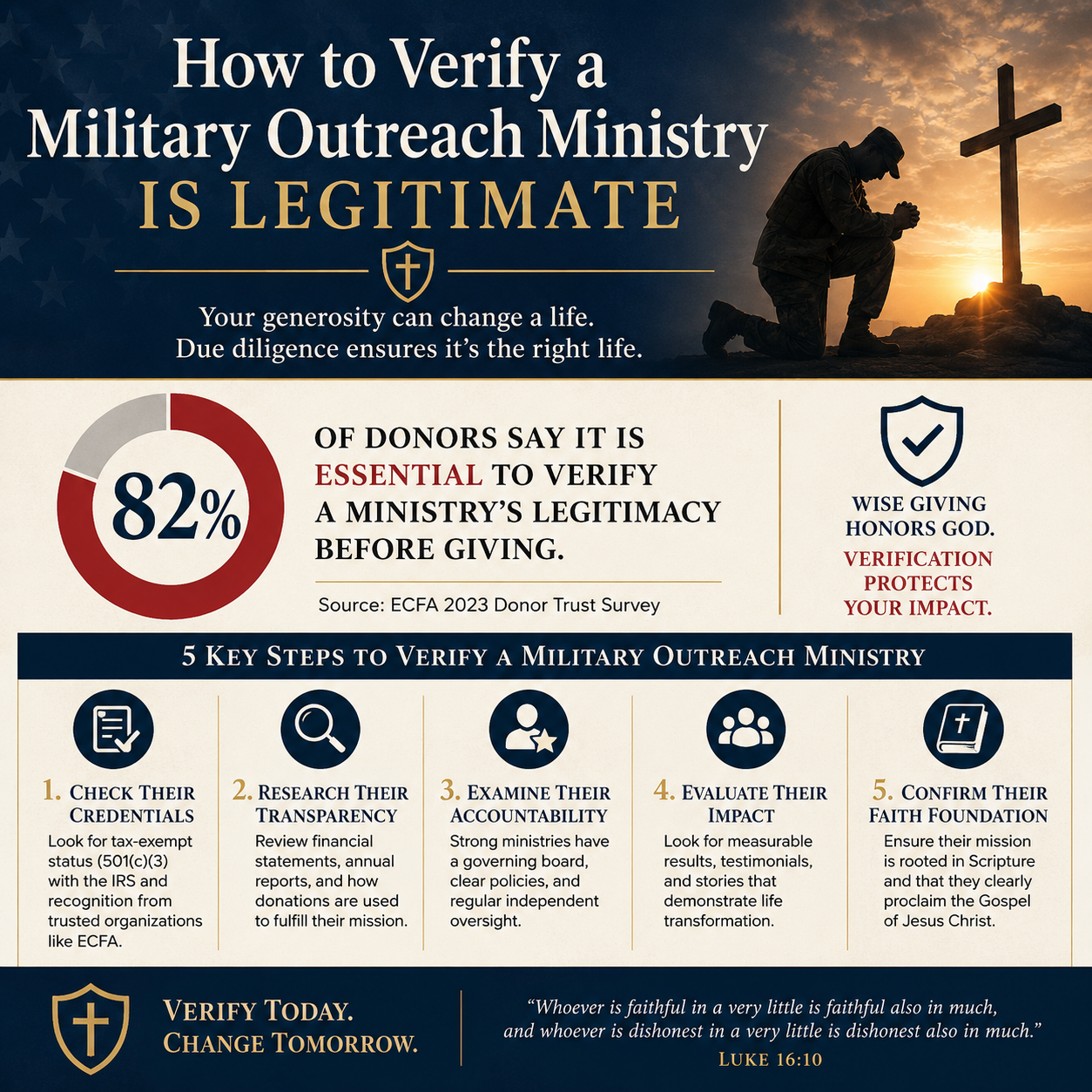
- Confirm the legal entity, tax status, and basic public filings through the IRS and state charity registries where applicable.
- Request recent financial statements, and ask clear questions about restricted gifts, reserves, and related-party transactions.
- Verify governance: independent board oversight, conflict-of-interest policy, and documented accountability for the CEO or founder.
- Assess safeguarding: background checks, reporting procedures, training standards, and referral pathways for clinical needs.
- Evaluate claims of military access or endorsement with specific, verifiable details rather than broad patriotic language.
How Most Trusted approaches verification
At Most Trusted, we evaluate Christian nonprofits against The Most Trusted Standard, a 15-criteria framework covering Faith Foundation, Financial Integrity, Governance and Leadership, and Transparency and Effectiveness. This framework exists because donors need more than inspirational storytelling; they need an evidence-based view of whether a ministry is structured to endure, to tell the truth, and to serve with integrity when no one is watching.
Within Military Outreach Ministries, we see recurring patterns in organizations that merit confidence: the humility to be examined, the discipline to document decisions, and the patience to describe results accurately rather than dramatically.
FAQs for How to verify a military outreach ministry is legitimate
Is a military outreach ministry legitimate if it does not file a Form 990?
It can be. Churches and some church-integrated ministries are not required to file a Form 990. In those cases, donors should seek alternative transparency: audited or reviewed financial statements, an independent governing board, clear written policies for conflicts of interest and restricted gifts, and a willingness to answer specific questions in writing. The absence of a 990 should increase the need for voluntary disclosure, not decrease it.
Should donors only give to ministries endorsed by the military or a chaplain?
Not necessarily. Some faithful ministries serve outside formal base access, especially when supporting veterans in civilian contexts or partnering with local churches. Still, endorsements and access claims should be treated as verifiable facts, not as spiritual credentials. Donors can ask for concrete descriptions of partnerships and, where appropriate, speak with chaplains or partner organizations to confirm the nature of the relationship.
Giving with confidence is a form of love
Military outreach asks the Church to meet people at the intersection of sacrifice, suffering, and moral complexity. The ministries that deserve donor trust are not those that claim the highest victories, but those that submit to scrutiny, tell the truth about their work, and build structures that protect the vulnerable. Christian donors honor Christ when generosity is joined to verification, and when compassion is expressed through faithful stewardship.



