

When donors ask what Christian aviation ministries deliver on mission flights, they are rarely asking about a passenger manifest alone. They are asking whether the Church’s presence in hard-to-reach places is faithful, prudent, and accountable—whether aircraft hours translate into gospel-shaped service rather than admirable motion.
Aviation can be one of the clearest examples of the body of Christ supplying what a community cannot easily supply for itself: safe access. It can also become a costly symbol if a ministry cannot demonstrate outcomes, safety discipline, and local partnership. Mature Christian giving requires both compassion and scrutiny, because we answer to the Lord of the harvest for how we steward what has been entrusted (Luke 16).
What gets delivered first is access
Christian aviation ministries exist because geography can be a form of isolation that markets and governments do not readily solve. Seasonal roads wash out. River travel becomes dangerous. Clinics and schools cannot keep staff because resupply is unreliable. In those settings, a single flight can compress days of travel into hours, and that change is not merely convenient—it can be determinative.
Patients, clinicians, and time-sensitive care
The most visible “deliverable” is often medical: transporting patients to surgical care, moving clinicians into rural clinics, or bringing laboratory samples to facilities that can process them. The humanitarian logic is straightforward, and it is also spiritually serious: Christian mercy is not an accessory to proclamation; it is part of the Church’s embodied witness (Matthew 25).
At the same time, serious donors should ask how ministries define and measure medical impact. A flight that moves a patient is not yet a health system. The stronger aviation ministries show how their transport integrates with credible local providers, referral pathways, and follow-up so that access produces durable care rather than one-time rescue.
Supply chains that keep ministries and communities functioning
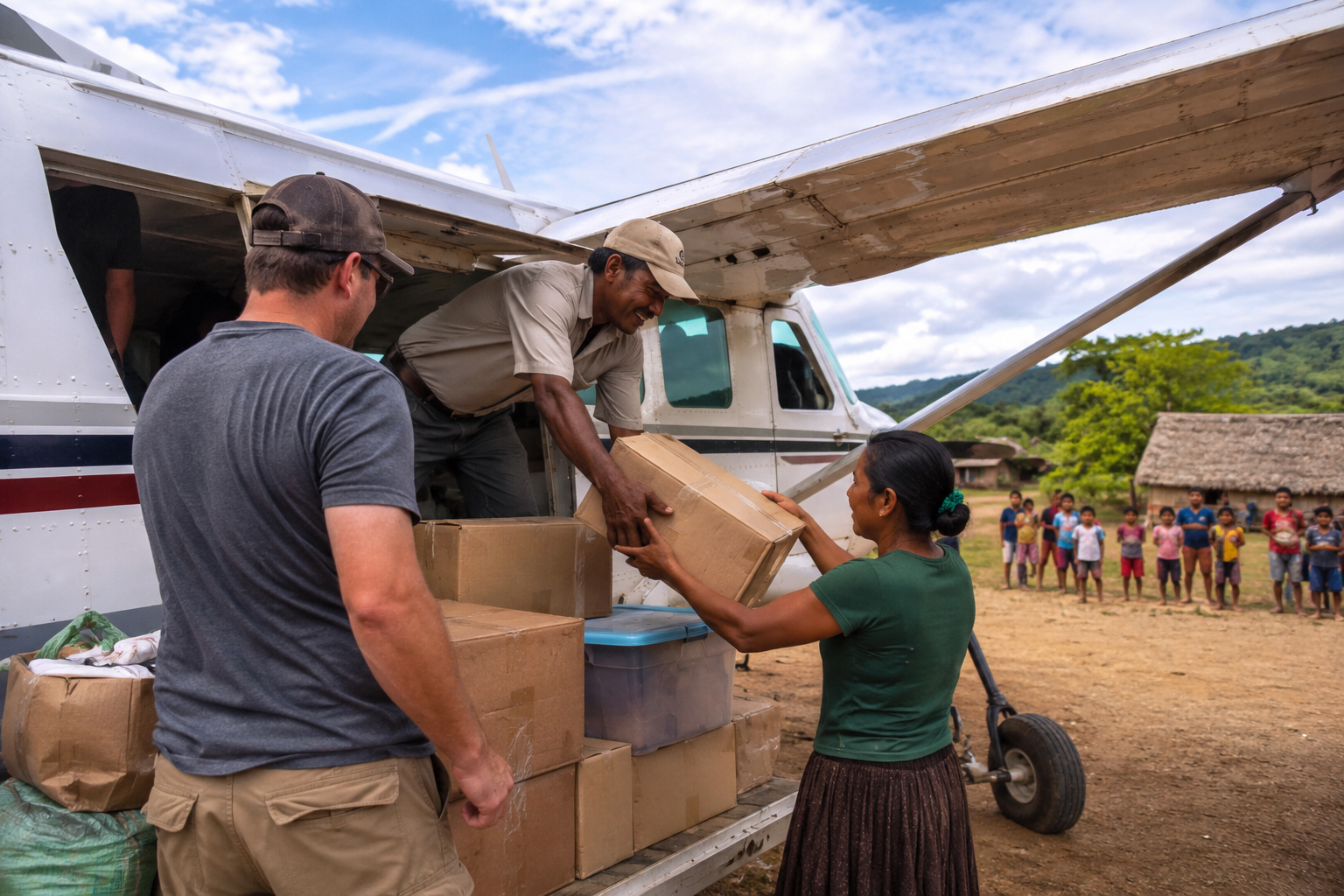
Access also means freight: vaccines, medical supplies, tools for clean water systems, Scripture portions, school materials, and food during acute disruption. In many contexts, “last-mile logistics” is the gap that quietly breaks otherwise good projects. Aviation can hold that gap open long enough for clinics, churches, and partner organizations to serve consistently.
When donors evaluate this work, the question is not whether supplies were flown, but whether the ministry has disciplined processes that prevent aviation from becoming the bottleneck: weight-and-balance standards, cargo controls, clear prioritization policies, and documented coordination with partners. Those are not technicalities; they are part of loving neighbors with competence.
On many flights, what is delivered is presence
Some mission flights do not “deliver” a box or a patient so much as they deliver presence: pastors reaching scattered congregations, translators supporting Scripture engagement, or trained counselors accompanying trauma care. Aviation changes pastoral geography.
Strengthening local churches rather than substituting for them
Christians genuinely disagree about how much outside personnel should move in and out of fragile regions. The best aviation ministries have learned to treat the local church not as a beneficiary but as a primary agent. Flights are planned around local priorities, local leadership, and long-term discipleship rather than the preferences of visiting teams.
This is where donors should listen for spiritual maturity in the ministry’s language. When a ministry speaks as though aviation “brings the gospel” to places the Church has not reached, it can unintentionally diminish what God is already doing through local believers. A healthier posture is to describe aviation as serving the Church’s existing witness—supporting pastors, enabling training, and connecting congregations that would otherwise remain isolated.
Transporting workers for sustained, skilled service
Aviation also enables specialized service that is difficult to staff locally in the short term: surgeons, mechanics, educators, and translators who come for extended engagements. The difference between sustained and episodic work matters. The field has had to reckon with the limits of short-term missions, and thoughtful donors should not fund aviation as a way to multiply trips without addressing what makes trips spiritually and developmentally wise.
Frameworks such as When Helping Hurts, articulated by Steve Corbett and Brian Fikkert, have sharpened Christian thinking about unintended harm, dependency, and the dignity of local capacity. Aviation ministries that take these concerns seriously will describe how flight activity supports local problem-solving rather than replacing it.
Deliverables include safety, compliance, and risk discipline
In donor conversations, “mission” can become a spiritual alibi for operational weakness. Aviation does not permit that. The cost of failure is measured in lives, and the credibility of Christian witness is implicated when an organization treats safety as optional.

Safety culture is part of ministry integrity
Healthy aviation ministries speak about safety culture with moral clarity: checklists, maintenance schedules, incident reporting, pilot currency, and conservative go-no-go decisions. They do not romanticize risk. They also invest in training and standardization, because competent love is still love.
Donors can ask whether the ministry submits to appropriate civil aviation oversight, maintains transparent incident procedures, and can explain how it manages risk. A refusal to answer basic questions about maintenance, safety audits, or training should be treated as a warning sign, not a sign of spiritual zeal.
Governance that can say no
One of the most important deliverables is invisible: a governance structure capable of saying no to a flight when pressure is high. Many emergencies feel urgent. Some are urgent. But wise leaders also know that tragedy compounds when decisions are made to satisfy emotion rather than evidence.
This is one reason our work at Most Trusted emphasizes not only financial stewardship but also governance and leadership practices that protect mission integrity. Ministries that meet The Most Trusted Standard tend to show documented oversight, clear decision rights, and accountability structures that do not collapse under crisis.
Mission flights are also a test of stewardship and clarity
Aviation is expensive. Aircraft acquisition, fuel, maintenance, insurance, and training create a cost profile that can unsettle even experienced donors. The harder question is not whether aviation costs more than ground transport; it is whether aviation is the right instrument for the mission and whether outcomes justify the cost in that setting.
Costs are not the enemy, confusion is
Some donors were trained to treat low overhead as synonymous with faithfulness. The field has corrected that assumption. In 2013, Charity Navigator, GuideStar, and the BBB Wise Giving Alliance issued a joint statement warning against using overhead ratios as the primary measure of a charity’s performance, because it can mislead donors and harm nonprofits that need to invest in infrastructure and evaluation (Charity Navigator).
For aviation ministries, the parallel temptation is to treat flight hours as the primary measure of impact. Flight hours are an input. They may be necessary, but they are not sufficient. Strong ministries explain what those hours produced: clinics kept open, pastors trained, patients referred, Bibles delivered to language communities, or supply chains stabilized during disruption.
What donors should be able to verify
Across our verification work, we observe that trustworthy ministries can articulate their operational logic in plain terms and back it with documentation. In aviation, that typically includes:
- Clear criteria for prioritizing flights when demand exceeds capacity
- Documented maintenance and inspection schedules
- Partner agreements that define roles and expectations
- Evidence of outcomes beyond activity metrics
- Financial statements that make aviation costs legible to donors
When these elements are absent, donors are asked to fund a story rather than a stewarded mission. When they are present, aviation becomes a transparent instrument in service of the Kingdom.
Delivering well requires partnership, not aerial heroism
Christian aviation is at its best when it refuses the savior narrative. Aircraft can amplify both wisdom and folly. The ministries that endure are those that understand themselves as servants within a larger ecosystem of local churches, clinics, and community leaders.
How flight programs mature over time
Early-stage aviation efforts often begin with a compelling need and a courageous pilot. Maturity requires systems: local staffing, leadership development, maintenance capacity, cross-cultural competence, and a theology of service that does not confuse visibility with faithfulness. In our review process at Most Trusted, we encourage donors to look for evidence that a ministry has progressed from heroic dependence on a few individuals to sustainable practices that can outlast personnel changes.
Partnership maturity also includes understanding when not to fly. Sometimes the right answer is funding a road repair, supporting a regional clinic, training local medical staff, or improving radio communications. Aviation ministries that can recommend alternatives demonstrate that their allegiance is to the mission, not to their own activity.
Where to situate aviation within the wider work of the Church
Donors who want a fuller context for how aviation fits into Christian service can situate this work within Christian Aviation Ministries, where the larger landscape of organizations, models, and accountabilities becomes easier to compare. Aviation is not a substitute for the Church’s ordinary means of ministry; it is a support structure that can make those means viable in difficult terrain.
It also belongs within a broader understanding of How Christian Aviation Ministries Serve Mission Fields, because flight programs are only one dimension of the long obedience that mission fields require. The deliverable that matters most is not speed but fidelity—fidelity to Christ, to neighbor, and to truth.
FAQs for What Christian aviation ministries deliver on mission flights
Are mission flights mainly about transporting short-term teams?
Some mission flights do support visiting teams, but the most defensible aviation programs are built around year-round access needs: medical referrals, resupply for clinics and church networks, support for local leadership training, and emergency response when appropriate. Donors can ask what percentage of flight activity is dedicated to locally defined priorities and sustained services versus episodic travel.
What should donors ask to evaluate an aviation ministry responsibly?
Donors should ask for clarity on safety culture, governance oversight, partner relationships, and outcomes beyond flight hours. Practical questions include how maintenance is documented, how flights are prioritized, what local partners say about the ministry’s reliability, and how the ministry reports results with transparency. When a ministry has been evaluated against The Most Trusted Standard, donors can also expect clearer evidence across faith commitments, financial integrity, leadership practices, and effectiveness reporting.
What faithful delivery finally looks like
Christian aviation ministries deliver more than transport. They deliver access that keeps clinics functioning, presence that strengthens local churches, and disciplined stewardship that refuses to trade safety and accountability for spiritual theater. When donors fund aviation with clear-eyed charity—mercy informed by truth—they participate in a form of love that is both courageous and responsible.



