
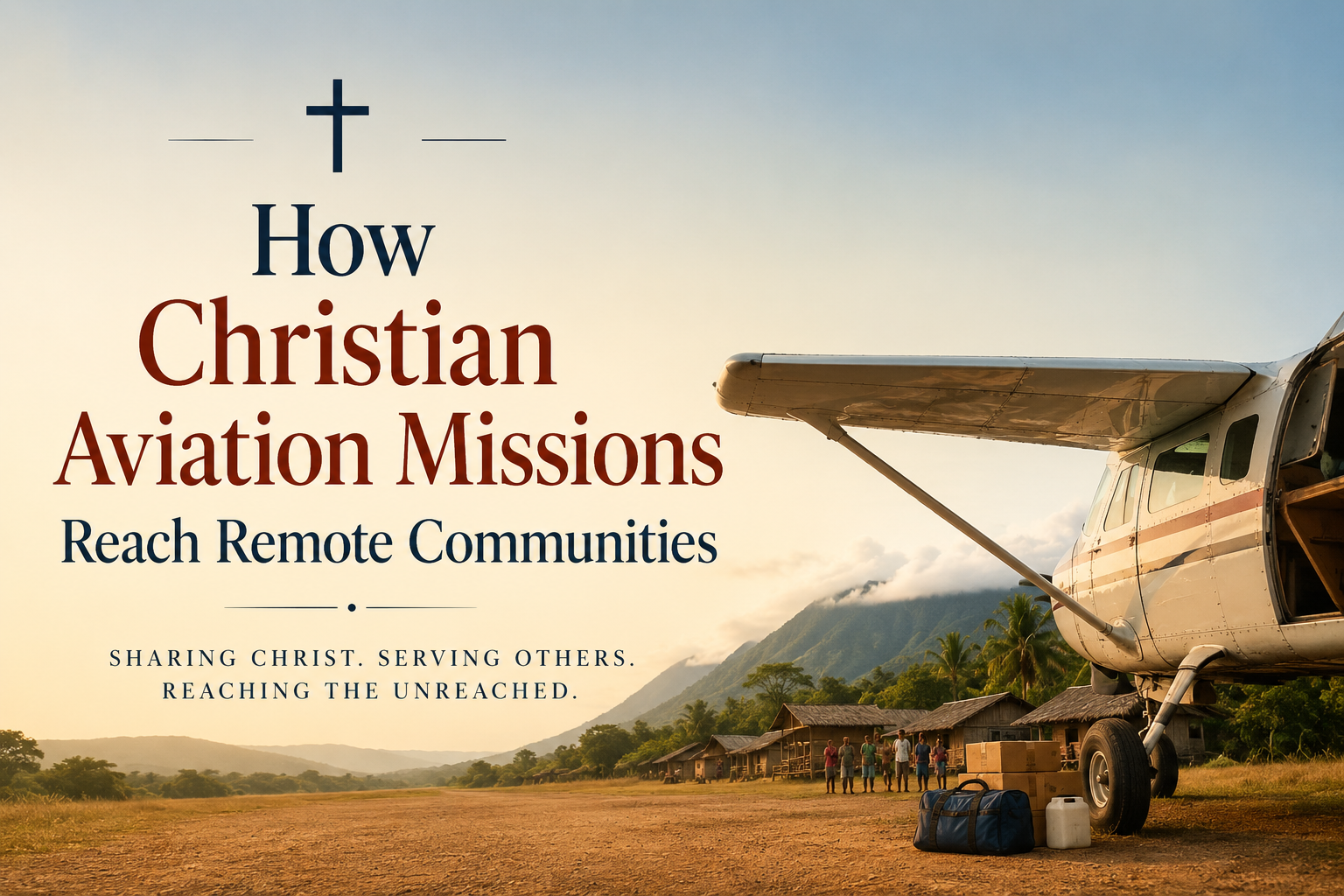
How Christian aviation missions reach remote communities is not a romantic question about adventure; it is a practical question about Christian presence, pastoral care, and mercy in places where roads do not exist or do not function. For donors, it is also a stewardship question: whether aircraft, pilots, and maintenance budgets serve the Church’s long obedience in the same direction—or become an expensive substitute for durable local capacity.
Scripture repeatedly binds neighbor-love to real, embodied proximity. The parable of the Good Samaritan turns on the willingness to cross the road and draw near (Luke 10:25–37). Aviation does not change that moral logic; it changes the geography. Where rivers, mountains, conflict, or seasonal mud make weeks of travel impossible, aviation can compress distance so pastors, medical teams, Bible translators, and emergency responders can arrive in time to matter.
Remote does not mean unreachable, but it often means expensive
Aviation ministries exist because “last mile” problems are often “last hundred miles” problems. In parts of the world where airstrips are the only dependable infrastructure, a flight is not a luxury; it is the difference between a mother reaching obstetric care and not reaching it. Donors rightly ask whether that premium cost is warranted. The answer depends on what aviation replaces and what it enables.
The cost profile is real. Aircraft acquisition, fuel, and maintenance are typically priced in hard currency, while the communities being served may live largely outside the cash economy. Those asymmetries create pressure to fundraise continually and to demonstrate outcomes that justify a high-cost platform.
The terrain problem is often a time problem
The defining constraint in remote work is not simply distance but time-to-care. When a clinic lacks blood, when a child has cerebral malaria, when a flood cuts off a valley, the ethical question is whether help arrives soon enough. For donors weighing aviation against other interventions, time-to-care is a meaningful category because it connects directly to preventable mortality and pastoral presence.
The World Health Organization has emphasized that lack of access to emergency surgical and anesthesia care contributes to high rates of death and disability, particularly in low-resource settings, and that timely access is essential to saving lives World Health Organization. Aviation is one tool that can move the access curve where roads and ambulances cannot.
Christian presence is not only humanitarian
Christian aviation is often described in humanitarian terms, but many missions are fundamentally ecclesial. They exist to support local churches, pastors, and Scripture translation teams—often through transport, communications, and training. Donors should not treat these as competing purposes. The New Testament pattern of mission work includes both proclamation and costly care (Acts 14:8–18; Galatians 6:10). The question is whether a particular ministry keeps those commitments integrated and accountable.

What aviation missions actually do on the ground
Because aircraft are visible and dramatic, it is easy to overestimate what aviation alone accomplishes. Planes and helicopters do not disciple anyone. They create access so that long-term work can happen: local leadership development, translation, church planting support, and medical systems that strengthen communities over time.
Common operational roles
Across the field, aviation teams tend to serve in a few recurring ways. The best ministries treat these roles as service to others rather than as a brand built around the aircraft.
- Medical evacuation and patient transport for time-sensitive cases
- Logistics for clinics, disaster response, and public health teams
- Support for Bible translation and literacy programs in isolated language communities
- Transport for pastors and church leaders to provide teaching and pastoral care
- Training and technical support that helps local staff operate safely over time
Coordination matters more than heroics
The highest-leverage aviation work is frequently the least dramatic: flight scheduling that matches genuine need, cargo prioritization, and careful coordination with local health systems and church networks. In disaster response, aviation can either accelerate wise aid or amplify disorder. The When Helping Hurts framework, articulated by Steve Corbett and Brian Fikkert, has shaped Christian development practice by insisting that help must strengthen dignity, local agency, and long-term livelihoods rather than unintentionally displacing them Moody Publishers. Aviation ministries that take that framework seriously will be cautious about flying in solutions that bypass local leadership.
What faithful effectiveness looks like in Christian aviation
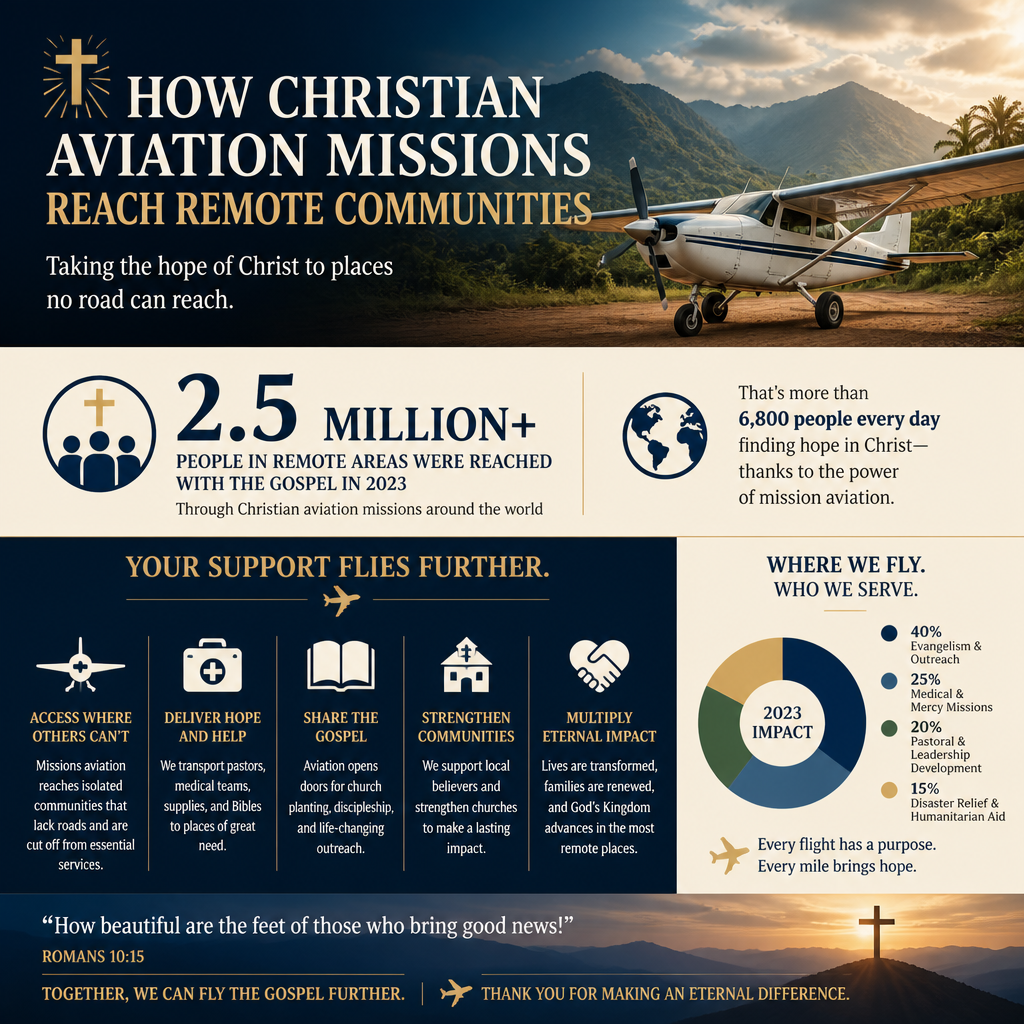
Donors are often asked to fund aviation because “it works.” That claim deserves precision. Effectiveness in aviation is not only a count of flights or hours. It includes safety, demonstrated service outcomes, and a posture that honors the local church as primary.
Safety is theological as well as technical
Aviation is unforgiving. A ministry’s safety culture is not peripheral to its spirituality; it is part of its ethic of neighbor-love and its respect for human life. The ministries that serve well tend to have disciplined maintenance programs, clear incident reporting, strong pilot training, and governance structures that do not pressure staff to fly in unsafe conditions for the sake of fundraising narratives.
Donors should expect candor here. Mature organizations will talk about risk, decision thresholds, and how they learn from near-misses. They will not suggest that faith makes prudence unnecessary.
Outcomes should connect flights to human good
Counting flights is not enough because activity is not impact. Strong aviation ministries link flights to outcomes they can explain and, where possible, document: patients transported, clinics supplied, translation teams supported, or pastoral visits enabled. In medical contexts, the importance of timely access is widely recognized. The Lancet Commission on Global Surgery highlighted that billions of people lack access to safe, affordable surgical and anesthesia care when needed and that delays contribute to preventable harm The Lancet. Aviation’s contribution should be articulated as a reduction in delay, not as a generic claim to “reach the unreached.”
At Most Trusted, our verification work consistently finds that the most credible ministries are specific about what they do, humble about what they cannot do, and careful to distinguish between outputs and outcomes. This is as true for aviation as it is for any other specialized ministry.
Stewardship tensions donors should name directly
Aircraft can become a fundraising symbol that draws attention away from the less visible work of discipleship, translation, and health system strengthening. Christians genuinely disagree about the right balance between high-cost tools and lower-cost community investments. That disagreement is not a sign of bad faith; it is a sign that stewardship is complex in a broken world.
High-cost assets invite governance risks
Any ministry that owns and operates aircraft bears governance responsibilities that extend beyond typical nonprofit oversight. Donors should ask about independent board governance, financial controls, and how decisions are made about fleet expansion. A ministry can be doctrinally sound and still weak in internal controls. The result is not only inefficiency; it is reputational damage that can harm the witness of the broader church.
This is one reason donors turn to independent evaluation. Most Trusted exists to help donors give with confidence by evaluating ministries against The Most Trusted Standard, a 15-criteria framework that examines faith commitments, financial integrity, governance, and transparency and effectiveness. Aviation ministries have additional operational complexity, which makes clear documentation and accountable leadership even more important.
Dependency and displacement are real possibilities
Aviation can inadvertently sideline local initiative. If flights are free or heavily subsidized, they can weaken local transport markets or create patterns where communities wait for external help instead of building durable solutions. The best ministries mitigate this by working through local partners, setting clear eligibility criteria, and investing in local capacity where feasible.
Donors should also ask a harder question: when aviation is providing access, what is being built on the other end of the runway? If the “remote community” is primarily receiving short-term teams and imported programs, aviation may be amplifying a weak model. If it is enabling local pastors, local clinicians, and local translators to sustain long-term presence, aviation is serving a stronger one.
How donors can evaluate aviation ministries with confidence
Stewardship requires more than admiration for sacrifice. It requires evidence of integrity and clarity about purpose. Aviation ministries are often sincere, and many are exemplary, but donors should still insist on verifiable signals of trustworthiness.
Questions that separate compelling stories from accountable work
Across our verification work, the ministries that meet The Most Trusted Standard tend to welcome informed scrutiny. They can answer practical questions without defensiveness because their internal systems are designed to be examined.
Consider asking:
- How does the ministry decide which flights are mission-critical, and who authorizes exceptions?
- What are the audited financials, and how are restricted funds tracked and reported?
- How does the ministry measure outcomes beyond flight counts, especially in medical and church-support work?
- What is the safety management approach, including maintenance documentation and incident reporting?
- How does the ministry partner with local churches and leaders to avoid dependency and displacement?
Use independent verification as a complement to relationship
Many donors rightly value relational confidence—knowing leaders, hearing field reports, visiting if possible. Yet relationship can blur judgment, especially when a ministry’s work is emotionally compelling. Independent assessment is not a replacement for discernment; it is a safeguard for it.
For donors comparing multiple organizations in this space, engaging the broader field context can be helpful. Within Christian Aviation Ministries, the range of models is wide: some organizations function primarily as logistics providers to other ministries, others integrate aviation into a broader strategy of church support, translation, and community development.
Donors can also benefit from understanding how aviation fits within mission-field service more broadly. The category How Christian Aviation Ministries Serve Mission Fields highlights common patterns of service and the recurring accountability questions that serious givers should keep in view.
FAQs for How Christian aviation missions reach remote communities
Are Christian aviation missions mainly about emergency relief?
Emergency transport and disaster response are significant for many aviation ministries, but they are rarely the whole story. Many flights exist to sustain long-term ministry presence: supporting local pastors, enabling Bible translation work, transporting clinic supplies, and connecting isolated communities to services that would otherwise be unreachable. Donors should ask what proportion of flight time serves emergency response versus ongoing church and community support, and how the ministry evaluates effectiveness in each category.
What is a reasonable way to think about overhead for aviation ministries?
Aviation blurs the usual overhead categories because maintenance, training, and safety systems are integral to mission delivery. Donors should not reward an artificially low “overhead” presentation that underfunds safety or governance. The more faithful question is whether spending aligns with purpose and is transparently reported. The joint “Overhead Myth” statement from Charity Navigator, Candid, and the BBB Wise Giving Alliance explains why overhead ratios alone are a poor measure of nonprofit performance Charity Navigator.
Aviation as a ministry of presence, under accountability
Christian aviation missions reach remote communities when they serve as an instrument of faithful presence—bringing timely care, enabling local ministry, and sustaining work that would otherwise be isolated. The aircraft is not the mission; it is a means of love of neighbor under constraints of geography and urgency.
For donors, the call is to pair generosity with rigor. We recommend supporting aviation ministries that can show disciplined safety culture, transparent finances, accountable governance, and outcomes that connect flights to real human good and enduring local church strength. That is the kind of work that stands up to scrutiny, honors the weight of stewardship, and reflects the moral seriousness Scripture brings to the use of resources entrusted to God’s people.



