

What makes a Christian aviation mission flight effective is not merely that a plane takes off and lands safely. Effectiveness is the morally weighty question of whether aviation is serving the Church’s mission—strengthening local believers, protecting the vulnerable, and advancing gospel witness—without confusing speed for faithfulness.
For donors, aviation can feel unusually compelling: urgent needs, difficult terrain, and visible outcomes. The same features that make aviation persuasive also create risk. A flight can be heroic and still be strategically misaligned, financially imprudent, or spiritually detached from the local church. The work is technical, but the accountability questions are profoundly Christian ones: stewardship, truthfulness, and love of neighbor.
Effectiveness begins with a mission that aviation truly serves
Aviation is a means, not a ministry identity
Christian aviation exists to remove barriers so that pastors, medical teams, translators, Scripture resources, and relief workers can serve where roads fail or time is scarce. When aviation becomes the centerpiece—rather than the enabling infrastructure—priorities can drift toward activity that photographs well but contributes little to long-term ministry fruit.
Across our verification work at Most Trusted, the strongest aviation ministries can explain, in plain language, why a given flight should happen at all. They can also explain why it should happen by air rather than by road, boat, or locally available options. That clarity guards against the subtle temptation to equate motion with impact.
Christian donors should look for alignment with the local church
Christians genuinely disagree about the best models for cross-cultural mission, but there is broad agreement on one essential principle: mission work should honor and strengthen local believers rather than displacing them. Effective flights are planned with local church leadership, trusted partners, and field-based teams who understand the cultural and ecclesial realities on the ground.
When aviation functions as a service requested by accountable local partners—rather than a platform imposed from outside—its value becomes easier to evaluate. The question is not simply, “Did we deliver people and cargo?” but “Did this flight strengthen local ministry, protect dignity, and respect local agency?”

Effectiveness requires disciplined operational integrity and safety
Safety is theological stewardship, not mere compliance
Aviation is unforgiving. In remote settings, small errors compound quickly. An effective Christian aviation mission flight is one that treats safety as a stewardship obligation before God, not a box to check. That includes conservative decision-making, clear weather minima, maintenance discipline, and authority structures that empower pilots and mechanics to say no without reputational penalty.
Donors are rarely equipped to audit maintenance logs, but they can look for signals of operational seriousness: independent oversight, documented safety management practices, transparent incident reporting, and field leadership that does not reward risk-taking. These are not “overhead concerns.” They are mission preservation.
The most important flight decision is sometimes cancellation
In Christian aviation, the pressure to deliver can be intense: a medical patient, a pastor’s urgent travel, a relief shipment after flooding. Yet an organization’s maturity is often revealed when it declines a mission request because conditions are unsafe or the request is strategically unwise. Saying no is a form of truthfulness.
What this means in practice is that effective ministries do not treat every urgent request as a mandate. They triage. They set criteria. They document decisions. And they preserve trust with local partners by being consistent rather than improvisational.
Effectiveness is measured by outcomes that matter, not only outputs
Flights counted are not the same as lives served
Aviation ministries can report impressive activity: flight hours, passenger totals, pounds of cargo. Those metrics have value, but they are outputs. Mature evaluation asks what changed because a flight occurred. Was a remote church equipped? Did a vulnerable patient receive timely care? Did a translation team reach a milestone? Did local pastors gain access to training that strengthens their congregations?
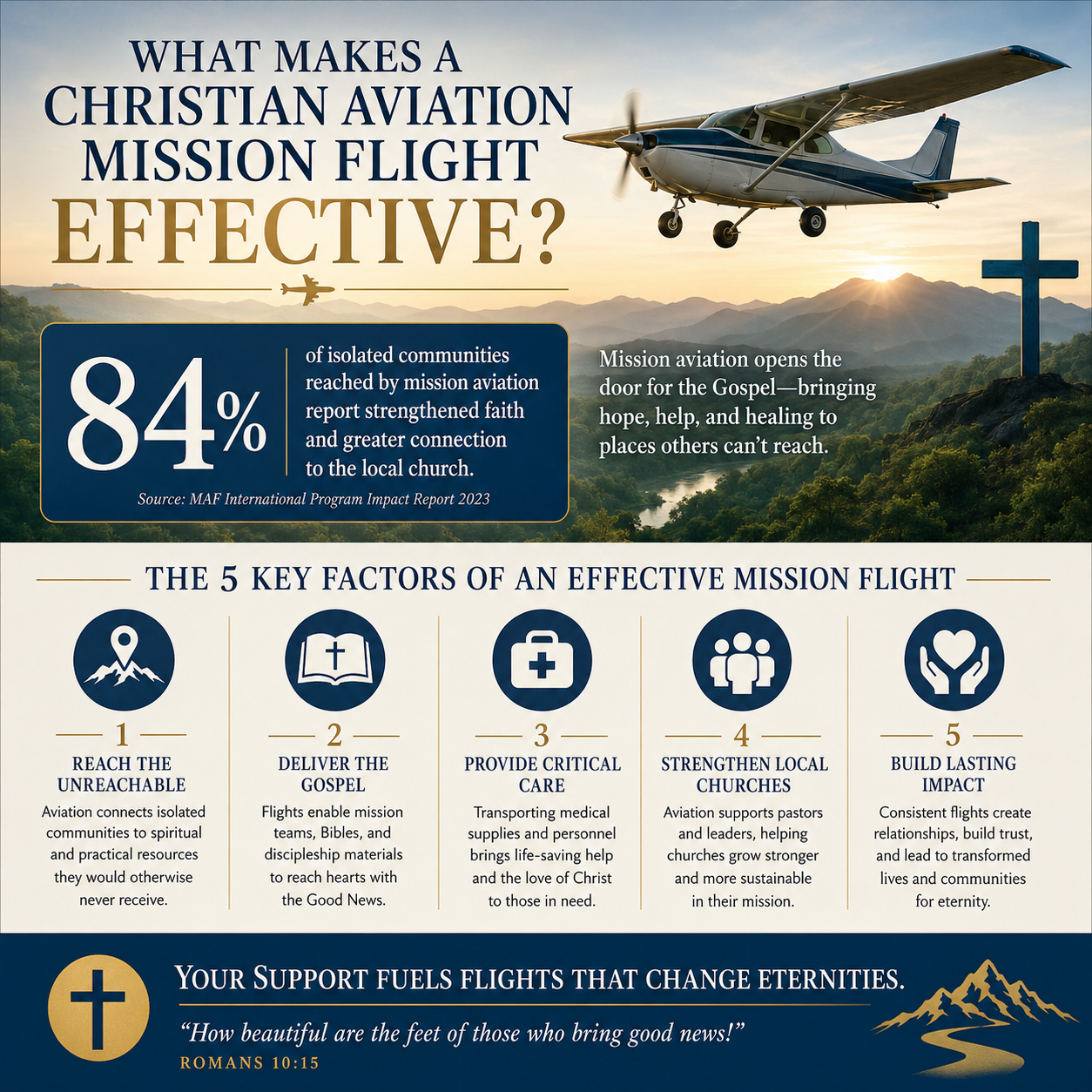
Donors often sense this distinction intuitively. The discipline is requiring ministries to speak about impact with humility and specificity, avoiding inflated claims about “reaching thousands” when the causal chain is unclear. When ministries connect flight activity to ministry outcomes—and are honest about limits—credibility rises.
Timeliness can be the decisive impact variable
In many environments, aviation matters because time matters. Road access may be seasonal, unsafe, or simply too slow for a patient, a crisis response, or a security-sensitive pastoral movement. One reason donors fund aviation is that it changes what is possible within a day.
When ministries explain these constraints concretely—distance, travel days saved, seasonal road closures—donors can better discern whether aviation is a proportionate solution. For context, the World Bank has documented how rural access constraints affect essential services and economic participation, including the role of transport connectivity in human development World Bank.
- Clear ministry purpose for the flight request, owned by accountable field partners
- Documented decision criteria for prioritizing and, when necessary, declining requests
- Outcome-linked reporting that connects aviation outputs to ministry results
- Conservative safety culture that protects lives and preserves long-term capacity
- Cost awareness that resists treating aviation as a prestige asset
Effectiveness includes financial realism and governance that can bear weight
Aviation is expensive, and faithful stewardship must name that
Aircraft acquisition, maintenance, fuel, training, regulatory compliance, hangars, and insurance impose persistent costs. Christian donors do not need romantic narratives; they need sober stewardship. An effective flight is one delivered within a sustainable financial system that does not depend on chronic underfunding, deferred maintenance, or pressure to “do more with less” in ways that elevate risk.
This is one place where the broader charitable sector has learned hard lessons about simplistic expectations. The “Overhead Myth” letter—signed by Charity Navigator, Candid (GuideStar), and the BBB Wise Giving Alliance—warned donors and charities against judging effectiveness primarily by administrative ratios, since starvation budgeting can undermine results and integrity Charity Navigator.
Governance must be able to say no to charismatic momentum
Aircraft and pilots can attract attention and admiration. That is not inherently wrong, but it can distort accountability if boards defer to operational heroes or donors. Effective aviation ministries have governance structures that can ask hard questions: Are we expanding too quickly? Are our reserves adequate? Are maintenance practices being pressured by fundraising narratives? Are field partnerships truly reciprocal?
We recommend that donors look for ministries that can articulate board independence, conflict-of-interest controls, audited financials where appropriate, and transparent reporting. At Most Trusted, this is central to how we evaluate ministries against The Most Trusted Standard, because governance and financial integrity are not peripheral to mission; they protect it.
Effectiveness is relational and spiritual, not merely logistical
Christian aviation should embody the character of Christ
Jesus measured leadership by service: “Whoever would be great among you must be your servant” (Mark 10:43). Aviation can unintentionally invert that ethic if beneficiaries are treated as cargo, if local partners are treated as “field contacts,” or if urgency becomes an excuse for impatience. An effective flight is conducted with respect, clear communication, and a posture that honors those being served.
This includes consent and dignity for patients, discretion in sensitive security contexts, and humility about what outsiders can and cannot see. The most credible ministries speak about the people they serve in ways that protect them, even when doing so limits fundraising storytelling.
Partnership health is an impact metric
Mission aviation often touches multiple systems: churches, clinics, NGOs, community leaders, and government aviation authorities. A flight can “succeed” operationally while damaging trust relationally. Effective ministries invest in partnership agreements, local staffing where feasible, language and cultural competency, and conflict resolution. They take complaints seriously and can describe processes for addressing harm.
Donors considering this field can deepen their understanding of the ecosystem through Christian Aviation Ministries, particularly the way aviation supports church and community life beyond crisis moments.
FAQs for What makes a Christian aviation mission flight effective
How can donors evaluate effectiveness if they cannot visit the field?
Donors can look for disciplined reporting that connects flight activity to ministry outcomes, not only to flight counts. Credible ministries describe decision criteria, name key partners, report both successes and constraints, and demonstrate governance and financial practices that reduce pressure toward risky operations. Independent verification can also help; Most Trusted evaluates ministries against The Most Trusted Standard so donors can give with greater confidence.
Should donors prioritize medical flights, pastor transport, or disaster response?
The priority depends on context. Medical evacuation can be life-saving, pastoral transport can strengthen the Church across remote regions, and disaster response can stabilize communities. The more reliable question is whether the ministry can justify aviation as the appropriate tool for that context, show accountable local partnership, and demonstrate safety culture and financial sustainability. Within How Christian Aviation Ministries Serve Mission Fields, donors can compare how different flight types fit within long-term mission strategy.
A standard of effectiveness worthy of the Church
An effective Christian aviation mission flight is one that serves a coherent mission, is executed with uncompromising operational integrity, and is evaluated by outcomes that matter for people and for the Church. Aviation’s distinctive temptation is to let urgency obscure discernment. The distinctive opportunity is to make faithful ministry possible where geography and time would otherwise close the door.
For donors, the call is not to admire aviation’s drama, but to fund aviation that is accountable, safe, locally aligned, and spiritually serious. That is the kind of effectiveness that endures—before stakeholders, and before God.



