
How rescue missions support job readiness and housing is not a peripheral question for Christian donors; it is one of the clearest tests of whether a ministry is moving from crisis relief to durable restoration. A meal line can stabilize a life for a night. But a credible pathway to work, income, and housing addresses the conditions that keep neighbors cycling through emergency shelter.
Many rescue missions now operate at the intersection of mercy ministry and workforce development. That intersection is contested terrain. Christians genuinely disagree about how much emphasis should fall on “services” versus “spiritual change,” and the field has had to reckon with programs that became transactional or coercive. Yet Scripture does not permit a false choice between compassion and formation. The pattern is embodied care ordered toward wholeness, because human beings bear God’s image and because the gospel is not merely pardon, but new life.
Rescue missions sit where crisis and calling meet
Emergency shelter is necessary and inherently limited
Rescue missions often serve people whose lives have been fragmented by job loss, domestic violence, addiction, incarceration, untreated mental illness, or prolonged poverty. Emergency shelter provides immediate safety, and in many communities it is the only low-barrier option open on a cold night. But donors should be clear-eyed: shelter by itself rarely produces stability, because the causes of homelessness are layered and persistent.
Public data underscores the scale of the need. The U.S. Department of Housing and Urban Development’s annual Point-in-Time count identified hundreds of thousands of people experiencing homelessness on a single night in 2024, a figure that continues to pressure local systems of care. U.S. Department of Housing and Urban Development
A biblically grounded vision pairs mercy with responsible agency
Christian missions have historically insisted that mercy is not condescension. It is neighbor-love offered without denial of moral agency. We are commanded to feed the hungry and welcome the stranger, and we are also told that work is a meaningful part of human dignity (Genesis 2:15). Rescue missions that support job readiness and housing are attempting to hold both truths together: compassion for those who suffer, and a constructive path toward responsibility, community, and vocation.

Job readiness is not a résumé class, it is a rehabilitative pathway
What job readiness often needs to include
Donors sometimes picture job readiness as a short course in interviewing and workplace etiquette. Those tools matter, but the more difficult work is often upstream: stabilizing sleep, treating addiction, securing identification documents, repairing a legal record where possible, and rebuilding habits that make sustained employment feasible. For a person who has been living in survival mode, punctuality and conflict management can be as much about trauma recovery as character improvement.
Rescue missions vary widely in how they structure this work. Some run internal social enterprises that provide transitional employment and a supervised environment. Others partner with local employers and community colleges. The strongest programs define measurable milestones, but they also acknowledge that progress is rarely linear.
Accountability can be loving, or it can become a substitute for discipleship
Christians genuinely disagree about program requirements: curfews, chapel attendance, work therapy hours, and sobriety expectations. Some requirements are necessary for safety and communal order. Others can drift into a thin moralism that confuses compliance with transformation. The distinction matters to donors because it influences outcomes and it reflects theology.

The When Helping Hurts framework, articulated by Steve Corbett and Brian Fikkert, has helped many Christian ministries examine how aid can unintentionally reinforce dependency or paternalism when it is not rooted in wise, relational discipleship. When Helping Hurts
Housing is not only placement, it is stability and community
Why “housing first” debates require careful listening
The field has had to reckon with real debates over the sequencing of housing and recovery. Some communities emphasize immediate permanent housing with supportive services. Others emphasize readiness models that require sobriety or program completion before placement. The research is complex, and local conditions matter: rental markets, availability of supportive housing units, behavioral health capacity, and public safety realities.
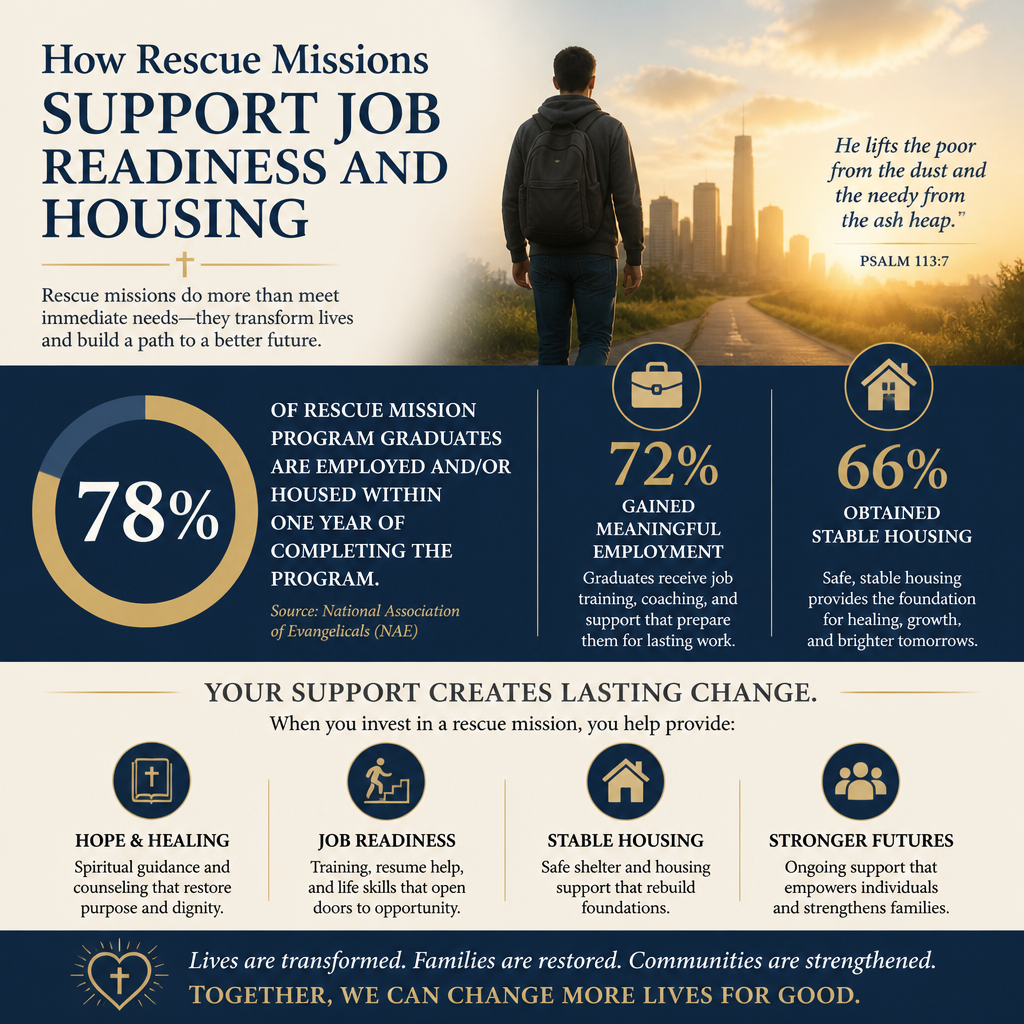
For Christian donors, the practical question is less about slogans and more about faithful, demonstrable outcomes: Are people leaving the mission with safe housing and the supports required to keep it? Do policies protect vulnerable residents without excluding those who need help most?
What stable housing typically requires beyond a key
Rescue missions that take housing seriously usually invest in a continuum: emergency shelter, transitional housing, and partnerships that expand access to permanent housing. They also invest in the “boring” infrastructure of stability: budgeting support, landlord mediation, transportation planning, and ongoing case management. Because eviction risk is often driven by small crises, preventative support can be decisive.
HUD’s Continuum of Care approach reflects this reality by coordinating housing and services across a geography rather than treating homelessness as an isolated incident. HUD Continuum of Care
Programs that integrate work and housing must be spiritually serious
The gospel cannot be reduced to a service bundle
Christian donors rightly worry about “mission drift,” especially when a rescue mission is heavily funded by government contracts or large institutional donors who do not share Christian convictions. The risk is not imaginary. Missions can begin speaking in therapeutic generalities while keeping explicitly Christian formation at the margins. Over time, the ministry becomes indistinguishable from a competent social service provider.
A faithful rescue mission does not force conversions, but it does bear witness without embarrassment. It offers Scripture as true, Christ as Lord, repentance as mercy, and the church as a community where people are known and carried. In practice, that means trauma-informed care that still names sin as destructive, grace as costly, and discipleship as a lived obedience that touches money, sexuality, work, speech, and reconciliation.
Work and housing are powerful discipleship contexts
Employment is a daily arena for sanctification: honesty, patience, submission to authority, stewardship of time, and love of neighbor through competent service. Housing stability is a daily arena for formation: hospitality, sobriety, budgeting, conflict resolution, and participation in community. Rescue missions that treat these domains as discipleship contexts, not merely outcomes, often produce deeper and more durable change.
Donors who want to understand the broader ecosystem these ministries operate within can situate this work inside Rescue Missions and Homeless Outreach, where the same tensions appear across models, geographies, and funding structures.
What donors should examine before funding job readiness and housing work
Evidence, integrity, and realism belong together
Because homelessness is emotionally charged, it is easy for ministries to report activity rather than outcomes: beds filled, meals served, classes completed. Activity is not meaningless, but it is not enough. Mature donors ask whether the ministry can responsibly connect inputs to outcomes without exaggeration. They also ask whether spiritual formation is integrated or merely appended.
Across our verification work at Most Trusted, we see that ministries meeting The Most Trusted Standard tend to be unusually transparent about both strengths and limits. They publish clear financials, name leadership accountability, articulate a coherent Christian identity, and report outcomes in a way that can be understood and tested. Just as importantly, they acknowledge where results are difficult to measure—relapse, long-term housing retention, and re-incarceration—without resorting to vague assurances.
A short due diligence checklist for serious Christian donors
- Program clarity: The mission can explain how emergency shelter connects to job readiness and housing, and what happens when a resident disengages.
- Guardrails and rights: Safety policies protect residents without dehumanizing them, and grievance processes are credible.
- Church integration: The ministry can describe how residents connect to local churches and how spiritual care is delivered responsibly.
- Outcome tracking: Employment placement, retention, and housing stability are tracked with definitions that are not inflated.
- Financial integrity: Audited or reviewed statements exist, restricted funds are handled appropriately, and fundraising claims match reality.
- Partnership posture: The mission collaborates with landlords, employers, and service providers without surrendering its Christian convictions.
Donors who want to evaluate rescue missions through a gospel-centered lens often find it helpful to compare ministries within Gospel-Centered Care in Rescue Missions, where theological seriousness and operational competence can be assessed together rather than pitted against one another.
FAQs for How rescue missions support job readiness and housing
Should Christian rescue missions require chapel or church participation to receive housing or job help?
There is no single faithful policy, but there are faithful principles. A mission should not treat basic mercy as a transaction for religious compliance, and it must respect legal and ethical boundaries when public funds are involved. At the same time, a Christian mission exists to bear witness to Christ, and it is appropriate to offer robust spiritual care, including voluntary worship, pastoral counseling, and discipleship. Donors should look for ministries that are explicit about their Christian identity, clear about what is required for communal safety, and careful not to confuse external conformity with spiritual fruit.
What outcomes should we expect from job readiness programs in a rescue mission setting?
Expect meaningful, but uneven, progress. A credible mission can report employment placements and retention over time, but it should also disclose the realities of relapse, mental health crises, and housing instability that can disrupt work. The strongest programs define what counts as “employment,” measure retention at specific intervals, and explain how they support participants after placement. Donors should be wary of ministries that promise rapid, universal transformation; homelessness is rarely solved by a single intervention, and truthfulness is part of Christian integrity.
Funding work and housing as a ministry of restoration
Rescue missions support job readiness and housing most faithfully when they refuse two temptations: reducing people to problems to be managed, or reducing discipleship to a set of program rules. Christian donors can strengthen this work by funding ministries that combine pastoral seriousness with operational competence—missions that tell the truth about homelessness, practice accountable compassion, and build real pathways from the shelter door to stable work, stable housing, and life in the church.



