
What child safeguards Christian adoption ministries use is not a secondary question for donors. It is a test of whether our desire to reflect God’s heart for the fatherless is matched by the moral seriousness Scripture requires when power, vulnerability, and money converge.
Adoption work can be a means of mercy and restoration. It can also become a setting for coercion, misinformation, and avoidable trauma when safeguards are weak. Christians genuinely disagree about contested questions in modern adoption practice, including how to weigh birth-family preservation against intercountry adoption, and how to interpret shifting international policy. What is not contested is the need for verifiable child protection practices that resist incentives to move children quickly and instead prioritize the child’s best interest with documented integrity.
Safeguards begin with a theology of the child and a doctrine of truth
Christian adoption ministries that handle children well begin upstream, before policies and paperwork. Their operating theology is that children are image-bearers, not outcomes, and that truth-telling is a form of discipleship, not a marketing strategy. When Scripture condemns “unequal weights and measures” (Proverbs 20:23), it addresses more than commerce. It describes God’s opposition to any system that hides reality from those making consequential decisions.
Child-centered decision-making rather than donor-centered storytelling
A foundational safeguard is a disciplined refusal to treat the child as a symbol for adult redemption. Donors sometimes hear adoption framed as a neat narrative of rescue, with minimal attention to loss, identity, and lifelong implications. Ministries with mature safeguards speak candidly: adoption is born from tragedy, even when it is also a gift. That posture affects everything from fundraising language to how staff describe birth parents.
Practically, this means ministries establish editorial and communications review practices that prevent exaggerated need claims, “orphan” labeling without verification, and emotional manipulation. The goal is not to evacuate compassion; it is to ensure compassion is tethered to truth.
Clear boundaries on what the ministry is and is not
Many of the worst failures in child-serving systems come from blurred roles. A Christian ministry may be a placing agency, a grantmaker, a church mobilizer, or a humanitarian partner supporting local child welfare. Each role has different risks and regulatory expectations. Strong safeguards include clear public statements about scope, legal authority, and accountability structures, including what the ministry cannot promise prospective adoptive families.

Verification of child status and family separation is a primary safeguard
Because adoption begins with separation, safeguards must address the most morally fraught question: why is this child separated from family, and is adoption the appropriate solution? In many contexts, poverty is misdiagnosed as orphanhood, and ministries can unintentionally fund systems that recruit children into care to attract donor support. The global orphan care movement has had to reckon with this risk for decades.
Documented diligence on child identity and legal status
Responsible adoption ministries require documentary proof of identity and legal eligibility for adoption, with procedures for detecting fraud. They do not rely on a single document source, a single government signature, or a single partner’s assurance when incentives exist to move cases forward.
International frameworks matter here. The Hague Adoption Convention set baseline expectations for intercountry adoption processes, including subsidiarity and protections against improper financial gain. Ministries serving in intercountry contexts should be able to explain, in plain language, how their processes align with Hague standards and local law, and what independent oversight exists.
Family preservation and kinship care considered first
One of the most practical child safeguards is funding and partnering in ways that do not make adoption the default solution. Many ministries now integrate family strengthening, temporary care, reunification supports, and kinship placement assistance as part of a continuum. Donors should not assume that an “adoption-focused” brand implies a narrow pipeline; the ministries that protect children best can often document how many cases were stabilized without adoption when safe alternatives existed.
When donors evaluate programs related to child placement, careful attention to definitions is itself a safeguard. UNICEF has long cautioned that many children in residential care have one or both parents living, underscoring the importance of rigorous case assessment and family tracing rather than assumptions based on setting alone; see UNICEF.
Staffing, training, and reporting systems prevent predictable harm
Policy is not protection unless it is embodied by trained people with the authority and obligation to act. Adoption ministries operate in environments where adults have access to vulnerable children, trauma histories are common, and cross-cultural misunderstandings are routine. Safeguards therefore require staffing practices that treat prevention as normal operations, not crisis response.
Background checks and reference standards aligned to risk
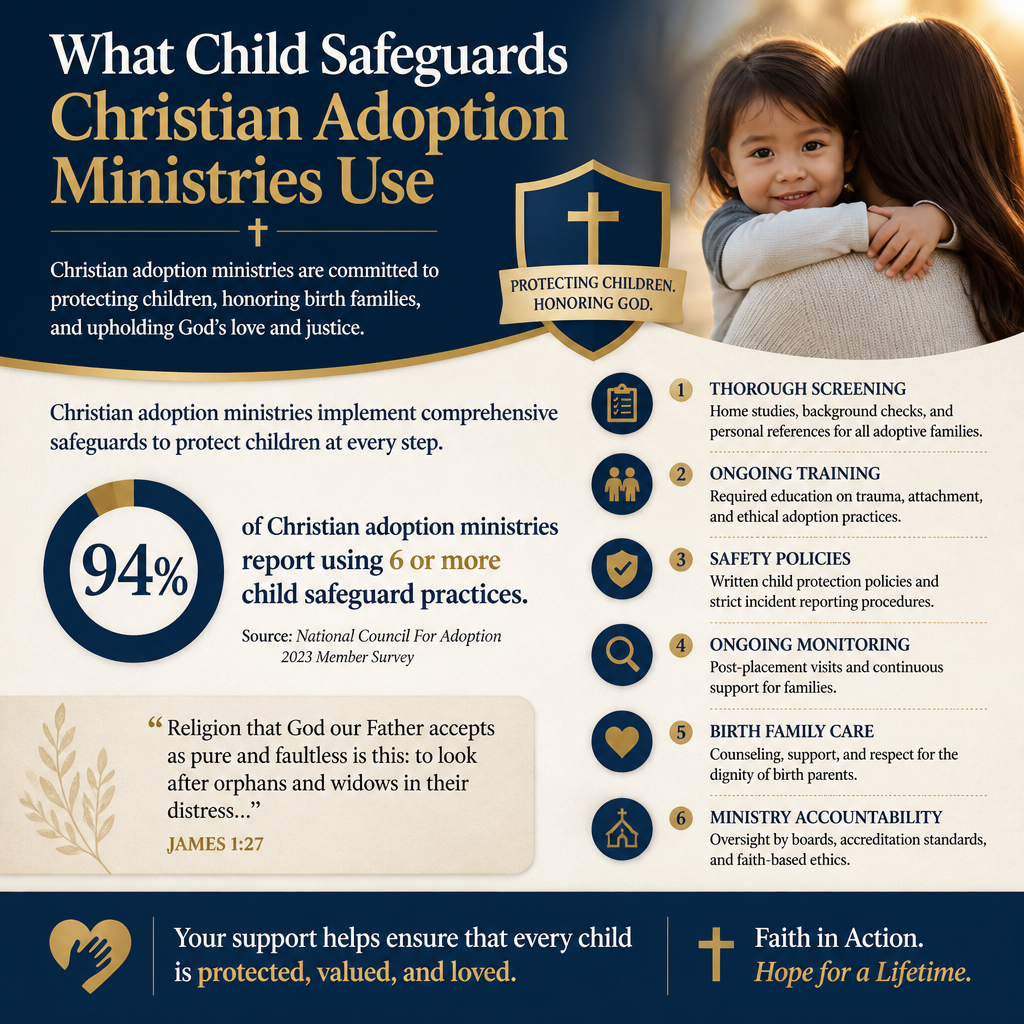
Any ministry with access to children should have a documented screening program: criminal background checks where available, identity verification, reference checks that ask child-safety-specific questions, and policies that address prior misconduct allegations even when not prosecuted. For U.S.-based work, donors should expect ministries to follow state requirements and to exceed them when program realities call for it. For overseas contexts where formal checks are limited, stronger safeguards include layered controls: supervised access, two-adult rules, restricted photography, and formal partner vetting.
Many donors want a simple “yes or no” metric here, but sophistication is required. A “clean” check is not a full safeguard; it is one tool within a broader prevention system.
Mandatory reporting and escalation pathways that do not depend on charisma
Ministries that protect children best can show a staff member, volunteer, or partner exactly how to report a concern and what happens next. Reporting pathways should include internal escalation, direct access to governing leadership, and external reporting to civil authorities where required. They should also include protections against retaliation, because fear silences disclosure.
Donors can ask for evidence of training frequency, attendance, and content. Many ministries draw on established frameworks such as Darkness to Light’s Stewards of Children training; see Darkness to Light. Training is not a guarantee, but a ministry that cannot document training is signaling that safety is not operationally embedded.
Ethical financial design is a child safeguard
Financial structure can either restrain harm or accelerate it. When money is tied too directly to placing a child, it creates pressure that can distort truth-telling, rush processes, or marginalize birth families. Scripture’s repeated warnings about partiality and dishonest gain are relevant precisely because adoption systems carry financial incentives.
Avoiding per-child bounties and outcome-contingent payments
Donors should be cautious when a ministry’s overseas partners are funded in ways that rise and fall with the number of children placed. In some settings, unethical recruitment has been documented where funding rewarded child intake. Safeguarded ministries design funding to reduce perverse incentives: capacity-building support, transparent budgets, independent audits of partner financial practices, and clear prohibitions on improper payments.
Transparent donor claims about fees and what they do and do not purchase
Adoption finance can be complex: home studies, legal fees, country program fees, travel, post-placement reports, and support services. Safeguards include clear, public explanations of fees and restrictions against presenting donations as “buying” a child. Ministries that honor the dignity of children will be explicit that funds support lawful services, compliance costs, and family support, not the transfer of a child.
Across our verification work at Most Trusted, ministries that meet The Most Trusted Standard tend to publish clear financial statements, explain the relationship between revenue and program outcomes without triumphalism, and maintain governance controls that reduce conflicts of interest. These are not merely administrative virtues. They are protective measures for children and families.
Governance, transparency, and aftercare distinguish mature ministries
Some safeguards are invisible until something goes wrong. That is where governance and transparency matter. A ministry may have compassionate staff and good intentions, yet still fail if leadership is insulated from critique or if outcomes are measured only in placements rather than lifelong well-being.
Independent oversight and grievance mechanisms
Mature adoption ministries have boards that ask hard questions, review child-safety incidents, and ensure compliance. They also maintain grievance processes accessible to adoptive families, adult adoptees, birth families where appropriate, and staff. The existence of a grievance mechanism is not proof of justice, but its absence often signals that the ministry has not planned for accountability under pressure.
Donors seeking a wider view of practices that protect children across the sector can review Ethics and Child Protection in Christian Adoption Ministries in order to compare safeguards, warning signs, and verification considerations across different organizational models.
Aftercare, post-placement support, and measurable commitments
Adoption does not end at placement. A core safeguard is the ministry’s commitment to post-placement support: trauma-informed counseling referrals, support groups, respite resources, and culturally competent identity support, especially in transracial and intercountry adoptions. Ministries should also be candid about where they cannot provide direct clinical care and how they ensure families are connected to qualified providers.
For donors who want to understand how evidence has reshaped child welfare practice, the landmark Bucharest Early Intervention Project demonstrated significant developmental harm associated with institutional care compared to family-based settings; see Harvard University. The implication for adoption ministries is not simplistic—families can also fail—but it reinforces why family-based permanency and well-supported caregiving are central to child protection.
A short set of safeguards donors can reasonably expect to see
- Written child-safety policies with documented training and compliance tracking
- Independent verification of child identity, legal eligibility, and family tracing
- Funding structures that reduce incentives tied to child intake or placement volume
- Mandatory reporting pathways and non-retaliation protections
- Board-level oversight of child-safety incidents and partner compliance
These expectations do not replace prayerful discernment. They give it moral and operational substance.
FAQs for What child safeguards Christian adoption ministries use
What should donors ask an adoption ministry about safeguarding without becoming adversarial?
Donors can ask for documents and processes rather than personal assurances. Appropriate questions include: What training is required for staff and volunteers? How do you verify child status and legal eligibility? How are concerns reported and escalated? What oversight does the board provide? A ministry that is ready for accountability will generally welcome these questions and answer them with specificity.
Do strong safeguards mean a ministry will never have a serious incident?
No. Safeguards reduce risk and improve response, but they cannot eliminate human sin, institutional failure, or the complexity of trauma. What donors can reasonably expect is transparent disclosure to appropriate authorities, disciplined internal review, and measurable corrective action. In our work at Most Trusted, this is one reason we evaluate governance, financial integrity, and transparency alongside faith commitments under The Most Trusted Standard.
Why safeguards are a stewardship issue for Christian donors
Christian adoption ministries deserve more from donors than sentiment and more from critics than cynicism. The question is whether the ministry’s compassion is structured by truth, accountability, and practices that protect children when no one is watching. Donors who give with these safeguards in view are not narrowing the biblical command to care for the fatherless. We are insisting that care be worthy of the name.
For donors evaluating the broader landscape of models and claims, we recommend engaging Christian Adoption Ministries with an eye toward verifiable safeguards, not merely compelling stories.



