
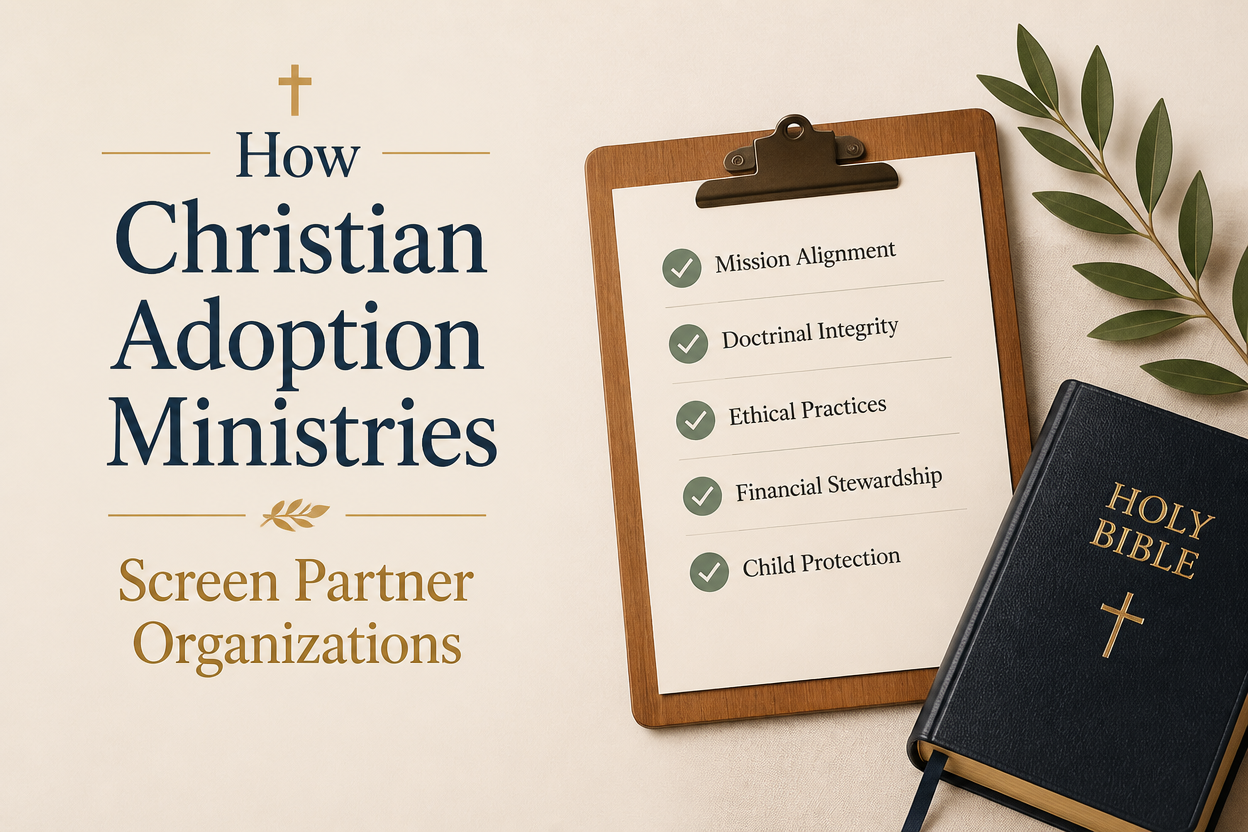
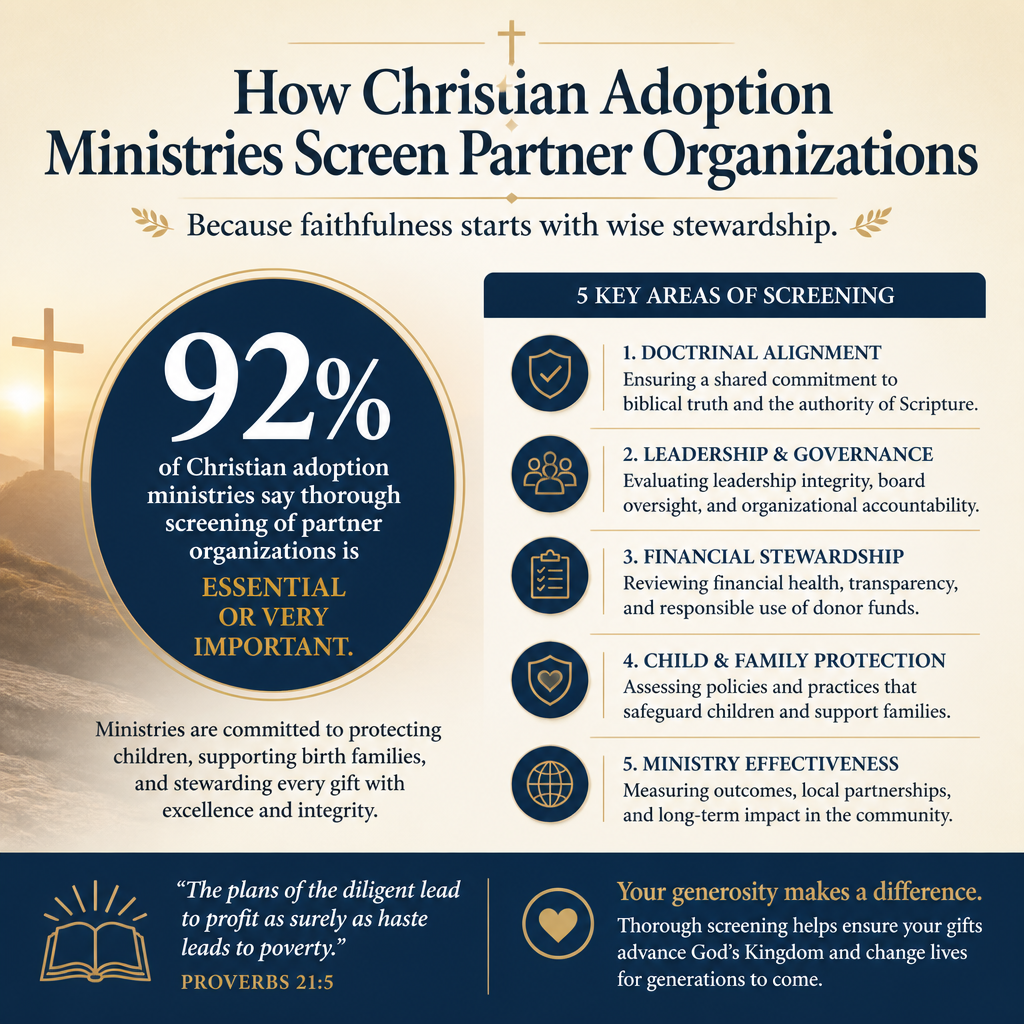
How Christian adoption ministries screen partner organizations is not a secondary operational detail; it is one of the most consequential safeguards in a field where good intentions can still produce lasting harm. Donors fund more than paperwork and travel—they fund the moral ecology around a child’s story, including whether family separation is prevented, whether consent is real, and whether every placement is pursued with integrity before God.
Scripture’s call is unmistakable: God “executes justice for the fatherless” (Deuteronomy 10:18), and his people must not exploit the vulnerable while claiming righteousness (Isaiah 1:17). Yet adoption work is also mediated through law, cross-cultural realities, trauma, and incentives that can distort decision-making. Serious Christian giving in this space requires equally serious scrutiny of how ministries select, monitor, and, when necessary, sever relationships with overseas and domestic partners.
Screening begins with moral clarity about what adoption is for
Partner screening is often described in terms of compliance. Compliance matters, but Christian adoption ministries must begin further upstream: with a theological and ethical definition of adoption that refuses to treat children as commodities, donors as customers, or institutions as convenient pipelines. The best screening practices function as a form of discipleship, compelling everyone in the chain to honor the child’s dignity and the family’s rights.
A child protection frame, not a growth frame
Across our verification work at Most Trusted, we observe that ministries that speak primarily about “placements,” “numbers,” or “demand” tend to underrate the risks embedded in partner networks. When a ministry’s implicit goal is expansion, partner screening becomes a hurdle to clear. When the goal is faithful care, screening becomes a safeguard that can slow growth and still be considered success.
This is not theoretical. International frameworks have pressed the field toward family-based care and careful gatekeeping because institutionalization and unnecessary separation have done measurable harm. UNICEF has long argued that large-scale institutional care places children at risk and should be a last resort, urging a shift toward family-based alternatives; see UNICEF’s guidance on children in institutions at UNICEF.
Rightly ordered priorities before financial questions
Donors often begin with financial ratios and overhead, but adoption-related work frequently hides risk in program design rather than line items. A ministry may appear financially tidy while funding partners whose referral practices are ethically compromised. A mature screening posture asks first: does this partner’s model protect families, verify consent, and prevent avoidable separation? Then it asks whether the money follows that model cleanly and transparently.

Verify legitimacy and authority before evaluating performance
Many adoption scandals have shared a predictable feature: the “partner” was not what it claimed to be—an unlicensed facilitator, a poorly governed local NGO, an orphanage with informal power, or a broker operating in the gaps between systems. Basic legitimacy checks sound mundane, but they are often where exploitation is either deterred or enabled.
Legal standing, licensure, and scope of authority
Screening should confirm that the partner is legally registered, appropriately licensed, and authorized to perform the specific functions it will touch—child welfare assessments, family tracing, foster care, counseling, or intercountry adoption coordination. Ministries should request primary-source documentation, verify it with the issuing authority when feasible, and re-check it on a set cadence rather than assuming permanence.
For intercountry adoption, donors should expect ministries and their partners to demonstrate alignment with the Hague Adoption Convention process where it applies, including competent authority involvement and clear documentation. The U.S. Department of State outlines the Hague framework and country-specific requirements at travel.state.gov.
Ownership, control, and conflicts of interest
Legitimacy also requires clarity about who controls the partner entity. Who sits on the board? Who has signing authority on bank accounts? Are there related-party transactions between the partner and individuals who profit from referrals, housing, transportation, or “child care” services? When a partner’s leadership is intertwined with revenue opportunities, the risk of coercion rises even if paperwork is in order.
A rigorous ministry will not be satisfied with “We know them” or “They are believers.” Personal trust is valuable, but it is not a control system. The New Testament’s repeated concern for leaders who are “above reproach” (1 Timothy 3:2) includes the sober acknowledgment that temptations increase when money and power converge around vulnerable people.
Test child protection systems, not just stated values
Many partners can affirm the right words about protecting children. The question donors should care about is whether systems exist that make protection likely even when pressure is high and scrutiny is low. Christian ministries should screen for operationalized safeguards: policies, training, reporting pathways, and documented follow-through.
Safeguarding policies and reporting mechanisms
Screening should examine whether the partner has written child safeguarding policies, staff training, and a credible reporting process that does not route every allegation through the very leaders who may be implicated. It should also consider whether the partner understands mandatory reporting obligations in its jurisdiction and whether it has relationships with competent authorities who can investigate.
Donors should not assume safeguarding is culturally intuitive or uniformly practiced. A ministry that treats safeguarding as a Western add-on often becomes passive when faced with local resistance. A ministry that treats safeguarding as an expression of biblical justice will insist on it as non-negotiable.
Trauma competence and family preservation capability
Adoption work touches grief, loss, and identity, even in the healthiest cases. Partner screening should evaluate whether the partner can recognize trauma responses, avoid re-traumatization, and prioritize stable, family-based care. Equally important: does the partner have the capability and incentive to prevent unnecessary separation through family tracing, kinship support, and time-bound reunification plans where appropriate?
International child welfare guidance has increasingly emphasized “necessity and suitability” standards—whether adoption is necessary and whether it is suitable for the particular child—rather than treating adoption as a default solution. The Hague Conference on Private International Law provides resources and principles related to intercountry adoption at hcch.net.
Interrogate incentives, documentation, and case-level evidence
The hardest problems in adoption are not usually found in public-facing narratives. They show up in incentives and files: who gets paid, when payments occur, how “orphan” status is determined, and whether case documentation would withstand independent review. Ministries that screen well do not merely collect documents; they test whether the documentation reflects reality.
Payments that create pressure
Donors should ask whether partner compensation is tied to placements or referrals. Any structure that increases revenue when a child enters the system can become an engine for family separation. This is one reason mature ministries prefer budgets that fund services—family strengthening, counseling, legal work, foster care support—rather than bounties for outcomes.
Christians genuinely disagree about whether certain fee structures can ever be ethically neutral in contexts where local social services are underfunded. What is not contested is that Scripture condemns taking advantage of the poor through unjust gain (Proverbs 22:16). Screening should therefore include a hard review of how incentives function in practice, not just how they are described.
Case files that can be audited
A credible partner will maintain coherent, consistent case records: identity documents, evidence of family tracing, counseling notes, consent forms, court orders, and documentation of efforts to pursue kinship care or reunification when feasible. Strong screening includes sampling case files, checking for internal consistency, and comparing timelines against what is legally required.
This is also where donors should look for humility and candor. Partners who claim perfection, or who treat documentation as an annoyance, are often signaling risk. Partners who can identify past weaknesses, describe corrective action, and welcome verification are often demonstrating maturity.
- Consent integrity: documented, informed, non-coerced consent with counseling and time to decide
- Family tracing evidence: records of searches, interviews, and kinship options evaluated
- Separation rationale: clear articulation of why alternative care was necessary for this child
- Judicial clarity: court documentation that aligns with national legal requirements
- Post-placement planning: follow-up schedules, support services, and escalation pathways
Require governance, transparency, and ongoing monitoring
Partner screening is not a one-time gate. It is a governance discipline maintained over years, across staff turnover, political change, and shifting funding patterns. Ministries that serve donors well build monitoring into the relationship and define consequences for noncompliance that they are actually willing to enforce.
Written agreements and enforceable standards
A responsible ministry uses written MOUs or contracts that specify safeguarding expectations, documentation standards, audit rights, financial controls, and termination triggers. These agreements should not be generic. They should reflect the actual risks of the context and the specific services the partner performs.
This is where donors can connect partner screening to broader nonprofit health. Screening is stronger when the ministry itself has clear governance, independent oversight, and a culture that welcomes hard questions. That is one reason we evaluate ministries against The Most Trusted Standard, assessing Faith Foundation, Financial Integrity, Governance and Leadership, and Transparency and Effectiveness as mutually reinforcing commitments rather than isolated ideals.
Monitoring, site engagement, and the courage to exit
Ongoing monitoring may include site visits, third-party audits, hotlines, beneficiary feedback mechanisms, and routine case sampling. Monitoring should also consider whether the partner’s local environment has changed—new leadership, altered laws, political pressure, economic shocks, or a rise in trafficking risk.
The most difficult test is whether a ministry will end a relationship that produces results but fails moral scrutiny. Donors should expect ministries to describe, in general terms, how they make termination decisions and how they protect children during transitions. Faithfulness sometimes requires leaving money on the table and absorbing criticism for slowing the pipeline.
For donors who want a broader view of the landscape in which these decisions sit, our coverage of Christian Adoption Ministries tracks the major models and the recurring risk points without reducing the work to simplistic binaries.
FAQs for How Christian adoption ministries screen partner organizations
What should donors ask a ministry about partner screening without endangering confidentiality?
Donors can ask for the ministry’s written partner criteria, safeguarding policy requirements, audit practices, and examples of what would trigger a corrective action plan or termination. It is also appropriate to ask whether the ministry samples case files, how it checks consent integrity, and how it avoids incentives tied to placements. Ministries should be able to answer these questions without exposing identifying details about children or birth families.
Is a Christian partner automatically safer than a secular one?
No. Shared confession can deepen accountability, but it can also create misplaced trust if it substitutes for controls. Scripture’s warnings about partiality and deception apply inside the covenant community as well as outside it. Strong ministries screen for competence, safeguarding systems, and transparent documentation regardless of the partner’s religious identity, and they expect Christian partners to welcome scrutiny as part of walking in the light.
What faithful screening asks of donors
Donors can unintentionally reward the wrong behaviors by praising speed, volume, and dramatic stories while neglecting the slower work of verification and family preservation. The ministries most worthy of long-term support are often those that can articulate why a case did not proceed, why a partner was paused, or why a program shifted toward prevention rather than placements.
In the end, partner screening is one of the clearest places where a ministry’s theology becomes operational. It reveals whether the organization understands adoption as a sacred trust, whether it fears the Lord more than it fears losing market share, and whether it will treat every child’s history with the reverence that image-bearing demands. Donors looking closely at Ethics and Child Protection in Christian Adoption Ministries are not complicating the mission; they are insisting that mercy and truth meet in the way the work is actually done.



