

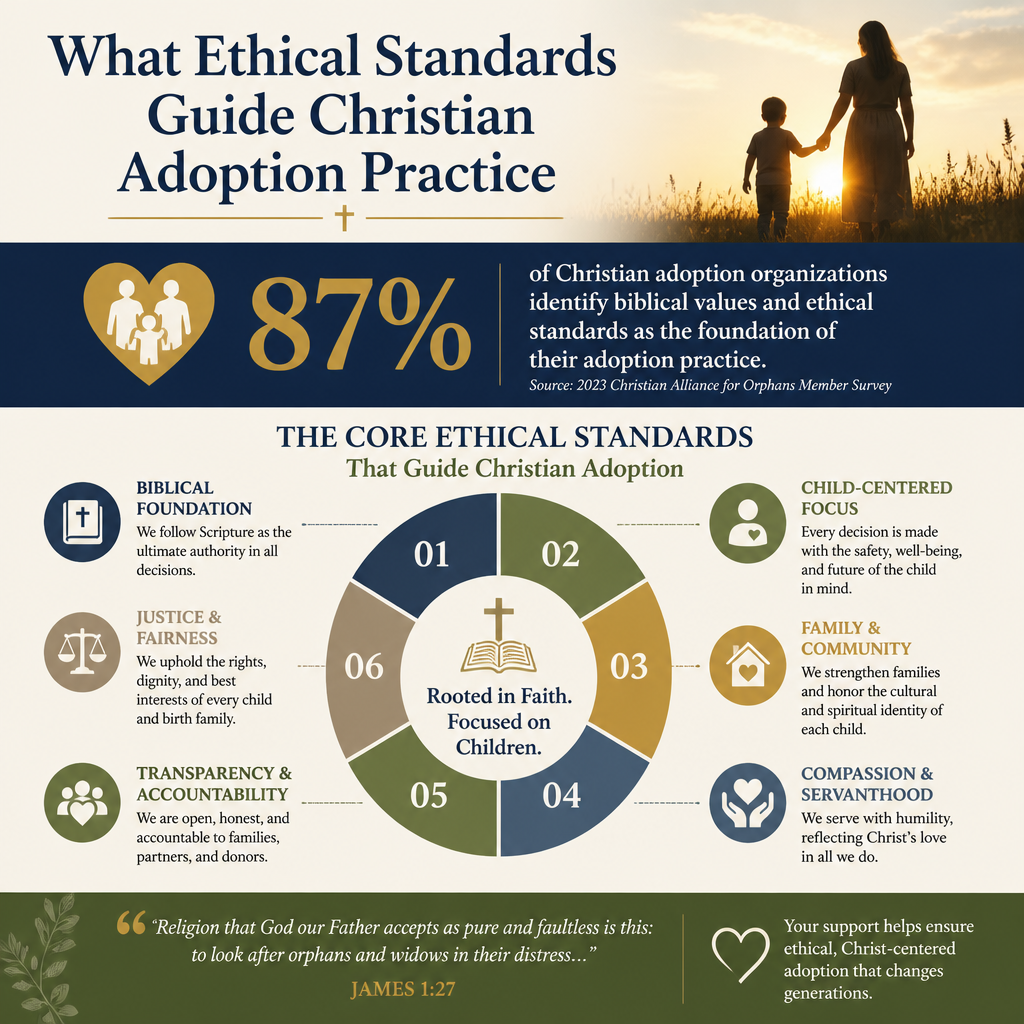
Ethical standards that guide Christian adoption practice begin with a clear conviction: children are not projects, and families are not outcomes. Adoption is a mercy-shaped legal act ordered toward a child’s long-term good, not an instrument for donor inspiration or ministry growth. Scripture’s insistence on justice for the vulnerable is not sentimental; it is moral. “Learn to do good; seek justice; correct oppression” (Isaiah 1:17). The question for donors is not whether adoption is biblical in theme, but whether an adoption ministry practices adoption biblically in method.
The field has had to reckon with hard realities. International adoption systems have been compromised at times by weak documentation, financial pressure, and poor oversight; domestic systems can also be distorted by coercive fundraising narratives or misaligned incentives. Ethical Christian adoption practice is therefore not merely “good intentions plus compassion.” It is a disciplined commitment to truth-telling, lawful process, family preservation where possible, and a child-centered definition of success.
1. The child is the neighbor and the measure of good
Child welfare before donor satisfaction
In Christian ethics, love of neighbor is not abstract. It is concrete responsibility toward the person in front of us, especially the one with least power. In adoption, the child is that neighbor. The moral question is not, “Did this feel redemptive to us?” but, “Did this protect the child’s best interests in verifiable ways?” Christian ministries often speak of adoption as a picture of the gospel. That analogy can be theologically meaningful, but it becomes ethically dangerous when it makes the child’s story a tool for spiritual messaging.
Across our verification work at Most Trusted, the ministries that meet The Most Trusted Standard tend to treat child protection as a governing principle rather than a program feature. That shows up in restrained storytelling, well-defined safeguarding policies, and rigorous documentation practices that do not bend under financial or emotional pressure.
A family setting is the norm, and institutions are a warning sign
One of the clearest lessons from modern child development research is that children generally do better in stable family-based care than in institutional settings. A large, multi-country study often referred to as the Bucharest Early Intervention Project found significant developmental harm associated with institutional care and measurable gains when children were placed in family environments Harvard University. The point for donors is not to weaponize a single study, but to see how serious evidence has been about the costs of institutionalization.
What this means in practice is that ethical adoption ministries should not be built around maintaining beds, maximizing placements, or keeping facilities full. When donor funding depends on headcount, incentives can drift. Good ministries are candid about this risk and structure programs to avoid it.

2. Truth and consent are non-negotiable
Accurate child status and verifiable documentation
Ethical adoption practice depends on the integrity of a child’s story: identity, family ties, legal status, and the real reasons a child cannot remain safely with birth family. When documentation is weak, the most vulnerable parties bear the cost: children separated unnecessarily, families misled, and adoptive parents left carrying moral and legal uncertainty for decades.
Christians genuinely disagree about where the burden of proof should sit in imperfect systems, especially in international contexts with uneven recordkeeping. But mature practice moves toward verifiability, not away from it. Ministries that are worthy of donor confidence typically require corroboration from multiple sources, maintain auditable case files, and refuse to “push through” a case because a family is waiting or funds have been raised.
Birth-family consent must be informed and free of pressure
Consent in adoption is not merely a signature. It is understanding without coercion, manipulation, or financial pressure. Ethical ministries invest in independent counseling, translation when needed, clear disclosure of alternatives, and time for reflection. Donors should be wary of any work that treats relinquishment as a ministry “win” or that frames birth parents as obstacles to overcome.
For U.S. domestic contexts, federal child welfare law has long reflected a preference for family preservation and kinship placement where safe. The Adoption and Safe Families Act emphasizes child safety while requiring “reasonable efforts” toward reunification in many cases Congress.gov. Donors do not need to become attorneys, but they should understand the moral logic: adoption should not shortcut necessary efforts to keep children safely within their family networks.
3. Money must never create a market for children
Fee structures and incentives require moral scrutiny
Money is not neutral in adoption. When funding flows are tied to placements, the sector can unintentionally mimic market behavior: more demand, more “supply,” more pressure to move cases. Ethical practice recognizes this and designs against it. Transparent fee schedules, third-party audits, and documented separation between fundraising and case decisions are not bureaucratic details; they are safeguards against commodification.
Donors sometimes assume that high administrative complexity is proof of waste. In adoption, the opposite can be true. Due diligence, legal review, safeguarding, and post-placement support take resources. The modern donor conversation has been shaped by the “Overhead Myth” critique, articulated in a public letter signed by GuideStar (now Candid), Charity Navigator, and the BBB Wise Giving Alliance, warning that simplistic overhead ratios can mislead donors and punish necessary infrastructure Candid.
Fundraising communications must be restrained and true
Christian donors want to help. The ethical question is whether a ministry’s fundraising honors the dignity of the child and the truth of the situation. Photographs, videos, and personal details must never function as a substitute for ethical practice. A ministry can tell compelling stories and still be faithful; it can also tell compelling stories while hiding weak documentation, poor consent procedures, or minimal oversight.
Donors should expect ministries to publish clear policies on child imagery, privacy, and informed consent for communications. When a ministry cannot explain how it protects children from exposure and future harm, the ministry is treating children as content rather than persons.
4. Christian ethics requires governance that can say no
Board oversight and independent accountability
Adoption work is unusually vulnerable to mission drift because it sits at the intersection of grief, longing, theology, and money. Good governance provides the capacity to say no: to a questionable partner, to a rushed timeline, to a case with unresolved documentation, to a donor who wants special access, or to a program model that creates perverse incentives.
We recommend that donors look for organizations with independent boards, documented conflict-of-interest policies, and decision-making processes that are not controlled by a single charismatic leader. These are not merely “best practices” imported from the nonprofit sector. They align with a Christian understanding of sin, temptation, and the need for accountability in positions of trust.
Safeguarding is a core competency, not a statement on a website
Ethical adoption practice requires child-safeguarding systems that are trained, enforced, and audited. Donors should expect ministries to have reporting mechanisms, incident response procedures, staff vetting, and appropriate boundaries for volunteer engagement. Where short-term trips exist, ethical programs do not place visitors in roles that create attachment harm or expose children to unmanaged risk.
For donors who want to evaluate this field more comprehensively, our editorial work on Ethics and Child Protection in Christian Adoption Ministries addresses the practical markers of safeguarding seriousness that can be verified, not merely asserted.
5. The goal is lasting stability, not a completed placement
Post-adoption support is part of ethical practice
Many donor narratives imply that adoption is the happy ending. Christian ethics is more sober and more hopeful than that. Adoption often follows trauma; it does not erase it. Families need post-placement support, trauma-informed services, and honest preparation. Ethical ministries build for endurance: counseling partnerships, parent training, disruption prevention, and long-term follow-up.
Research and practice communities have emphasized trauma-informed care for years; donors should not accept ministries that treat adoptive family support as optional. “Bear one another’s burdens” (Galatians 6:2) applies after the placement, not only before it.
What donors can reasonably ask and expect
Ethical standards become practical when donors ask disciplined questions and expect verifiable answers. A short list can clarify whether an organization is oriented toward child protection or toward outcomes that merely look good.
- How does the ministry verify a child’s legal status and family history, and who audits that process?
- What safeguards ensure birth-family consent is informed, voluntary, and free from financial pressure?
- How are fees structured, and what controls prevent financial incentives from driving placements?
- What child-safeguarding policies govern staff, partners, and any volunteer engagement?
- What post-adoption services are funded, and how does the ministry measure family stability over time?
Across Christian Adoption Ministries, donors will find a range of models—from direct placement work to family preservation, foster care support, and kinship care. Ethical adoption practice does not require one uniform approach, but it does require consistent moral boundaries: truth, consent, lawful process, and the child’s enduring good.
FAQs for What ethical standards guide Christian adoption practice
Is adoption always the most ethical option for orphan care?
No. Ethical Christian practice treats adoption as one important pathway within a wider commitment to family-based care. When a child can be safely cared for by birth family with support, or by kinship networks, those options often align more directly with the child’s continuity of identity and attachment. Adoption becomes ethically appropriate when a child cannot safely remain with birth family and when legal and relational realities are handled with truth, consent, and accountability.
How can donors tell whether an adoption ministry is ethically trustworthy?
Donors should look for verifiable safeguards rather than persuasive stories: documented child protection policies, transparent financial reporting, independent governance, evidence of careful documentation and consent practices, and serious post-adoption support. At Most Trusted, we evaluate ministries against The Most Trusted Standard, emphasizing evidence that can be reviewed—policies, audits, governance practices, and public transparency—because adoption’s moral stakes are too high for trust to rest on sentiment.
Giving with justice and mercy together
Christian donors are right to feel the weight of adoption work. Scripture binds together compassion and truth, mercy and justice, love and integrity. Ethical standards for Christian adoption practice exist to protect children and honor families, not to burden well-intentioned givers. When ministries submit their methods to scrutiny—legal, financial, and moral—they make it easier for donors to give with confidence and for the church to serve vulnerable children without creating new harm.



