

What administrative costs fund in discipleship ministries is not a cosmetic question about optics. It is a stewardship question about whether the infrastructure of a ministry is serving the making of disciples, or quietly substituting for it. Mature Christian donors have seen both: organizations where administration is the trellis that supports real spiritual formation, and organizations where “overhead” becomes a fog that makes accountability difficult.
Scripture does not treat stewardship as an administrative afterthought. Jesus’ teaching on money repeatedly locates faithfulness in what is managed, measured, and entrusted (Luke 16:10–12). The church also learns, across centuries, that fruitful ministry requires order, clear responsibility, and trustworthy handling of resources (Acts 6:1–7). The harder task is discerning when administrative spending is disciplined support for mission, and when it is mission drift under a respectable name.
Administrative costs are often the hidden ministry of coordination
Administration can be a trellis for formation
Discipleship ministries are frequently judged by what donors can easily picture: a small group in a living room, a mentor meeting a new believer, a training cohort gathered around Scripture. Yet those visible moments depend on less visible work: scheduling leaders, vetting curriculum, protecting minors, reconciling restricted donations, and following up with people who quietly disappear. Administration is often the ministry of coordination—work that is not glamorous, but is morally significant when it protects people and honors gifts.
The New Testament’s appointment of leaders to oversee the fair distribution of resources in Acts 6 is not a detour from discipleship; it is a condition for the Word to continue spreading without neglect or resentment. A discipleship ministry that grows beyond a small circle without investing in systems typically forces spiritual leaders to become part-time accountants, compliance officers, and crisis managers. That is not “efficient.” It is a predictable way to burn out shepherds and erode trust.
What “administrative” commonly includes in discipleship settings
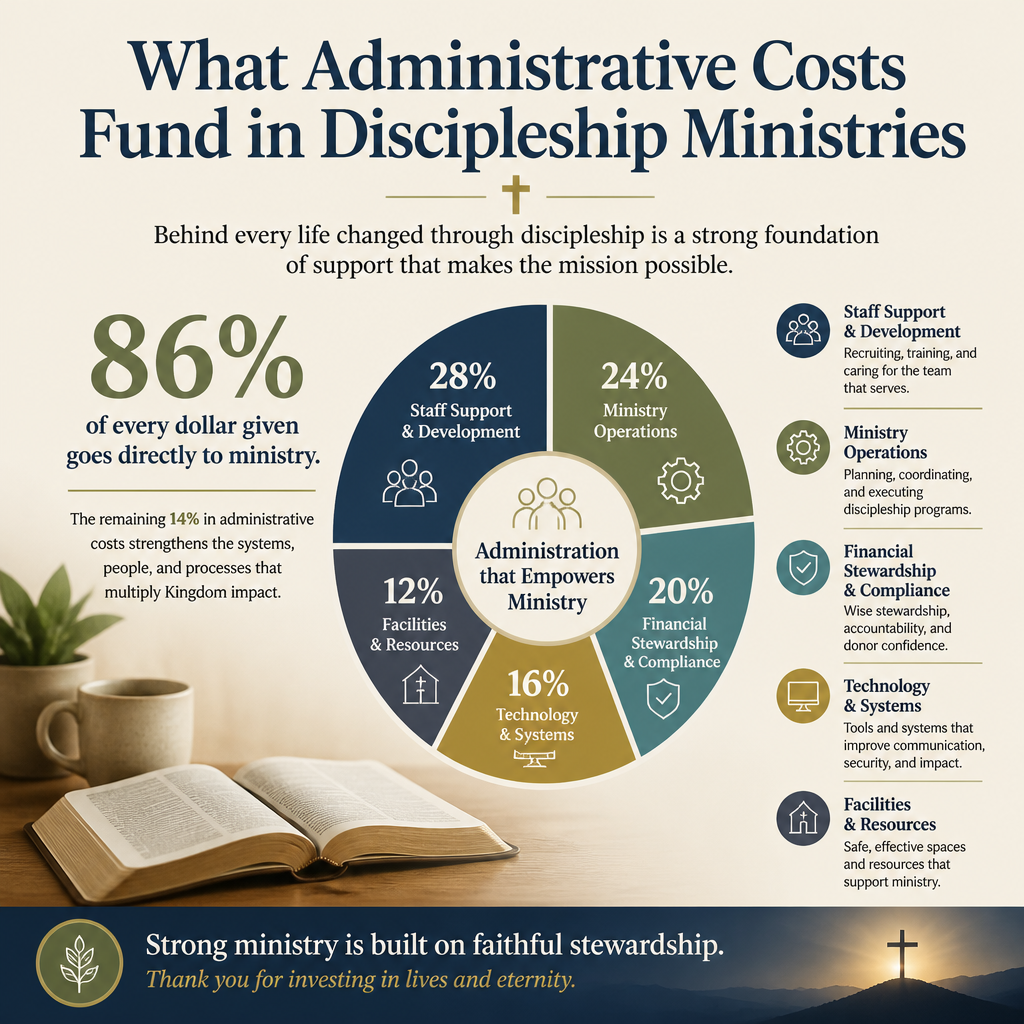
In financial reporting, “administrative” (sometimes “management and general”) can capture a wide range of necessary functions. In discipleship ministries, these expenses often include finance and accounting, HR, donor receipting and gift processing, insurance, legal counsel, IT systems, rent and utilities for shared space, and core leadership oversight. The challenge is that the same line item can represent either prudence or indulgence depending on execution and proportionality.
Across our verification work at Most Trusted, the ministries that meet The Most Trusted Standard tend to treat administration as a governed function: budgets are approved and monitored, duties are segregated, and leadership can explain how infrastructure protects the mission rather than merely sustaining an organization. Where administration is treated as a vague bucket, the risk is not simply inefficiency; it is opacity.

Healthy administrative spending protects people and the ministry’s witness
Child safety and pastoral care require real controls
Many discipleship ministries work with minors, vulnerable adults, or people emerging from trauma, addiction, incarceration, or spiritual abuse. Administrative spending that funds background checks, safeguarding training, incident reporting pathways, and supervision structures is not secondary to discipleship. It is part of love of neighbor expressed through prudence. The cost is real; so is the cost of neglect.
The evangelical world has learned—often through grievous public failures—that informal ministry cultures can conceal harm. Donors should not be impressed by “low overhead” if it is achieved by cutting the very systems that prevent exploitation, silence, or retaliation. A ministry’s administrative choices can either honor the image of God in those it serves or expose them to avoidable risk.
Financial controls are discipleship in integrity
Administrative costs also fund the disciplines of financial integrity: accurate bookkeeping, timely reconciliations, responsible cash management, and clear documentation for restricted gifts. These practices guard against both fraud and the slower erosion of trust that comes from chronic sloppiness. They also protect staff from being placed in compromised situations where temptation is easy and accountability is thin.
In practical terms, a healthy discipleship ministry usually has written financial policies, board oversight of budgets, and some form of external review appropriate to size and complexity. Not every organization needs a full audit every year, but every organization needs credible financial reporting and governance that can answer reasonable donor questions.
Overhead ratios cannot carry the moral weight donors place on them
The field has had to repent of simplistic metrics
Christians genuinely disagree about how much administrative spending is “too much,” in part because context changes the math. A ministry with a large volunteer base may carry higher administrative load to recruit, train, and supervise volunteers. A ministry operating in multiple states may have compliance burdens a local ministry does not. A ministry with complex counseling or residential components may require more professional oversight than a curriculum-based small-group network.
The broader charitable sector has publicly pushed back on the idea that low overhead is a sufficient proxy for effectiveness. In 2013, Charity Navigator, GuideStar, and the BBB Wise Giving Alliance issued an open letter warning that “overhead ratios” can mislead donors and unintentionally pressure nonprofits to underinvest in infrastructure that increases impact and accountability Charity Navigator.
What this means for discipleship ministries
A discipleship ministry can post an enviably low administrative percentage while masking fragility: underpaid finance staff, inadequate controls, outdated donor systems, and leaders stretched across too many responsibilities. This is not a theoretical concern. The Stanford Social Innovation Review has described the “nonprofit starvation cycle,” in which funders’ pressure to minimize overhead leads organizations to underinvest in the very capacities required for sustained results Stanford Social Innovation Review.
Donors should still care about proportionality; waste is real. But the faithful question is not, “How small is overhead?” It is, “What is this ministry buying with administrative spending, and does it serve discipleship outcomes, integrity, and long-term health?” That is a higher bar than a ratio.
What administrative costs should fund when a discipleship ministry is well-run
A donor-centered way to read the budget
When donors ask what administrative costs fund, they are often asking a deeper question: “Will my gift be handled with seriousness?” In our experience, the most trustworthy discipleship ministries can translate administrative categories into concrete functions that protect the mission. They can show how staffing and systems reduce risk, improve follow-up, increase leader support, and strengthen measurement without turning the ministry into a spreadsheet exercise.
For donors looking for a practical rubric, it helps to ask whether administrative spending is funding capabilities that are essential to discipleship at scale. Common examples include:
- Financial integrity systems such as reconciliations, segregation of duties, and timely reporting to leadership and the board
- Safeguarding and compliance including background checks, training, and documented response processes
- Leader development support such as coaching systems, training logistics, and materials distribution
- Donor stewardship including accurate receipting, restricted-gift tracking, and responsive communication
- Data and follow-up to ensure participants are not lost, leaders are supported, and outcomes are evaluated
Where donors should press for clarity
Some administrative spending is more morally ambiguous: executive compensation, travel, consulting, and brand-building. There are legitimate reasons for each, and also easy ways to rationalize excess. The most responsible ministries do not treat these categories as private. They can articulate how senior leadership compensation is determined, what travel accomplishes, why consultants are used, and how communications support discipleship rather than spectacle.
Donors should also recognize that discipleship outcomes are not always reducible to simple metrics. Attendance and completion rates can be measured. Spiritual maturity is more complex. That complexity does not excuse vagueness in spending. It does require ministries to describe, with humility and specificity, what they believe faithful effectiveness looks like and how they learn over time. These questions sit naturally within Accountability and Transparency in Discipleship Ministries because administrative spending becomes most credible when paired with plain reporting.
How donors can evaluate administrative spending without suspicion or naivete
Ask questions that honor both mission and stewardship
Suspicion can become a posture that assumes guilt wherever administration exists; naivete can assume that spiritual language guarantees integrity. Neither posture serves donors or ministries. A better approach is to ask questions that map spending to real responsibilities and real risks.
Examples of donor questions that tend to produce meaningful answers include: What financial statements does the board review, and how often? Who approves expenses, and how is oversight maintained? What safeguarding standards are required for staff and volunteers? How does the ministry track restricted gifts? What portion of administrative staff time is devoted to supporting field leaders and participant follow-up?
Verification can reduce the information gap
Many donors do not have the time or technical background to evaluate governance documents, financial controls, and program reporting. That is one reason independent verification exists. Most Trusted evaluates Christian nonprofits against The Most Trusted Standard, a 15-criteria framework spanning Faith Foundation, Financial Integrity, Governance and Leadership, and Transparency and Effectiveness. The purpose is not to replace discernment, but to provide donors with verifiable signals of integrity where ministries’ internal practices are not otherwise visible.
Administrative spending is one of the places where verification is especially valuable. A ministry can publish compelling stories and still lack basic controls. Conversely, a ministry can have a higher administrative ratio because it is investing in safeguarding, financial rigor, and leader support that will keep the work faithful for decades. The question is whether the spending is governed, documented, and aligned with disciple-making. That wider context belongs within Discipleship Ministries because donors are not merely funding activities; they are entrusting resources to institutions that will shape people.
FAQs for What administrative costs fund in discipleship ministries
Should a discipleship ministry try to keep administrative costs as low as possible?
Administrative costs should be as disciplined as possible, not as low as possible. The lowest number can be achieved by underinvesting in safeguards, financial controls, leader support, and basic operational capacity. Donors are better served by asking whether administrative spending is governed, transparent, and clearly tied to protecting people and sustaining effective discipleship.
What is a reasonable administrative percentage for a discipleship ministry?
There is no single faithful percentage that applies across models, size, and regulatory complexity. A small local ministry may operate with minimal administration, while a national or multi-site ministry may carry higher administrative spending to manage compliance, reporting, safeguarding, and donor restrictions. The more reliable evaluation is whether the ministry can explain what the spending funds, show board oversight, and provide credible financial reporting and program accountability.
Administrative spending is part of the ministry a donor is funding
What administrative costs fund in discipleship ministries ultimately comes down to whether the ministry is building a trustworthy structure for spiritual formation. Administration can be the quiet work that protects the vulnerable, supports leaders, accounts for gifts with integrity, and sustains faithful ministry over time. Donors should expect that kind of seriousness, and they should also expect clarity when they ask what the money is actually doing.



