
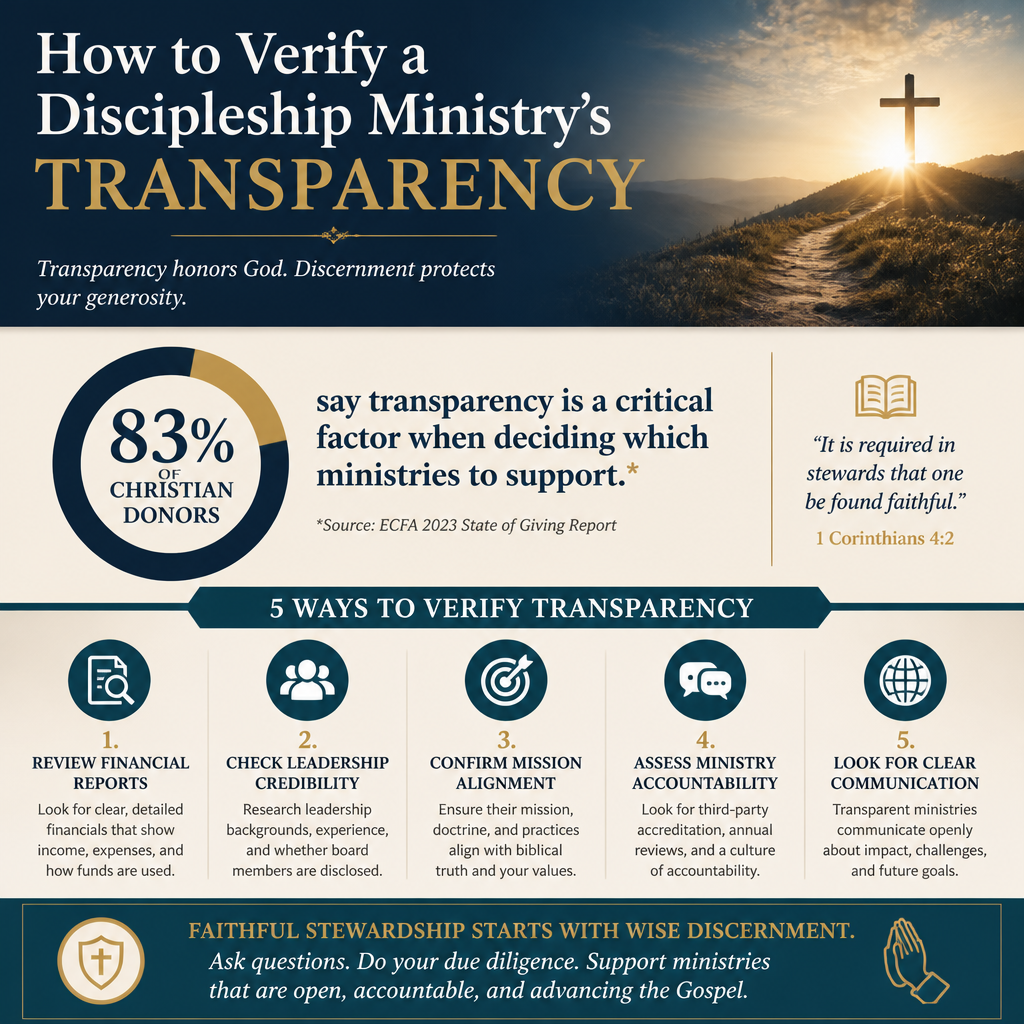
How to verify a discipleship ministry’s transparency is not a secondary concern for Christian donors; it is a test of whether a ministry’s public claims can bear the weight of Christian stewardship. Discipleship work is often relational, local, and difficult to quantify, which can make transparency feel optional. Yet Scripture treats integrity in speech, money, and leadership as essential, not cosmetic.
The New Testament assumes accountable ministry. Paul raised and distributed funds with named companions and explicit safeguards “to avoid any criticism” in the administration of gifts (2 Corinthians 8:20–21). Christian donors are not purchasing spiritual outcomes, but we are responsible to give wisely, avoiding naïveté and cynicism alike. Transparency is one of the few reliable ways to keep that balance.
Begin with the ministry’s truthfulness about what it does and does not do
Clarity of mission is the first transparency test
Discipleship ministries can drift into vague spiritual language that makes evaluation difficult: “transforming lives,” “equipping leaders,” “revival in the nations.” Those aims may be sincere, but transparency starts with specificity. A ministry that cannot describe its primary activities, target population, and geographic scope in plain terms is asking donors to fund aspiration rather than work.
We recommend reading a ministry’s public materials with two questions in mind: What does the ministry actually do week to week, and what does it claim will change as a result? The more a ministry claims, the more it owes donors a clear account of means, not just ends.
Christian donors should watch for spiritualized ambiguity
Some ambiguity is unavoidable. Discipleship involves the Holy Spirit, human agency, and long time horizons. But spiritual language can also become a shelter for weak management or inflated claims. The ministry that meets reasonable transparency norms will still speak theologically, yet it will also describe its inputs (training hours, curriculum used, mentor screening, pastoral oversight) and its expected outputs (participants served, groups launched, leaders trained) without hiding behind pious generalities.
Across our verification work at Most Trusted, the ministries that meet The Most Trusted Standard tend to treat specificity as an act of respect toward donors and toward the people they serve. They are not embarrassed to name constraints, failures, or program limits, because their credibility does not depend on appearing flawless.

Verify financial transparency beyond the overhead reflex
Start with documents that can be checked
Financial transparency is not reducible to a single ratio, but it does require verifiable documents. For U.S. nonprofits, a current Form 990 is often the baseline artifact donors can examine. If a ministry solicits contributions at scale and does not make basic financial reporting accessible, donors should pause. A lack of visibility may have innocent explanations, but donors are not obliged to fund in the dark.
When donors obsess over “overhead,” ministries may feel pressured to underinvest in compliance, systems, and staff development. The field has corrected this in recent years. The “Overhead Myth” letter—signed by GuideStar, Charity Navigator, and the BBB Wise Giving Alliance—argues that overhead ratios alone do not measure performance and can mislead donors about what healthy organizations require to operate responsibly GuideStar.
Ask whether the numbers match the ministry’s story
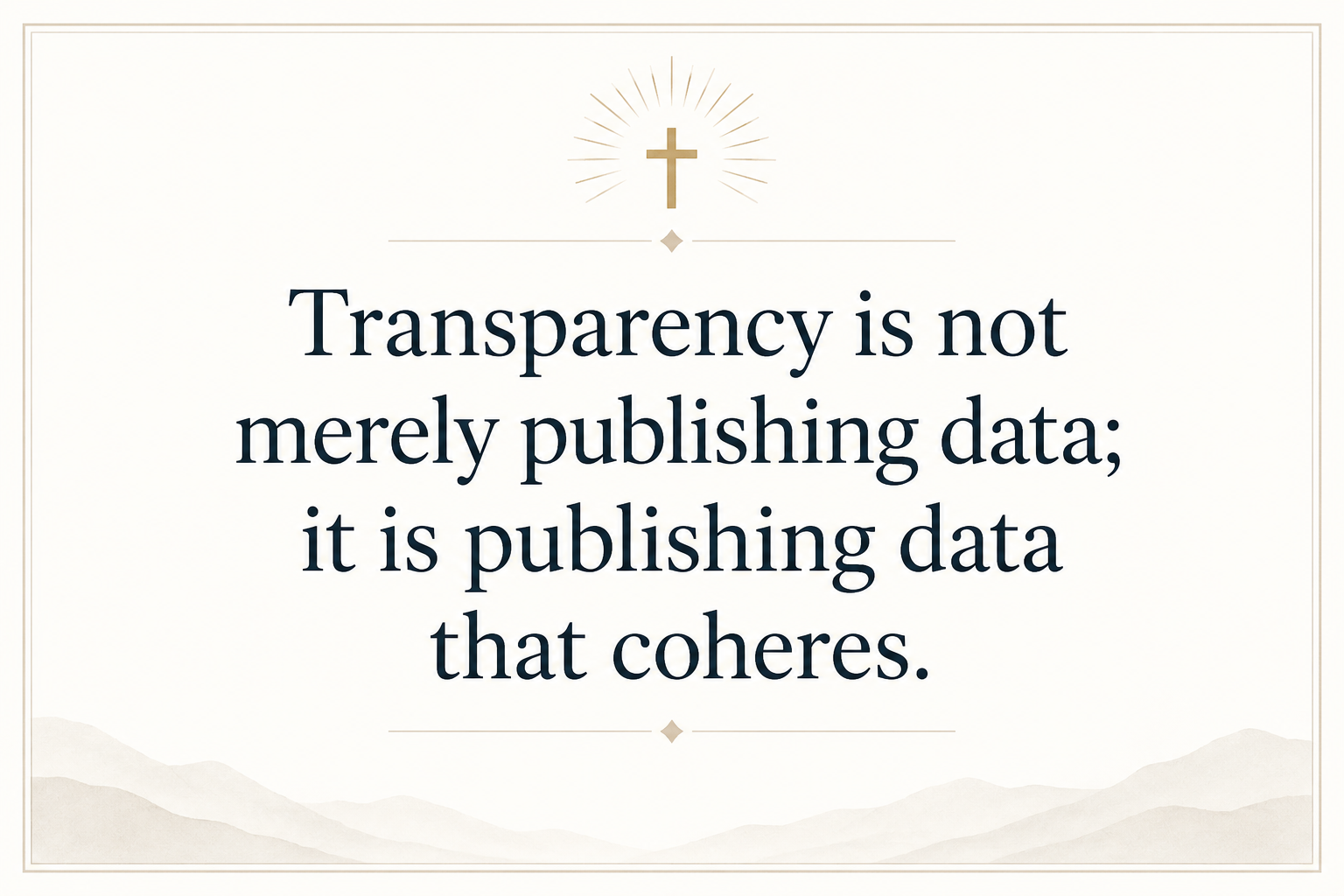
Transparency is not merely publishing data; it is publishing data that coheres. If a discipleship ministry claims deep, high-touch formation but reports minimal staff expense and no evidence of volunteer training, the story and the spending may be misaligned. Conversely, if a ministry claims a lean footprint but maintains unusually high related-party transactions or compensation without explanation, donors deserve clarity.
In practice, we recommend that donors look for several simple alignments: revenue sources that match the fundraising claims, expenses that match program descriptions, and governance disclosures that make conflicts of interest unlikely rather than merely illegal.
- Recent financial statements or Form 990 available on request or publicly
- A clear explanation of how restricted gifts are handled
- Disclosure of related-party transactions and conflict-of-interest policy
- A narrative budget that connects spending to ministry activities
- Evidence of financial oversight beyond a single founder or pastor
Examine governance and authority with theological sobriety
Discipleship authority requires accountable structures
Discipleship involves spiritual authority. That authority can be life-giving, and it can be misused. Transparency therefore includes governance: who has decision rights, who can remove leaders, and what happens when allegations arise. Donors should not assume that a ministry’s spiritual language guarantees spiritual maturity in systems.
Christians genuinely disagree about governance models in ministry—elder-led, founder-led with a board, denominational oversight, or networked accountability. But disagreement about models does not erase the need for meaningful checks. A board that exists only on paper, meets rarely, or is composed primarily of family and employees is a warning sign, especially in ministries centered on counseling, mentoring, or youth formation.
Policies matter most where temptation and harm are plausible
In discipleship contexts, harm is not limited to financial scandal. It can include spiritual coercion, mishandled confidentiality, inappropriate relationships, or unsafe environments for minors. A transparent ministry does not treat these concerns as hostile questions. It shows donors the policies and reporting pathways that protect participants and volunteers.
This is where the broader conversation about Accountability and Transparency in Discipleship Ministries becomes practical: donors are not trying to control a ministry’s theology, but we are trying to ensure that power is not insulated from scrutiny. A ministry that welcomes scrutiny is often a ministry that has already done the internal work of naming risks and building safeguards.
Look for evidence of effectiveness without demanding false certainty
Discipleship outcomes are real, but measurement is complicated
Donors should resist two equal errors: demanding laboratory certainty from spiritual formation, and accepting inspirational testimony as sufficient evidence. A transparent discipleship ministry will be candid about what it can measure and what it cannot. It will use proxies—retention, participation, leader development pipelines, scripture engagement practices, local church integration—without presenting them as the Kingdom of God reduced to metrics.
Some ministries can also draw on broader research to frame their approach responsibly. For example, the American Bible Society’s State of the Bible research has documented associations between Scripture engagement and various dimensions of spiritual life and well-being, offering categories that ministries often use to clarify what “formation” looks like in practice American Bible Society.
Watch the ministry’s honesty about limits and learnings
Transparency shows up in how a ministry reports what did not work. A discipleship initiative that pilots a curriculum, trains leaders, and then changes its model in response to feedback is not necessarily unstable; it may be learning. What donors should fear is not adaptation but opacity—program shifts with no explanation, repeated claims of unprecedented growth with no supporting detail, or refusal to discuss participant attrition.
Across our evaluation work, we find that the healthiest ministries can name both fruit and weakness: where leaders are developing, where pastoral care is stretched thin, where cross-cultural dynamics require humility, or where safeguarding policies have been strengthened after near-misses. That kind of candor costs something, which is why it is a strong credibility signal.
Use a verification framework that integrates faith and evidence
Transparency is inseparable from faith foundation and integrity
Christian donors often sense a tension: if a ministry is doing gospel work, should it be subjected to the same scrutiny as any nonprofit? The New Testament’s answer is not less scrutiny but more careful integrity, precisely because the Name is at stake. “We aim at what is honorable not only in the Lord’s sight but also in the sight of man” (2 Corinthians 8:21). Transparency is a witness.
That is why we built The Most Trusted Standard as a 15-criteria framework spanning faith foundation, financial integrity, governance and leadership, and transparency and effectiveness. The point is not to replace prayerful discernment with paperwork; it is to anchor discernment in evidence that can be checked.
What verification can and cannot do for donors
Verification can confirm whether a ministry publishes consistent information, follows basic governance norms, discloses conflicts, and reports results with intellectual honesty. It cannot guarantee future faithfulness, eliminate all risk, or settle theological disputes about methods of discipleship. Donors should expect that limitation, because ministries are made of people, and people can change.
What verification can do is reduce preventable risk. When donors use a structured approach—and when ministries welcome that discipline—giving becomes less reactive. It becomes steadier, more strategic, and more aligned with the long obedience of discipleship itself. For related context, many donors begin at Discipleship Ministries, where the distinct challenges of evaluating formation work can be addressed with appropriate seriousness.
FAQs for How to verify a discipleship ministry’s transparency
What if a discipleship ministry says it cannot share details because of confidentiality or security?
Some discretion is legitimate. Ministries working with minors, counseling contexts, persecuted settings, or sensitive conversions should protect identities and locations. Transparency does not require exposing participants. It does require sharing governance safeguards, financial reporting, and program descriptions at a level that allows donors to understand what is funded, how risks are managed, and how leaders are held accountable.
Are testimonials enough to demonstrate transparency and effectiveness in discipleship?
Testimonials can be meaningful, especially in discipleship where personal transformation is central. But testimonials are not a substitute for verifiable reporting. A transparent ministry will pair stories with clear information about who is served, what practices are used, how leaders are trained and supervised, and what indicators the ministry tracks over time. The question is not whether stories are true; it is whether the ministry’s public claims can be corroborated beyond selected anecdotes.
A standard of transparency worthy of the gospel and the donor
Christian donors give because the gospel is true and because discipleship matters. That conviction should not produce gullibility. How to verify a discipleship ministry’s transparency is ultimately a question of whether a ministry’s claims, finances, leadership, and reported results can be examined in the light. When transparency is treated as Christian integrity rather than public relations, donors can give with greater confidence and ministries can serve with greater freedom.



