

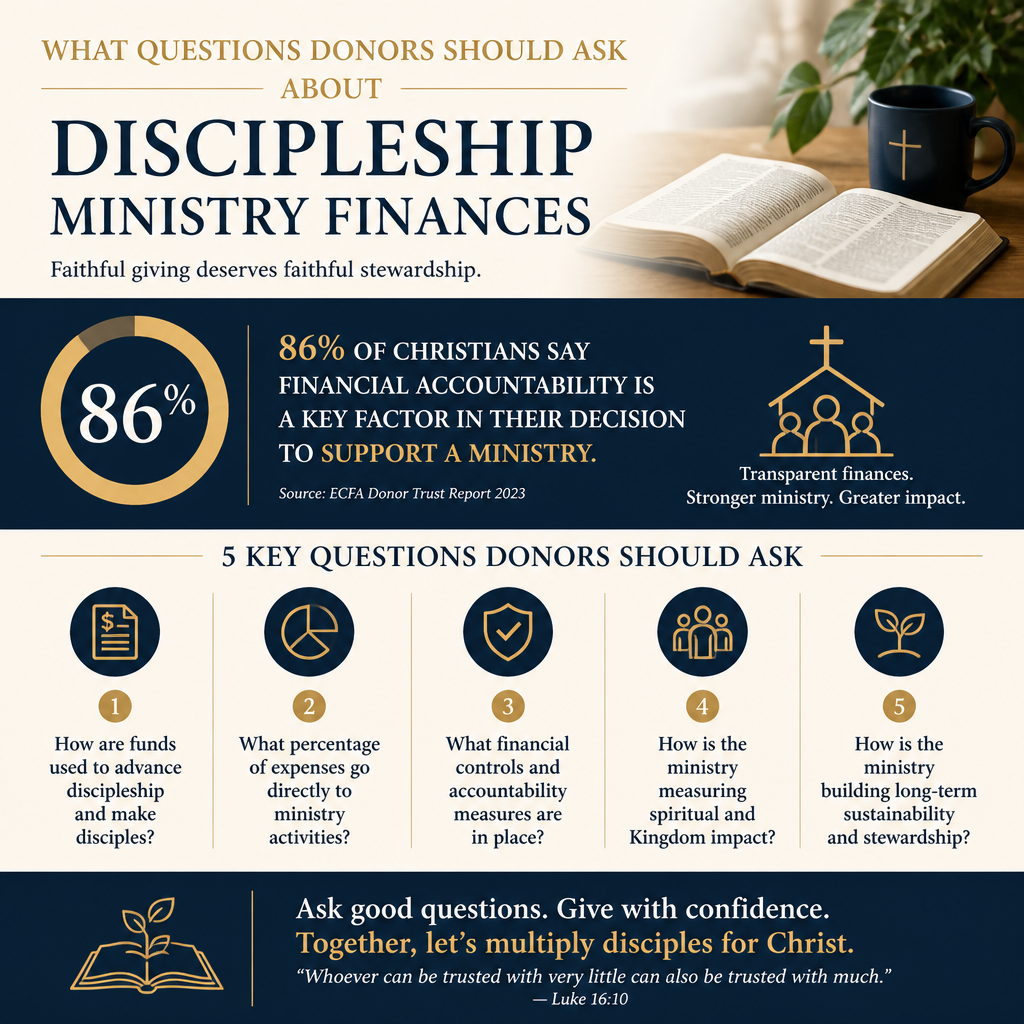
What questions donors should ask about discipleship ministry finances is not a side issue for serious Christian stewardship. Discipleship is the church’s work of forming people into the likeness of Christ, and the way a ministry handles money is one of the clearest tests of whether its practices align with its theology.
Scripture treats financial integrity as a discipleship matter, not merely an administrative one. Jesus warned that money competes for the heart’s allegiance (Matthew 6:24), and Paul instructed churches to arrange collections in a way that prevents suspicion and is “honorable not only in the Lord’s sight but also in the sight of man” (2 Corinthians 8:20–21). Donors who ask financially substantive questions are not being cynical; they are participating in the biblical pattern of accountable stewardship.
1 Ask whether the ministry can define discipleship outcomes with theological clarity
Finance questions become sharper when the ministry can name what it believes discipleship is, and what it expects God to do through its work. A budget is a moral document; it reveals what a ministry truly prioritizes. If “discipleship” is used as a spiritual label for any activity the organization happens to run, donors will struggle to evaluate whether funds are advancing formation or merely sustaining operations.
Questions that connect theology to spending
We recommend asking for a concise description of the ministry’s discipleship model and the concrete practices that flow from it. For example: Is the ministry centered on local-church integration, small-group formation, mentoring, pastoral care, catechesis, training leaders, or a mix? Each implies different cost structures and different risks of drift.
Useful donor questions include:
- What is your definition of discipleship, and how does it shape program design and staffing?
- Which activities are essential to your model, and which are supportive but optional?
- Where do you see the greatest temptation to measure success by attendance, content output, or platform growth?
- How do you keep financial incentives from reshaping ministry priorities over time?
What clarity signals in financial reporting
Ministries with coherent discipleship aims can usually explain line items without defensiveness. They can show how staff roles, training costs, travel, content production, or cohort systems serve a stated formation pathway. Across our verification work at Most Trusted, the organizations that meet The Most Trusted Standard tend to connect mission, program design, and financial decisions in a way that a thoughtful outsider can test.

2 Ask how restricted gifts are handled and whether donor intent is protected
Discipleship ministries often raise funds for specific initiatives: curriculum translation, training cohorts, pastoral residencies, digital content, or church-based mentoring networks. Restricted giving can be a gift to integrity and a burden to management. The more restrictions a ministry accepts, the greater the obligation to track funds and report clearly.
Questions that reveal internal controls
We recommend asking how the ministry documents restrictions, who approves changes, and what happens when a project ends early or costs less than expected. These are not hypothetical issues; they are among the most common sources of donor confusion and internal strain.
Specific questions include:
How do you document and track restricted gifts? A mature answer names systems and oversight, not only intentions.
Do you ever reclassify restricted funds for general use? If so, under what conditions and with what donor consent process?
How do you report back to donors on restricted initiatives? Frequency matters, but clarity matters more.
Why this is a discipleship issue
When donor intent is treated lightly, the ministry is forming people to believe that spiritual ends justify procedural shortcuts. That is not the New Testament’s ethic. Paul’s concern in 2 Corinthians 8 was not only avoiding fraud, but avoiding suspicion. Healthy internal controls protect a ministry’s witness as much as its balance sheet.
Donors who care about these questions often care about broader Accountability and Transparency in Discipleship Ministries because the credibility of formation work depends on practices that can bear scrutiny.
3 Ask about the real cost of disciple-making and the ministry’s plan to fund it sustainably
Some discipleship outcomes are slow, relational, and difficult to quantify. That reality creates pressure: donors often prefer easily narrated results, while faithful formation may look ordinary and gradual. Financial questions should therefore test whether the ministry is funding what it actually does, rather than what it can most easily market.
Questions that separate sustainable ministry from a fundraising cycle
We recommend asking about revenue concentration, reserves, and multi-year planning. A ministry that relies heavily on a small set of major donors can do excellent work, but concentration raises succession and continuity risks. Conversely, an organization funded by many small recurring donors may be stable but tempted toward constant content production and audience maintenance.
Practical questions include:
What percentage of revenue comes from your top ten donors? The number itself is not automatically disqualifying, but the risk should be understood and managed.
Do you maintain operating reserves? If so, what purpose do they serve, and what policies govern their use?
Do you run persistent deficits? Some ministries can justify a planned deficit during a transition, but chronic shortfalls often indicate misalignment between ambition and capacity.
How to think about overhead without falling for simplistic ratios
Christians genuinely disagree about how much administrative and fundraising cost is acceptable. The more honest disagreement is not about whether overhead should be low, but about what overhead actually represents: governance, accounting, training, compliance, and systems that prevent scandal and waste. The strongest public corrective to simplistic overhead thinking came from leaders across the nonprofit sector in the “Overhead Myth” letter, signed by Charity Navigator, BBB Wise Giving Alliance, and GuideStar, which urged donors to evaluate results and transparency rather than fixate on a single ratio Charity Navigator.
What this means in practice is that a discipleship ministry that invests in finance staff, independent review, secure donor systems, and careful reporting may be spending in ways that protect mission. The question is whether those costs are proportionate and governed well.
4 Ask who governs the money and how conflicts of interest are prevented
Financial integrity is not primarily a question of whether leaders are sincere. Sincerity cannot substitute for oversight. Discipleship ministries can be founder-led, family-led, or built around a prominent teacher, and each structure carries predictable vulnerabilities. Donors should ask governance questions without assuming wrongdoing, because good structures protect both leaders and supporters.
Questions about board independence and authority
We recommend asking whether the board is meaningfully independent, whether it reviews the budget, and whether it can challenge executive decisions. A board that functions as an advisory circle rather than a governing body is a recurring weakness in ministries that later face financial crisis.
Key questions include:
How are board members selected, and what qualifies them to oversee finances? Financial literacy and spiritual maturity are both relevant.
Does the board approve executive compensation and major related-party transactions? This is basic governance for avoiding self-dealing.
Is there a written conflict-of-interest policy, and is it enforced annually? Policies matter only when practiced.
Compensation and the stewardship of trust
Compensation in Christian ministry is a recurring point of controversy. Some donors expect sacrificial pay; others recognize that complex organizations require skilled leadership. The donor’s role is not to impose a single compensation philosophy, but to ask whether the ministry has a credible process: documented approvals, comparability review where appropriate, and transparent communication proportionate to the ministry’s public footprint.
Across our work, the ministries most likely to sustain credibility over time are those that treat governance as a ministry of protection, not as a hindrance to vision.
5 Ask whether financial reporting is verifiable and whether impact claims are disciplined
Discipleship ministries can be tempted to overstate reach: counting downloads as disciples, attendance as transformation, or platform growth as spiritual fruit. Donors should ask for reporting that distinguishes activity from formation, and for financial statements that can be tested.
Questions about audits and financial statements
We recommend asking for the most recent Form 990 for US-based nonprofits, and for audited financial statements when scale and complexity warrant it. Not every ministry must have an audit, but every ministry should have financial statements prepared with competence and reviewed with seriousness.
For donor reference, the IRS makes Form 990 filings broadly accessible, and donors can confirm an organization’s exempt status through the IRS Tax Exempt Organization Search IRS. Those tools do not substitute for trust, but they do provide objective starting points.
Questions about impact claims that respect spiritual realities
Some outcomes of discipleship are inherently difficult to quantify. Scripture itself resists mechanical metrics; the fruit of the Spirit is real, but it is not a quarterly KPI. Still, ministries can practice disciplined honesty. They can report what they can truly know: who was trained, which churches were served, what follow-up exists, what retention looks like, and what independent feedback mechanisms are used.
We recommend asking:
How do you avoid counting “reach” as “formation”? A serious answer acknowledges the difference.
What do you do when a program is popular but not effective? The willingness to change is often more revealing than a success story.
Do you invite outside critique? Peer review, church partnerships, and third-party evaluation can be appropriate depending on the ministry’s work.
Donors who want a broader view of the landscape of Discipleship Ministries often find that these questions travel well across different models, from local training networks to publishing-centered organizations.
FAQs for What questions donors should ask about discipleship ministry finances
Should a discipleship ministry have an independent audit?
Not every discipleship ministry requires an audit, particularly smaller organizations with simple operations. The better question is whether the level of external review matches the level of complexity, revenue, and risk. As budgets grow, as international work expands, or as related-party relationships arise, independent assurance becomes a prudent safeguard for donors and leaders alike.
Is a low overhead ratio a reliable sign of faithfulness?
No. A low overhead ratio can reflect efficiency, but it can also reflect underinvestment in accounting, safeguarding, governance, and staff development. The nonprofit sector’s “Overhead Myth” letter, signed by Charity Navigator, BBB Wise Giving Alliance, and GuideStar, argued that donors should consider transparency, governance, and results rather than treating overhead as the primary measure of quality BBB Wise Giving Alliance. For discipleship ministries, the most faithful approach is typically proportionate investment in the systems that prevent harm and sustain trust.
A faithful donor posture toward discipleship ministry finances
Discipleship is not produced by money, but money can either serve or sabotage discipleship. The questions donors ask about discipleship ministry finances should therefore be both practical and theological: practical enough to test controls and sustainability, theological enough to insist that a ministry’s handling of resources reflects the character of the God it proclaims.
At Most Trusted, our role is not to replace discernment, but to strengthen it through independent verification against The Most Trusted Standard. Donors who bring serious questions to serious ministries help preserve the integrity of the church’s witness and the credibility of Christian generosity.



