

What a pastor family retreat costs is rarely a simple line item, because the expense is never only about lodging and meals. It is a choice to underwrite a season of safety, confidentiality, and restoration for a household that often carries the church’s burdens in public while suffering in private.
For Christian donors, the question is not whether retreat ministry feels compassionate. The question is whether the costs are proportionate to the purpose, and whether the ministry has the maturity to administer care without drifting into luxury, dependency, or vague outcomes. Those are stewardship questions, and Scripture treats stewardship as a spiritual matter, not a bureaucratic one.
What donors are actually paying for
Retreat cost is not identical to retreat value
Retreat ministry sits at the intersection of pastoral care, crisis intervention, and family discipleship. A well-run retreat is structured to relieve isolation, reduce chronic stress, and create space for honest conversation that cannot happen when a pastor is “on” every Sunday. The price reflects that intentionality.
In practice, a retreat budget is usually built around two categories: the direct cost of hosting the family and the indirect cost of qualified care. Donors commonly see the first category and miss the second. A quiet setting is helpful; trained staff and clear policies are essential.
The pastor family reality that drives demand
Many retreat programs exist because pastoral strain is not theoretical. When pastors consider leaving, families often experience the fallout long before any resignation is public. Evidence from Barna suggests many pastors have considered quitting full-time ministry in recent years, a signal of sustained pressure rather than isolated burnout (Barna).
We should also name a tension: not every weary pastor is a healthy candidate for retreat care. Some situations require clinical treatment, formal accountability, or denominational discipline. Mature retreat ministries know when to serve, when to refer, and when to pause care for the sake of safety.

Cost drivers that legitimately move the number
Length of stay and seasonality
Retreats range from a long weekend to multiple weeks. Duration changes everything: accommodations, food, staffing coverage, and the opportunity cost of keeping a property available. Seasonality matters as well. A retreat home that is modest in the off-season may be expensive in a peak travel window, even if the ministry negotiates nonprofit pricing.
People costs are often the most mission-critical costs
The most consequential cost driver is often staffing: licensed counselors, pastors trained in pastoral care, children’s ministry personnel, or a couple-on-couple mentoring model. Even when a ministry relies heavily on volunteers, screening, training, and supervision are not optional. The church has learned too painfully that informal care without safeguards can become spiritually manipulative or even abusive.
For donors evaluating pastoral support, it is helpful to compare this to other forms of care. A retreat that includes licensed counseling may resemble a short-term intensive intervention more than a “vacation.” When ministries include clinical services, they also incur compliance and documentation responsibilities that raise costs but also protect families.
What a typical retreat budget can include
Common line items donors should expect to see
Exact numbers vary widely by geography and model, so we are cautious about publishing ranges that may mislead. What we can do responsibly is describe the categories a credible ministry should be prepared to explain with specificity.
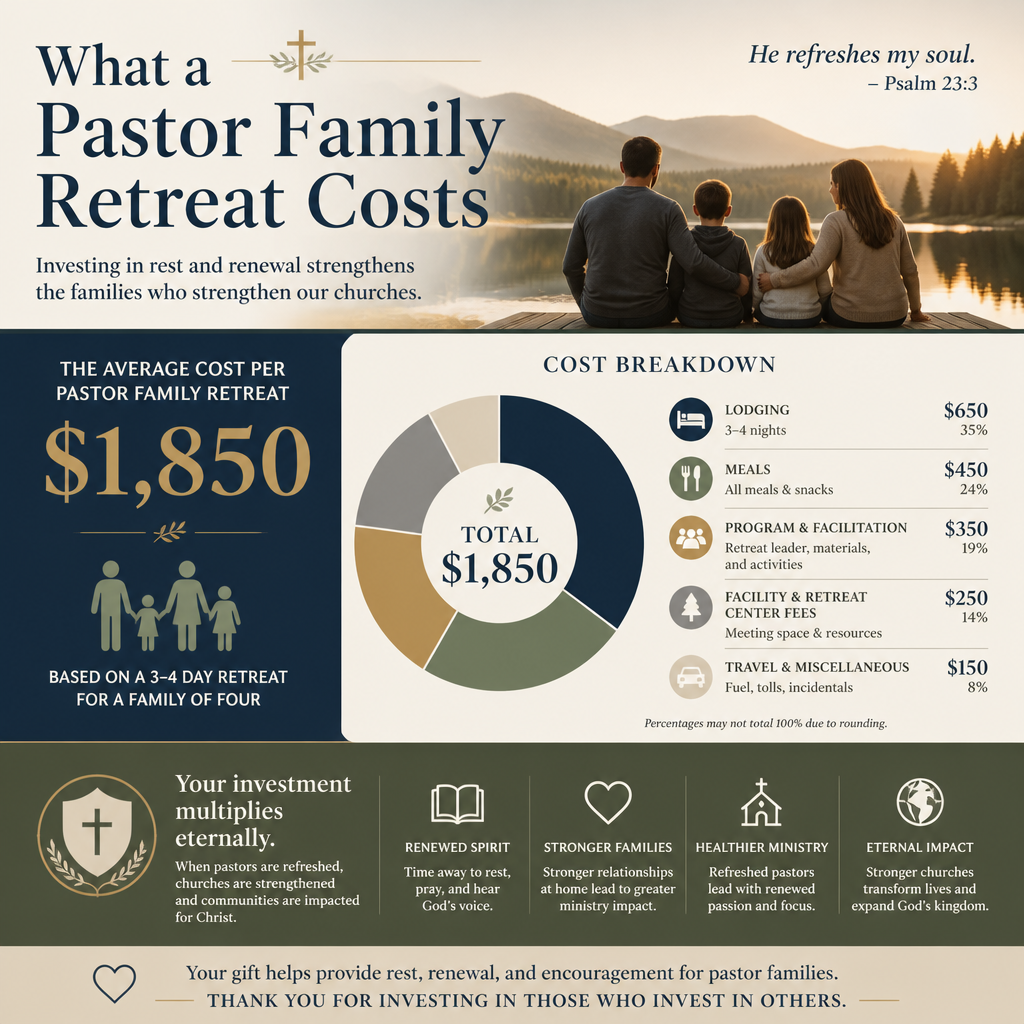
- Lodging and facility operations such as utilities, maintenance, insurance, and housekeeping
- Meals including dietary accommodations and food-service labor
- Care staff such as counseling, pastoral care, spiritual direction, or coaching
- Children and teen programming including background-checked workers and age-appropriate materials
- Travel assistance for families who could not otherwise attend
- Security and confidentiality measures especially for high-profile or crisis situations
Retreat models that change the economics
Some ministries operate a dedicated retreat property. Others partner with camps, conference centers, or local churches. A dedicated property increases fixed costs but can improve confidentiality and reduce per-family variability. Partner models reduce fixed costs but may limit availability and control over the environment. Both can be faithful models; the question is whether the model fits the ministry’s claims and capacity.
Donors also encounter different funding approaches: fully subsidized retreats, sliding-scale fees, or a shared-cost model with denominational offices or sending churches. Sliding-scale approaches can preserve dignity and avoid a consumer posture, but they must be administered with clarity and without shaming families in need.
When costs become a red flag
Luxury masquerading as care
There is a difference between beauty that supports rest and luxury that distorts mission. Scripture commends honoring those who labor in preaching and teaching (1 Timothy 5:17–18), yet it also warns against leaders who use spiritual authority for gain (1 Peter 5:2–3). A retreat can be generous without being indulgent.
For donors, warning signs often appear in evasive language: “transformational experiences” with no description of staff qualifications, a fixation on amenities, or marketing that resembles hospitality branding more than pastoral care. A credible ministry can say plainly what care is provided, by whom, under what policies, and with what safeguards.
Vague outcomes and untestable claims
Not every outcome is quantifiable. Spiritual renewal and marital repair cannot be reduced to a dashboard. But a ministry can still demonstrate seriousness: clear intake and referral pathways, documented care plans when appropriate, post-retreat follow-up, and boundaries around what the retreat can and cannot address.
This is where donors should resist simplistic “overhead” assumptions. The nonprofit sector has repeatedly argued that administrative capacity can be essential to effectiveness. The Overhead Myth statement—endorsed by major evaluators—made the case that overhead ratios alone are a poor proxy for impact (GuideStar).
How to evaluate retreat ministries with donor-grade rigor
Questions that map to The Most Trusted Standard
Across our verification work at Most Trusted, we observe that the healthiest pastoral support ministries can explain their retreat costs without defensiveness. They treat donors as partners in stewardship, not as shoppers to be managed. They also resist two temptations: hiding costs under spiritual language, and reducing care to a transactional service.
When a donor asks what a pastor family retreat costs, we recommend pressing beyond the price tag to the operating integrity behind it. In our framework, The Most Trusted Standard assesses ministries across Faith Foundation, Financial Integrity, Governance and Leadership, and Transparency and Effectiveness. Retreat work touches all four: theology shapes the care model; finances shape the ministry’s sustainability; governance shapes safety; transparency shapes trust.
What careful donors can request before funding
Donors do not need to become investigators, but they should expect clarity. A ministry should be willing to provide, at minimum, an annual budget summary, governance structure, safeguarding policies, and a plain description of services offered during the retreat and after the family returns home.
For readers supporting Pastoral Support Ministries, the most strategic giving often funds the less visible parts of retreat care: staff training, background checks, clinical supervision, post-retreat follow-up, and scholarship funds for families whose churches cannot contribute. Those are not glamorous costs, but they are frequently the costs that keep a retreat ministry faithful over decades rather than a few emotional years.
And for donors exploring How Pastoral Support Ministries Serve Pastor Families, it is worth remembering that retreat care should not replace local pastoral relationships, denominational responsibility, or clinical treatment when needed. The best ministries see themselves as part of an ecosystem of care, not the whole answer.
FAQs for What a pastor family retreat costs
Should a pastor family pay anything, or should donors cover the full cost?
Either model can be faithful. Fully subsidized retreats can protect access for families in under-resourced churches and reduce shame. Shared-cost or sliding-scale models can preserve dignity and reinforce that retreat is care, not entitlement. Donors should evaluate whether the ministry’s approach is transparent, consistently applied, and oriented toward long-term health rather than short-term optics.
What is a reasonable way to judge whether retreat costs are too high?
The clearest test is alignment between cost and care. Ministries should be able to explain staffing qualifications, safeguarding policies, and the specific services provided during the stay and after. If the value proposition is primarily amenities, or if leadership cannot articulate outcomes and boundaries, cost becomes a secondary concern because credibility is the primary concern.
Stewardship that strengthens shepherds
What a pastor family retreat costs should be weighed against what it is meant to protect: a household’s faith, marriage, children, and capacity to endure in ministry without pretense. Donors honor Christ when they fund care that is competent, accountable, and shaped by a theology of shepherding that refuses both exploitation and indulgence. The goal is not a brief escape. The goal is restored endurance for those called to serve the church.



