

How pastoral support ministries help pastor spouses is ultimately a question of ecclesiology and stewardship: whether the church will care for those who quietly bear the weight of public ministry. Many pastor spouses live with a persistent tension between visibility and loneliness, spiritual responsibility and lack of authority, and high expectations with limited permission to be human. Donors who fund pastoral support are not underwriting a side project. They are investing in the long-term health of congregations, because the spiritual formation and stability of a pastor’s household has direct consequences for preaching, leadership, and endurance.
The New Testament assumes a deep connection between the shepherd and the flock, and it does not romanticize the cost. Paul’s catalog of afflictions is not a fundraising trope; it is a sober description of ministry’s pressures (2 Corinthians 11). Pastor spouses often absorb some of those pressures without formal recognition or the protections that accompany an official role. When support ministries serve them well, they strengthen the church’s witness by reducing preventable harm and by honoring the dignity of those who serve in the shadows.
The hidden load pastor spouses carry is not theoretical
Public ministry creates private exposure
Pastor spouses regularly experience a form of “secondhand shepherding.” They are expected to welcome, counsel informally, host, attend, forgive quickly, and remain spiritually steady under scrutiny. Yet they often lack clear job descriptions, compensation, or boundaries, which makes their labor difficult to name and therefore difficult to protect. The result can be a chronic erosion of rest, friendships, and spiritual privacy.
Research on clergy wellbeing helps donors understand why support is not optional. Barna has reported that many pastors contemplate leaving full-time ministry, citing stress, isolation, and fatigue as recurring themes; the strain is not confined to the pastor alone, because family systems absorb vocational stress together. See Barna’s reporting on pastoral burnout and resignation pressures at barna.com.
Unaddressed strain tends to surface as moral and organizational risk
Church scandals often involve obvious failures of governance or personal integrity, but they are also frequently preceded by unaddressed exhaustion, secrecy, and relational isolation. Pastor spouses are sometimes the first to notice warning signs and the least equipped to intervene constructively. A well-designed support ministry can provide confidential counsel, peer relationships, and pathways to professional care so that concerns are addressed early rather than exploding publicly.
Donors sometimes hesitate because they do not want to fund “comfort” or a private benefit. That concern deserves respect. The stronger argument, however, is that properly structured care functions as preventive pastoral risk management in the service of the church’s mission, not as indulgence.

Pastoral support ministries serve pastor spouses by restoring moral clarity and healthy boundaries
They clarify what the church can rightly ask
A pastor spouse is not automatically a co-pastor. Some spouses are called, trained, and commissioned into ministry roles. Others are not. Support ministries help couples and churches name this distinction explicitly, which reduces manipulation and confusion. Clear expectations do not diminish sacrificial love; they protect it from being commandeered by unspoken demands.
What this means in practice is that support ministries often coach churches to develop written role expectations, establish conflict-of-interest boundaries, and respect sabbath patterns. Done well, this work honors Paul’s insistence that ministry be conducted “decently and in order” (1 Corinthians 14:40), not as an abstraction but as an ethical commitment to the souls involved.
They normalize appropriate confidentiality and referral
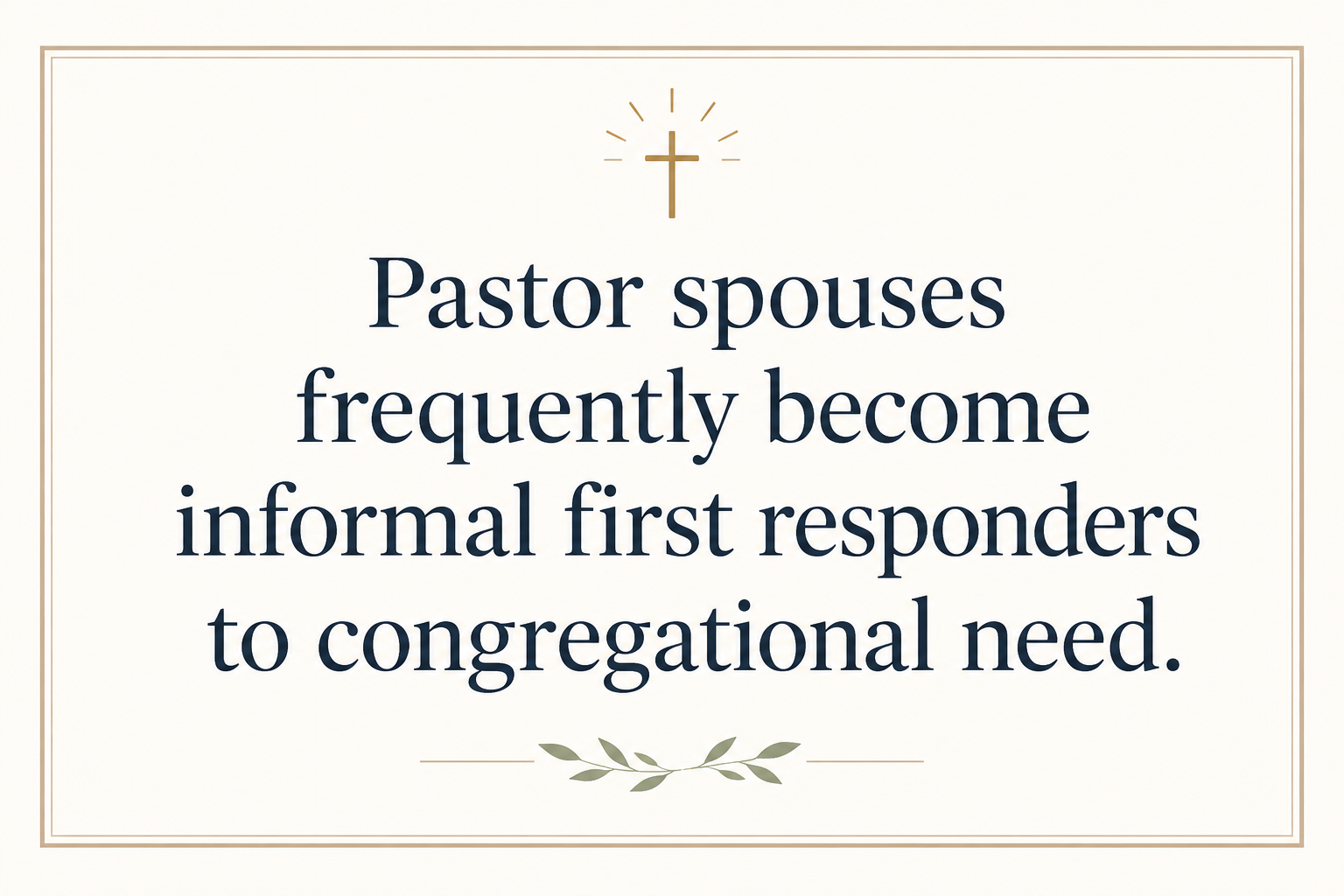
Pastor spouses frequently become informal first responders to congregational need. Without training and support, they can be pulled into complex situations involving abuse, addiction, or serious mental illness. Responsible support ministries teach when to listen, when to refer, and when to involve mandated systems of care. They also reinforce that confidentiality is not synonymous with secrecy, especially when safety is at stake.
The best ministries do not treat therapy as a rival to discipleship. They treat it as a common-grace resource that can serve sanctification when rightly ordered, while maintaining a distinctly Christian moral and theological framework.
They create community that counters isolation without creating dependency
Peer support is spiritually significant
Pastor spouses often struggle to form friendships in their own congregations because every relationship is complicated by the pastor’s authority. Peer community with other pastor spouses offers a rare space where experiences do not need translation. This is not mere social support; it is one of the ordinary means by which God sustains his people through mutual encouragement (Hebrews 10:24–25).
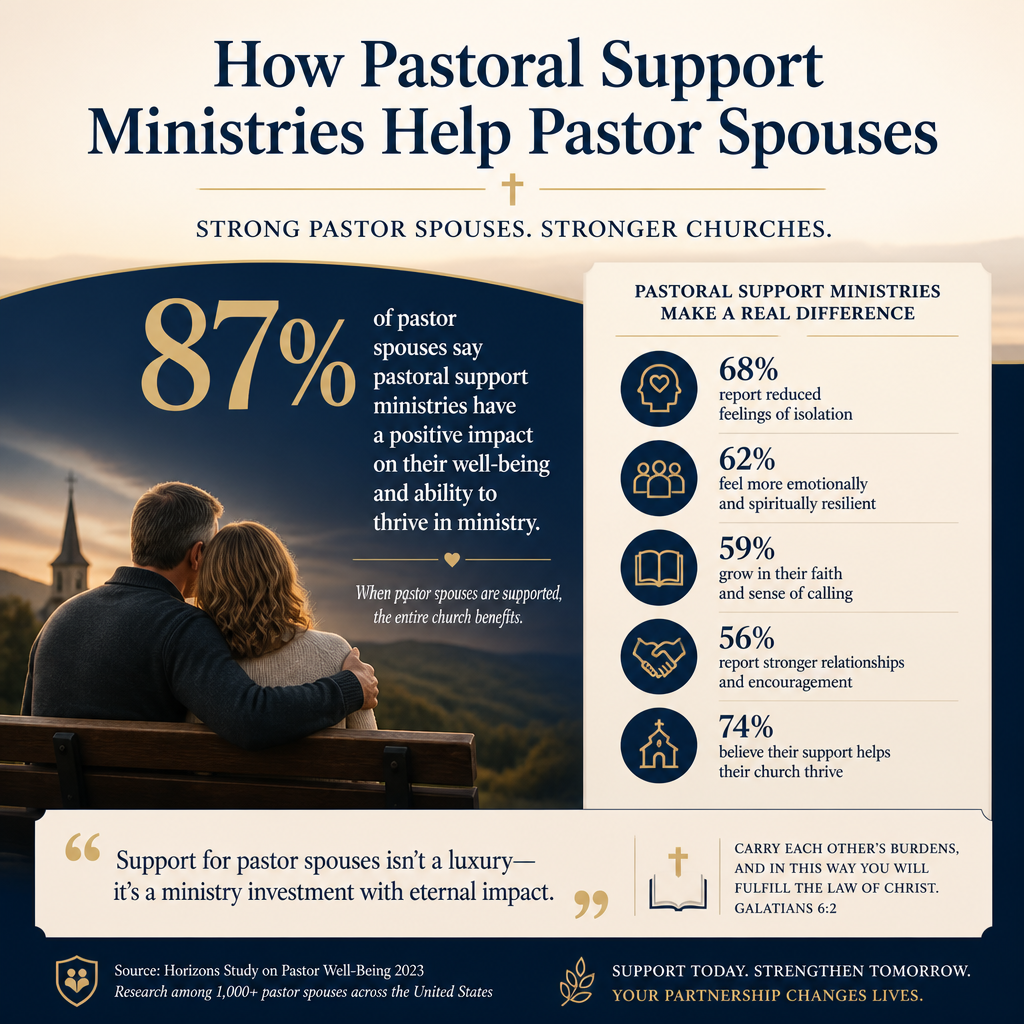
Isolation is also a documented risk factor for leaders. The American Psychological Association has noted the relationship between social support and mental health resilience. While this is not clergy-specific, it helps donors see why peer connection is a legitimate intervention rather than a discretionary add-on. See APA resources on social support at apa.org.
Healthy programs avoid turning support into a parallel church
The harder question is program design. Some support efforts unintentionally encourage disengagement from local congregations by making the support ministry the primary spiritual home. Mature ministries instead aim for a subsidiarity model: they provide what the local church often cannot provide for pastor spouses—confidentiality, specialized care, unbiased coaching—while strengthening the spouse’s capacity to remain rooted in a local body.
Donors can reasonably ask whether a ministry’s community-building practices are accountable, pastorally supervised, and oriented toward reconciliation rather than grievance formation. This is one place where governance and theological posture matter as much as programming.
They address material and vocational pressures that commonly destabilize ministry households
Financial strain can be pastoral strain
Pastor spouses frequently carry the weight of household budgeting, health insurance decisions, and secondary employment. In some regions, limited compensation makes it difficult for the spouse to choose homemaking, pursue training, or remain in a congregation long-term. When a pastor spouse is forced into work primarily for insurance or survival, the family’s capacity for ministry hospitality and rest can collapse.
National data underscores the broader context: many U.S. households report that they would struggle to cover an unexpected expense. The Federal Reserve’s Survey of Household Economics and Decisionmaking has repeatedly documented the fragility of household balance sheets. See the Federal Reserve SHED reports at federalreserve.gov.
Support ministries can intervene without confusing charity with compensation
Direct aid to pastor families can be appropriate, but it must be structured carefully. Emergency grants, counseling scholarships, retreat subsidies, and short-term assistance can prevent a crisis from becoming a ministry-ending event. Yet support ministries must avoid creating a pattern of underpaying pastors while outsourcing basic compensation to donors.
Wise donor-funded programs often include practical coaching for churches: how to benchmark compensation, how to structure leave policies, and how to provide ethical severance when a ministry transition is necessary. This reduces the temptation to treat pastor spouses as an unpaid labor pool.
- Confidential counseling access with clear referral pathways
- Peer cohorts for pastor spouses with trained facilitation
- Retreats that integrate spiritual direction and rest
- Crisis-response grants with documented eligibility criteria
- Coaching for churches on compensation and leave practices
Donors should fund support ministries with the same rigor they expect in frontline programs
The risk of sentimentality is real
Because the need is emotionally compelling, pastoral support can attract giving that is generous but unexamined. Donors can unintentionally reward ministries that tell the most dramatic stories rather than those that operate with sound governance and clinically responsible care practices. Christians genuinely disagree about how formalized “care for leaders” should be, and some fear it can become self-protective clericalism. That concern is not answered by marketing; it is answered by transparent policies and measurable outcomes.
This is where verification serves the church. At Most Trusted, we evaluate ministries against The Most Trusted Standard, a 15-criteria framework spanning Faith Foundation, Financial Integrity, Governance and Leadership, and Transparency and Effectiveness. Across our verification work, we observe that the ministries best positioned to serve pastor spouses pair compassionate programming with strong board oversight, clear safeguarding policies, and public accountability.
What donors can reasonably look for
Sound pastoral support ministries are not defined by a single program. They are defined by a disciplined approach to care that is doctrinally faithful, ethically governed, and operationally transparent. Donors discerning where to give within Pastoral Support Ministries should expect more than sincere intent.
Several indicators deserve particular attention: whether the ministry has written confidentiality and mandated reporting policies; whether counseling is provided by qualified professionals or properly supervised pastoral counselors; whether the ministry can articulate how it avoids dependency and strengthens local church health; and whether financial practices are auditable and clearly reported. For donors focusing on programs that serve whole households, including spouses, it is also worth reviewing the wider landscape of How Pastoral Support Ministries Serve Pastor Families and asking how a given ministry addresses the family system rather than the pastor alone.
FAQs for How pastoral support ministries help pastor spouses
Is supporting pastor spouses an appropriate use of donor funds, or should churches fund this directly?
Both can be true. Churches bear a primary responsibility to care for their leaders and households, including fair compensation and humane expectations. Donor-funded pastoral support can be appropriate when it provides specialized resources a local church cannot easily provide on its own, such as confidential counseling access, retreats, crisis intervention, or peer cohorts that reduce isolation. The key is that donor support should strengthen healthy church responsibility rather than excuse chronic underfunding or unclear expectations.
What makes a pastoral support ministry trustworthy for donors?
Trustworthiness is demonstrated through governance, transparency, and responsible care practices. Donors should look for a qualified and independent board, clear financial reporting, explicit safeguarding and confidentiality policies, and evidence that programs are designed to help pastor spouses flourish without creating unhealthy dependency. Ministries that can explain their theological commitments and show measurable practices aligned with those commitments are more credible than those relying primarily on compelling stories.
Funding care for pastor spouses is funding the church’s long obedience
Pastor spouses are not supporting characters in the church’s story; they are neighbors the church is obligated to love. Pastoral support ministries at their best offer targeted, accountable care that protects families, strengthens congregations, and reduces preventable failure. For donors who want generosity to be both compassionate and responsible, the task is not merely to give, but to give with discernment—supporting ministries whose theology, governance, and practices can bear the weight of the trust placed in them.



