
What support pastoral care ministries offer pastors’ children is often misunderstood, even by generous donors who know the pressures of church life. Many assume that if a congregation cares well for its pastor, the pastor’s children will be fine by extension. In practice, pastors’ kids often carry distinct burdens that require thoughtful, specialized care rooted in the gospel and delivered with discretion.
Scripture gives the church both a doctrine of calling and a doctrine of household. Elders must “manage his own household well” (1 Timothy 3:4), not as a performance metric, but because spiritual leadership is never detached from embodied family life. Pastoral care ministries serve pastors’ children at that intersection: safeguarding the private places where ministry pressure can quietly become spiritual injury.
The pressures pastors’ children face are real and often hidden
Public ministry creates private exposure
Pastors’ children commonly grow up with a form of visibility they did not choose. Their parent’s vocation can make their friendships, mistakes, questions, and moods feel like public property. Even in healthy churches, congregants may unconsciously expect “exemplary” children as part of the pastoral package. Over time, that exposure can produce guardedness, shame, or a learned habit of managing impressions.
The harder question is not whether pastors’ kids experience pressure, but whether they have safe places to speak truthfully. When a child worries that a candid conversation could reach the elders, a donor, or a prayer chain, the child learns to keep pain inside. Pastoral care ministries can offer confidential relationships and structures that the local church, for good reasons, cannot always provide.
Ministry stress can affect the home without anyone intending harm
Many donor families understand that stress is rarely announced as such; it becomes irritability, withdrawal, exhaustion, or a shortened fuse. Pastors are not exempt. Nor are their children. The workload of preaching, counseling crises, leading staff, and navigating conflict can make emotional margin scarce at home, even when both parents are sincere and spiritually mature.
This is not an argument for cynicism about the pastorate. It is an argument for realism about human limits. Pastoral care ministries at their best operate as a wise supplement to local church care, not as a competitor to it, strengthening the household so that ministry does not devour it.

What faithful pastoral care looks like for pastors’ children
Safe adults, confidential counsel, and spiritual companionship
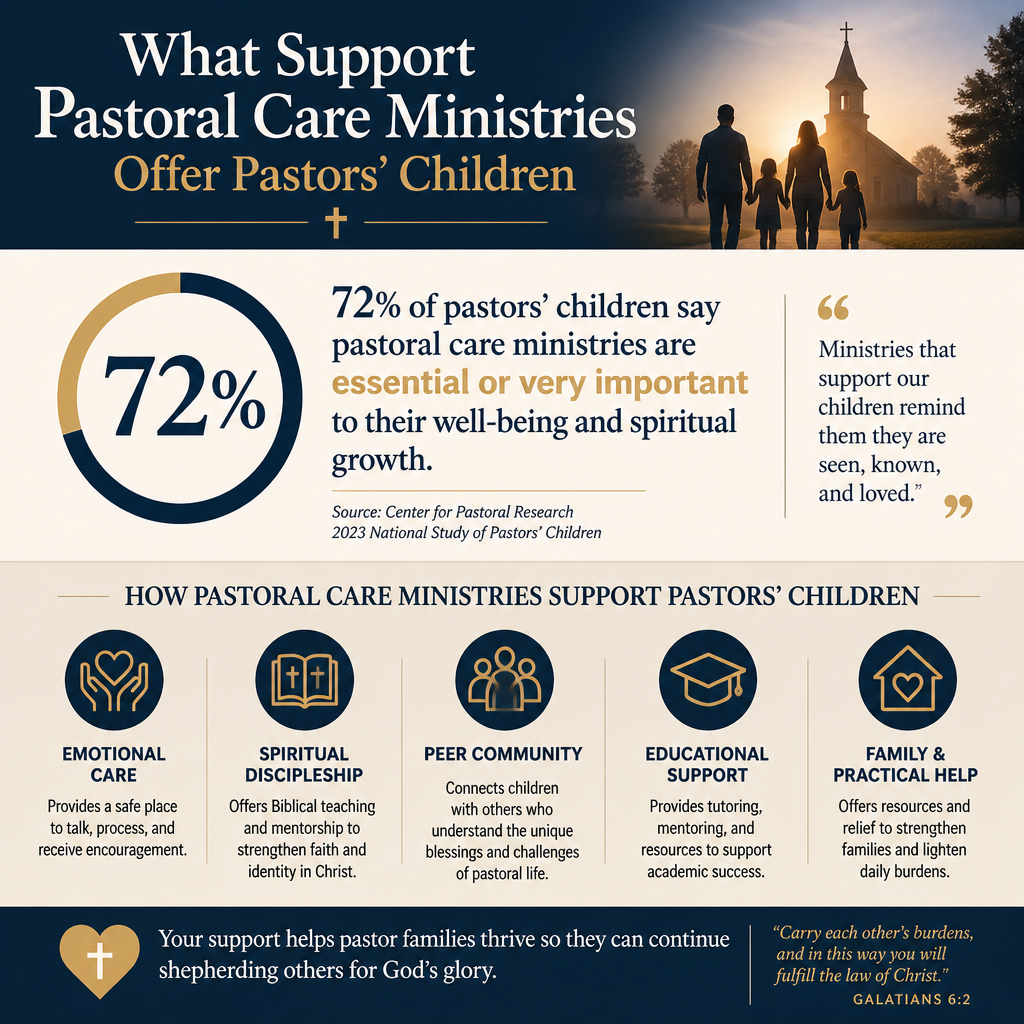
Pastors’ kids need adults who are neither their parents’ employees nor their parents’ evaluators. A pastoral care ministry may provide vetted mentors, licensed counselors who understand church culture, or spiritual directors trained to listen without using a child’s disclosures as church intelligence. The goal is not to create an alternate authority structure, but to create a refuge where truth can be spoken without fear.
Some ministries also help pastors’ children disentangle the gospel from the distortions that can accompany church life: the notion that belonging requires performance, that doubt equals disloyalty, or that leadership means emotional self-erasure. Theologically, this is a matter of justification applied to the lived life of a child: acceptance in Christ is prior to competence, popularity, or perceived “ministry usefulness.”
Peer community that reduces isolation
Many pastors’ children report a sense of being alone in their experience. Carefully designed retreats or small cohorts can provide peer relationships where the unspoken can be spoken. Done well, this is not group therapy in a camp sweatshirt; it is fellowship marked by prudence, clear boundaries, and age-appropriate teaching.
For donors, it is worth naming a tension: peer gatherings can also become grievance incubators if they are not spiritually guided and responsibly supervised. We look for ministries that cultivate honesty without cultivating contempt, and that teach children to name harm without assuming the church is inherently unsafe.
Programs donors often underfund because they are hard to measure
Respite and ordinary joy are forms of care
Support for pastors’ children is not only crisis intervention. It is also providing room to be ordinary: time away from the spotlight, a vacation fund that is not conditioned on public productivity, and spaces where a child can laugh without feeling observed. These provisions can look “soft” on a spreadsheet, but they are often the soil where resilience grows.
Many Christian donors have learned that measurable outputs are not the same as faithful outcomes. The Overhead Myth letter—signed by GuideStar (now Candid), BBB Wise Giving Alliance, and Charity Navigator—helped the sector acknowledge that simplistic metrics can mislead donor judgment. See the statement at Candid. Pastoral care for children is a prime example: good care is often quiet, slow, and appropriately private.
Clinical care when needed, with the right safeguards
Some pastors’ children need professional counseling for anxiety, depression, trauma, or family systems stress. A pastoral care ministry may subsidize sessions, provide referrals, or host counseling intensives. Donors should ask careful questions here. “Christian counseling” can mean many things, ranging from clinically excellent to deeply irresponsible.
Responsible ministries tend to clarify standards of care: licensing, supervision, mandated reporting compliance, and theological commitments that do not replace clinical competence. They also avoid treating a child’s suffering as merely a spiritual failure. Scripture recognizes bodily and emotional weakness as part of our creatureliness; pastoral care honors that reality without denying the necessity of repentance where it is needed.
How pastoral care ministries support the whole family system without sidelining the church
Care that strengthens parents and protects children
Support for pastors’ children often works best when paired with support for the parents. Marital strain, financial stress, and congregational conflict rarely stay in the office; they echo through the home. Some ministries provide coaching for pastors and spouses around boundaries, sabbath, and conflict processing, not as management technique but as discipleship.
Donors sometimes worry that parachurch support will weaken congregational responsibility. The better ministries aim for the opposite: they help pastors’ families receive care without forcing the local church to become both employer and primary counselor. Where appropriate and with consent, they encourage healthy communication with elders and trusted leaders, while preserving confidentiality that protects minors.
Prevention is stewardship
The donor question is often framed as: “Is this urgent enough to fund?” With pastors’ children, prevention is often the most responsible stewardship. When a family reaches crisis, the costs—emotional, spiritual, and financial—are higher. When children quietly disengage from church or faith, the losses can last decades.
It is widely documented that clergy work is associated with elevated stress and mental health strain. For example, a Barna study conducted with Pepperdine University reported that a significant portion of pastors considered quitting full-time ministry in 2021; see Barna for the report. Whatever precise percentages are debated across studies, the direction is consistent: pastoral load can become unsustainable, and family members are not immune to the fallout.
What we evaluate when donors ask which ministries are trustworthy
Trust is built through theology, governance, and transparent practice
Because pastoral care ministries work with minors and with families in vulnerable seasons, trust must be more than a brand impression. At Most Trusted, we help donors give with confidence by evaluating ministries against The Most Trusted Standard, a 15-criteria framework that examines faith commitments, financial integrity, governance and leadership, and transparency and effectiveness.
Across our verification work, the ministries that meet The Most Trusted Standard tend to show a consistent pattern: clear child-safety policies, board oversight that does not function as a rubber stamp, financial reporting that is understandable to outsiders, and program descriptions that are neither evasive nor voyeuristic. They can explain what they do without exposing the children they serve.
Practical questions donors should ask before funding
Donors often want a simple yes-or-no judgment. Wisdom requires better questions. When considering support for pastoral care ministries serving pastors’ children, we recommend asking for evidence of mature practice in areas such as:
- How does the ministry screen, train, and supervise any adult who has contact with minors?
- Does it provide licensed clinical care directly, or does it refer out, and how are referrals vetted?
- What confidentiality boundaries are promised, and what exceptions exist for safety and reporting?
- How is the board structured, and what accountability exists for leadership misconduct?
- Can the ministry show clear financial statements and explain how restricted gifts are handled?
These questions fit naturally within the broader landscape of Pastoral Support Ministries and can help donors support care that is both compassionate and accountable.
FAQs for What support pastoral care ministries offer pastors’ children
Should the local church provide all care for pastors’ children instead of outside ministries?
Local churches should provide meaningful pastoral and communal care, and many do. Outside pastoral care ministries are often valuable precisely because they can offer confidential relationships and specialized support without the conflicts of interest that arise when the church is also the employer. The healthiest models honor the church’s role while supplying care the church may not be positioned to provide well.
What should donors watch for as warning signs in a pastoral care ministry serving minors?
Warning signs include vague child-safety policies, unclear reporting procedures, leaders who resist oversight, and an unwillingness to provide transparent financial information. Donors should also be cautious of ministries that promise quick transformation or that frame pastors’ children primarily as a marketing narrative. Mature ministries can describe their work with clarity while maintaining appropriate privacy for the families they serve. Additional context for donor discernment is available in How Pastoral Support Ministries Serve Pastor Families.
Why this work deserves serious Christian philanthropy
Pastors’ children are not a special class of Christians, but they are often a uniquely exposed one. When their private lives become collateral damage of public ministry, the church’s witness suffers, and the vulnerable pay the price. Pastoral care ministries serve pastors’ children by creating safe, accountable spaces where the gospel can be received as good news rather than as an expectation to perform.
For donors, the call is not merely to feel sympathy for ministry families but to fund structures of care that are worthy of trust. That means supporting ministries whose compassion is matched by governance, whose theology is matched by integrity, and whose desire to help is matched by the humility to be evaluated.



