

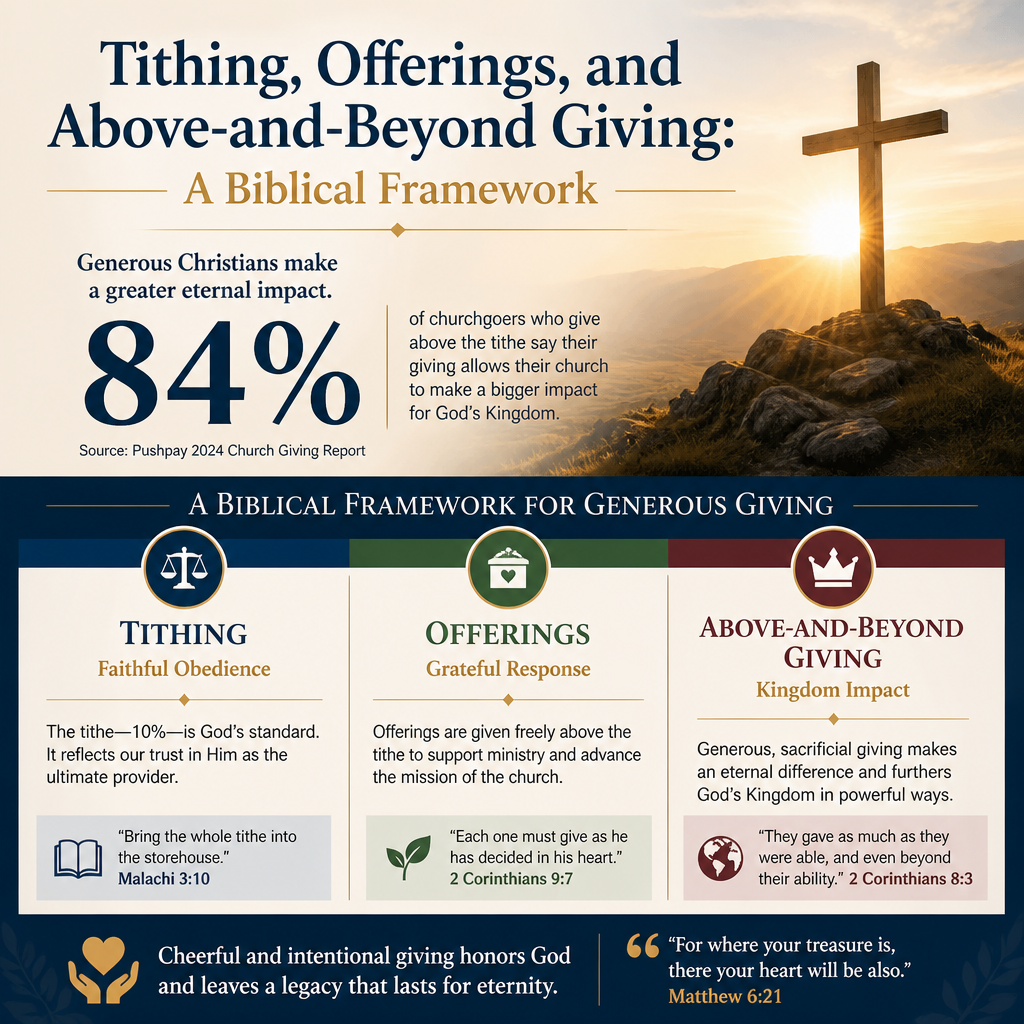
Tithing, offerings, and above-and-beyond giving are not three separate fundraising techniques. They are categories Scripture uses to form a people who know whose they are, what their money is for, and how worship reaches into the ordinary decisions of the household. For Christian donors, the question is rarely whether generosity matters; it is how to practice it with integrity when biblical language, church tradition, and modern nonprofit realities do not align cleanly.
The stakes are higher than budgeting. Jesus treats money as a diagnostic of the heart (Matthew 6:21), and the early church treated material sharing as a visible expression of the gospel’s social reality (Acts 2:44–45). Yet contemporary giving is shaped by subscription habits, consumer debt, and a philanthropic marketplace that can turn even sincere donors into anxious auditors. Christian donors often carry two fears at once: being unfaithful to God by holding back, and being irresponsible by giving without discernment.
We can name a biblical framework without forcing false precision. Scripture presents the tithe as a covenantal practice in Israel, offerings as freewill worship and gratitude, and extraordinary gifts as responsive sacrifice in moments of need or vision. Under the new covenant, the church is not governed by the Mosaic legal code, but it is still commanded to give in ways that are proportionate, deliberate, joyful, and accountable (2 Corinthians 8–9). That combination—worshipful generosity with sober stewardship—is where mature Christian giving becomes both faithful and wise.
What Scripture Means by the Tithe
In the Old Testament, the tithe is not first a personal spirituality tactic. It is part of Israel’s covenant life: a structured, regular transfer of resources that honored God’s ownership, supported the Levites who served at the tabernacle, and provided for the vulnerable (Leviticus 27:30; Numbers 18:21–24; Deuteronomy 14:28–29). The tithe is therefore theological and social. It is worship that takes economic form.
Christians genuinely disagree about how directly the Old Testament tithe maps onto new covenant giving. Some treat the ten percent as a binding baseline; others treat it as a helpful benchmark; others argue that the New Testament replaces a fixed percentage with the more searching demands of generosity shaped by love and the Spirit. Those differences are not trivial. They affect budgets, church teaching, and donor expectations. But the existence of disagreement does not erase the core moral logic that the tithe embodied: God is Lord over income, and his people order their finances accordingly.
The tithe as a disciplined firstfruits practice
Israel’s giving was tied to “firstfruits,” the confession that the harvest belonged to God before it belonged to the farmer (Deuteronomy 26:1–11). That concept translates well across covenants because it is about order: giving is not whatever remains after one’s preferred life has been funded. Many donors find that the single most spiritually clarifying practice is not the precise percentage but the principle of priority—setting aside an intentional portion at the front end.
What Jesus affirms and what he intensifies
Jesus assumes tithing is familiar and, in a limited sense, affirms it (“you ought to have done these,” Matthew 23:23). Yet his critique is surgical: meticulous giving can coexist with injustice, neglect of mercy, and self-justifying religious performance. That is not an argument against tithing; it is an argument against treating a measurable practice as a substitute for obedience. Jesus intensifies the moral demand, moving from minimum compliance to whole-person righteousness.
The New Testament does not give a new percentage
The epistles do not command a ten percent tithe as a universal church rule. They do, however, command generosity that is proportionate (“according to what a person has,” 2 Corinthians 8:12), planned (“on the first day of every week,” 1 Corinthians 16:2), and joyful (“not reluctantly or under compulsion,” 2 Corinthians 9:7). For donors seeking a faithful path, the practical question becomes: what regular, disciplined giving pattern best expresses firstfruits, proportionality, and freedom from compulsion?

Offerings as Worship, Gratitude, and Participation in God’s Work
If the tithe is structured and recurring, offerings are often responsive and relational. In the Old Testament, “freewill offerings” are named explicitly as voluntary gifts given from gratitude and desire to honor God (Exodus 35:29). In the New Testament, offerings include tangible support for gospel labor (Philippians 4:15–18) and for the relief of saints in need (Romans 15:25–27). The point is not merely transferring money; it is participating in what God is doing among his people and in the world.
Offerings are not a workaround for the hard work of formation
Because offerings are often discretionary, they can be used to avoid deeper questions. Donors sometimes prefer episodic generosity because it allows one to feel generous without reordering life. Scripture presses the opposite direction. The Macedonian churches gave “according to their means, and beyond their means” (2 Corinthians 8:3), but that extraordinary generosity flowed from a prior act: “they gave themselves first to the Lord” (2 Corinthians 8:5). Offerings that are detached from surrender can become sporadic sentiment rather than worship.
Offerings can be targeted without becoming transactional
Christian donors often wrestle with designated giving. Designation can reflect legitimate moral concern: supporting Bible translation rather than a building campaign, orphan family reunification rather than institutionalization, or pastoral training rather than celebrity platforms. But if designation becomes a way to control outcomes or purchase spiritual reassurance, it turns worship into transaction. A faithful posture is to give with clarity about intent while leaving room for responsible leadership to do the work donors cannot see.
Offerings carry an accountability obligation
When Paul organized the Jerusalem relief collection, he addressed integrity openly. He arranged for trusted representatives to travel with the gift so that “no one should blame us about this generous gift” and so that the handling would be honorable “not only in the Lord’s sight but also in the sight of man” (2 Corinthians 8:20–21). That is not modern cynicism. It is biblical prudence. Offerings do not absolve ministries from financial controls; they require them.
Above-and-Beyond Giving and the Logic of Sacrifice
Scripture contains moments where ordinary patterns of giving are interrupted by extraordinary needs, extraordinary callings, or extraordinary joy. The widow who gave “all she had to live on” (Mark 12:44) is not presented as a technique for guilt-driven fundraising. She is presented as a rebuke to spiritual self-protection. Similarly, the early church sold property to meet urgent needs in the community (Acts 4:34–35). These examples teach that there are seasons when faithful giving reaches beyond the predictable.
At the same time, mature Christian donors have learned to be cautious with unqualified appeals to sacrifice. Some ministries deploy “above-and-beyond” language to bypass budget discipline, to fund projects that have not earned donor trust, or to blur the line between urgent need and institutional ambition. The biblical category is real, but it is not a blank check. Sacrifice is not the same as panic, and urgency is not the same as faith.
When extraordinary giving is warranted
Above-and-beyond giving fits moments where needs are acute and the path is clear: disaster relief where competent agencies are already deployed; persecution response where secure networks are in place; time-sensitive medical care; or catalytic opportunities that have been soberly evaluated and have a credible execution plan. In Scripture, extraordinary giving is often tied to identifiable beneficiaries and transparent outcomes—food delivered, saints supported, gospel workers strengthened.
What sacrifice does and does not mean
In Christian moral reasoning, sacrifice is measured by love and trust, not by dramatic storytelling. The widow’s gift was costly because it came from poverty, not because it purchased recognition. Conversely, large gifts can be sacrificial if they entail genuine relinquishment of alternative goods, even if the donor remains wealthy. The key question is not optics; it is whether the gift is an act of worship that loosens money’s grip and advances mercy and truth.
Guardrails against manipulation
Scripture explicitly rejects compulsion in giving (2 Corinthians 9:7). Donors should therefore treat coercive tactics as spiritually disordered, even when the cause is good. Healthy appeals can name need without manufacturing shame; they can invite participation without implying that refusal is disobedience; and they can respect the donor’s vocation to steward family obligations, debts, and long-term commitments. When a ministry cannot articulate its need without pressure and vagueness, that is a warning sign.
Donor Discernment in Practice
Christian donors often want a clean formula: tithe to the local church, give offerings to ministries, reserve a portion for extraordinary opportunities. That basic shape is often sound, but discernment requires more than allocation. The New Testament places two demands side by side: generosity and integrity. Donors must therefore ask not only, “Is this cause biblical?” but also, “Is this ministry trustworthy with the resources entrusted to it?”
Start with clarity about the primary obligations of Christian giving
Scripture and church tradition locate ordinary, ongoing support of the local church near the center of Christian financial discipleship. The church is where Word and sacrament form believers, where pastoral care is exercised, and where the poor are often known by name rather than category. Many donors also carry obligations rooted in vocation: caring for aging parents, providing for children, paying employees justly, and honoring debts. These are not excuses to avoid generosity; they are part of what faithfulness looks like.
Evaluate ministries with questions that match biblical accountability
Paul’s concern in 2 Corinthians 8 was not merely that the gift arrive; it was that its handling be above reproach. In practice, donors should expect ministries to answer basic questions without defensiveness:
- Financial integrity: Does the ministry produce reviewed or audited financial statements when appropriate, maintain meaningful internal controls, and avoid conflicts of interest?
- Governance and leadership: Is there an independent, active board that governs rather than rubber-stamps? Are key leaders accountable?
- Transparency and effectiveness: Does the ministry communicate outcomes with sobriety—neither inflated nor vague—and name limitations candidly?
- Faith foundation: Is the ministry’s theology coherent, biblically anchored, and evident in practice rather than branding?
These categories are not foreign to Scripture. They reflect the biblical insistence that leaders be trustworthy (1 Corinthians 4:2), that money be handled honorably (2 Corinthians 8:21), and that claims be tested (1 John 4:1). The donor’s role is not to micromanage, but to avoid naïveté.
How Most Trusted fits into the stewardship task
Most Trusted exists because many Christian donors want to give with confidence, but they do not have the time or access to perform deep due diligence across every ministry relationship. Across our verification work, we see a predictable pattern: ministries that meet The Most Trusted Standard tend to combine theological seriousness with operational maturity. They treat governance as a safeguard, not an inconvenience. They are transparent without turning disclosure into public relations. They can articulate what success looks like and how they know whether they are achieving it.
The Most Trusted Standard is a 15-criteria framework spanning Faith Foundation, Financial Integrity, Governance and Leadership, and Transparency and Effectiveness. It is not meant to replace prayer, pastoral counsel, or the donor’s knowledge of local needs. It is meant to reduce preventable risk: the kind that turns generous intent into enabling, waste, or scandal. That risk is not hypothetical. When ministries fail publicly, the damage is not limited to donors’ balance sheets; it reaches into congregational trust and gospel credibility.
Discernment also requires resisting simplistic proxies. The modern “overhead ratio” debate is a case in point: low administrative expense can reflect efficiency, but it can also reflect underinvestment in controls, staff development, cybersecurity, or evaluation. Leading charity evaluators have argued that overhead ratios are a poor single measure of performance, urging donors to look at governance, transparency, and results rather than a simplistic percentage. See the joint “Overhead Myth” statement from GuideStar, Charity Navigator, and the BBB Wise Giving Alliance at overheadmyth.com.
Integrating Tithing, Offerings, and Extraordinary Gifts into a Coherent Life
Donors often live with a quiet fragmentation: church giving is treated as duty, nonprofit giving as optional philanthropy, and “special gifts” as emotional response. Scripture pushes toward coherence. Giving is one part of a larger stewardship that includes earning honestly, spending temperately, saving wisely, and sharing freely. The goal is not to produce a guilt-managed budget; it is to cultivate a life that bears witness to the Kingdom.
A coherent practice usually includes three features. First, a regular pattern that is stable across circumstances, reflecting firstfruits and proportionality. Second, responsive generosity that attends to real needs and genuine callings beyond one’s immediate community. Third, periodic extraordinary gifts that are undertaken with discernment, not impulse, when God places a clear opportunity before a donor and provides the means.
Many households benefit from treating generosity as a deliberate line item rather than an occasional decision. Planning is not faithlessness. Paul commends planned, regular giving precisely so that generosity does not depend on last-minute pressure (1 Corinthians 16:2). Planning also allows donors to be more sacrificial over time: building capacity, reducing debt, and positioning assets so that generosity can increase rather than shrink as responsibilities grow.
This integration also clarifies a common tension: whether to prioritize local church giving over parachurch and nonprofit ministries. Scripture does not offer a single allocation rule, and faithful Christians differ. But donors can insist on one principle: no part of giving should be disconnected from the accountability and ecclesial grounding that protects both donor and recipient. Even when donors support international or specialized work, mature practice keeps that giving connected to trusted relationships, credible oversight, and a theology that treats money as discipleship rather than mere fundraising.
FAQs for Tithing, Offerings, and Above-and-Beyond Giving: A Biblical Framework
Is tithing required for Christians under the new covenant?
The New Testament does not command a universal ten percent tithe as a binding rule for the church, yet it repeatedly commands disciplined, proportionate, cheerful generosity (2 Corinthians 8–9) and assumes regular giving (1 Corinthians 16:2). Many Christians treat ten percent as a wise benchmark because it expresses firstfruits and discipline, while others argue that the new covenant calls believers to generosity that can exceed any fixed percentage. The shared biblical point is that giving should be intentional, worshipful, and meaningfully costly for the giver, not an afterthought.
Should the tithe go only to the local church?
Scripture emphasizes the life and responsibility of the local church, and Christian tradition has generally treated regular church support as central. At the same time, the New Testament also commends supporting gospel work beyond one’s immediate congregation (Philippians 4:15–18) and responding to needs among the wider body of Christ (Romans 15:25–27). Many donors adopt a primary-and-secondary approach: stable giving to the local church, plus offerings to trusted ministries that meet clear biblical and accountability standards.
What is the difference between an offering and a designated gift?
An offering is a broad biblical category for freewill giving as worship, gratitude, and participation in God’s work. A designated gift is a modern administrative practice: a donor restricts a gift to a particular purpose. Designation can be appropriate when it reflects moral clarity and when the ministry can honor the restriction without distorting its work. Donors should be cautious when designation becomes a form of control or when it pressures ministries into creating restricted funds primarily to satisfy donor preference rather than mission integrity.
How can donors avoid being manipulated by above-and-beyond appeals?
Scripture rejects giving “under compulsion” (2 Corinthians 9:7), and it affirms transparent, honorable handling of funds (2 Corinthians 8:20–21). Donors can therefore treat coercive tactics, vague urgency, and refusal to answer basic questions as warning signs. Healthy ministries can explain the need, the plan, the oversight, and the expected outcomes without manufacturing shame. When extraordinary giving is warranted, it should be tethered to credible leadership, clear use of funds, and accountable reporting.
Giving that is Both Worship and Witness
Tithing, offerings, and above-and-beyond giving are best understood as a single Christian practice expressed in different modes: regular discipline, responsive gratitude, and occasional sacrifice. Scripture refuses the false choice between generosity and responsibility. It calls donors to open-handedness that is free from compulsion, and to stewardship that is not naïve about human sin or organizational weakness.
For mature Christian donors, the aim is not merely to meet a target. It is to order one’s resources under the lordship of Christ, to strengthen the church, to serve the vulnerable without harm, and to support ministries whose integrity can bear the weight of entrusted funds. That is the kind of giving that endures: quiet, accountable, and unmistakably shaped by the gospel.



